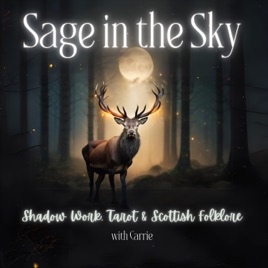
Advertise on podcast: Sage in the Sky
Rating
5from
This podcast has
66 episodes
Language
EnglishPublisher
Carrie BarrExplicit
No
Date created
2024/11/21
Latest episode
2026/09/20
Average duration
37 min.
Release period
8 days
Description
A soul-led podcast exploring shadow work, Tarot, Scottish folklore, and witchcraft for healing and self-discovery. Each Sunday, journey through myth, magic, and the mysteries within. Guided by a Scottish-rooted spiritual practitioner weaving stories, reflections, and ritual to help you reclaim your light through the dark.
Unlock Sage in the Sky podcast Email contact info,
Listeners & Audience details
Email contact information
Direct podcast contact details

Listeners
Audience numbers & engagement insights

Audience details
Podcast Insights

Podcast episodes
Check latest episodes from Sage in the Sky podcast
The Light Over the Next Hill
2026/09/20
This is the twelfth and last of the series, and it's the equinox. Light and dark come level soon and then they tip, and from then the dark half has it.
It isn't a recap and it isn't a big finish. What it is, is a doorway episode. We stand at the threshold for an hour, look back down the glen quickly without making a meal of it, and then say something over the going.
The folklore is one of the Gaelic journey blessings, said standing at your own door before setting out. And it doesn't ask for what you'd expect. Not a safe arrival, not clear weather, not the business at the other end going your way. It asks for the earth beneath the foot to be blessed, and the path whereon I go. Nothing at all about the destination. There's a kindness in that which took me a while to see, because if you bless the destination you've given yourself something to keep checking on, and if you bless the ground you're standing on then it's already done.
Then the gap you're about to be in, and why you'll probably misread it. William Bridges separated change, which is the external event with a date on it, from transition, which is the internal business of becoming somebody for whom that's now true. And transition begins with an ending rather than a beginning, and the bit in the middle where the old thing is over and the new one hasn't started is not a failure of the process. It is the process. I've included what it actually feels like, since people recognise the symptoms long before they recognise the description.
There's also a passage in here for anybody who has listened to all twelve and still hasn't climbed the hill. Twelve podcast episodes were never going to shift something that has been in place for nine years, and I'd not have you turn that into evidence about yourself.
And the card is the Fool, which is numbered zero, which takes it out of the sequence and lets it sit at either end of the deck. So finishing on it isn't a trick. The mountains are behind the traveller rather than ahead. The bundle is tiny. And Pamela Colman Smith didn't paint the fall, in either direction, which is honest.
The practice at the end is a doorway one, and it finishes with the blessing and a turn.
The letter carries on every week. The podcast comes back around Samhain.
This week's card: the Fool. Numbered zero, which is why it can be the first card or the last one.
What happens now
The weekly letter carries on. If you'd like company through the dark half, that's where I'll be. The podcast is resting through the autumn and comes back around Samhain with a new series. All twelve episodes stay up, so if somebody you know is standing at the foot of something, they can start at the beginning whenever they like.
Take the quiz
You already know. So what are you waiting for? Nine questions, about three minutes, and at the end you get the name of the pattern keeping you where you are. Each result is a figure out of Scottish folklore, and you've met one or two of them across this series. At sageinthesky.com
Who Are You Lighting Fires For?
2026/09/13
Back at Lùnastal we spent an hour asking who lit the fire on your hill. This is the other side of it. Who are you lighting them for.
And I want to be careful, because the obvious version of this episode is one you don't need. You have been pouring yourself out for other people since you were about nineteen and it's a large part of why you're tired.
So here's what I actually think. Most of what we call helping is doing things for people that they could do themselves. It doesn't light any fires. It makes them smaller and it makes you emptier, and those turn out to be the same process.
There's a piece of family systems work behind that, from a psychiatrist called Murray Bowen, and it's the sharpest thing I've brought you in this series. He described over-functioning and under-functioning as reciprocal positions. They produce each other. One person's taking over is what creates the room for the other's stepping back, and the stepping back pulls more taking over. So the woman doing eighty percent of everything is not surrounded by useless people. The people around her have become less capable because she does it all. Same fact, seen from two ends.
He was clear that this isn't a character flaw. It's a way of managing anxiety and it works, which is why it's so hard to shift. The line worth having is that both positions bring the anxiety down, and what neither of them does is help anybody grow.
Then the alternative, which our people had. The taigh-cèilidh, the visiting house. Every township had one, and it wasn't appointed, it emerged, usually because the fire was good or the woman of the house was welcoming. People drifted there after the work was done. The news first, then the songs and the long tales that could run three nights. And over in the corner, out of the way, the children, half asleep, absorbing an entire culture.
The folklorists call these houses informal schools. And nobody in that room was teaching anybody. The adults were doing the thing, well, in front of people who knew when you got it wrong. That's the whole method, and it carried the language, the stories and the music of Gaelic Scotland across centuries with almost nothing written down.
And the Queen of Wands, who is the warmest woman in the deck and is sitting down. She isn't out looking for anyone. She's seated, holding her own sprouting wand, with a black cat at her feet that cannot be commanded by anybody. And her body faces you while her head is turned away, which is a very particular kind of welcome.
There's a practice at the end about handing one thing back, and it's the hardest one I've given you.
Next week is the last of the twelve, on the equinox.
A note: none of this applies to somebody who genuinely can't do the thing. Small children, people who are ill, anyone in a crisis. Doing the work for a person who isn't able is care, and it isn't what this episode is about. The episode says so.
Take the quiz
You already know. So what are you waiting for? Nine questions, about three minutes, and at the end you get the name of the pattern that's been keeping you where you are. Each result is a figure out of Scottish folklore. At sageinthesky.com. Answer as you are, not as you intend to be.
Life Doesn't End at the Top of the Hill
2026/09/06
There's a feeling I hear about constantly from women in their forties and fifties, and it never comes out directly. It sounds like: I've left it too late. That was the window, and I was busy. The interesting part has already happened and I wasn't paying enough attention while it did.
Underneath all of those is a picture, and I want to get it out into the light. The picture is a hill. You climb, you reach the top, and then you go down the other side. Which puts a woman of forty-eight somewhere on the descent, not because of anything she's done, but because of the shape of the diagram.
I've called this series Light Over the Hill, so I've been handing you that shape for nine weeks. This week I'd like to complicate it, and offer two others.
The first is the Cailleach. The old woman who made Scotland, striding across the country with a creel of stones on her back, dropping the mountains behind her as she went. Blue-skinned, one-eyed, rust-red teeth, and nobody has ever tried to make her lovely. She rules the dark half of the year from Samhain to Beltane, washes her great plaid in the Corryvreckan whirlpool until it comes out white and lays it over the country as the first snow, herds and protects the red deer, and vanishes at Beltane. Her power and her age are the same fact. And there's a stone house in Glen Lyon where somebody still takes her family out at Beltane and puts them back at Samhain, every year, as far back as anyone can trace.
I've also included the part that stops this being a pep talk, which is that she grieves. There's a poem twelve hundred years old in which the oldest woman in our folklore sits down and mourns her own youth in some detail. Both things are true at once.
Then the research that has been arguing with the hill for twenty years, and I've given you the contested version rather than the headline, because the shape has been changing and it deserves honesty. What has survived every revision is that none of it is a hill.
And the Wheel of Fortune, which floats in the sky with no ground beneath it, because on a wheel there is no summit. The top is a position you pass through.
Next week we come near the end, and it's the other side of the Lùnastal episode. We asked then who lit the fire on your hill. Next week, who you're lighting them for.
This week's card: the Wheel of Fortune. It floats with no ground under it, and the top is somewhere you pass through.
Take the quiz
You already know. So what are you waiting for? Nine questions, about three minutes, and at the end you get the name of the pattern that's been keeping you where you are. Each result is a figure out of Scottish folklore. At sageinthesky.com. Answer as you are, not as you intend to be.
Creating Your Own Light
2026/08/30
This is the warm one. We've had eight weeks of heavy weather, and the year has turned toward the harvest, so I've the Sun for you.
Which is exactly where somebody in my line of work is most likely to say something useless. So here's the thing I want to be straight about. You cannot make a sun. And a fair bit of your life has gone by while you waited for one to come up, because there's a way of thinking that goes: I'll start when work settles, when I've got my energy back, when I feel more like myself. Every one of those is waiting on something arriving from outside you that changes the conditions, and you have no hand in any of it.
So this episode is about the other thing. At the end of August, the women and the bairns went out to the wet ground to cut rushes. You strip the green skin off to get at the pith inside, leaving one narrow rib of green running the length of it, because without that the pith has no backbone and collapses in your hand. Then you dip it in whatever fat the household has saved in a pan by the fire. And you have light, made out of a weed from the worst bit of the field and the grease off the dinner.
These things existed because a tax in 1709 priced poor people out of candles. So this is not a charming rustic craft. And they were held in an iron clip at about forty-five degrees, because too upright burns dim and too flat burns out fast. Our people built the discipline into the object rather than relying on anybody's willpower.
There's also where the phrase comes from. You could light a rushlight at both ends for twice the light and half the time, and it originally meant reckless and wasteful. I don't think I need to labour that one.
Then a diary study of twelve thousand entries that found the single strongest driver of a good day was making some progress on something that mattered, and that small progress worked nearly as well as breakthroughs. Along with the half of that finding nobody quotes, which is that setbacks hit two to three times harder than progress helps.
And the Sun card, which has a wall in it that most people walk straight past.
Next week is the one I've been looking forward to since I planned this series, and it's about the old woman who made the mountains.
This week's card: the Sun. The sun makes no effort at all, and that isn't available to us. The wall is the interesting part.
Take the quiz
You already know. So what are you waiting for? Nine questions, about three minutes, and at the end you get the name of the pattern that's been keeping you where you are. Each result is a figure out of Scottish folklore. At sageinthesky.com. Answer as you are, not as you intend to be.
You Don't Need to See the Whole Mountain
2026/08/23
This is the third time in eight weeks I've come at the same problem, and I want to be honest about that. In week three we looked at the hill you keep circling and I said the circling costs more than the climb would. A fortnight ago we were out on the bog and I said you're waiting for a certainty this sort of decision never produces. Both of those are true. Neither has got some of you moving, and I've been sitting with why.
Here's the thing I think I'd been missing. Wanting to see the whole mountain isn't really a request for information. It's a request for a version of the climb where you get to skip being a beginner. Because if you could see the entire route, you could plan it, and if you could plan it you'd never be caught out, and you'd arrive at the top having somehow never once been a novice. Which is the one way up that doesn't exist.
And that matters more for you than for most people. You've been the capable one since school. Which sounds like a blessing, and is actually a gap in your training, because it means you've built a life almost entirely without the experience of being visibly incompetent in front of witnesses. Chris Argyris found something like this when he studied management consultants and expected them to be the best learners in the building. They were the worst. Because they'd almost never failed, they'd never learned how to learn from failing.
The folklore this week is cairns. The heaps of stones on Scottish hills that do three different jobs, and the thing all three have in common. There's the plain one, which is waymarking across ground where the line isn't obvious. There's memory, and the old blessing cuiridh mi clach air do chàrn, I'll put a stone on your cairn, which means I won't forget you. And there's the tradition where each man placed a stone before a battle and the survivors took theirs back afterwards, so that what remained was the exact number of the dead, and nobody had to count.
Every one of those was built by somebody who isn't there. Which is how you actually cross a hill you can't see. Nobody has ever done it by knowing the route. You walk to the stone you can see, and the next one appears when you get there, and never before.
And the card is the Page of Wands, the youngest and least experienced figure in the suit, standing in a desert with a sprouting stick and no plan, looking at the one living thing in his hands rather than scanning the horizon. Nothing in that card is embarrassed about him.
There's a practice at the end about naming the audience you can't bear to be a beginner in front of, and giving yourself a bad-at-it allowance.
Next week the year turns and we go somewhere warmer, with the Sun.
This week's card: the Page of Wands. The beginner, holding one living thing, in a desert, going anyway.
Take the quiz
You already know. So what are you waiting for? Nine questions, about three minutes, and at the end you get the name of the pattern keeping you where you are. Each result is a figure out of Scottish folklore. At sageinthesky.com. Answer as you are, not as you intend to be.
The Lantern Only Lights the Next Step
2026/08/16
I've said the same line in nearly every episode of this series. The lantern only lights the next step. This week I want to take it apart, because I think most of us hear it wrong.
The way it usually lands is as consolation. Poor you, out in the dark with your inadequate wee light, never mind, you only need the next bit. That reading has the Hermit stumbling about lost. So go and look at the card. He isn't lost. He's standing on the top of a mountain he already climbed, with a staff in his hand because he walked up there and there's nothing in his face wishing the lamp were bigger.
Last week we spent an hour chasing a light that kept its distance. Here's the answer to it, which is that you stop chasing lights when you're carrying one.
The folklore this week is the shieling, the àirigh, the summer town up on the high grazing. Every year from around Beltane, a large share of the women and girls of a township went up the hill with the cattle and stayed for six weeks to fourteen. They milked, made butter and cheese, and made a startling amount of the Gaelic song tradition while they were at it, because you don't get that volume of song out of people who are busy. Around this time of August they came back down, and the township turned out to meet them, and nobody debated whether she had been entitled to go, because the butter was walking down the hill in front of her.
Then the part that might sting a little. Solitude and loneliness are separated by one thing, which is whether you chose it. And most capable women aren't short of time alone. They're short of chosen time alone. The commute, the lunch at your desk, the fifteen minutes between meetings, whatever falls between the phone calls. Those are gaps between duties that you were issued rather than picked, and the missing ingredient is the only one that does any work.
And the Hermit, whose arm is up. He's holding that lantern out over the edge of the peak as a beacon for whoever is still climbing. It isn't lighting his feet at all. He didn't find it either. He made it up there on his own, which is the only reason it's small, and small turns out to be plenty.
There's a practice at the end about picking your own shieling and putting it in the calendar the way the cows needed the grass.
This week's card: the Hermit. He isn't lost, he's arrived, and the light in his hand is one he made.
Take the quiz
You already know. So what are you waiting for? There's something you've been circling. You can describe it accurately, and still it sits where it sat. That isn't indecision, it's a pattern, and it has an old shape. Nine questions will name yours and each result is a figure out of Scottish folklore. About three minutes, at sageinthesky.com. Answer as you are, not as you intend to be.
Following the Light You Can't Yet Reach
2026/08/09
We've spent five weeks talking about a light over a hill as though every light is worth walking toward. This week I want to poke at that, because it isn't true.
The Spunkie is the Highland name for the thing that hovers out on the moss at night. Every country with wet ground has one, and every one gave it a different name, which tells you how often people ran into it. In the Highlands it was said to appear as a linkboy, the lad who stood at a corner with a torch and lit you home for a coin, so the thing that leads you into the water arrives looking exactly like the help you were hoping for. It got blamed for shipwrecks too, mistaken for a harbour light by crews doing the sensible thing.
And there's a tell, repeated across every county and every language. It recedes. You walk toward it and the gap holds. A real light does the most ordinary thing in the world, which is that it gets bigger and lets you arrive.
Which is where this gets uncomfortable, because I know a fair few women walking toward a light that has kept the same distance for years. The one called being sure. One more sign, one more reading, one more month to see how things settle.
So I want to sort out three things we've jammed into one word. Your intuition is a faculty, and it's yours, and nobody needs to certify it. Jung had it as one of the ways we perceive, the one that gets its information from underneath and arrives already finished. Everyone has it. Some people have just spent forty years being told to stop picking up. And then there are the two that turn up wearing its coat, which are fear and wanting, and they can be told apart by how they behave rather than by whether some outcome later scored them correct.
There's a section in here on why I'm not going to hand you a way of proving which is which, and on what you can do instead.
Then the Moon, which is lit entirely by borrowed light, with a crayfish half out of the pool and a path going off between two towers that regular listeners will recognise from a few weeks back.
This one comes with a proper word of care in the middle about safety and about alarms that were set very early, and I'd rather you heard it than skipped it.
Next week we stay out in the dark with the only figure in the tarot carrying his own light rather than chasing somebody else's.
This week's card: the Moon. Nothing in that picture is lit by anything of its own, and there's still a path.
Your free companion
The Light Over the Hill is a free six-card spread that lays out along a path climbing the slope, to help you find your own hill, your own light, and your own next step. It's at sageinthesky.com, and it comes with the weekly letter.
Who Lit the Fire on the Hill?
2026/08/02
It's Lùnastal, the first harvest, and for a very long time in this country that meant everybody climbing the local hill together with baskets to pick blaeberries and light a fire on the top. Nobody organised it. Everybody simply knew, because it had been handed down the line for so long that the names had come off it.
So this week I want to ask who lit the fire on your hill.
We go up for the gathering, and I tell you about the founding of this festival, which I knew nothing about for years and which stopped me in my tracks when I finally looked it up. Lughnasadh began as a funeral feast. Lugh held it for his foster-mother Tailtiu, who cleared the forests of Ireland so there could be fields, and died of the work, and never saw a single harvest. The first harvest festival in these islands is a thank-you to a woman who wore herself out so other people could eat. And she got thanked properly, for about two thousand years.
Then I tell you about a piece of research I found. Kumar and Epley asked people to write to somebody who had changed their life, and to predict how it would land. Every time, the writers underestimated how happy it would make the person, underestimated how surprised they'd be, and badly overestimated how awkward it would feel. Which means the people who lit fires for you genuinely do not know they did it. And it means you have lit fires you know nothing about, which matters if you're somebody who has poured herself into others for years and never had much in the way of a receipt.
There is also a section in this one for anyone whose family line is a difficult one, and it isn't an afterthought. The old Gaelic world reckoned foster-kin above blood, with a proverb to prove it, and Tailtiu herself was a foster-mother who was handed no field by anybody. If you are the first in your line to do something differently, this episode turns out to be more yours than anybody's.
And we sit with the Six of Cups, where one child hands a flower to another while the person who planted the whole garden walks quietly off down the path without waiting to be thanked.
The practice this week asks you to actually do something, which is rare for me. Name them, write down what you still use, and then tell one of them.
Next week we go after a light that moves, out on the bog at night, and talk about which of your instincts are worth following.
Your free companion
The Light Over the Hill is a free six-card tarot spread that lays out along a path climbing the slope, to help you find your own hill, your own light, and your own next step. It's at sageinthesky.com, and it comes with the weekly Light Over the Hill letter: a piece of folklore, one card, a prompt, and something small to do.
When Hope Doesn't Feel Bright
2026/07/26
Some of you have been listening to this series while running on almost nothing. Nodding along, knowing exactly which hill it is and unable to climb anything at all. This week is for you. No hills, I promise.
We have a very sunny picture of what hope is supposed to feel like: a lift in the chest, a sense of possibility. So when we're depleted and can't find that anywhere, we assume we've lost hope altogether. But that bright feeling was only ever hope in daylight. What hope looks like when you have nothing is smaller and duller and far more impressive ~ getting out of bed, drinking a glass of water, answering one email out of forty, lighting a candle in a dark kitchen for no particular reason.
We go to the old Highland hearth, and the nightly practice of smooring ~ banking the fire down under ash so it survives the night, with a blessing said over it. These hearth fires were kept alight for generations, and not by burning brightly: by someone knowing exactly how to keep them low. Our ancestors had a whole named craft for the low season, and prayers for both ends of it, one for putting the fire down, one for raising it up. We've kept only half that vocabulary, which is why our own flat months feel like personal failure rather than a season with its own skill.
Then, the psychology: what the research on behavioural activation actually says about doing things when you have no motivation left, that action comes before motivation rather than after it, and that the task simply has to be smaller than your resistance. Not "go for a walk." Put your shoes on. We also look at why continuing to function is no evidence at all that you're fine and how, for a capable woman, her own competence is precisely what hides her.
And we sit with the Four of Swords: a knight lying down in full armour, three of his swords hung up on the wall and one still beneath him, and a single small stained-glass window doing its quiet work above. Not a sunrise. Not a star. Just enough coloured light to see by, in a room where somebody has stopped because they had to.
The episode closes with the gentlest practice of the series. No journal needed. If all you do is lie still and listen, that counts as having done it.
A note: this one is about tiredness and low seasons, and it goes gently. It also touches on when low is more than low — there are support links below.
Next week the year turns: it's Lùnastal, the first harvest, and we go up onto the hill where the fires were lit to ask who lit the ones that have warmed you. Who Lit the Fire on the Hill?
This week's card: The Four of Swords — rest, not defeat. He lies down in his armour, three swords hung up and one still with him, under the only light in the room.
If you're struggling
This episode talks about ordinary low seasons. If yours has gone on for weeks, or nothing brings you any pleasure, please talk to a doctor or someone you trust, that's exactly what they're for. Wherever you are in the world, free, confidential support lines are available, many of them day and night. findahelpline.com lists services by country.
Your free companion
The Light Over the Hill is a free six-card tarot spread that lays out along a path climbing the slope, to help you find your own hill, your own light, and your own next step. Download it at sageinthesky.com, and you'll also start receiving the weekly Light Over the Hill letter: a story, a card, a prompt, and one small practice, every week.
The Hill You Keep Avoiding
2026/07/19
There's one particular thing you've been walking the long way round for years. You don't have to search for it, it arrived the moment you read that sentence. The conversation. The decision. The appointment. The thing you already know.
This week's Light Over the Hill is about that, and about a claim I'll make and then spend the hour defending: the hill is not what's hurting you. The circling is.
We begin at a ford at dusk, with the Bean Nighe, the Washer at the Ford, who kneels at Scottish crossing places washing the shrouds of those about to die. The old rule was unambiguous: if she sees you first, or you turn your face away, you lose the use of your limbs. Approach her, and she must answer you truthfully and the fate she's washing for can be turned aside. Flee, and be paralysed. Approach, and be answered. We follow that into the Highland world of fosterage, where the way to master the thing you dread was not to fight it but to go close enough to make it kin.
Then we look, honestly, at what avoidance does inside a person: the relief that teaches your brain to keep avoiding, the hill that grows because you never gather evidence against it, and the world that quietly narrows around it. Including the disguises avoidance wears in capable women, because "staying busy," perfectionism and always putting other people first are on the clinical list of ways we avoid. The over-functioning is the long road round the hill, and everyone praises you for walking it. And then the good news, which is better than you'd think: research on how badly we predict our own feelings, and the psychological immune system you keep forgetting to count. The dread isn't a preview. It's a tax.
And we sit with the card people cancel readings over: Death. Four figures meet the rider, a king who tried to outrank it, a bishop who stands and looks, a child offering flowers, and a maiden whose face is turned away. And behind all of them, between two pillars on the horizon, the sun is rising. The light is on the far side of the thing they're all avoiding. It always was.
The episode closes with a gentle guided practice. We're not climbing anything. We're just going down to the water to look.
A note: this one talks about avoidance, and about the Death card, steadily, and without drama, but come to it when you have a little quiet. Not all avoidance is a problem, and the episode says so.
Next week: When Hope Doesn't Feel Bright ~ for anyone listening to all this with a hill they genuinely can't climb yet.
This week's card: Death ~ not an ending so much as a transformation, and the only card in the deck with a sunrise behind it. The light is on the far side.
Your free companion
Walk with a lantern of your own. The Light Over the Hill is a free six-card tarot spread that lays out along a path climbing the slope, to help you find your own hill, what you're carrying, and your own next step. Download it at sageinthesky.com, and you'll also start receiving the weekly Light Over the Hill letter: a story, a card, a prompt, and one small practice, every week.
Sometimes the Light is Ahead, Not Behind
2026/07/12
We spend so much of our lives facing backward, toward who we were, what we had, the version of ourselves that feels, from here, like the real one. This week's Light Over the Hill is about the most human thing there is, the backward glance, and the slow, permitted turn toward what's ahead.
We begin at a sculpture on the far north coast of Scotland, an emigrant family, the man facing forward, the woman facing back, a child between them learning both and with the grief of the Highland Clearances, handled with care: not a metaphor, but a real loss, and a real lesson in how those who were torn from the land carried the whole of it forward with them, songs and language and all. Then we turn to the strange history of nostalgia, coined in 1688 as a disease, now understood as one of the mind's genuine resources and the crucial difference between visiting the past with your arms open and moving in: the comparison that holds then against now, so now can only ever lose. We look at what it means to grieve not a person but a self, and at why healing was never about "letting go." And we read the Eight of Cups: the quiet, weary, sacred card of the traveller who turns from a life that works but isn't enough, and walks ~ without looking back ~ toward mountains they cannot yet see.
The episode closes with a gentle guided practice: name what you keep facing, keep the love but set down the comparison, and turn, just far enough to take the next few feet toward the light ahead.
A note: this one touches on grief and loss, gently. Come to it when you have a little quiet.
Next week: The Hill You Keep Avoiding ~ the change you already know is coming, and the card that frightens people most and shouldn't. Death.
In this episode
~ Which way are you facing? Why hope over the hill isn't enough if your back is turned to it
~ The Emigrants at Helmsdale, the Clearances, and the grief of the backward glance
~ What the cleared carried across the ocean and why the past doesn't have to stay on the shore
~ Thomas the Rhymer and the threshold you can't walk back through
~ Nostalgia: from 17th-century "disease" to one of the mind's real resources
~ The difference between nostalgia and comparison, the past as fuel vs the past as a courtroom
~ Grieving a self, not just a person and continuing bonds: moving forward with, not on from
~ The Eight of Cups, and the missing cup worth crossing the mountains for
~ A guided practice: name it, keep the love, turn, take one step
This week's card: The Eight of Cups ~ the courageous, tender turn away from a good-enough life toward the something-more you can't yet see. Not looking back isn't coldness; it's how you walk forward.
Your free companion
Walk with a lantern of your own. The Light Over the Hill is a free six-card tarot spread that lays out along a path climbing the slope — to help you find your own hill, your own light, and your own next step. Download it at sageinthesky.com, and you'll also start receiving the weekly Light Over the Hill letter: a story, a card, a prompt, and one small practice, every week.
The Light Over the Hill
2026/07/05
Welcome to Light Over the Hill ~ a new weekly companion for the woman standing at the foot of a climb she already knows she has to make.
This first episode sets the premise of the whole series: not a guide at the top of the mountain telling you it's easy, but a companion slightly further up the same path, turning round to say there's a light up here, keep coming.
We begin where our people always began: on the hill. We sit inside the old Scottish need-fire, the tein-éigin, when a whole township would let every hearth go dark and rekindle them all from a single flame carried down the slope and we look to the pole star our ancestors steered by, a light that shows you none of the ground and somehow enough. Then we turn to the psychology of hope, and the distinction that changes everything: optimism waits, but hope walks. Most of us aren't missing the goal, or even the path, we're missing the quiet belief that we're allowed to take the step. And we read The Star: the card of hope after the storm, the woman with her eyes on the light and her foot still working the ground.
The episode closes with a small guided practice ~ name the hill, name the light, take the next few feet ~ because that has always been all that hope asks at the start.
Next week: Sometimes the Light Is Ahead, Not Behind ~ on why we spend so long looking backward, and how to turn gently toward what's actually in front of us.
In this episode
The premise of the series ~ the companion slightly further up the pathThe Beltane need-fire (tein-éigin): one flame on the hill, a hundred hearths relitThe pole star, the lost Gaelic sky, and light that shows the way without showing the groundWhy hope isn't optimism ~ goals, pathways, and the agency that wears thin in the capable womanThe Star tarot card, and why its hope is never passiveA guided practice: name the hill, name the light, take the next few feetThis week's card: The Star ~ hope after the storm; the fixed light you steer by, and the foot that keeps working the ground.
Your free companion
Walk with a lantern of your own. The Light Over the Hill is a free six-card tarot spread that lays out along a path climbing the slope, to help you find your own hill, your own light, and your own next step. Download it at sageinthesky.com, and you'll also start receiving the weekly Light Over the Hill letter: a story, a card, a prompt, and one small practice, every week.
The Giant You Don't Realise You Are ~ Imposter syndrome and your own hidden power
2026/06/21
The giant you fear and the giant you are have been the same size all along.
On the longest day of the year, when the light climbs higher than on any other and your shadow shrinks to almost nothing beneath your feet, we go looking, not for the darkness we've hidden, but for the largeness we've disowned. This is an episode about imposter syndrome, about the growth that went invisible because you're living inside it, and about the golden shadow: the power you'd honestly rather not be responsible for. We follow Scotland's sleeping warriors into the hill, learn why people keep dropping the horn and running, and find the giant that has been breathing beneath you the whole time, wearing your own face.
~ The solstice as the day you can finally see your own height~ The shadow, re-explained and the part almost nobody mentions: the gold in it (Robert A. Johnson)~ Where the term "imposter syndrome" really came from, and why it found high-achieving women first (Clance & Imes, 1978)~ The sleeper under the hill: Fionn, Thomas the Rhymer, and the Sleeping Warrior of Arran (Donald Mackenzie)~ "Draw the sword before you blow the horn" — how to claim power without panicking~ Strength, the Queen of Wands & the Magician — three faces of the waking giant~ A ~13-minute guided visualisation: The Cave Under the Hill~ Five journal prompts to find your true size
1. The thing you call ordinary. Name one skill or quality that comes so easily to you that you've assumed it's nothing special. Now write it down as if describing a stranger who has it. Does it still look like nothing?
2. Where do you blow the horn twice and run? Recall a recent moment when you felt a bigger, more capable version of you start to rise and you pulled the smaller self back over you. What frightened you about the size of it?
3. Who carries your gold? Robert Johnson said we hand our finest qualities to the people we admire most, because we'd rather see them "out there" than own them. Who do you most admire and which of their qualities is, secretly, a sleeping part of you?
4. Draw the sword first. What would "taking up the sword before the horn" look like for one specific thing in your life right now, what is the knowledge or permission you'd need to hold first, before you act?
5. The right size. Not smaller, not grander — accurate. If you described yourself today with total honesty and zero shrinking, what's one true sentence about your capability you usually wouldn't let yourself say out loud?
Sources & further reading:~ Donald A. Mackenzie, Scottish Folk-Lore and Folk Life (Glasgow, 1935)~ Robert A. Johnson, Owning Your Own Shadow: Understanding the Dark Side of the Psyche (1991)~ Pauline Rose Clance & Suzanne Imes, "The Impostor Phenomenon in High Achieving Women" (1978)
Go deeper:~ Shadow Map Reading — a one-to-one tarot session to map your golden shadow → sageinthesky.com~ At the Threshold — self-guided shadow work, £11 → sageinthesky.com~ The Threshold Tarot Spread — free five-card download → sageinthesky.com
Come and find me:~ Instagram: @sage_inthe_sky~ sageinthesky.com
A note: this episode touches on self-doubt and self-worth. If what you're carrying feels heavier than a quiet "not yet" — persistent, grinding, hard to lift — please reach out to someone you trust or a professional who can sit with you in it. Being your full size was never meant to be done alone in the dark.
The Land of Giants ~ Why Grief and Change Feel Larger Than Us
2026/06/14
Some seasons of a life feel like a land of giants. The grief, the loss, the change, the new beginning, too large for the ordinary measurements of a day. In this episode we explore the landscape of the vast: what it feels like, why it disorients, and what the Celtic otherworld understood about moving through territory that doesn't fit your maps.
This is not a fixing episode. It is a company episode. For the woman who is in the middle of something enormous and needs it named accurately before she can begin to navigate it.
Includes the Cailleach as the keeper of honest scale, the Celtic otherworld as a map for significant life seasons, and three ways of moving through a landscape that dwarfs your instruments.
Links:
Free Threshold Tarot Spread Shadow Map ReadingLantern LettersInstagram: @sage_inthe_sky
The Giant Who Ran from a Baby ~ Fionn, Fear, and the Stories We Tell Ourselves
2026/06/08
One of the most beloved stories in Scottish and Irish folklore ~ the legend of Fionn mac Cumhaill, Benandonner, and the building of the Giant's Causeway ~ turns out to be one of the most psychologically precise stories about fear ever told.
In this episode we retell the legend in full, explore its Scottish dimension through Fingal's Cave on Staffa, and go deep into the psychology of the imagined giant, the story we construct around the things we are facing that makes them larger than they actually are.
Includes three practical questions for identifying where your own imagination has been building giants.
Links:
Free Threshold Tarot SpreadShadow Map ReadingLantern LettersInstagram: @sage_inthe_sky
Podcast sponsorship advertising
Start advertising on Sage in the Sky relevant audience podcasts
You may also like to advertise on these Podcasts
4.115911450
The Tucker Carlson Show
Tucker Carlson Network

4.827973446
Huberman Lab
Scicomm Media

4.240683
To Be The Man
Podcast Heat | Cumulus Podcast Network

4.41511152000
The Ben Shapiro Show
The Daily Wire

4.2155648
TENNIS.com Podcast
TENNIS.com Podcast/Tennis Channel Podcast Network
4.510815766
The Joe Budden Podcast
The Joe Budden Network
4.611603506
The Bulwark Podcast
The Bulwark

4.711443386
Matt and Shane's Secret Podcast
Matt McCusker & Shane Gillis

4.82479176
Smosh Reads Reddit Stories
Smosh
4.975117744
Small Town Murder
James Pietragallo, Jimmie Whisman