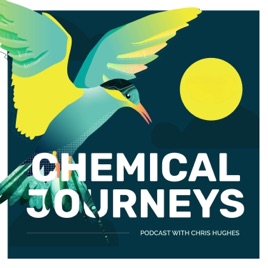
Advertise on podcast: Chemical Journeys
Rating
5from
This podcast has
26 episodes
Language
EnglishPublisher
Chris HughesExplicit
No
Date created
2024/11/28
Latest episode
2026/03/02
Average duration
58 min.
Release period
22 days
Description
Welcome to Chemical Journeys. Explore the science and story of chemicals in the environment through conversations with people working in this area.
Unlock Chemical Journeys podcast Email contact info,
Listeners & Audience details
Email contact information
Direct podcast contact details

Listeners
Audience numbers & engagement insights

Audience details
Podcast Insights

Podcast episodes
Check latest episodes from Chemical Journeys podcast
Uncovering chemical biodegradation in the environment - Kathrin Fenner, Eawag
2026/03/02
In this episode I speak with Prof. Kathrin Fenner, one of the leading academic scientists in the study of chemical biodegradation and environmental persistence.
Kathrin and I have a far-reaching conversation covering her background and research interests, challenges and developments in chemical biodegradation research, and implications for policy and society.
We have learned an enormous amount about the fate and persistence of chemicals in recent years, and the work of Kathrin and her group has been at the heart of this.
Listen to the episode to find out about biodegradation of chemicals in different environmental settings, what factors contribute to persistence, understanding transformation products and pathways, predicting biodegradation for different chemicals and scenarios, and how we can utilise this knowledge toward safer and more sustainable use of chemicals.
Works cited:
Innovate beyond PFAS | Science
Designing Small Molecules for Biodegradability | Chemical Reviews
Bridging across OECD 308 and 309 Data in Search of a Robust Biotransformation Indicator | Environmental Science & Technology
Developing a weight-of-evidence methodology for persistence assessment of substances in the environment | IEAM
Breaking it down: Unveiling the roles of chemical structure, concentrations and technology on micropollutant biotransformation in wastewater treatment plants - ScienceDirect
High-Throughput Miniaturized Biotransformation Testing Using Activated Sludge Enables Rapid Chemical Persistence Assessment | Environmental Science & Technology Letters
Read-Across of Biotransformation Potential between Activated Sludge and the Terrestrial Environment: Toward Making It Practical and Plausible | ES&T
Modernizing persistence–bioaccumulation–toxicity (PBT) assessment with high throughput animal-free methods | Archives of Toxicology
Do biotransformation data from laboratory experiments reflect micropollutant degradation in a large river basin? - ScienceDirect
Eawag-Soil in enviPath: a new resource for exploring regulatory pesticide soil biodegradation pathways and half-life data - Environmental Science: Processes & Impacts
FAIR and Effective Communication of Data on Chemical Contaminant Biotransformation in the Environment | ES&T Letters
Confidently Uncertain: Probabilistic Machine Learning to Predict Soil Biotransformation Half-Lives | ES&T
Predicting Micropollutant Removal in Wastewater Treatment Based on Molecular Structure: Benchmark Data and Models | ES&T
Persistence Assessment of Chemicals: Trajectories toward New Approach Methodologies (P-NAMs) | ES&T
Discover enviPath.org
Chemicals in our language - Joanna Gavins, University of Sheffield
2026/01/29
In this episode I speak with Joanna Gavins, who is a professor of English Language and Literature at the University of Sheffield.
Joanna and I discuss the language we use and how this influences the way we think, feel and act in relation to choices we make, the environment, and chemicals.
We start off by discussing the work Joanna has been doing at the Bio-based and Biodegradable Industries Association (BBIA) on how to effectively communicate information about sustainability to consumers. We also delve into our complex relationship with nature, and how this is influenced by language.
Our conversation then moves onto chemicals. We do a deep dive into the language surrounding chemicals in modern discourse, and how this influences public perception and emerging policy. We talk about the issue of chemicals in the environment, how this relates to us, and how we might get better at talking - and thinking - about these issues.
I hope you will find this discussion as fascinating as I did!
Plastic: Unwrapped podcast - Plastic Planet | The University of Sheffield Player
Human/Nature podcast | The University of Sheffield Player
White paper: Growing the UK’s Modern Industrial Bioeconomy
Effective Communication to Advance the Modern Industrial Bioeconomy - report
Just Earth: How a Fairer World Will Save the Planet - Tony Juniper
Vanished: An Unnatural History of Extinction - Sadiah Qureshi
Ecolinguistics: Language, Ecology and the Stories We Live By – Arran Stibbe
Early career journeys in academia and beyond - Fola Ogungbemi, Currenta
2026/01/12
Happy 2026, and welcome to Chemical Journeys Season 2!
In this episode, I speak with Dr. Fola Ogungbemi, Senior Expert in Product Compliance at Currenta.
Fola and I talk about his career journey so far, from student in ecotoxicology to senior regulatory consultant. We discuss experiences of early career scientists finding their next steps after completing a PhD, adapting to working in different sectors, the importance of staying open for continuous growth and learning, and the value of mentorship and support along the way.
Fola also shares some of his personal experiences of relocating to multiple cities, finding friends and community, and his adventures as a DJ. We talk about Fola's journey with the Society of Environmental Toxicology and Chemistry (SETAC), and that part that the organisation has played in his development. Fola also reflects on his Christian Faith and how this shapes his outlook and approach to life.
Fola Ogungbemi, PhD | LinkedIn
DJ with a PhD (@djfolaflo) • Instagram photos and videos
SETAC Europe 36th Annual Meeting
Putting yourself in a regulator's shoes - Watze de Wolf
2025/11/19
In this episode, I speak with Dr. Watze de Wolf.
Watze has had a long and accomplished career working as a scientist and manager in both industry and regulatory settings, including 15 years working at the European Chemicals Agency (ECHA).
We have a wide-ranging discussion about his experiences and observations of how chemicals management has evolved over recent decades, and attempt to provide a diagnosis for the current situation and outlook for the years ahead.
This includes:
Watze’s background, career journey and people he worked withThe tension between the uncertainty and complexity of science vs the need for clear and predictable regulationThe importance of communication and meeting your audience where they areContrasting sensitivities and drivers of behaviour in different industriesThe shift away from risk-based approaches, and the rise of persistenceThe importance of dialogue and the value of organisations like the Society of Environmental Toxicology and Chemistry (SETAC)Understanding EU regulations as complex systems Experiences with REACH dossiers, from both industry and regulator perspectivesWhat it’s like for early career scientists at ECHADiscussions and experiences from the ECHA Member State CommitteeThoughts on the Biocidal Products Regulation (BPR)What a new harmonised classification of ethanol means for its ongoing use as a disinfectantThe essential use concept and how it could re-define chemicals management in EuropeImportance of EU Member State participation, and the impact of Brexit on regulatory discussionsRegrettable restrictions and thoughts on the ongoing group-wide restriction of PFASThoughts on the overall direction of travel, broader technological and societal shifts, and the impact on science
Watze's website: rMSC.fi – rMSC
Member State Committee - ECHA
Trifluoroacetic Acid in the Environment: Consensus, Gaps, and Next Steps | Environmental Toxicology and Chemistry | Oxford Academic
Persistence Science Interest Group Pushes Forward with Global Collaboration and New Initiatives
Literature review on micro‐ and nanoplastic release from food contact materials during their use | EFSA
Reflecting on 40 years of regulatory developments in Europe – Peter Fisk — Embark Chemical Consulting
Visit my website for more content and insights www.embarkchemical.com
A tool to improve your regulatory foresight - Steven Brennan, Foresight
2025/10/27
In this episode I speak with Dr. Steven Brennan, co-founder and CEO of Foresight.
Foresight is a software platform that helps organizations to make sense of complex and fast moving chemical regulations, so they can always be ready for what's coming next.
Steven and I have a nice conversation that shows how he turned his years of regulatory experience into a software solution that solves a key challenge - how to get access to key insights faster to understand and manage regulatory change.
Listen to this conversation if you want to get a look into the world of startups and software as a solution (SaaS) from a chemical regulatory point of view. We also talk about aspects of building and growing a business, and some reflections on life as founders and keeping everything in balance.
Our conversation covers:
Steven's background and career journeyThe story behind Foresight - identifying an industry need, and developing a solutionFeatures of Foresight - how the tool delivers advanced regulatory insightsApplications and limitations of AI in chemicals regulationREACH Article 129 - Member State safeguard clauseWhat kinds of customers are using Foresight?What process and considerations go into developing new features?Building the company - from startup to commercialisationThe customer buyer journeySteven's work as a co-opted member of the ECHA Socio-Economic Analysis Committee (SEAC)Steven and Chris swap stories about life as founders
Follow the link to find out more about Foresight and start your free trial: Foresight | The future of chemical policy monitoring
Visit my website for more content and insights www.embarkchemical.com
Getting a grip on environmental persistence – Irene Bramke, AstraZeneca
2025/10/06
What happens to the chemicals we use in everyday life once they enter the environment?
In this episode, I am joined by Dr. Irene Bramke, Senior Environmental Risk Assessor at AstraZeneca.
Irene and I have a detailed discussion about persistence (how long it takes for chemicals to break down in the environment). With recent concerns around plastic pollution, PFAS 'forever chemicals', and broader sustainability goals, the persistence of chemicals in the environment has become one of the most urgent and pressing issues for policymakers and society.
Irene and I discuss the science behind persistence, and how it relates to the risks chemicals might pose to people and the environment. We also talk about recent regulatory developments in Europe, and how these are reshaping the future of chemicals management.
Our conversation covers:
Irene's background and career journeyGrappling with complexity - insights from studying soils in an agrochemicals companyIndustry's participation in regulatory science - then vs nowIssues of environmental relevance in laboratory biodegradation testingThe evolving policy landscape for persistenceNon-degradable chemicals and the legacy P/vP criteriaIn the eye of the beholder - the meaning of word 'persistent'Implications of new policies - the PMT/vPvM hazard classesA troubling outlook - data gaps, transformation products, and questionable impact assessments?Reflections on OECD simulation tests as tools for persistence assessmentsInsights from AstraZeneca's Ecopharmacovigilance programmeThe importance of data quality in monitoring efforts - the CREED approachShifting regulatory paradigms - hazard assessment vs risk assessment, and the need for continuing dialogueCan we get better at assessing persistence? High-throughput and predictive methods
PBT/PMT assessment of active pharmaceutical ingredients - ScienceDirect
Environmental fate and effects assessment of human pharmaceuticals: lessons learnt from regulatory data | Environmental Sciences Europe
Overcoming challenges and advancing (bio)degradation guidelines: OECD TG309 revisited - ECETOC
AstraZeneca - EcoPharmacoVigilance Dashboard
Using environmental concentration exposure datasets in environmental assessments: The development of Criteria for Reporting and Evaluating Exposure Datasets (CREED): Integrated Environmental Assessment and Management
HOMEPAGE - imi-premier
Modernizing assessment of persistence and transformation products of chemicals – from new tools to implementation (23-October 24, 2025): Overview · HIFIS and Helmholtz Events (Indico)
Visit my website for more content and insights www.embarkchemical.com
Fostering advances in chemical safety research - Katherine Santizo, Cefic-LRI
2025/09/15
In this episode I speak with Dr Katherine Santizo, Programme Manager of Cefic's Long-range Research Initiative (LRI).
Since 1999, Cefic-LRI has funded over 250 projects (totaling approximately €90 million) to advance the scientific assessment of the safety of chemicals, and to improve understanding of potential health and environmental risks.
Tune in to hear first-hand from Katherine about the exciting work that Cefic-LRI does, and how this is helping to deliver progress in chemicals assessment science.
Our conversation covers:
What is Cefic-LRI? The LRI mission, and what makes it differentHow it works - the LRI process from ideation to publicationsTools and solutions to address key regulatory challengesKatherine's background and career journeyWorking across disciplines - integrating environmental science with human healthReflecting on the 25 year anniversary of Cefic-LRIUpcoming research projects: new approach methodologies (NAMs), mobility and biodegradationOther hot topics in chemicals safety researchCefic-LRI's contribution to persistence assessment science
Cefic-Lri – Long-Range Research Initiative
Determining the water solubility of difficult-to-test substances: A tutorial review - ScienceDirect
Cefic-LRI workshop highlights advances in chemical assessments aligned with evolving regulations – Cefic-Lri
LRI Marks 25 Years of Advancing Chemical Safety Assessments – Cefic-Lri
Cefic-LRI 25th Anniversary Commemorative Book
New funding opportunities for research on NAMs, biodegradation testing and mobility assessment – Cefic-Lri
ECO52 – Bioavailability, complex substances and overall persistence (BCOP): three themes to deliver a step-change in persistence assessments – Cefic-Lri
Developing a weight-of-evidence methodology for persistence assessment of substances in the environment | Earth, Space, and Environmental Chemistry | ChemRxiv | Cambridge Open Engage
Visit my website for more content and insights www.embarkchemical.com
Green chemistry in practice - Anna Zhenova, Green Rose Chemistry
2025/09/08
In this episode I speak with Dr Anna Zhenova of Green Rose Chemistry.
Green Rose Chemistry are a mission-driven consultancy applying the principles of green chemistry to help organisations to develop more sustainable products and processes.
Our conversation covers:
What does Green Rose Chemistry do?Green chemistry as a grass roots movement - the need for education and champions within organisationsHow different sectors are at varying stages on the green chemistry journeyThe importance of language in communicating sustainabilityExamples of green chemistry solutions - chemical substitution vs functional substitutionReflections on connecting chemical safety with product development and other disciplinesAvoiding tunnel vision and uncovering win-wins - a case with safer solventsWhat is green chemistry? 12 principles, 3 pillarsOn externalities - economic vs moral questionsChemicals in the environment, persistence, transformation products, and mixturesDealing with overwhelm and working within your sphere of influenceHow do green chemists differ from traditional chemists
Green Rose Chemistry | Sustainable Chemistry Consultants
Beyond Benign
Green Rose Chemistry | Training
Advancing Safer Alternatives Through Functional Substitution | Environmental Science & Technology
12 Principles of Green Chemistry - American Chemical Society
Visit my website for more content and insights www.embarkchemical.com
Serving the regulatory compliance community - Janet Greenwood, TT Environmental
2025/08/06
In this episode, I speak with Janet Greenwood of TT Environmental.
Janet has been working for many years in chemicals safety and regulatory compliance, and runs a community of regulatory professionals (the Chemical Regulations Self Help Group) here in the UK, and a regular newsletter (Chemicals Coffee Time) with over 4000 subscribers across the globe.
Janet therefore brings an important perspective from regulatory professionals and small and medium enterprises (SMEs) working 'on the ground' to address regulatory compliance within the chemicals industry.
Our conversation covers:
Janet's background and the origins of her community and newsletterChemicals Coffee Time - during lockdown and beyondJanet's journey to becoming an environmental consultantEnvironmental permits, sustainability and ISO 14001Top-down procedures vs individual vigilanceSafety Data Sheets (SDS), CLP labels, and the need to keep the end user in the focusDealing with the deluge of regulatory changes in the EU and UKThe impact of new substances of very high concern (SVHCs) Reflections on the evolution and broader impacts of REACHThe shifting chemicals marketplace and shared responsibilityViews on environmental challenges, and the concept of stewardship
TT Environmental Consultancy Yorkshire | EP, IPPC, REACH, COMAH, ADMS & Environmental modeling
The Chemical Regulations Self Help Group – Peer support for REACH, CLP and other chemical regulations
Sign up to Chemicals Coffee Time weekly - Chemicals Coffee Time
Chemicals Coffee Time Monthly newsletter - LinkedIn
Visit my website for more content and insights www.embarkchemical.com
The dual revolution of AI and animal-free science - Thomas Hartung, Johns Hopkins University
2025/07/28
In this episode I speak with Professor Thomas Hartung.
Prof Hartung is Doerenkamp-Zbinden Chair of Evidence-based Toxicology at Johns Hopkins Bloomberg School of Public Health, and Professor of Pharmacology and Toxicology at the University of Konstanz. He also holds positions as Director of the Center for Alternatives to Animal Testing (CAAT) and Field Chief Editor of the academic journal Frontiers in AI, and was the 2025 recipient of the prestigious Peter Singer Prize.
We have a fascinating discussion about the breathtaking developments in AI and animal-free toxicology, and what this means for areas like drug development, chemical regulation, public health, animal testing, research ethics, the exposome, and the future of our society.
Our conversation covers:
New Approach Methodologies (NAMs): the new automobile?Technological advances in microphysiological systems (MPS) and artificial intelligence (AI)The problems with animal modelsChallenges with validation and regulatory acceptance of NAMsThe importance of education for uptake of NAMsRecent developments on US animal testing policyWhat is happening in the EU? Differences between regions and regulatory systemsHow AI is transforming research, and using it in day-to-day work Implications of AI for quality of scientific publications and risk of biasThe Human Exposome Project: what is it, and how can AI help deliver it?Environmental persistence, the exposome, and the public discourse on chemicals
NAMazing: Déjà Vu at the lab bench - Why animal-free science is the new automobile - ScienceDirect
NIH stops funding new projects which focus only on animal testing | Cruelty Free International
The turning point: April 2025 marks historic shift in US animal testing policy | ALTEX - Alternatives to animal experimentation
REACH out-numbered! The future of REACH and animal numbers | ALTEX - Alternatives to animal experimentation
A systematic analysis of read-across adaptations in testing proposal evaluations by the European Chemicals Agency | ALTEX - Alternatives to animal experimentation
Guidance for Good In Vitro Reporting Standards (GIVReSt) – A draft for stakeholder discussion and background documentation | ALTEX - Alternatives to animal experimentation
Top 10 Emerging Technologies of 2024 | World Economic Forum
Assessing risk of bias in toxicological studies in the era of artificial intelligence | Archives of Toxicology
Is regulatory science ready for artificial intelligence? | npj Digital Medicine
How AI can deliver the Human Exposome Project | Nature Medicine
Stockholm Declaration on Chemistry for the Future
Visit my website for more content and insights www.embarkchemical.com
Working together to advance chemical safety - Blanca Serrano, ECETOC
2025/07/21
In this episode I speak with Dr. Blanca Serrano Ramón, Secretary General of the European Centre for Ecotoxicology and Toxicology of Chemicals (ECETOC).
ECETOC is a scientific organisation that brings together experts from industry, academia and regulatory bodies to tackle challenges and deliver solutions for chemical safety.
Through its range of task forces, events and coordination activities, ECETOC is working across the full spectrum of chemical hazard and risk assessment topics, including endocrine disruption, new approach methodologies (NAMs), biodiversity, microplastics, persistence, and mobility (to name a few). They also develop and maintain a number of advanced risk assessment tools.
Our conversation covers
What is ECETOC? What do they do?Why it's important to have dialogue between industry, academia and regulatory bodiesFace-to-face vs online interactionsBlanca’s background and journey to ECETOCReflections on working at ECETOCECETOC’s work on polymersThe need to improve awareness and education in regulatory scienceRisk perception, trust in science, and science communicationTwo years on: the debate on conflicts of interestECETOC associate membership
Home - ECETOC
ECETOC Workshop Report Highlights Advances and Challenges in Biodegradation Testing Guidelines - ECETOC
ECETOC task force proposes three-tiered approach to targeted information requirements for polymers - ECETOC
Visit my website for more content and insights www.embarkchemical.com
Decoding messages from nature - Andrew Johnson, UK Centre for Ecology & Hydrology
2025/07/09
In this episode I speak with Andrew Johnson, Environmental Research Scientist at the UK Centre for Ecology & Hydrology and Visiting Professor at Brunel University.
Andrew and I have a fascinating discussion about the current state of scientific research and public discourse on chemicals, and how a different approach might ultimately lead to better outcomes for wildlife.
Our conversation covers:
Andrew's background and research interestsWhat's wrong with the way we do research on chemicals?Endocrine disruption and uncovering population-relevant effectsInsights from 30 years of monitoring data on macroinvertebrate diversity in English riversThe issue of combined sewer overflowsWhy monitoring data is so valuable, and so underappreciatedProblems with the Water Framework Directive Risk assessment of chemicals and the mixture assessment factor (MAF)Are we prioritising the wrong things?Perverse incentives in research Science in the media and improving public discourseAdvice for early career scientists
Zinc and Copper Have the Greatest Relative Importance for River Macroinvertebrate Richness at a National Scale | Environmental Science & Technology
Review of the Classification Framework for Ecological Status/Potential under the Water Environment (Water Framework Directive) England and Wales Regulations - WT15168
Are we going about chemical risk assessment for the aquatic environment the wrong way? | Environmental Toxicology and Chemistry | Oxford Academic
How to be a Better Scientist | Andrew Johnson, John Sumpter | Taylor & Francis
Visit my website for more content and insights www.embarkchemical.com
How should society manage the use of chemicals? A conversation with Todd Gouin
2025/06/30
In this episode I am joined by Todd Gouin of TG Environmental Research. Todd and I have a far-reaching discussion about the science and policy of chemicals in the environment.
Our conversation covers:
Todd's career journey and the role of Don MackayThe concept of environmental persistenceTools for chemicals management and the evolving policy landscapeExposure assessment and risk assessment - the importance of considering exposure in addressing chemical risksHow sustainability is changing the way we look at chemicalsHow science is produced, and communicated in the mediaHow well do our tools fit what is happening in the environment?Biodiversity and the roles of chemical and non-chemical stressorsChanges to policy around persistence - storing up problems for the future?Why biodegradability is important for consumer-facing sectorsPersistence in the discussion on product circularity and innovationWhat's at stake? Balancing costs to societyThe need for multidisciplinary expertise and the role of industryRecorded on 12th March 2025
Environmental Fate and Exposure - TG Environmental Research
In Memoriam: Don Mackay
Zinc and Copper Have the Greatest Relative Importance for River Macroinvertebrate Richness at a National Scale | Environmental Science & Technology
A review of DEB theory in assessing toxic effects of mixtures - ScienceDirect
Why environmental persistence should be a top priority for safe and sustainable products
The Wizard and the Prophet: Two Remarkable Scientists and Their Dueling Visions to Shape Tomorrow's World
Visit my website for more content and insights www.embarkchemical.com
How should we expect the new hazard classes under EU CLP to play out in practice?
2025/06/10
In this episode I share an article discussing the new hazard classes under the EU CLP regulation, and what this might mean for chemicals management more broadly.
As a reminder, the new CLP hazard classes are:
Endocrine disruptors (ED) for human health and the environment;Persistent, bioaccumulative and toxic (PBT); very persistent and very bioaccumulative (vPvB); andPersistent, mobile and toxic (PMT); very persistent and very mobile (vPvM).I also share some insights on what has been happening since the article was published.
Read the original article: How should we expect the new hazards under EU CLP to play out in practice? — Embark Chemical Consulting
Events I attended in May:
SETAC Europe 35th Annual Meeting
Designing for Circularity in Biodegradable Chemicals and Polymers | Sustainable Chemicals and Materials Manufacturing Hub
CHEMUK 2025 EXPO
Latest developments on the new CLP hazard classes:
ECHA clarification on deadlines - New hazard classes 2023 - ECHA
ECHA guidance on the new CLP hazards - Guidance on the Application of the CLP Criteria - Part 4/5: Environmental hazards and additional hazards
Persistence Assessment Tool (PAT) preprint - Developing a weight-of-evidence methodology for persistence assessment of substances in the environment | Earth, Space, and Environmental Chemistry | ChemRxiv | Cambridge Open Engage
ECHA webinar and Q&A - Events - ECHA
New hazard classes added to IUCLID - All news - ECHA
C&L Inventory moves over to ECHA CHEM - All news - ECHA
View the latest proposals for harmonised CLP classifications - Registry of CLH intentions until outcome - ECHA
CLH proposal for trifluoroacetic acid (TFA) - Registry of CLH intentions until outcome - ECHA
Visit my website for more content and insights www.embarkchemical.com
Investigating the fate of chemicals in the environment – Gabriel Sigmund, Wageningen University & Research
2025/04/28
I speak with Gabriel Sigmund, Assistant Professor at Wageningen University and Research, and board member of the International Panel on Chemical Pollution (IPCP).
We discuss:
Gabriel’s background and research interestsHow the fate of charged organic compounds differs from neutral compoundsThe issue of mobility in the environment and the concern around persistent, mobile and toxic (PMT) substancesComplex interactions controlling sorption and other fate processes in soilThe ongoing importance of laboratory experiments in the age of AIData availability and data quality challenges for persistence and mobility assessmentsImplications of the new PMT/vPvM hazard classes under the EU CLP regulationSimplification and essential use concepts for chemicals managementThe issue of extreme persistence and the concern around trifluoroacetic acid (TFA)Pesticides as a potential source of TFA to the environmentHow differences in worldviews influences the debate on chemicalsActivities of the SETAC Persistence Science Interest Group
Apologies for some sound issues on this one.
Correction: During the discussion on TFA I commented that I had seen evidence in a presentation by Freeling that concentrations in plant samples had apparently increased four-fold between 2010 and 2020. Having revisited the published work (link below), the approximately four-fold increase was reported over the observation period 1989-2020.
Sorption and Mobility of Charged Organic Compounds: How to Confront and Overcome Limitations in Their Assessment | Environmental Science & Technology
The Global Threat from the Irreversible Accumulation of Trifluoroacetic Acid (TFA) | Environmental Science & Technology
Pesticides can be a substantial source of trifluoroacetate (TFA) to water resources - ScienceDirect
‘Alarming’ increase in levels of forever chemical TFA found in European wines | Pfas | The Guardian
Levels and Temporal Trends of Trifluoroacetate (TFA) in Archived Plants: Evidence for Increasing Emissions of Gaseous TFA Precursors over the Last Decades | Environmental Science & Technology Letters
Pollution is Colonialism - book by Max Liboiron (2021)
SETAC Persistence Science Interest Group
Webinar recording: Addressing Extreme Persistence – Identification, Behavior and Management of “Forever Chemicals” Beyond PFAS
Upcoming webinar: How to increase understanding of microbial inocula in biodegradation testing?
SETAC Europe 35th Annual Meeting
In Memoriam: John Parsons
Themed collection: Transformation Products and Mixtures – Environmental Science: Processes & Impacts
Visit my website for more content and insights www.embarkchemical.com
Podcast sponsorship advertising
Start advertising on Chemical Journeys relevant audience podcasts
You may also like to advertise on these Podcasts

4.922331833
The Ten Minute Bible Hour Podcast
Matt Whitman

4.662842000
The Dr. Laura Podcast
Dr. Laura Schlessinger & SiriusXM

4.723702000
Everything Everywhere Daily
Gary Arndt

4.813252012
The Jeff Cameron Show ~ Warchant.com
Jeff Cameron Show

4.8258931492
Relatable with Allie Beth Stuckey
Blaze Podcast Network
4.8224751793
The Andrew Klavan Show
The Daily Wire

4.716492000
Morning Mindset Christian Daily Devotional Bible study and prayer
Carey Green

4.810941764
Warchant Podcasts featuring Seminole Headlines
Warchant.com

4.82762857
Dopey: On the Dark Comedy of Drug Addiction
Dave & Chris

4.890611566
Fearless with Jason Whitlock
Blaze Podcast Network