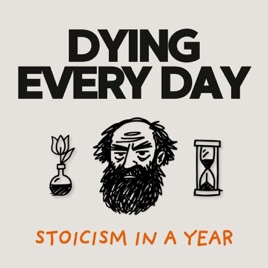
Advertise on podcast: Dying Every Day (Stoicism in a Year)
Rating
4.8from
This podcast has
171 episodes
Language
EnglishPublisher
Perennial Leader ProjectExplicit
No
Date created
2025/01/01
Latest episode
2026/10/01
Average duration
12 min.
Release period
7 days
Description
Dying Every Day is a podcast by the Perennial Leader Project. Each episode turns a selected passage from Stoic philosophy into a guided meditation designed to help you (and me) contemplate what it means to live a ‘good’ life. Learn more at perennial.substack.com.
Unlock Dying Every Day (Stoicism in a Year) podcast Email contact info,
Listeners & Audience details
Email contact information
Direct podcast contact details

Listeners
Audience numbers & engagement insights

Audience details
Podcast Insights

Podcast episodes
Check latest episodes from Dying Every Day (Stoicism in a Year) podcast
Day 158: You Will Never Know Enough: Socrates and Epictetus on Acting Without Certainty
2026/10/01
📮 Want more meditations for mortals? Sign up here: https://perennial.substack.com/subscribe
Welcome back to Dying Every Day. This is Day 158.
You’ve read the advice. You’ve asked the people you trust. And you’re still looking.
Somewhere along the way, the search for information became a search for assurance. One asks the world a question. The other asks the world for a promise.
So how much do you need to know before you act? You’ll never know enough to be certain. But you can know enough to act with care. An oracle once called Socrates the wisest man alive. He spent years trying to prove it wrong. [...]
The Life You Are Actually Living | Dying Daily
2026/09/28
📮 Want more meditations for mortals? Sign up here: https://perennial.substack.com/subscribe
Welcome back to Dying Every Day. This is Daying Daily.
You have been avoiding this thought.
Not consciously. Not with deliberate effort.
Simply by staying busy enough that it never quite surfaces. By treating awareness of death as something to manage—acknowledged briefly when unavoidable, then returned to its proper place at the far edge of consciousness, well away from the ordinary business of the day.
We have even developed extraordinary technology to support this avoidance.
The busyness, the noise, the endless scroll—all of it serves, among other things, to keep the biggest fact about human existence just below the level of genuine awareness. The Stoics thought this was exactly backward. [...]
Can Self-Discipline Be Trained? | Mortal Questions
2026/09/24
📮 Check out my new course, Resist and Persist: https://perennial.substack.com/p/introducing-resist-and-persist
Welcome back to Dying Every Day. This is Mortal Questions.
I want to try something new here on Dying Every Day. I’m calling it Mortal Questions.
The idea is pretty simple. There are certain questions that seem to follow us through life—questions about happiness and suffering, work and love, ambition and regret, attention and death, and so on. Some have occupied philosophers for thousands of years. Others show up on an ordinary Tuesday afternoon when something goes wrong, and we suddenly realize we have no idea what to do.
And often, they’re the same questions.
Every so often, I want to take one of them and spend some time thinking it through. Sometimes the questions come from listeners. I’ve set up an email address—[email protected]—where you can send whatever you’ve been wrestling with (you can remain anonymous or not). [...]
Day 157: Carrying the Fire with Shane Trotter | Dying Every Day
2026/09/17
📮 Want more meditations for mortals? Sign up here: https://perennial.substack.com/subscribe
Welcome back to Dying Every Day. This is Day 157.
What does it take to become strong enough to carry responsibility well?
In this episode, I speak with writer, coach, and author Shane Trotter about discipline, mentorship, responsibility, and the work of character.
Much of Shane’s work centers on a simple but increasingly important idea: people need more than information. They need formation.
We talk about standards, challenge, physical training, responsibility, and the role parents, teachers, coaches, and mentors play in helping young people develop character, judgment, resilience, and purpose.
We also explore what can happen when adults remove too much difficulty from a young person’s life—and why meaningful struggle, properly understood, can be part of learning how to live well.
Shane Trotter’s Work:
Shane writes Setting the Bar on Substack, where he explores education, parenting, character, discipline, and human development through philosophy, psychology, and practical experience.
His new course, Carry the Fire, is designed to help fathers, coaches, and mentors prepare young men to become capable, responsible adults. The program emphasizes mentorship, meaningful challenge, physical training, self-mastery, reflection, and formation.
The emphasis is not simply on teaching lessons. It is on becoming the kind of person capable of carrying something forward.
Shane is also the author of Setting the Bar: Preparing Our Kids to Thrive in an Era of Distraction, Dependency, and Entitlement, a thoughtful examination of what young people need in order to flourish in an age of distraction, overprotection, and slipping standards.
If you are a parent, teacher, coach, or mentor—or simply someone interested in how character is formed—I highly recommend Shane’s work. [...]
"Let us Postpone Nothing" | Dying Daily
2026/09/15
📮 Want more meditations for mortals? Sign up here: https://perennial.substack.com/subscribe
Welcome back to Dying Every Day. This is Daying Daily.
You have been avoiding this thought.
Not consciously. Not with deliberate effort.
Simply by staying busy enough that it never quite surfaces. By treating awareness of death as something to manage—acknowledged briefly when unavoidable, then returned to its proper place at the far edge of consciousness, well away from the ordinary business of the day.
We have even developed extraordinary technology to support this avoidance.
The busyness, the noise, the endless scroll—all of it serves, among other things, to keep the biggest fact about human existence just below the level of genuine awareness. The Stoics thought this was exactly backward. [...]
"The Art of Paying Attention" | Letters from a Mortal
2026/09/10
📮 Want more meditations for mortals? Sign up here: https://perennial.substack.com/subscribe
Welcome back to Dying Every Day. This is Letters from a Mortal.
Before we begin, a word about this edition of the podcast.
Letters from a Mortal is meant to be experienced a little differently from the usual podcast episode.
The pace is slower. There is more silence.
These letters are meant to be more of a contemplation and an invitation to step away from the noise at least for a few minutes.
They are written mostly for audio, intended for a time of stillness.
There is nothing you need to memorize.
Nothing you need to accomplish. Simply notice what stays with you. [...]
The Architecture of a Good Life | Dying Daily
2026/09/07
📮 Want more meditations for mortals? Sign up here: https://perennial.substack.com/subscribe
Welcome back to Dying Every Day. This is Dying Daily.
Aristotle spent years trying to answer a question that most people never stop to ask. Not what makes people successful. Not what makes them comfortable or admired or free from obvious pain. Something harder and more interesting.
What makes a human life genuinely good?
Not good in someone else’s estimation. Not good according to the prevailing standards of the culture.
Genuinely, deeply, lastingly good—the kind of good that holds up under examination, that you would choose again at the end, that constitutes something worth having been.
His answer was not what most people expect. [...]
Day 156: The Unchosen Life—What Kierkegaard and the Stoics Knew About Freedom
2026/09/03
📮 Want tools for the art of living? Sign up here: https://perennial.substack.com/subscribe
Welcome back to Dying Every Day. This is Day 156.
Imagine a young man with every door open.
He is talented, and he knows it. He could be a scholar—the mind is there. He could be an artist; people have told him so. He could go into business and probably do well, or travel, or fall in love, or devote himself to a cause.
Every path is available to him, and that is precisely the point: they are all still available, all still open, because he has walked down none of them. He keeps them open the way a collector keeps things in their original packaging.
To choose one would be to close the others, and he cannot bear to close anything. So he stands at the center of all his beautiful possibilities, turning slowly, admiring them, committing to nothing.
We know this young man. Many of us have been him. And we live in the age that has perfected him: the age of the open tab, the unchosen life, the endless scroll of options, none of which we select.
We have made a virtue of keeping our options open. [...]
---
🖇️ Stay Connected:
Newsletter: https://perennial.substack.com/subscribeInstagram: https://www.instagram.com/perennialmeditations/YouTube: https://www.youtube.com/@PerennialMeditations--- 🦉 Additional Resources:
Perennial Meditations archive: https://perennial.substack.com/archiveListen to more podcasts: https://www.perennialleader.com/podcasts
Dying Daily: The Gap Between Knowing and Doing
2026/08/28
📮 Want tools for the art of living? Sign up here: https://perennial.substack.com/subscribe
Welcome back to Dying Every Day. This is Dying Daily.
The philosopher and the athlete are working on the same problem. The athlete knows that wanting to be fast is not the same as being fast.
Between the desire and the capacity lies the only thing that actually closes the gap—the practice, repeated daily, in conditions that are sometimes ideal and more often not. No serious athlete waits to feel motivated.
Motivation is a consequence of practice, not its precondition.
You train. The capacity develops. The desire follows.
The philosopher has the same problem and the same solution.
“First say to yourself what you would be, and then do what you have to do.” — Epictetus, Discourses
Epictetus taught philosophy the way a coach teaches sport.
The point is not the argument. The point is performance, and it happens under the actual conditions of your life. [...]
---
🖇️ Stay Connected:
Newsletter: https://perennial.substack.com/subscribeInstagram: https://www.instagram.com/perennialmeditations/YouTube: https://www.youtube.com/@PerennialMeditations--- 🦉 Additional Resources:
Perennial Meditations archive: https://perennial.substack.com/archiveListen to more podcasts: https://www.perennialleader.com/podcasts
Dying Daily: The Returning Mind
2026/08/24
📮 Want tools for the art of living? Sign up here: https://perennial.substack.com/subscribe
Welcome back to Dying Every Day. This is Dying Daily.
Picture a man tied to the mast of his own ship.
He gave the order himself. Bind me here, he told his crew, and whatever I say, however I beg, do not untie me until we’re past. Then he had them fill their own ears with beeswax so they couldn’t hear a thing, but he left his own ears open.
And then the ship sails into the most dangerous stretch of water in the world, where the Sirens sing—a song so beautiful that every sailor who’s ever heard it has steered straight for the rocks to get closer, and died there, surrounded by the bones of everyone who came before. The man at the mast hears it. And it’s worse than he imagined. He strains against the ropes. He screams at his crew to turn the ship, to let him go; he has to get closer—and they can’t hear him, and the ropes hold, and slowly the singing fades behind them, and he survives.
That’s Odysseus. And if you’re anywhere near a movie theatre, you might be aware of Christopher Nolan’s Odyssey in theaters (I saw it a few days ago). For this Dying Daily episode, a shorter and more casual version of the podcast, I want to talk about why the Stoics were interested in this story. [...]
---
🖇️ Stay Connected:
Newsletter: https://perennial.substack.com/subscribeInstagram: https://www.instagram.com/perennialmeditations/YouTube: https://www.youtube.com/@PerennialMeditations--- 🦉 Additional Resources:
Perennial Meditations archive: https://perennial.substack.com/archiveListen to more podcasts: https://www.perennialleader.com/podcasts
Dying Daily: A Stoic Lesson from The Odyssey
2026/07/22
📮 Want tools for the art of living? Sign up here: https://perennial.substack.com/subscribe
Welcome back to Dying Every Day. This is Dying Daily.
Picture a man tied to the mast of his own ship.
He gave the order himself. Bind me here, he told his crew, and whatever I say, however I beg, do not untie me until we’re past. Then he had them fill their own ears with beeswax so they couldn’t hear a thing, but he left his own ears open.
And then the ship sails into the most dangerous stretch of water in the world, where the Sirens sing—a song so beautiful that every sailor who’s ever heard it has steered straight for the rocks to get closer, and died there, surrounded by the bones of everyone who came before. The man at the mast hears it. And it’s worse than he imagined. He strains against the ropes. He screams at his crew to turn the ship, to let him go; he has to get closer—and they can’t hear him, and the ropes hold, and slowly the singing fades behind them, and he survives.
That’s Odysseus. And if you’re anywhere near a movie theatre, you might be aware of Christopher Nolan’s Odyssey in theaters (I saw it a few days ago). For this Dying Daily episode, a shorter and more casual version of the podcast, I want to talk about why the Stoics were interested in this story. [...]
---
🖇️ Stay Connected:
Newsletter: https://perennial.substack.com/subscribeInstagram: https://www.instagram.com/perennialmeditations/YouTube: https://www.youtube.com/@PerennialMeditations--- 🦉 Additional Resources:
Perennial Meditations archive: https://perennial.substack.com/archiveListen to more podcasts: https://www.perennialleader.com/podcasts
Day 155: Resist and Persist - The Stoic Art of Self-Discipline | Dying Every Day
2026/07/16
📮 Want tools for the art of living? Sign up here: https://perennial.substack.com/subscribe
Welcome back to Dying Every Day. This is Day 155.
This week's episode is something a little different. Over the past few months, I've been building an audio course called "Resist and Persist: The Stoic Art of Self-Discipline." And I wanted you to hear the introduction. Mostly because the argument it makes stands on its own, and I think it's the most useful thing I've written this year: that if you've failed at self-discipline and everyone listening to this has, it's probably not a character flaw. It was a sequencing error. You were working on the right problem in the wrong order. [...]
---
🖇️ Stay Connected:
Newsletter: https://perennial.substack.com/subscribeInstagram: https://www.instagram.com/perennialmeditations/YouTube: https://www.youtube.com/@PerennialMeditations--- 🦉 Additional Resources:
Perennial Meditations archive: https://perennial.substack.com/archiveListen to more podcasts: https://www.perennialleader.com/podcasts
Day 154: Epictetus on the Discipline of Waiting | Dying Every Day
2026/07/09
📮 Want tools for the art of living? Sign up here: https://perennial.substack.com/subscribe
Welcome back to Dying Every Day. This is Day 154.
“Don’t demand that things happen as you wish, but wish that they happen as they do happen, and you will go on well.”
— Epictetus, Enchiridion
Waiting reveals what the soul believes it deserves.
The delayed reply. The stalled decision. The slow line.
The season of life that will not resolve on your preferred schedule.
Impatience is rarely just about time. More often, it is about control. The mind wants reality to move at the pace of its wishes. When it does not, irritation rises—not only because the thing is delayed but also because the self feels crossed.
Epictetus gives one of the sternest and most liberating pieces of Stoic advice: “Stop demanding that things happen as you wish.” [...]
---
🖇️ Stay Connected:
Newsletter: https://perennial.substack.com/subscribeInstagram: https://www.instagram.com/perennialmeditations/YouTube: https://www.youtube.com/@PerennialMeditations--- 🦉 Additional Resources:
Perennial Meditations archive: https://perennial.substack.com/archiveListen to more podcasts: https://www.perennialleader.com/podcasts
Day 153: Stoicism and the Founding Fathers | Dying Every Day
2026/07/04
📮 Want tools for the art of living? Sign up here: https://perennial.substack.com/subscribe
Welcome back to Dying Every Day. This is Day 153.
“A day, an hour, of virtuous liberty is worth a whole eternity in bondage.” — Joseph Addison, Cato: A Tragedy (1713)In the brutal winter of 1777, the Continental Army was dying at Valley Forge.
Not in battle. In the cold, the hunger, the disease. Men with no shoes, no blankets, no reason left to believe the war could be won. Desertion was constant. The cause looked finished.
And in the middle of that, George Washington did something strange.
He had a play performed for his men.
The play was Cato—Joseph Addison’s tragedy about Cato the Younger, the Roman senator who stood against Caesar’s tyranny and would not bend. It was Washington’s favorite play. He quoted it throughout his life. And he chose that winter, of all winters, to put it before his freezing, starving soldiers—because he believed the play’s message was the very thing that might keep them in the field.
That message was Stoic virtue. [...]
---
🖇️ Stay Connected:
Newsletter: https://perennial.substack.com/subscribeInstagram: https://www.instagram.com/perennialmeditations/YouTube: https://www.youtube.com/@PerennialMeditations--- 🦉 Additional Resources:
Perennial Meditations archive: https://perennial.substack.com/archiveListen to more podcasts: https://www.perennialleader.com/podcasts
Dying Daily: Seneca on Learning to Die
2026/06/29
📮 Want tools for the art of living? Sign up here: https://perennial.substack.com/subscribe
Welcome back to Dying Every Day. This is Dying Daily.
“He who has learned how to die has unlearned how to be a slave.”
— Seneca, Moral Letters
Much of fear is fear of losing. Losing comfort. Losing status. Losing strength.
Losing the familiar structure of the life you have arranged and quietly begun to mistake for permanent.
Seneca’s point is severe because it reaches the root. Until you have made some peace with death, you will be ruled by lesser fears. You will delay when you should begin. Cling where you should let go. Submit where you should stand upright.
To learn how to die is not to become theatrical about mortality. [...]
#stoicism #philosophy #lifelessons
---
🖇️ Stay Connected:
Newsletter: https://perennial.substack.com/subscribeInstagram: https://www.instagram.com/perennialmeditations/YouTube: https://www.youtube.com/@PerennialMeditations--- 🦉 Additional Resources:
Perennial Meditations archive: https://perennial.substack.com/archiveListen to more podcasts: https://www.perennialleader.com/podcasts
Podcast reviews
Read Dying Every Day (Stoicism in a Year) podcast reviews
JenHug27 2025/02/22
Stoic Wisdom for the Good Life
Great podcast for people looking to learn more about Stoic Philosophy in a shorter format! Easily digestible meditations that are thought-provoking at...
Lposse1 2025/01/03
Outstanding Podcast
Wonderful and inspiring leadership opportunities abound when you listen to this cast!
Podcast sponsorship advertising
Start advertising on Dying Every Day (Stoicism in a Year) relevant audience podcasts
You may also like to advertise on these Podcasts

4.443361346
Something You Should Know
Mike Carruthers | OmniCast Media
4.7906254
Everything is Fine
Jennifer Romolini and Kim France

4.610766567
Serialously with Annie Elise
Annie Elise & Audioboom Studios

4.41171483
The Outlier Health Podcast
Matt Frazier, Matt Tullman, Isabelle Caputo, and Doug Hay

4.616078353
Giggly Squad
Hannah Berner & Paige DeSorbo

4.8219787
Imperfect Action
Steph Taylor

4.727420586
This Past Weekend w/ Theo Von
Theo Von

4.712993373
The Tim Dillon Show
The Tim Dillon Show

4.115921451
The Tucker Carlson Show
Tucker Carlson Network

4.827992447
Huberman Lab
Scicomm Media