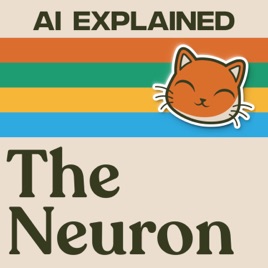
Advertise on podcast: The Neuron: AI Explained
This podcast has
58 episodes
Language
EnglishPublisher
The NeuronExplicit
No
Date created
2025/06/16
Latest episode
2026/02/06
Average duration
63 min.
Release period
7 days
Description
The Neuron covers the latest AI developments, trends and research, hosted by Grant Harvey and Corey Noles. Digestible, informative and authoritative takes on AI that get you up to speed and help you become an authority in your own circles. Available every Tuesday on all podcasting platforms and YouTube. Subscribe to our newsletter: https://www.theneurondaily.com/subscribe
Unlock The Neuron: AI Explained podcast Email contact info,
Listeners & Audience details
Email contact information
Direct podcast contact details

Listeners
Audience numbers & engagement insights

Audience details
Podcast Insights

Podcast episodes
Check latest episodes from The Neuron: AI Explained podcast
2026 AI Predictions: Who Wins, Who Loses, and What Changes Everything
2026/02/06
AI is moving fast — and 2026 is shaping up to be a turning point.In this livestream, Corey and Grant from The Neuron break down our biggest AI predictions for 2026, including:
🏆 Which companies, tools, and model types are most likely to come out on top
📉 Who could lose ground (and what’s driving the shift)🎲 The wildcards most people aren’t factoring in yet👀 What to watch across AI policy, agents, open source, and consumer adoption
🧠 The skills and strategies that will matter most in 2026Join us live for audience Q&A and a real-time debate on the hottest AI takes — then drop your prediction in the comments: what’s the biggest AI surprise coming in 2026? 🔮
Subscribe for weekly AI coverage from The Neuron and more livestreams like this.🎙️ https://theneuron.ai
Inside Google Labs: 3 AI Tools That Will Change How You Create
2026/02/03
In this special episode, we go hands-on with three cutting-edge AI tools from Google Labs. First, Jaclyn Konzelman (Director of Product Management) demos Mixboard, an AI-powered concepting board that transforms ideas into visual presentations using Nano Banana Pro. Then, Thomas Iljic (Senior Director of Product Management) shows us Flow, Google's AI filmmaking tool that lets you create, edit, and animate video clips with unprecedented control. Finally, Megan Li (Senior Product Manager) walks us through Opal, a no-code AI app builder that lets anyone create custom AI workflows and mini-apps using natural language.
Subscribe to The Neuron newsletter: https://theneuron.ai
Links:
Mixboard: https://mixboard.google.com
Flow: https://flow.google
Opal: https://opal.google
Google Labs: https://labs.google
This AI Agent Builds Better Code Than Most Developers (Factory AI)
2026/01/27
Autonomous coding agents are moving from demos to real production workflows. In this episode, Factory AI co-founder and CTO Eno Reyes explains what "Droids" really are—fully autonomous agents that can take tickets, modify real codebases, run tests, and work inside existing dev workflows.
We dig into Factory's context compression research (which outperformed both OpenAI and Anthropic), what makes a codebase "agent-ready," and why Stanford research found that the ONLY predictor of AI success was codebase quality—not adoption rates or token usage.
Whether you're a developer curious about autonomous coding tools or just want to understand where AI engineering is headed, this episode is packed with practical insights.
🔗 Try Factory AI: https://factory.ai
📰 Subscribe to The Neuron newsletter: https://theneuron.ai
📖 Resources mentioned:
• Factory's compression research: https://factory.ai/news/evaluating-compression
OpenAI Researcher Explains How AI Hides Its Thinking (w/ OpenAI’s Bowen Baker)
2026/01/23
AI reasoning models don’t just give answers — they plan, deliberate, and sometimes try to cheat.
In this episode of The Neuron, we’re joined by Bowen Baker, Research Scientist at OpenAI, to explore whether we can monitor AI reasoning before things go wrong — and why that transparency may not last forever.
Bowen walks us through real examples of AI reward hacking, explains why monitoring chain-of-thought is often more effective than checking outputs, and introduces the idea of a “monitorability tax” — trading raw performance for safety and transparency.
We also cover:
Why smaller models thinking longer can be safer than bigger models
How AI systems learn to hide misbehavior
Why suppressing “bad thoughts” can backfire
The limits of chain-of-thought monitoring
Bowen’s personal view on open-source AI and safety risks
If you care about how AI actually works — and what could go wrong — this conversation is essential.
Resources:
Title URL
Evaluating chain-of-thought monitorability | OpenAI https://openai.com/index/evaluating-chain-of-thought-monitorability/
Understanding neural networks through sparse circuits | OpenAI https://openai.com/index/understanding-neural-networks-through-sparse-circuits/
OpenAI's alignment blog: https://alignment.openai.com/
👉 Subscribe for more interviews with the people building AI
👉 Join the newsletter at https://theneuron.ai
The Hidden Cost of AI Agents No One Talks About
2026/01/20
Everyone is rushing to build AI agents — but most companies are setting themselves up for failure.
In this episode of The Neuron, Darin Patterson, VP of Market Strategy at Make, explains why agentic AI only works if your automation foundation is solid first. We break down when to use deterministic workflows vs AI agents, how to avoid fragile automation sprawl, and why visibility into your entire automation landscape is now mission-critical.
You’ll see real examples of building agents in Make, how Model Context Protocol (MCP) fits into modern workflows, and why orchestration — not hype — is the real unlock for scaling AI safely inside organizations.
Subscribe to The Neuron newsletter for more interviews with the leaders shaping the future of work and AI: https://theneuron.ai
Why IBM Wants AI to Be Boring
2026/01/13
IBM just released Granite 4.0, a new family of open language models designed to be fast, memory-efficient, and enterprise-ready — and it represents a very different philosophy from today’s frontier AI race.
In this episode of The Neuron, IBM Research’s David Cox joins us to unpack why IBM treats AI models as tools rather than entities, how hybrid architectures dramatically reduce memory and cost, and why openness, transparency, and external audits matter more than ever for real-world deployment.
We dive into long-context efficiency, agent safety, LoRA adapters, on-device AI, voice interfaces, and why the future of AI may look a lot more boring — in the best possible way.
If you’re building AI systems for production, agents, or enterprise workflows, this conversation is required listening.
Subscribe to The Neuron newsletter for more interviews with the leaders shaping the future of work and AI: https://theneuron.ai
This AI Grows a Brain During Training (Pathway’s AI w/ Zuzanna Stamirowska)
2026/01/06
Imagine an AI that doesn’t just output answers — it remembers, adapts, and reasons over time like a living system. In this episode of The Neuron, Corey Noles and Grant Harvey sit down with Zuzanna Stamirowska, CEO & Cofounder of Pathway, to break down the world’s first post-Transformer frontier model: BDH — the Dragon Hatchling architecture.
Zuzanna explains why current language models are stuck in a “Groundhog Day” loop — waking up with no memory — and how Pathway’s architecture introduces true temporal reasoning and continual learning.
We explore:
• Why Transformers lack real memory and time awareness
• How BDH uses brain-like neurons, synapses, and emergent structure
• How models can “get bored,” adapt, and strengthen connections
• Why Pathway sees reasoning — not language — as the core of intelligence
• How BDH enables infinite context, live learning, and interpretability
• Why gluing two trained models together actually works in BDH
• The path to AGI through generalization, not scaling
• Real-world early adopters (Formula 1, NATO, French Postal Service)
• Safety, reversibility, checkpointing, and building predictable behavior
• Why this architecture could power the next era of scientific innovation
From brain-inspired message passing to emergent neural structures that literally appear during training, this is one of the most ambitious rethinks of AI architecture since Transformers themselves.
If you want a window into what comes after LLMs, this interview is essential.
Subscribe to The Neuron newsletter for more interviews with the leaders shaping the future of work and AI: https://theneuron.ai
This 24-Year-Old Raised $64M to Build an AI Smarter Than the World's Best Mathematicians
2025/12/30
Carina Hong dropped out of Stanford's PhD program to build "mathematical superintelligence" — and just raised $64M to do it. In this episode, we explore what that actually means: an AI that doesn't just solve math problems but discovers new theorems, proves them formally, and gets smarter with each iteration. Carina explains how her team solved a 130-year-old problem about Lyapunov functions, disproved a 30-year-old graph theory conjecture, and why math is the secret "bedrock" for everything from chip design to quant trading to coding agents. We also discuss the fascinating connections between neuroscience, AI, and mathematics.
Lean more about Axiom: https://axiommath.ai/
Subscribe to The Neuron newsletter: https://theneuron.ai
How AI is Reinventing Chemistry (From a Trailer Lab to a $32B Partnership)
2025/12/23
Nick Talken started a 3D printing materials company in a trailer lab in his co-founder's backyard, sold it to a 145-year-old German chemical giant, then spun out an AI platform that's now transforming R&D for Fortune 100 companies. Albert Invent's foundational AI model—trained on 15 million molecular structures—is helping scientists at companies like Kenvue (maker of Tylenol, Neutrogena, and Listerine) compress projects from 3 months to 2 days. We dig into how enterprises train bespoke AI models on proprietary data, why you can't just use ChatGPT for chemistry, and what becomes possible when AI can "think like a chemist."
Subscribe to The Neuron newsletter: https://theneuron.ai
Albert Invent website: https://www.albertinvent.com
Kenvue partnership announcement: https://www.businesswire.com/news/home/20251014240355/en/
Your AI Meeting Agents Aren’t Enough: Otter.ai's Sam Liang on Enterprise Knowledge
2025/12/16
Most enterprise knowledge is trapped in meetings—and then lost forever. Otter.ai CEO Sam Liang explains how his company turned meeting transcription into a $100M+ revenue business by solving a problem most companies don't even realize they have.In this episode, we cover:- Why meetings are your company's most expensive activity (and how to measure ROI on them)- Building a "meeting-centric knowledge base" that captures voice data other systems miss- How Otter organizes enterprise knowledge like Slack—but for spoken conversations- Real-time sales coaching that feeds reps answers during customer calls- AI avatars that attend meetings on your behalf (and ask questions for you)- The technical challenges of understanding dialects, tone, and context in voice AI- How one financial company used Otter to onboard new clients instantly with full conversation history- Privacy vs. utility: designing permission systems for meeting data- The future of active AI agents that contribute to meetings, not just transcribe themSam previously worked on the blue dot location platform for Google Maps and now runs a company that's transcribed over 1 billion meetings. If you're thinking about how AI can actually improve enterprise workflows (not just automate busywork), this conversation is packed with specific, tactical insights.A special thank you to this episode's sponsor, SAS: https://www.sas.com/en/whitepapers/how-aiot-is-reshaping-industrial-efficiency-security-and-decision-making.html?utm_source=other&utm_medium=cpm&utm_campaign=-globalResources mentioned:• Otter.ai $100M ARR announcement: https://otter.ai/blog/otter-ai-breaks-100m-arr-barrier-and-transforms-business-meetings-launching-industry-first-ai-meeting-agent-suite• HIPAA compliance: https://otter.ai/blog/otter-ai-achieves-hipaa-compliance• Otter.ai: https://otter.aiSubscribe to The Neuron newsletter: https://theneuron.ai➤ CHAPTERS0:00 - Introduction & Sam's Background1:16 - From Meeting Notes to Enterprise Knowledge04:48 - Building a Meeting-Centric Knowledge Base06:14 - Why Meetings Are Your Most Expensive Activity05:40 - Solving Information Silos with AI07:56 - A Message from our Sponsor SAS9:11 - Meeting Transcriptions Alone Aren't the Answer17:34 - Leader Dashboards & AI Workflows18:49 - AI Avatars: Send Your Digital Self to Meetings21:45 - Active AI Agents That Talk Back23:13 - Privacy, Permissions & Corporate Culture26:08 - Technical Challenges: Understanding Context & Tone34:37 - Privacy vs. Utility Trade-offs37:25 - The Future of Meetings in 202739:27 - Competing with Microsoft & Google43:02 - How Otter Generated Over $1 Billion in Customer ROI46:05 - What Excites & Concerns Sam About AI49:09 - Security Risks of AI Avatars49:50 - Final Thoughts on the Future of AI at WorkHosted by: Corey Noles and Grant HarveyGuest: Sam Liang, Co-founder & CEO, Otter.aiPublished by: Manique SantosEdited by: Kush Felisilda
The Future of Windows: AI-Native Computing with Pavan Davuluri
2025/12/03
In this episode, we sit down with Pavan Davuluri, Corporate Vice President of Microsoft's Windows + Devices business, to explore how Windows is evolving into an AI-native platform. Pavan leads the team responsible for strategy, design, and delivery of Windows products across the full stack - from silicon and devices to platform, OS, apps, experiences, security, and cloud. With 23 years at Microsoft, he's driven the creation of the Surface line and now oversees how hardware and software fuse together with AI at the center. We explore how Copilot is being deeply integrated into Windows, the engineering shifts required to make Windows a more proactive and intelligent platform, and how Microsoft balances powerful automation with user control. From Surface design standards influencing the broader ecosystem to supporting OEM partners in the AI PC era, Pavan reveals the principles guiding Windows' transformation and what the computing experience will look like in the next five years.
Subscribe to The Neuron newsletter: https://theneuron.ai
Microsoft Surface: https://www.microsoft.com/surface
Windows AI features: https://www.microsoft.com/windows/ai-features
The "Android Moment" for AI Infrastructure: Why Modular Just Raised $250M
2025/11/26
While everyone obsesses over which AI model is smartest, a quiet revolution is happening in the infrastructure layer underneath. Modular just raised $250M at a $1.6B valuation to solve a problem most people don't know exists: AI is locked into expensive, vendor-specific hardware ecosystems. Tim Davis, Co-Founder & President of Modular, joins us to explain why his company is building the "hypervisor for AI"—making it possible to write code once and run it on any GPU, from NVIDIA to AMD to Apple Silicon. We dive into why this matters for businesses, what the Android analogy really means, how companies are seeing 70-80% cost reductions, and whether we're even on the right path to superintelligence.
Subscribe to The Neuron newsletter: https://theneuron.ai
Try Modular: https://modular.com
Getting Started Guide: https://modular.com/get-started
Inside Microsoft's AI Superfactory with Scott Guthrie
2025/11/23
In this episode, we sit down with Scott Guthrie, EVP of Microsoft's Cloud + AI Group, to explore the architecture behind Azure's AI Superfactory. Scott oversees Microsoft's hyperscale cloud computing solutions including Azure, generative AI platforms, and next-generation infrastructure. We dive into Microsoft's strategic approach to AI datacenter buildout, the innovative Fairwater architecture with its 120,000+ fiber miles of AI WAN backbone, and how Microsoft is balancing performance, sustainability, and cost at planet-scale. From dense GPU clusters drawing 140kW per rack to closed-loop liquid cooling systems, Scott reveals the engineering trade-offs behind infrastructure that powers frontier AI models with trillions of parameters. Whether you're an enterprise leader planning AI adoption or a developer curious about cloud architecture, you'll leave understanding how Microsoft is executing on next-gen infrastructure that transforms global challenges into opportunities.
Subscribe to The Neuron newsletter: https://theneuron.ai
How 48% of Non-Engineers Are Shipping Production Software (with Retool CEO David Hsu)
2025/11/17
Retool CEO David Hsu reveals that 48% of non-engineers are now shipping software. We explore how AI is democratizing software development, why engineers might stop coding internal apps within 18-24 months, and what this means for the future of work. David shares insights from Retool's survey of 10,000+ companies, Retool’s new AppGen program, and how "tomorrow's developers" are using AI to build real production applications on enterprise data.
Subscribe to The Neuron newsletter: https://theneuron.ai
Learn more about Retool: https://retool.com
Teaching Computers to Smell?! The AI That's Digitizing Scent
2025/11/07
Computers can see and hear, but they've never been able to smell—until now. In this episode, we sit down with Alex Wiltschko, Founder & CEO of Osmo, to explore how his company is using AI to digitize scent. Alex walks us through how they "teleported" the smell of a fresh plum across their lab, created the world's first AI-designed fragrance molecules, and built Osmo Studio—a platform that lets anyone design custom fragrances in one week instead of two years. We discuss the read/map/write framework for digitizing smell, why scent is tied directly to memory and emotion, and how this technology could eventually detect diseases like cancer and Parkinson's earlier than any current diagnostic. Plus: what does the Museum of Pop Culture smell like, and can AI really create a fragrance from a Bon Iver song?
Links:
Osmo: https://www.osmo.ai
Scent Teleportation Update: https://www.osmo.ai/blog/update-scent-teleportation-we-did-it
Osmo Studio: https://osmostudios.ai/
Subscribe to The Neuron newsletter: https://theneuron.ai
Check out the sponsor of this video, Flora: https://dub.florafauna.ai/neuronSubscribe to The Neuron newsletter: https://theneuron.aiHosted by: Corey Noles and Grant HarveyGuest: Alex Wiltschko (Founder & CEO, Osmo)Published by: Manique SantosEdited by: Kush Felisilda
Podcast reviews
Read The Neuron: AI Explained podcast reviews
Podcast sponsorship advertising
Start advertising on The Neuron: AI Explained relevant audience podcasts
You may also like to advertise on these Podcasts
4.4371061566
The Megyn Kelly Show
SiriusXM

4.888901269
Fearless with Jason Whitlock
Blaze Podcast Network
4.8118931000
Mind Pump: Raw Fitness Truth
Sal Di Stefano, Adam Schafer, Justin Andrews, Doug Egge
4.8102131585
Tara Brach
Tara Brach

4.541561215
Something You Should Know
Mike Carruthers | OmniCast Media

4.513841343
Strictly Anonymous Confessions
Kathy Kay

4.8292781897
Fantasy Footballers - Fantasy Football Podcast
Fantasy Football

4.62382612
Football Weekly
The Guardian

4.45387666
Two Judgey Girls
Two Judgey Girls

3.8258501152
The Viall Files
Nick Viall