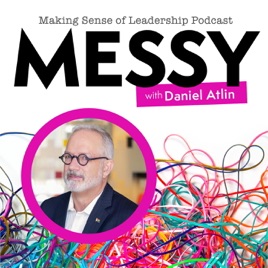
Advertise on podcast: Messy with Daniel Atlin
This podcast has
27 episodes
Language
EnglishPublisher
Solid Gold Podcasts #BeHeardExplicit
No
Date created
2025/06/20
Latest episode
2026/09/30
Average duration
48 min.
Release period
19 days
Description
Make Sense of the Mess of Leadership. Today’s leaders are facing unprecedented challenges. It’s a messy, complex world that requires a different approach and mindset to get things done. This is where you'll find conversations on how leaders in complex organizations navigate and make sense of the mess they find themselves in.
Unlock Messy with Daniel Atlin podcast Email contact info,
Listeners & Audience details
Email contact information
Direct podcast contact details

Listeners
Audience numbers & engagement insights

Audience details
Podcast Insights

Podcast episodes
Check latest episodes from Messy with Daniel Atlin podcast
Yes to the Mess Part 1: What Jazz Teaches Us About Learning, Failure, and Finding Your Voice
2026/09/30
Jazz pianist and organizational scholar Frank Barrett on play, shame, and finding your voice.
This episode is for anyone who has ever felt held back by a voice telling them they are doing it wrong.
Frank Barrett, jazz pianist, organizational scholar, and author of Yes to the Mess, traces the roots of improvisation back to where it really begins: childhood, play, shame, and the difference between learning that is alive and learning that is rule-bound. If you love music, suspect that fear of mistakes is quietly limiting you, or want to understand what jazz can genuinely teach leaders about navigating uncertainty, this conversation is for you.
Frank's story starts at his grandfather's piano in a small Irish-American home in Cleveland, where ragtime and laughter shaped a different relationship with mistakes than any formal lesson ever could. He traces how that early experience of playful, joyful learning was replaced by shame when structured piano lessons began, and how that shame became the main enemy of improvisation throughout his life and career. The contrast between mistakes that generate laughter and mistakes that generate silence is one of the most practical insights in this episode.
The conversation moves through Frank's accidental journey into jazz: teaching himself by ear, playing with the late great jazz clarinetist Ken Popowski, surviving a very public humiliation in the wrong key with the Tommy Dorsey Band at the Sands Hotel in Las Vegas, and receiving the bluntest possible feedback to find his own voice. These are not polished success stories. They are exactly the kind of messes that turn into wisdom.
Frank also traces how his lived experience as a musician collided with the organizational thinking of Karl Weick, whose concept of sense-making and compressed expertise runs through this episode. He describes the 1996-97 Academy of Management symposium on jazz that sparked his research career, his early connection to David Cooperrider and the birth of appreciative inquiry at the Cleveland Clinic, and his relationship with Deborah Ancona's work on leadership and the family ghosts we carry into our professional lives. The episode closes on the phrase that anchors Frank's entire framework: yes to the mess is an appreciative move.
Part two (next week) covers leadership, unlearning, minimal structure, maximal autonomy, and AI. Connect with Frank on LinkedIn · Yes to the Mess · Karl Weick's Social Psychology of Organizing · Deborah Ancona's research at MIT Sloan · Website · Connect with Daniel on LinkedIn
Sir Anton Muscatelli on Leading Public Institutions Through Complexity, Slow Growth, and the AI Age
2026/09/16
Sensemaking leadership as a team sport.
This episode is for anyone who cares about the future of public institutions and what it takes to lead them well in a world of slow growth, eroding trust, and rapid technological change.
Sir Anton Muscatelli, economist, former Principal of the University of Glasgow, and current President of the Royal Society of Edinburgh, shares a rare combination: deep academic expertise, two decades of institutional leadership, and an immigrant's perspective shaped by childhood across Italy, the Netherlands, and the UK.
Anton lays out a three-part framework for how expert institutions must communicate to preserve public trust: show your reasoning, be honest about where expertise ends and judgment begins, and be accountable when you get things wrong. He applies this directly to flashpoint debates including Brexit, climate change, and US tariffs - explaining why experts are losing credibility and what they must change.
The conversation moves into the structural pressures facing advanced economies: why slower growth makes politics more zero-sum and fuels populism, what the history of the interwar years tells us about today's protectionism, and why Anton remains an optimist about democracy, technology, and humanity's capacity to overcome adversity.
Anton reflects on interdisciplinary research and institutional design, including the Advanced Research Centre at Glasgow and parallels with Cambridge, and what form-follows-function really means when building institutions for wicked problems.
He humbly shares his personal leadership philosophy: curiosity first, team leadership always, and the player-coach model as the practical antidote to the lonely decisions at the top.
The episode closes with a distinction that cuts to the heart of the AI era: knowledge is becoming abundant and easy to access, but wisdom, the judgment to know how to use knowledge in a particular situation, remains scarce and irreducibly human. That, Anton argues, is exactly the role universities and national academies must own going forward. · Royal Society of Edinburgh · University of Glasgow Advanced Research Centre · UK Productivity Institute · Website · Connect with Daniel on LinkedIn
Leading With Purpose: From Manager to Mentor | Kathy Biondi
2026/09/09
Kathy Biondi on 40 years of leadership in action and navigating uncertainty
This episode is for leaders and aspiring leaders in the public sector who want a frank, experience-grounded conversation about what it really takes to navigate organisational upheaval, closures, mergers and cultural change. Kathy Biondi spent nearly forty years in the Ontario government and closed a college campus, led teams through mergers, and directed a far-reaching operations branch in the Correctional Ministry. Her lessons are practical, humble, and immediately transferable.
Kathy unpacks the moments that defined her leadership: physically staying on site until the last day of a college closure in 1994, personally phoning to secure jobs for every displaced staff member, and building the kind of trust that meant people brought her solutions rather than just problems.
She shares how her background in education and communications became a thread running through every role she held, and how written communication - briefing notes, documented decisions, clear expectations - became one of her most powerful leadership tools.
The conversation covers the concept of 'profits beyond money' - how prosperity in mission-driven and public organisations is measured in healthier communities, stronger relationships and better quality of life rather than a financial bottom line. Kathy also reflects on the next generation of public sector leaders she is meeting today, the COVID generation of health professionals driving policy change from the middle of their careers, and what senior leaders risk if they fail to listen to them.
Topics include:
servant leadership and leading from the middle;
distributed problem-solving and trust-building;
managing organisational closure with compassion;
navigating government restructuring a in Ontario;
performance management through documentation;
the role of communication, clear language and written records in leadership;
community foundations and post-retirement public service; and,
the idea that leadership is less about control and more about regrouping, planning and returning to basics when things get messy. Website · Connect with Daniel on LinkedIn
What shapes the leaders we become? | Nkulu Madonko
2026/06/17
Leadership, identity, and the human need to belong.
In this deeply personal episode of Messy, Daniel Atlin sits down with executive coach and leadership practitioner Nkulu Madonko to explore the often-overlooked relationship between identity, belonging, and leadership.
Drawing on a remarkable life journey that spans Zambia, Zimbabwe, the United Kingdom, and South Africa, Nkulu reflects on the formative experiences that shaped him — from being sent to boarding school at age six, to navigating questions of race, culture, and belonging, to helping leaders make sense of complexity in their organizations and within themselves.
Together, Daniel and Nkulu explore why leadership challenges are often rooted in deeper questions of identity and meaning. They discuss how many of the behaviours we describe as “leadership styles” may actually be survival strategies developed long ago in response to our need to belong, succeed, be safe, or be loved.
The conversation examines the importance of self-awareness, curiosity, reflection, and the power of the pause in leadership. Nkulu shares insights from his coaching work with executives, arguing that leaders often lead from deeply ingrained patterns rather than consciously chosen purpose.
Along the way, they discuss race, culture, coaching, emotional regulation, purpose, vulnerability, and why personal sensemaking is not separate from leadership — it is leadership.
The episode concludes with a reflection on the Southern African greeting Sawubona: "I see you" and its powerful connection to leadership, identity, and the human need to be truly seen.
Key Themes
- Identity and leadership
- Belonging, safety, and meaning-making
- The hidden origins of leadership behaviour
- Leading from purpose rather than pattern
- Personal and organizational sensemaking
- Race, culture, and lived experience
- The power of reflection and self-awareness
- Executive coaching and leadership transformation
- Curiosity as a leadership discipline
- Sawubona: seeing others and being seen Connect with Nkulu on LinkedIn · Quintus Wealth and Coaching · Website · Connect with Daniel on LinkedIn
Henry Mintzberg: Rebalancing Society Before It's Too Late
2026/06/03
Rebalance the world and celebrate our interdependence.
Henry Mintzberg, one of the world's most influential management thinkers, makes the case that society is dangerously out of balance and that every one of us has a role in fixing it.
This episode is for anyone who feels cynical, overwhelmed, or immobilised by the state of the world but is still looking for a reason to act.
Mintzberg, now in his mid-eighties and still publishing, argues that communism did not lose to capitalism in 1991, it simply collapsed under its own weight. The dangerous myth that capitalism triumphed has licensed a predatory form of it to tilt society off its axis. His remedy is a three-sector model of society: balancing private business, government, and what he calls the plural sector - cooperatives, NGOs, mutual organisations, and community enterprises. He uses Co-op Sapporo in Hokkaido, Japan as a living proof-of-concept: a cooperative that fills every gap left by retreating businesses and governments, from supermarkets to funeral services to mobile ATMs in depopulated villages.
The conversation covers Mintzberg's four-stage roadmap for societal rebalancing, outlined in his pamphlet 'Balance Now for the Sake of Survival': first, reframing and committing via the Declaration of Interdependence; second, mobilising through tangible grassroots action; third, transforming institutions to make governments more respected, businesses more responsible, and communities more robust; and fourth, consolidating into comprehensive social economy models. He cites the women of Paraguay pelting a corrupt senator's house with eggs until the smell forced his resignation as the spirit of stage two.
On organisations, Mintzberg revisits his foundational four-form framework from 'Understanding Organizations, Finally' - program, project, personal, and professional - illustrated through sports analogies from North American football to yacht racing. He champions communitieship over leadership, arguing that healthy organisations function as communities, not hierarchies, and that you cannot create a manager in a classroom any more than you can create a swimmer in a classroom.
Mintzberg also reflects on MBA education reform, the isolating effects of every technology from the car to AI, the viral potential of the Reformation as a model for individual-led change, and why he is searching for a 'first follower' to help his rebalancing message spread.
His inspiration: Martin Luther, an obscure monk whose one-page rant nailed to a church door changed Christianity.
If Mintzberg at 86 is still trying to change the world, his argument is clear - so should the rest of us. Connect with Henry Mintzberg on LinkedIn · Henry Mintzberg's website and blog · Rebalancing Society - free PDF and resources · The declaration of our interdependence · Derek Sivers TED Talk - how to start a movement · Website · Connect with Daniel on LinkedIn
Philosophy, AI and the Mess of Leading: the future of institutions in a rapidly changing world | Duncan Ivison
2026/05/20
President and Vice-Chancellor of the University of Manchester on AI, philosophy, and institutional change.
This episode is for people who are struggling to see how transformative change, especially AI adoption, can be introduced without fracturing trust or triggering institutional paralysis.
Duncan Ivison, President and Vice-Chancellor of the University of Manchester, one of the UK's largest and most comprehensive universities, in conversation with Daniel Atlin, explains how he is leading significant change: not by minimizing disruption, but by leaning into it deliberately and bringing the community along.
Duncan describes the University of Manchester's landmark partnership with Microsoft, the first of its kind globally. It is providing free, unrestricted access to the latest version of Copilot to all 65,000 students and staff, alongside ethical frameworks, working groups on environmental impact, and structured training.
He is frank about what he got wrong: underestimating the emotional response, the anxiety about AI's effect on organizational culture, and the importance of 'deliberated disagreement', having actual conversations rather than making assumptions about what people think. The 1,700 person town hall that followed the announcement, ranging from 'this is evil' to 'where is my licence?', became a masterclass in why dialogue and transparency matter more than consensus.
Duncan draws directly on his background as a philosopher, trained in the limits of knowledge, first principles thinking, and asking better questions - to explain how he navigates decisions in an institution that is simultaneously a research powerhouse, a civic anchor, a global brand, and a complex adaptive system of competing disciplines and stakeholders. He argues that in an AI-mediated world, large language models don't think, rather human beings do, and that philosophy and the humanities are entering a golden era precisely because the ethical and value questions AI raises will not be answered by the tech industry.
The conversation also covers:
- distributed leadership and when to step in versus step back
- strategy as narrative and why universities drift when purpose is unclear
- reimagining university structures around real-world problems rather than academic disciplines
- lifelong and flexible learning as the new model
- the fragility of universities' social licence to operate
- And the career philosophy of saying yes to opportunities before you know the outcome.
Duncan reflects on 22 years at the University of Sydney, the 'two body problem' of a global career, and what growing up in multicultural, bilingual Montreal taught him about identity, power and ideas.
This is a thoughtful conversation about leadership in complexity, the future of higher education, and why deeply human capacities may matter more than ever in the age of AI.
As always, thanks for listening to Messy. Connect with Duncan Ivison on LinkedIn · University of Manchester AI and Microsoft Copilot partnership · Alan Turing at the University of Manchester · University of Manchester - From Manchester For The World strategy · Website · Connect with Daniel on LinkedIn
Leadership is bringing people along... through empathy, integrity, and curiosity | Mary Anne Chambers
2026/04/29
And meeting them where they're at.
In this episode of Messy, Daniel Atlin sits down with Mary Anne Chambers, former Ontario cabinet minister, banking executive, and lifelong advocate for equity and access, to explore what it truly means to lead in complex, purpose and people-centered systems.
From her early experiences growing up in Jamaica, where she learned to understand lives different from her own, to her work as a bank executive, to a member of government and minister shaping policies that expanded access to education and childcare, Mary Anne reflects on the power of empathy, integrity, and lived experience in leadership.
This conversation goes beyond titles and achievements. It’s about how leaders navigate competing pressures, balance politics with purpose, and make decisions that serve the public good, even when those decisions are difficult.
At its core, this episode is a reminder that leadership in the mess isn’t about control or authority. It’s an inspiring and motivating conversation about connection and meeting people where they are, listening deeply, and bringing others along toward a shared future.
Key Takeaways:
• Empathy is not soft, rather it’s essential for effective leadership
• People’s decisions make sense only when you understand their context
• Structural barriers often hide opportunity and talent
• Leadership is about influence, not just authority
• Good public policy requires long-term thinking not quick fixes
• Trust and integrity are a leader’s most valuable capital
• Listening does not mean agreeing, it means understanding
• Leadership is about bringing people along, not pushing them forward.
I hope you'll find this conversation helpful and motivating in getting through the mess. If you like it, please write a review and share it with a friend.
Working through messes is easier with others. Mary Anne Chambers' profile as Chancellor at the University of Guelph · Website · Connect with Daniel on LinkedIn
What others see as messes, some see opportunities | David Agnew
2026/04/15
Don't be afraid to try something new.
What does it take to lead in systems that are complex, constrained, and constantly changing?
Daniel Atlin sits down with David Agnew, President of Seneca Polytechnic, whose career has spanned politics, finance, international development, and higher education. One common is stepping into organisations at moments of tension, transition, and uncertainty.
This conversation explores what leadership really looks like in public institutions, where the stakes are high, the problems are rarely neat, and the pressure to act is constant. It’s about navigating competing demands, making decisions you know will be unpopular, and holding steady in the storm.
Key insights:
1. Leadership is holding tension, not resolving it. Organisations want stability but reality demands change.
2. Not all “mess” is the same. It can be a transition, a leadership gap, or a system under pressure
3. Public institutions operate under different rules. Unlike businesses, they don’t choose their customers and can’t walk away from problems
4. Leadership is not a popularity contest. Leaders must make decisions without full agreement, withstand criticism, and accept not everyone will be satisfied
5. Inner sensemaking shapes outer action. Before decisions there is a process happening internally: What matters? What do I stand for? What am I willing to act on?
6. Time horizons matter. In many public systems today's decisions may not yield results for years. Leaders must think long-term but act in the present, and manage expectations in between
7. Careers and leadership journeys are rarely linear. Plans change, opportunities emerge, and growth often comes from stepping into the unknown
This episode is a reminder that leadership in messy systems isn’t about having the answers. What some people see as a mess, others see as meaningful work. Connect with David Agnew on LinkedIn · Seneca Polytechnic Website · Website · Connect with Daniel on LinkedIn
Putting the Mouth Back into the Body Politic | Sara Hurley
2026/03/25
Public Service = Designing Fairness at Scale.
In this episode of Messy, Daniel Atlin is joined by Sara Hurley, former Chief Dental Officer for England, a leader whose career spans frontline clinical care, military service, and senior government leadership. Few have operated as consistently at the intersection of individual care, institutional complexity, and public policy.
Sara offers a deeply reflective account of leadership in the mess.
Drawing on her experience during COVID, she describes what it feels like to make decisions when there are no good options — only trade-offs. In these moments, she argues, leadership is not about projecting certainty, but about holding uncertainty on behalf of others, while maintaining trust, clarity, and integrity.
The conversation moves fluidly between the personal and the systemic:
• The shift from authority to trust as the foundation of leadership
• The emotional labour of carrying responsibility in complex systems
• The challenge of leading in environments where outcomes are delayed, diffuse, and often invisible
• The importance of stewardship — leaving systems better than you found them, even if the impact unfolds long after you’ve left
Sara also makes a compelling case for public service as one of the last places where fairness can be intentionally designed into systems at scale — an idea that feels increasingly urgent in a time of institutional mistrust.
At its core, this episode is about sensemaking: how leaders navigate ambiguity internally, while shaping systems externally.
It’s a conversation about leadership in the real world: messy, human, and deeply consequential.
If you like this episode please write a review and share it with a friend. Sara Hurley's LinkedIn · Website · Connect with Daniel on LinkedIn
Is the University Model Broken? | Tim Blackman
2026/03/11
Rethinking higher education — and finding your purpose.
What if the real problem with higher education isn’t funding, technology, or rankings, but the model itself?
In this episode, Daniel Atlin speaks with Tim Blackman, former Vice-Chancellor and President of the Open University, about whether the dominant university model is simply out of sync with modern life.
While most universities still organise learning around a single intensive period in early adulthood, Tim argues that the future lies in lifelong learning, shorter credentials, and education woven throughout people’s working lives. Drawing on his experience leading one of the largest and most distinctive universities in the UK, he reflects on the challenge of changing institutions that are structurally designed to protect the status quo.
But this conversation is also deeply personal.
While in his role leading the Open University, Tim was diagnosed with stage four prostate cancer. The experience forced a profound pause, prompting him to reflect on legacy, responsibility, and a simple but powerful question: What kind of world do I want to leave my grandchildren?
That moment sharpened his focus on the larger purpose of higher education. In his recent paper for the Higher Education Policy Institute, Tim argues that universities should orient themselves around a guiding mission: helping to build a sustainable economy: environmentally, socially, and financially.
The discussion ranges from institutional leadership and lifelong learning to the challenge of misinformation in an increasingly fragmented knowledge landscape.
Above all, it’s a conversation about purpose and the reminder that it is never too late to rethink your work, your impact, and the difference you want to make. In a messy world, Tim reminds us that leadership isn’t just about managing institutions - it’s about deciding what really matters with the time we have. Connect with Tim on LinkedIn · The HEPI paper · Website · Connect with Daniel on LinkedIn
Making Sense of Making Sense | Why the mess matters
2026/03/04
This episode is different.
There’s no guest. It’s just me, Daniel Atlin, answering the question I ask every leader who comes on Messy: to riff off the Kierkegaard quote “Life must be lived forwards, but can only be understood backwards."
I look back at the moments that shaped my curiosity about leadership, complexity, and what I now call “the mess.” I talk about growing up between cultures and religions, about realising I was gay in the 1980s, about feeling different and discovering that everyone carries a backstory you can’t see.
After senior roles across government, cooperative organisations, and higher education, I kept noticing the same pattern: smart people, important missions, and good intentions. And… stalled initiatives, quiet failures, and exhausted leaders.
Why is leadership in mission-driven organisations so difficult?
That question led me to study leadership more formally at Oxford and HEC Paris and to interview 25 university leader across four countries. What I discovered surprised me.
Leaders who navigated complexity most effectively weren’t the ones with perfect strategies but the ones who could make sense of politics, competing narratives, incomplete data, and their own emotional reactions.
They were practicing two forms of sensemaking at the same time:
1. Personal sensemaking: regulating emotion, building resilience, understanding how your nervous system affects the organisation.
2. Organisational sensemaking: exploring the terrain, shaping narrative, improvising when plans collide with reality, and adapting collaboratively.
When those two disconnect, leadership falters.
When they align, something powerful happens.
This episode explains what I’ve learned so far, and why naming complexity is oddly liberating.
If you’re wrestling with leadership in uncertain times, this episode and the series is for you. Website · Connect with Daniel on LinkedIn
Should you Collaborate with the Enemy? | Adam Kahane
2026/02/25
If you're not part of the problem, you can't be part of the solution.
In this episode of Messy, Daniel Atlin sits down with global facilitator and systems practitioner Adam Kahane to explore what it really means to collaborate when agreement feels impossible.
They explore collaboration across deep divides, the courage to see our own part in the problem, and how change often starts in the smallest crack in a hardened system.
Drawing from his newly revised second edition of "Collaborating with the Enemy", Adam challenges the romantic idea that collaboration is always the right answer. Instead, he offers a more grounded framework: collaboration is one option among four, alongside forcing, adapting, and exiting. The key question is “When, and under what conditions, is collaboration the most viable path?”
The conversation explores several core ideas:
• "Enemy-fying": Adam’s invented word for the habit of labeling others as enemies simply because we disagree with them. In polarized systems, this reflex deepens fragmentation and limits our options.
• The Three Stretches of Collaboration:
1. Embrace conflict as well as connection
2. Experiment your way forward
3. Recognise your role in the game
• Power, Love, and Justice: Drawing on Martin Luther King Jr. and Paul Tillich, Adam frames social change as a tension between the drive to realize oneself (power), the drive to unify the separated (love), and the structures that balance the two (justice).
• Failure as Teacher: Adam speaks candidly about mistakes in both professional and personal contexts, arguing that experimentation, not certainty, is the only way forward in complex systems.
One of the key take aways for those interested in “Messy” leadership is that collaboration begins not with technique, but with introspection: Who am I in this system? How am I contributing to the very dynamics I’m frustrated by?
If you like this episode, share it with a friend. And buy Adam's book! Link to Adam's book: Collaborating with the Enemy · Reos Partners Website · Website · Connect with Daniel on LinkedIn
Between the Dance Floor and the Balcony | Iain Martin
2026/02/10
Leading across Australia, the UK, and New Zealand.
What does it mean to lead a university when trust in public institutions is eroding and the rules keep changing?
In this episode of Messy, I speak with Iain Martin, President and Vice-Chancellor of Deakin University, about navigating leadership in the thick of complexity. From global rankings and political scrutiny to AI, massification, and polarisation, the conversation surfaces the often unseen pressures shaping modern universities.
The “dance floor and balcony” metaphor comes from the adaptive leadership work of Ron Heifetz and Marty Linsky. It captures the leadership challenge of staying grounded in day-to-day realities while also stepping back to see system-level patterns.
Iain reflects on his leadership journey across three Commonwealth systems. He shares how curiosity, narrative, and sensemaking (rather than rigid planning) have guided his approach. Central to the discussion is the idea of social license: who grants it, how easily it can be lost, and why rebuilding it requires leaders to think beyond their own institutions.
Without offering simple solutions, this episode sits with the mess, exploring how leaders balance the dance floor and the balcony, strategy and stewardship, optimism and realism. It underscores why universities still matter as places for difficult conversations in a fractured world.
Key highlights
• Why universities cannot “go it alone” on social license
• The leadership cost of ignoring community expectations
• Universities as complex adaptive systems that require “productive chaos”
• Transparency as a practical trust-building strategy
• The future of assessment and learning in an AI-enabled world
• Why narrative and storytelling are essential leadership tools
I hope you enjoy this conversation. If you do, please write a review and share it with a friend.
Living and leading in the mess is easier with others. Iain Martin's Bio and contact info at Deakin · Iain's discussion & paper on the social license challenge of universities · Website · Connect with Daniel on LinkedIn
Structured Chaos in a Messy System | John Yip
2026/01/28
A little playbook, a little Picasso.
Healthcare is often treated as a hospital story, until you need care at home.
In this episode of Messy, I am joined by John Yip, President & CEO of SE Health, to talk about leading at the intersection of health systems, digital transformation, workforce innovation, and social purpose.
John shares how his early work in the digital economy still echoes today, why home and community care is both essential and misunderstood, and what it takes to build alignment across a complex, distributed organisation operating in Canada’s fragmented provincial landscape. The conversation goes deep on COVID-era leadership: uncertainty, moral pressure, scarcity, and the real-world improvisation required when there is no playbook.
We also explore what “digital transformation” should mean now and how to ensure technology serves care (not the other way around), why safe experimentation matters, and the potential of healthcare data to improve aging and wellbeing. John offers a powerful metaphor from his personal endurance project: “running every street” as a practice of curiosity, resilience, and rewiring your perspective.
Key themes:
• Sensemaking across long arcs of change
• Healthcare as a complex, fragmented ecosystem
• Leadership in distributed, mission-driven systems
• Frontline intimacy and relational care
• Crisis leadership requires improvisation
• Resilience through exploration and “structured chaos”
If leadership sometimes feels like chopping wood, this episode is a reminder: the grind is part of the work and purpose is what helps you stay even-keeled through the mess.
If you like this episode, write a review and share. Leading through the mess is easier with friends and colleagues. SE Health Website · Running magazine Canada article about John running every street · Website · Connect with Daniel on LinkedIn
Universities at the Boundary | Meric Gertler
2026/01/15
Sensemaking and Placemaking.
In June 2025, Meric Gertler completed a 12-year term as President of the University of Toronto.
I had the privilege and good fortune to first meet and work with Meric Gertler in 2007 when he was then the Dean of the Faculty of Arts and Science at the University of Toronto. What stood out most was his curious, thoughtful, and deeply empathetic approach to leadership.
Now, 18 years later, I thoroughly enjoyed our "Messy" conversation. A great deal of it explores how sensemaking is a crucial but often unrecognised function of university presidents, involving engaging with communities in all its definitions, interpreting signals, global trends and events to help their institutions understand their role in addressing societal challenges.
We cover lots more ground in our conversation:
• Why sensemaking is a non-delegable responsibility of senior leaders
• How universities build (or lose) legitimacy and public trust
• What higher education truly owes society
• Universities as engines of access, inclusion, and opportunity
• The challenge of fostering real debate & “disagree welling”
• Leading through the pandemic
• Navigating geopolitical disruption and social media fragmentation
• How U of T became a global leader in sustainability
• Lessons about mobilising change in complex systems
• Practical leadership lessons on delegation, listening, and sustaining yourself in demanding roles
This episode is a powerful reflection on leadership at the boundary: between institutions and society, certainty and ambiguity, responsibility and possibility.
If you’re navigating complexity, questioning institutional purpose, or trying to lead with integrity in uncertain times, this conversation will stay with you.
If you like it, please subscribe and share it with a colleague or friend! University of Toronto · Website · Connect with Daniel on LinkedIn
Podcast reviews
Read Messy with Daniel Atlin podcast reviews
Podcast sponsorship advertising
Start advertising on Messy with Daniel Atlin relevant audience podcasts
You may also like to advertise on these Podcasts
4.6137731960
The Rubin Report
Dave Rubin
4.6253122000
The Glenn Beck Program
Mercury Radio Arts

4.7106572000
FantasyPros - Fantasy Football Podcast
iHeartPodcasts

4.890571544
Fearless with Jason Whitlock
Blaze Podcast Network
4.732581927
The President's Daily Brief
The First TV

4.838292000
Entrepreneurs on Fire
John Lee Dumas of EOFire
4.715161997
Thrivetime Show | Business School without the BS
Clay Clark

4.920591167
Toni and Ryan
Toni Lodge and Ryan Jon

4.735951296
The Bonfire with Big Jay Oakerson and Robert Kelly
SiriusXM

4.762542000
The Lawfare Podcast
The Lawfare Institute