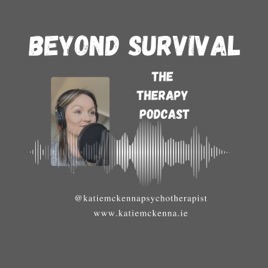
Advertise on podcast: Beyond Survival - The Therapy Podcast with Katie McKenna
Rating
5from
This podcast has
69 episodes
Language
EnglishPublisher
Katie McKennaExplicit
No
Date created
2025/06/24
Latest episode
2026/10/02
Average duration
57 min.
Release period
7 days
Description
This Podcast is for anyone who grew up up in a dysfunctional or narcissistic family system and now finds themselves stuck in patterns of people-pleasing, anxiety or unhealthy relationships. Each episode offers real-world insight into trauma recovery, relationships, boundaries, nervous system healing and reconnecting to your true self. Whether your just starting your healing journey or looking to deepen it, you’re welcome here - just as you are
Unlock Beyond Survival - The Therapy Podcast with Katie McKenna podcast Email contact info,
Listeners & Audience details
Email contact information
Direct podcast contact details

Listeners
Audience numbers & engagement insights

Audience details
Podcast Insights

Podcast episodes
Check latest episodes from Beyond Survival - The Therapy Podcast with Katie McKenna podcast
PMDD - with Dr Shubhangi Karmakar (S7 Ep.8)
2026/10/02
"It really made me feel like it was a kind of Dr. Jekyll, Mr. Hyde kind of life."
For two weeks of every month, Dr. Shubhangi Karmakar was thriving: studying medicine, completing a master's, and researching PMDD.
The other two weeks of the month, they wanted to crawl out of their skin, and wondered what the point of it all was.
In this episode, we talk about PMDD – premenstrual dysphoric disorder – a severe hormonal mood disorder.
Dr. Shubhangi is a practising clinician, psychiatry researcher, and barrister in Ireland, and they brings both their clinical expertise and their lived experience to the conversation.
We explore what PMDD can look like, from depression, hopelessness, and anxiety to sudden rage, exhaustion, sleep and appetite changes, and difficulty concentrating.
We also talk about how it affects relationships and your sense of self, the relief that comes when symptoms lift, and why every person's experience is different.
Whether you suspect you have PMDD, have a diagnosis, or want to support a friend, sister, partner, or daughter, this conversation offers understanding, validation, and practical next steps.
Resources mentioned, including a free, evidence-based PMDD self-assessment you can bring to your clinician, are linked in the show notes.
Form:
Gold Standard - Severity of Symptoms
Websites:
IAPMD.org
Clinics / Services:
Marblearchhealth.com
Drummartin Clinic
Kingsbridge Private Hospital
The Menopause hub
Well Woman Centre
Sign up - Free Masterclass
🎧 The CALM Parent - Podcast
▶️ The CALM Parent - YouTube
BEYOND SURVIVAL - The Therapy Podcast
In The Shadows (S7 Ep.7)
2026/09/25
The narcissistic parent hands their child a mirror.
The child job is to hold it up and reflect back whatever the parent needs to see.
Beside it, the parent paints a canvas and says: this is you. Selfish. Difficult. Ungrateful. Cold. Unlovable.
None of that was ever you.
In this episode, I pull apart what it means to grow up invisible. Behind the mirror and behind that ugly painted canvas, there's a blank one.
It isn't blank because there's nothing there. It's blank because you were never allowed to find out.
I explore why:
You don't know what you actually feel, only what's "allowed"
You mistake self-erasure for being "easygoing" or "low-maintenance"
You confuse being needed with being loved
You can't trust what happened until someone else confirms it.
You get to exist. Not for anyone else's benefit. For yours.
Sign up - Free Masterclass
🎧 The CALM Parent - Podcast
▶️ The CALM Parent - YouTube
BEYOND SURVIVAL - The Therapy Podcast
'Why Does He Do That? Inside The Minds of Angry and Controlling Men' - Lundy Bancroft (S7 Ep6)
2026/09/18
Have you ever found yourself wondering, “Why is he doing this?”
You replay the argument. Question what you said.
Apologise when you’re not even sure what you’ve done wrong.
You explain away the silence, the accusations, the sudden shifts in mood.
He was stressed. He had a bad day. I could have said it differently.
But what happens when you stop looking at each moment on its own — and start looking at the pattern?
In this week’s episode of Beyond Survival, I’m joined by Lundy Bancroft, who has spent more than 30 years working with abusive men and their families and is the author of 'Why Does He Do That? - Inside The Minds of Angry and Controlling Men'
Lundy describes an abusive man as operating a little like a magician. The trick isn’t necessarily what he’s doing — it’s where he gets you to look.
While you’re focused on his feelings, his anger, his wounds and what you might have done to cause them, you can lose sight of what’s actually happening.
This conversation is about stepping back from the confusion of individual moments and noticing what happens when you look at them together.
Because sometimes, the things that are hardest to see are the things we’ve been living with for so long that they simply feel normal.
Sign up - Free Masterclass
🎧 The CALM Parent - Podcast
▶️ The CALM Parent - YouTube
BEYOND SURVIVAL - The Therapy Podcast
Naming the Grief, You Can't Yet Name (S7 Ep.5)
2026/09/11
In this solo episode I tackle the complex topic of grief.
If you grew up in a narcissistic or dysfunctional family
system, the first roadblock to this grief is often minimising it.
“It wasn't that bad”
“Other people had it worse”
“I've nothing to complain about"
We say this so automatically, that we never even get to the feeling underneath it.
In the episode, I use an example that might surprise you —
Ireland's colonization, and what happened when we were denied our own language.
I know that sounds like a strange place to start a therapy podcast, but stay with me, because the parallel is exact: a narcissistic parent does the same thing to a child.
They deny you the language of yourself — your own feelings, wants, preferences, boundaries — until you're so disconnected from them that you don't even know they were ever yours to have.
And it's hard to grieve something you never knew you were missing.
This episode goes deeper into the invisible child, the cruelty of the inner critic, and how to start giving yourself the compassion you never got.
Sign up - Free Masterclass
🎧 The CALM Parent - Podcast
▶️ The CALM Parent - YouTube
BEYOND SURVIVAL - The Therapy Podcast
If You Knew Me Would You Love Me? - with Irish psychologist A.J. Cosgrave
2026/09/04
In this episode, I speak with Irish psychologist and author A.J. Cosgrave about her deeply personal book, If You Knew Me Would You Love Me?, and her experience of living with Dissociative Identity Disorder (DID), formerly known as Multiple Personality Disorder.
DID is a condition that is often misunderstood, sensationalised, or reduced to the way it is portrayed in films and television. A.J.’s story offers something very different: an honest, thoughtful and remarkably accessible insight into what living with DID can actually look like.
We talk about her own journey, the realities and challenges of living with dissociation, the process of integration and recovery, and the importance of approaching the condition — and the people who live with it — with empathy rather than fear or stigma.
This conversation about identity, trauma, understanding ourselves and others, and ultimately learning to meet complexity with kindness and courage.
Buy - 'If You Knew Me Would You Love Me? - click here
Sign up - Free Masterclass
🎧 The CALM Parent - Podcast
▶️ The CALM Parent - YouTube
BEYOND SURVIVAL - The Therapy Podcast
The FOG: When Guilt Makes the Decisions for You (S7 Ep.3)
2026/08/28
Guilt is a natural emotional response. It can tell us when we've done something that doesn't align with our values and prompt us to repair, take responsibility and make things right.
But when guilt becomes excessive, it can become a heavy burden — creating an overwhelming sense of expectation and responsibility that isn't actually yours to carry.
In this final episode of the FOG — Fear, Obligation and Guilt — I look at what happens when guilt becomes the driving force behind your decisions.
You feel obligated to do something, and when you consider saying no, the guilt arrives before you've even made a decision.
You assume you've done something wrong.
You worry you've hurt someone.
You feel guilty for having needs, setting boundaries, disappointing someone or even thinking about saying no.
And so you give in.
Not because you want to — but because the fear of feeling guilty becomes more powerful than your own wants, needs or judgement.
If you grew up in an emotionally immature or emotionally abusive family, you may have learned to take responsibility for other people's feelings while questioning your own.
In this episode, I explore why guilt can become so powerful, how it gets tangled up with obligation and people-pleasing, and how to recognise when guilt is giving you useful information — and when it's controlling your choices.
Because feeling guilty doesn't always mean you've done something wrong.
Sometimes, it simply means you're doing something differently.
Sign up - Free Masterclass
🎧 The CALM Parent - Podcast
▶️ The CALM Parent - YouTube
BEYOND SURVIVAL - The Therapy Podcast
The FOG: Why Do I Feel Responsible for Everyone Else? (S7 Ep.2)
2026/08/21
Why saying no can feel selfish, even when you're exhausted from putting everyone else first.
If you grew up with an emotionally immature, narcissistic, or emotionally abusive parent, you may have learned early that other people's needs come before your own.
That learned sense of obligation can follow you into adulthood — shaping your relationships, parenting, boundaries and decisions. And obligation and guilt often go hand in hand: you feel you should do something, and when you consider saying no, your inner critic tells you you're selfish, difficult or letting someone down.
In this episode, I explore people-pleasing, guilt, obligation and the fear of conflict, and why you may find yourself over-explaining, justifying your needs or taking responsibility for other people's feelings.
Because having a need doesn't make you selfish.
And saying no doesn't make you a bad person.
Sign up - Free Masterclass
🎧 The CALM Parent - Podcast
▶️ The CALM Parent - YouTube
BEYOND SURVIVAL - The Therapy Podcast
The FOG: When Fear Follows You into Adulthood (S7 Ep.2)
2026/08/14
For anyone who experienced a childhood in which emotional safely or physical safety weren't consistent, stable and predictable, Fear, Obligation and Guilt — will be the dominant emotions controlling their behaviour and decision making.
In this episode, I focus on Fear and how The FOG keeps adult children stuck in survival mode, and why fight, flight, freeze and fawn becomes our automatic responses.
I look at what happens when these survival responses are still running the show in your adult relationships — from shutting down in the middle of an argument, to lashing out, giving in, apologising when you don't need to, or putting everyone else's needs before your own.
Most importantly, I look at how to recognise these patterns in real time, rather than only understanding them intellectually or seeing them once the moment has passed.
Because the goal isn't simply to understand why you react the way you do.
It's learning that you have a choice now.
Sign up - Free Masterclass
🎧 The CALM Parent - Podcast
▶️ The CALM Parent - YouTube
BEYOND SURVIVAL - The Therapy Podcast
Am I a Bad Daughter for Not Wanting to Care for My Mother? (S6 Ep.10)
2026/08/07
What happens when you realise your relationship with your mother has been shaped by emotional parentification, enmeshment, and emotional abuse?
In this week’s letter, a 48-year-old woman shares how much of her identity and behaviour was shaped around managing her mother’s needs. After setting boundaries and working through childhood trauma in therapy, she begins to recognise the familiar cycle of guilt, gaslighting, victimhood, emotional manipulation, and rewriting history.
Now she faces a question many adult children of toxic parents wrestle with: “Am I the cold, heartless bitch for not wanting to fly to her side and become her caregiver if she needs help?”
This episode explores narcissistic mothers, emotionally immature parents, parentification, enmeshment, toxic family dynamics, boundaries, estrangement, caregiver guilt, and complicated grief—and offers reassurance to anyone who has spent a lifetime questioning whether protecting themselves makes them a bad person.
Sign up - Free Masterclass
🎧 The CALM Parent - Podcast
▶️ The CALM Parent - YouTube
BEYOND SURVIVAL - The Therapy Podcast
A Wolf in Sheep's Clothing (S6 Ep.9)
2026/07/31
A Wolf in Sheep's Clothing – When Your Mother Won't Protect You
"I always thought my mom was the softer, kind parent."
"She would tell me to just ignore it, or apologise"
After finally setting boundaries with her abusive stepfather, this weeks listener faces a painful new reality: her mother still refuses to acknowledge the harm she experienced and instead pressures her to forgive, reconnect, and keep the peace.
As she struggles with guilt, grief, family exclusion, and the possibility of going low contact or no contact with her mother, she asks a deeply painful question: How do you navigate a relationship with a mother who didn't protect you—and how do you manage the guilt if you choose to walk away?
This episode explores childhood emotional abuse, family trauma, maternal invalidation, toxic family dynamics, setting boundaries with parents, estrangement, guilt, and the difficult journey of healing from an abusive childhood.
When Your Mother Won’t Protect You: Setting Boundaries After Childhood Abuse
Book: If You Knew Me, Would You Love Me?
Author: A.J. Cosgrave
Sign up - Free Masterclass
🎧 The CALM Parent - Podcast
▶️ The CALM Parent - YouTube
BEYOND SURVIVAL - The Therapy Podcast
Am I Mad For Even Wanting to Try? (S6 Ep.8)
2026/07/24
How do I build and maintain a boundaried relationship with narcissistic parents?
Or am I mad for even wanting to try?
This week, a listener asks: What happens when the parents who hurt you are finally trying — but still fall back into the same old patterns?
After years of being parentified, emotionally manipulated, and punished whenever she tried to assert her independence – this weeks listener went no contact and it gave her the space she needed to heal. She's learned to regulate herself, break old patterns, and show up differently in her own relationships and as a parent.
But now comes the hard part.
Her parents went to family therapy for 9 months – and the picture is mixed. She can now see the manipulation as it happens, rather than weeks later. There are signs of genuine effort, but the old patterns still emerge when they feel challenged or don't get what they want.
In this episode, Ruth and I explore the complexities of reconnecting after estrangement, how to distinguish genuine change from attempts to regain access, and what it means to maintain boundaries when someone is making an effort but still isn't able to fully take accountability.
We also explore neurodivergence, intergenerational trauma, parentification, and the difficult question at the heart of this letter: How do I build and maintain a boundaried relationship with narcissistic parents that includes my children?
Watch this episode on YouTube
Sign up - Free Masterclass
🎧 The CALM Parent - Podcast
▶️ The CALM Parent - YouTube
BEYOND SURVIVAL - The Therapy Podcast
Am I The Only One? (S6 Ep.7)
2026/07/17
"I feel stupid for tolerating it for so long"
This week's listener grew up in a narcissistic evangelical family where religion was used to justify fear, control and abuse.
As the eldest child, she became a high-achiever, believing that self-sacrifice and obedience were the keys to love and acceptance.
Decades later, after her sister disclosed childhood sexual abuse by their father, everything changed.
Therapy, reporting her own abuse and finally leaving her own coercive and abusive marriage brought freedom—but also devastating loss when another sister chose to defend the perpetrator instead.
Katie and Ruth explore why some siblings remain loyal to abusive parents.
How narcissistic family systems operate like cults.
And why so many survivors unknowingly repeat abusive patterns in adulthood.
You're not alone — and this episode explains why.
Watch 'Beyond Survival' on YouTube
SERVE – My Lost Years At The Heart of Opus Dei – by Anne Marie Allen
Uncultured – A memoir of growing up in a Cult – by Daniella Mestyanek Young
MonteMader on Instagram - Platform on deconstructing Christian Nationalism
Sign up - Free Masterclass
🎧 The CALM Parent - Podcast
▶️ The CALM Parent - YouTube
BEYOND SURVIVAL - The Therapy Podcast
Does Illness Change Everything? (S6 Ep.6)
2026/07/10
When you finally find the strength to go no contact with abusive parents, it can feel like the hardest decision you'll ever make.
But what when of those parents becomes seriously ill?
This week we hear from a listener who spent decades trying to make sense of life with a covertly narcissistic mother and an enabling father before choosing to protect herself and her own family through estrangement.
Over time, things have quietened, but the attempts to provoke contact have never fully stopped.
And then a brief letter arrives revealing her father's diagnosis, bringing with it an unexpected wave of grief, guilt and emotional conflict.
Together, Ruth and I explore one of the most painful questions adult children of narcissistic families face:
Does a parent's illness change anything?
Are boundaries possible?
Can you hold compassion for someone's suffering while still protecting yourself from further harm?
If you've ever questioned your decision to remain no contact, worried that illness means you "should" go back, or struggled with the guilt that can surface when an abusive parent becomes vulnerable, this episode offers understanding, validation, and a compassionate framework for navigating one of the most emotionally complex situations adult survivors can face.
www.callaghancounselling.ie
Sign up - Free Masterclass
🎧 The CALM Parent - Podcast
▶️ The CALM Parent - YouTube
BEYOND SURVIVAL - The Therapy Podcast
Narcissism or Neurodivergent? (S6 Ep.5)
2026/07/03
What happens when the behaviours that hurt you look similar to traits associated with autism or ADHD?
Where is the line between someone struggling because they're neurodivergent and someone causing harm through narcissistic patterns?
In this episode, we explore the important differences between intention, impact, empathy, accountability, and "own agenda" behaviour.
We also talk about why understanding someone's neurodivergence doesn't require you to minimise your own experience or abandon the boundaries you've worked so hard to build.
If you've ever found yourself questioning whether the person who hurt you was narcissistic, neurodivergent, or both, this conversation will help you bring more clarity to a topic that is often misunderstood.
www.callaghancounselling.ie
Sign up - Free Masterclass
🎧 The CALM Parent - Podcast
▶️ The CALM Parent - YouTube
BEYOND SURVIVAL - The Therapy Podcast
Emotional Eating (S6 Ep4)
2026/06/26
For many children raised by narcissistic parents, their body becomes another battleground where they learn that who they are is never quite acceptable.
Too thin? There's a problem.
Too heavy? There's a problem.
Trying to improve yourself? That's a problem too.
" I always felt that I disappointed my parents and they didn't like me."
"I always went from chunky to super skinny and kept moving back and forth with my weight."
"As an adult now, I'm an emotional eater. Food is my comfort."
"I don't drink or use any substances but when it comes to eating I just struggle."
"When I feel even a bit hungry I start to panic like the food will not be there later."
If you've spent years blaming yourself for emotional eating, binge eating, constantly thinking about food, or feeling out of control around eating, this episode may help you understand something important:
What if your relationship with food isn't really about food at all?
Many adult children of narcissistic, emotionally immature, or dysfunctional parents grow up believing they have a lack of willpower. They tell themselves they're lazy, undisciplined, or simply incapable of maintaining healthy habits.
But often, what looks like a food problem is actually a nervous system problem.
In this week's episode Dr. Ruth Callaghan and I, dive deep into this weeks letter of a listener of growing up with a narcissistic mother, an enabling father, family alcoholism, religious dysfunction, and a childhood where food became tangled up with love, safety, criticism, and survival.
Watch 'Beyond Survival' on YouTube
www.Bodywhys.ie
Sign up - Free Masterclass
🎧 The CALM Parent - Podcast
▶️ The CALM Parent - YouTube
BEYOND SURVIVAL - The Therapy Podcast
Podcast reviews
Read Beyond Survival - The Therapy Podcast with Katie McKenna podcast reviews
needsediting 2026/01/28
Incredible Podcast!!
Do not sleep on this. Listen immediately don’t waste a second !!
Game changer . Katie McKenna is a phenomenal voice on this subject loved it, Devoure...
sjk328 2025/12/04
Incredible Podcast
I couldn’t recommend this podcast more. Katie is an incredible host. I heard her on another podcast and was so excited to find she had one herself. I ...
papalsjfbeiepsp 2025/11/08
Very insightful
Wonderfully insightful and nuanced to highlight self-awareness and understanding.
Podcast sponsorship advertising
Start advertising on Beyond Survival - The Therapy Podcast with Katie McKenna relevant audience podcasts
You may also like to advertise on these Podcasts

4.838292000
Entrepreneurs on Fire
John Lee Dumas of EOFire
4.818382000
The Cabral Concept
Dr. Stephen Cabral
4.917101547
DarrenDaily On-Demand
Darren Hardy LLC
4.6221642000
Mark Levin Podcast
Cumulus Podcast Network
4.92001922
The Wright Report
Bryan Dean Wright

4.98391800
The Adam Mockler Show
MeidasTouch Network

4.813842000
Daily Tech News Show
Tom Merritt
4.858221911
Sara Gonzales Unfiltered
Blaze Podcast Network

4.810941750
Warchant Podcasts featuring Seminole Headlines
Warchant.com

4.824761865
Deck The Hallmark
Bramble Jam Podcast Network