1831619588
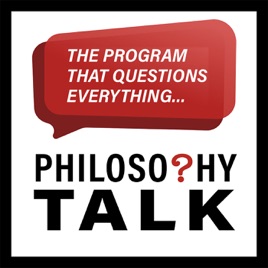
Philosophy Talk

Advertise on podcast: Philosophy Talk

Rating
★★★★★
5
from
12 reviews
Categories
Country
United States
This podcast has
668 episodes
Language
English
Explicit
No
Date created
2025/08/06
Latest episode
2026/09/27
Average duration
52 min.
Release period
7 days

Description

"The program that questions everything—except your intelligence." Philosophy Talk began as a weekly one-hour radio series and has been on the air for more than two decades. The host-professors bring clarity, depth, and humor to everyday topics that are lofty (Truth, Beauty, Justice), arresting (Terrorism, Intelligent Design, Suicide), and engaging (Baseball, Love, Happiness). This is not a lecture or a college course; it's philosophy in action! From timeless philosophical questions about the ultimate nature of things to contemporary social and political issues, as well as our most fundamental beliefs about science, morality, and the human condition, Philosophy Talk invites you to challenge your assumptions and think about things in new ways.

Unlock Philosophy Talk podcast Email contact info,
Listeners & Audience details

Email contact information

Direct podcast contact details

Listeners

Audience numbers & engagement insights

Audience details

Podcast Insights

Podcast episodes

Check latest episodes from Philosophy Talk podcast


Islamic Philosophy
2026/09/27
Some of the many topics discussed in Islamic philosophy are the Qur’an, knowledge, dreams, justice, poetry, reality, prophethood, peace, and the State.  How has Islamic philosophy interacted historically with other philosophical traditions?  How has philosophy influenced the popular practice and interpretation of Islam?  When has Islamic philosophy melded with or clashed with Islam’s religious teachings? John and Ken are joined by Mashhad Al-Allaf from the University of Sharjanh, author of The Essential Ideas of Islamic Philosophy.
Hildegard of Bingen
2026/09/20
Hildegard von Bingen was a 12th century mystic, polymath, and composer whose work spanned visionary theology, philosophy, cosmology, medicine, botany, and music. Her extraordinary intellectual accomplishments belie her humble claim to be “just a woman”. Was her humility justified in the face of the divine, internalizing misogynistic stereotypes, or a strategic decision to get her voice heard? What can mystical experience teach us about the world? And how can we understand ourselves in relation to the divine? Josh and Ray explore her life and thought with Jennifer Bain from Dalhousie University, editor of The Cambridge Companion to Hildegard of Bingen.  Part of the Wise Women series, which was supported by a grant from the National Endowment for the Humanities.
Maimonides and the Goodness of the World
2026/09/13
Moses Maimonides (also known as the Rambam) was a 12th century rabbi and scholar, most famous as the author of The Guide for the Perplexed. He thought that understanding the world through science and logic would lead you to knowledge, and that this in turn would lead you to love God. But is the world in fact something lovable? What do we do with all the pain and suffering? And is faith something you can prove using reason? Josh and guest co-host Yonah Schiller get good with Ross Brann from Cornell University, author of Moses Maimonides: A Very Short Introduction.
(End of) Summer Readig List
2026/09/06
The Philosophers talk to the authors of recent and forthcoming books that speak to our dangerous times: Christopher Star from Middlebury College, editor of How to Face the End of the World: An Ancient Guide for Apocalyptic Times Christian Miller from Wake Forest University, author of The Honesty Crisis: Preserving Our Most Treasured Virtue in an Increasingly Dishonest World Rebecca Newberger Goldstein, author of The Mattering Instinct: How Our Deepest Longing Drives Us and Divides Us
Why Be Reasonable?
2026/08/30
“You’re being unreasonable.” “Reasonable doubt.” The “reasonable person” standard. Talk of reasonableness is everywhere we turn, but what does it actually come to? What makes something reasonable, as opposed to unreasonable? And why does it matter? Could we hope for a society full of reasonable people, or is that an unreasonable thing to ask? Josh and guest-host Lanier Anderson get sensible with their Stanford colleague Krista Lawlor, author of Being Reasonable: The Case for a Misunderstood Virtue.
The Philosophical Worlds of Borges
2026/08/23
Argentinian writer Jorge Luís Borges wrote some of the world’s most brilliant, mind-bending, and philosophical stories. Drawing on sources from Europe, India, China, and Persia, these stories tackled topics like time, reality, selfhood, and art. Yet Borges also said “I don’t think ideas are important.” So what can we get out of philosophical stories that don’t try to teach us what to think? And how can Borges help us grapple with our mortality, our confusion, our doubts? Josh and Ray explore the labyrinth with Héctor Hoyos from Stanford University, author of Beyond Bolaño: The Global Latin American Novel.
What Is Game Theory?
2026/08/16
Game theory is a set of mathematical techniques for thinking about how people should choose when their choices interact. But real people aren’t exactly rational actors. Can a mathematical model explain real-world decisions? How can game theorists account for the fact that we don’t always know each other—or ourselves? Josh and Ray play no games with economist Jonathan Levin, President of Stanford University.
Wise Woman: Simone Weil
2026/08/09
French philosopher and mystic Simone Weil was also an activist whose goal was to elevate the lower classes.  But she was opposed to the kind of revolution where the oppressed overthrow their oppressors. So, how did she think we could achieve peace and justice? Is it enough to pay the right kind of attention to each other’s suffering? And how does this connect to her conversion to a mystical form of Christianity? Josh and Ray attend to the life and thought with Rebecca Rozelle-Stone from the University of North Dakota, editor of Simone Weil and Continental Philosophy.
James Baldwin and Social Justice
2026/08/02
Sometimes, we struggle to tell the truth—especially when it's the truth about ourselves. Why did James Baldwin, a prominent Civil Rights-era intellectual and novelist, believe that telling the truth about ourselves is not only difficult but can also be dangerous? How can truth deeply unsettle our assumptions about ourselves and our relations to others? And why did Baldwin think that this abstract concept of truth could play a concrete role in social justice? The Philosophers seek their own truth with Christopher Freeburg from the University of Illinois, author of Counterlife: Slavery after Resistance and Social Death.
The 2026 Dionysus Awards
2026/07/26
What movies of the past year challenged our assumptions and made us think about things in new ways? Josh and guest co-host Jorah Danenberg present our annual Dionysus Awards for the most thought-provoking recent movies: Best Future-Facing Fantasy That Asks What Makes Us Human (and Whether That’s Even a Good Thing) Best Tweak on a Classic That Raises Questions about Parents and Children Best TV Show That Blows Up All Your Theories of Personal Identity
How Do We Learn?
2026/07/19
We’re all learning about the world all the time—not just as small children but all the way into old age. But how do we learn how to learn? How much depends on the circumstances of our birth, our upbringing, and our formal education? How can we get better at learning and teaching? And how do we figure out what’s valuable to retain and what’s important to ignore? Josh and guest-host Blakey Vermeule learn from NYU psychologist Catherine Hartley, Director of the Hartley Lab.
Crisis and Creativity in Mayan Mythology
2026/07/12
The Popol Vuh, written in 1702, was based on a Mayan oral tradition encompassing creation myths, history, and cosmology. These stories were written in a time of crisis: European colonialism had decimated the Mayan population and destroyed much of their cultural knowledge. How do stories help a society survive and thrive? Can they console us in times of crisis? How much of a culture can historians save in times of devastation? Josh and Ray rewrite history with Edgar Garcia from the University of Chicago, author of Emergency: Reading the Popol Vuh in a Time of Crisis.
Wise Woman: Emma Goldman
2026/07/05
Activist and anarchist philosopher Emma Goldman fought for human liberation in every realm of life. While she opposed the women’s suffrage movement, she was a staunch advocate for women’s rights. So why did she think the right to vote was so unimportant? What did she think was required to achieve her anarchist goals? And how ahead of her time was she on labor, prison abolition, and sexual liberation? Josh and Ray explore her life and thought with Candace Falk, editor of Emma Goldman: A Documentary History of the American Years.
Summer Reading List 2026
2026/06/28
The Philosophers talk to the authors of recent and forthcoming books that speak to our dangerous times: Christopher Star from Middlebury College, editor of How to Face the End of the World: An Ancient Guide for Apocalyptic Times Christian Miller from Wake Forest University, author of The Honesty Crisis: Preserving Our Most Treasured Virtue in an Increasingly Dishonest World Rebecca Newberger Goldstein, author of The Mattering Instinct: How Our Deepest Longing Drives Us and Divides Us
Jean-Paul Sartre
2026/06/21
Jean-Paul Sartre was one of the first global public intellectuals, famous for his popular existentialist philosophy, his works of fiction, and his rivalry with Albert Camus. His existentialism was also adopted by Simone de Beauvoir, who used it as a foundation for modern theoretical feminism. So what exactly is existentialism? How is man condemned to be free, as Sartre claimed? And what’s so hellish about other people? John and Ken speak in good faith with Thomas Flynn from Emory University, author of Sartre: A Philosophical Biography.

Podcast reviews

Read Philosophy Talk podcast reviews


5 out of 5
12 reviews
★★★★★
Ww44ss 2026/08/31
My favorite radio show all time now on Apple Podcasts
A low key & thoughtful way to discover interesting insights into mind, community, and the natural world. I’ve enjoyed this show for decades. Wonderful...
check all reviews on apple podcasts

Podcast sponsorship advertising

Start advertising on Philosophy Talk relevant audience podcasts


What do you want to promote?