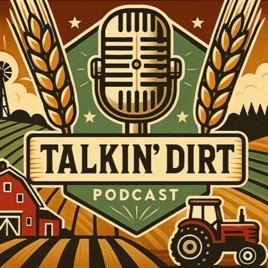
Advertise on podcast: Talkin' Dirt
Rating
5from
This podcast has
33 episodes
Language
EnglishPublisher
Robert PetersExplicit
No
Date created
2025/10/01
Latest episode
2026/10/13
Average duration
76 min.
Release period
16 days
Description
Talkin’ Dirt digs into the culture of farming today — the stories, challenges, traditions, and unexpected wins that happen when people put their hands in the soil. Host Robert Peters travels to farms big and small, talking with growers who are feeding their neighbors, rebuilding land, and reimagining what farming can be. It’s honest conversation, rooted in curiosity, bringing real voices from the field straight to you.
Unlock Talkin' Dirt podcast Email contact info,
Listeners & Audience details
Email contact information
Direct podcast contact details

Listeners
Audience numbers & engagement insights

Audience details
Podcast Insights

Podcast episodes
Check latest episodes from Talkin' Dirt podcast
KinPark Youth Urban Farm: Growing Food, Growing Community
2026/10/13
In this episode of Talkin’ Dirt, I sit down with Karissa and Fionna at KinPark Youth Urban Farm in Duncan, British Columbia. Karissa is the farm manager at KinPark, a project of the Cowichan Green Community, and Fionna is one of the local young people involved with the farm.
KinPark is about a whole lot more than growing vegetables. The farm provides opportunities for young people to gain hands on experience in agriculture, learn where their food comes from, and develop skills while contributing to something meaningful in their community. It's also a place that brings people together through local food production, education, and community involvement.
Karissa shares the vision behind KinPark, how the farm operates, and why connecting young people with agriculture is such an important part of its mission. Fionna offers her own perspective on what it's like to be involved, what she's learning, and what the experience has meant to her.
As a teacher myself, I especially appreciated this conversation. There's something incredibly valuable about giving young people opportunities to get outside, work with their hands, and develop a connection to the land and the food they eat.
Learn more:
Cowichan Green Community: https://cowichangreencommunity.org/
Talkin’ Dirt: https://talkindirt.farm
Instagram: @talkin.dirt
YouTube: @Talkin_Dirt
Substack: @talkindirt
Biodynamics and Cowichan Valley Water Rights at Alderlea Farm
2026/10/01
In this episode of Talkin’ Dirt, I sit down with John and Katy Ehrlich at Alderlea Farm in Duncan, British Columbia. For more than 20 years, they’ve been growing vegetables on their 10-acre farm, running a CSA, and building a community around local food. Right on the property is the Alderlea Farm Cafe, where food grown on the farm makes its way directly onto the menu.
John and I get into biodynamic agriculture and some of the ideas that have shaped the way he farms. We talk about Rudolf Steiner, burying manure in cow horns, planting with lunar cycles, biodynamic preparations, soil health, pest management, and the importance John places on simply observing what’s happening on the farm.
Katy also shares the struggle they’re facing over agricultural water access in the Cowichan Valley. We talk about water licensing, restrictions on farmers, the decisions being made around water use, and the larger questions those decisions raise about local agriculture and food security.
It’s a conversation about looking at a farm as a living system, paying attention to the land, and what it takes to keep a small farm viable when some of the biggest challenges are coming from outside the farm itself.
Alderlea Farm & Cafe: alderleafarm.com
🌱 Connect with Talkin’ Dirt
Talkin’ Dirt: talkindirt.farmInstagram: @talkin.dirtYouTube: @Talkin_DirtSubstack: @talkindirt
Speedy and Flo’s Sweet Corn: Fifty Acres and a Montana Following
2026/09/20
In this episode of Talkin’ Dirt, I sit down with Flo and his dad, Speedy, from Speedy & Flo’s Sweet Corn in Hardin, Montana.
Speedy came to the United States from Mexico in the late 1970s and has spent most of his life working in agriculture. What started with a few acres of sweet corn has grown into a family operation with around 50 acres of corn, a greenhouse, vegetables, flowers, and three generations of the family involved.
We talk about Speedy’s journey from Mexico to Montana, how the sweet corn operation grew, and what it takes to plant, harvest, and sell that much corn during a short Montana growing season. Flo and Speedy explain how they stagger their planting to keep fresh corn coming throughout the summer, load up their vans, and sell directly to customers across the area, including plenty of regulars who wait for Speedy & Flo’s corn every year.
We also get into working alongside family, dealing with hail and unpredictable weather, their approach to pesticides and pests, and why they still love farming despite the long days and hard work. Speedy’s story also leads us into a conversation about immigration, agricultural labor, and how the process of coming to the United States has changed since his own experience decades ago.
Speedy & Flo’s Sweet Corn: https://www.speedyandflosweetcorn.com/
🌱 Connect with Talkin’ Dirt
Instagram: @Talkin.Dirt
Website: TalkinDirt.farm
Flowers, Farming and a Healthy Dose of Optimism with Aimee Miklovic
2026/09/07
In this episode of Talkin’ Dirt, I sit down with Aimee from Full Bushel Farm in Montana’s Bitterroot Valley. Aimee didn’t grow up farming, but after finding her way into working with plants, she discovered she had a knack for growing things and eventually decided to turn that into a farm of her own.
We talk about how Aimee got started growing flowers, what it was like building a business on rented land, and some of the challenges that came with trying to figure out flower farming as she went. We also get into the commercial flower industry, why locally grown flowers are so different from the bouquets most of us see at the grocery store, and what goes into growing and selling flowers on a small scale.
Full Bushel is about more than flowers. Aimee also raises dairy cows, chickens, ducks, turkeys and goats, and we talk about the ways she’s trying to connect all of those pieces through composting, food scraps and other waste streams that can be put back to work on the farm.
We also get into the importance of local agriculture, what Aimee sees for the future of small farms, and why a certain amount of optimism might just be necessary if you’re going to make a living planting things in the dirt.
If you enjoy the show, follow Talkin’ Dirt and leave a rating or review wherever you listen. It’s one of the easiest ways to help more people find the podcast.
Learn more about Full Bushel Farm:https://fullbushelfarm.com
🌱 Connect with Talkin’ Dirt
Instagram: @Talkin.Dirt
Website: TalkinDirt.farm
From Starting a Small Berry Patch to Running a Commercial Pollen Business with Jennifer and Scott Beddard
2026/08/26
In this episode of Talkin’ Dirt, I sit down with Jennifer and Scott Beddard, former owners of Beddard Berry Farm in Washington’s Yakima Valley.
Jennifer and Scott share the story of building their berry farm from the ground up, learning as they went, raising a family alongside the farm, and eventually making the difficult decision to close the operation.
From there, we dive into a side of agriculture most people rarely get to see: commercial pollination. Jennifer and Scott spent years working with fruit growers throughout the region, collecting blossoms, extracting and testing pollen, and helping orchardists make sure their trees actually produced a crop. We talk about the surprisingly complicated science behind pollination, why different varieties of fruit trees depend on one another, and just how much can go wrong during the short window when an orchard is in bloom.
After selling their commercial pollination business, Jennifer and Scott found another way to put all of that experience to use. They started PollenPro, where they now provide small quantities of commercial-grade fruit tree pollen specifically for backyard growers. Toward the end of the episode, we talk about how that idea came together and how home growers can use supplemental pollen to help get fruit from trees that might otherwise struggle with pollination.
Learn more about PollenPro and their pollen for backyard fruit trees here:https://www.pollenpro.com/
We also zoom out and talk about what Jennifer and Scott have witnessed happening in agriculture around the Yakima Valley; the challenges facing smaller farms, the increasing pressure from larger operations, and what it takes to make a living in farming today.
It’s a conversation about starting a small farm, walking away from it, finding a different place within agriculture, and seeing firsthand just how complicated the system behind our food really is.
If you enjoy Talkin’ Dirt, follow the show, leave a rating or review, and share this episode with somebody who might enjoy it. Every little bit of support helps more people find these conversations.
🌱 Connect with Talkin’ Dirt
Instagram: @Talkin.Dirt
Website: TalkinDirt.farm
One Acre and a Full Heart with Pete Temrowski
2026/08/14
In this episode of Talkin’ Dirt, I sit down with Pete Temrowski of Full Heart Farm, a one-acre farm in Carnation, Washington.
Pete’s path to farming took him from growing plants as a kid in Atlanta, to working in the cannabis industry, to eventually starting a farm of his own in the Snoqualmie Valley. Today, he’s building Full Heart slowly and intentionally, growing vegetables, herbs, flowers and perennial crops while experimenting with seed saving, composting, low-till practices and ways to improve the health of his soil.
We talk about what it actually takes to start a small farm with limited resources, the importance of community among local farmers, why Pete has become so interested in saving and adapting seeds, and the realities of trying to make a living on a one-acre operation.
Pete is refreshingly realistic about what he’s building. He’d love to farm full time someday, but he also recognizes that farming may always be something he does alongside other work. For him, it’s less about getting big and more about growing good food, feeding his family and community, and getting to spend his life working with plants.
This is a great conversation about small-scale farming, soil, seeds, community, and simply doing something because you love it.
🌱 Connect with Talkin’ Dirt
Instagram: @Talkin.Dirt
Website: TalkinDirt.farm
Virginia Hemp Under Pressure: The Cost of Compliance at Redfern Hemp
2026/07/31
In this episode of Talkin' Dirt, I sit down with Graham Redfern, founder of Redfern Hemp, and Joe Domino, the company's research director. Graham's path into agriculture wasn't a traditional one. After careers in construction and banking, he became convinced that industrial hemp had the potential to transform everything from building materials and textiles to wellness products and sustainable manufacturing. What followed was years of farming, research, product development, and advocacy as Redfern Hemp grew into one of Virginia's leading hemp companies.
Our conversation begins with the story of how Redfern Hemp came to be but quickly expands into the complex regulatory landscape surrounding hemp production in the United States. Virgina's laws regarding hemp are changing on August 15th of this year. Graham and Joe explain how Virginia's changing hemp laws are reshaping their business, why full-spectrum hemp products have become the center of a growing legal debate, and what it's like trying to build a company when the rules governing your industry continue to evolve. Along the way, we discuss the promise of industrial hemp, the realities of running a vertically integrated agricultural business, and the practical challenges facing farmers trying to invest in an uncertain future.
More broadly, this conversation explores a question that reaches far beyond hemp: What happens when regulation becomes one of the defining forces shaping an agricultural industry? We talk about the relationship between public policy and innovation, the growing cost of regulatory compliance, and whether changing rules unintentionally make it harder for small producers to compete. Regardless of where you land on the issues discussed, this episode offers a thoughtful look at how agriculture, entrepreneurship, and government policy intersect—and why those conversations matter for the future of farming.
🌱 Connect with Talkin’ Dirt
Instagram: @Talkin.Dirt
Website: TalkinDirt.farm
Challenging Conventional Wisdom in AG with Jay Hayward
2026/07/05
In this episode of Talkin' Dirt, I sit down with Jay Hayward, owner of Hayward Garlic in Montana's Bitterroot Valley. Jay has built one of the country's leading seed garlic businesses, but his path into farming wasn't exactly a straight one.
Jay shares how studying behavioral psychology, working in agricultural technology, and recruiting for manufacturing companies eventually led him back to the farm. We talk about what it takes to build a specialty crop business, the realities of marketing as a small farmer, garlic genetics, soil health, and what the label "organic" really means.
We also discuss hydroponics, consumer food choices, and some of the assumptions many of us have about modern agriculture. Toward the end of the conversation, Jay shares some of the research behind the book he's writing on the controversy surrounding cows and climate change and why he believes it's a conversation worth taking a closer look at.
This is a thoughtful conversation about farming, science, and questioning conventional wisdom.
🌱 Connect with Talkin’ Dirt
Instagram: @Talkin.Dirt
Website: TalkinDirt.farm
Chestnut Trees and Market Forces with Steve Jones
2026/06/08
This week on Talkin' Dirt, I sit down with Steve Jones of Colossal Orchards in Selah, Washington. Steve's journey into chestnuts began almost by accident when a friend suggested they give the crop a try. More than 35 years later, that small side project has grown into one of the Pacific Northwest's largest chestnut operations.
Our conversation explores what it takes to build an orchard designed to last generations. Steve shares the challenges of establishing a crop that can take years to produce meaningful yields, the realities of marketing a niche product, and the long-term thinking required when planting trees that may outlive the person who planted them.
Along the way, we discuss the fascinating history of the American chestnut and the devastating blight that transformed forests across Appalachia. We also dive into some of the bigger forces shaping modern agriculture, including water rights in the American West, rising labor costs, agricultural consolidation, global commodity markets, and why one of the greatest strengths of American agriculture may also be one of its greatest challenges.
From chestnut orchards and pollination to drought, trade, and the future of farming, this conversation offers a thoughtful look at the complex systems that shape the food we eat and the people who produce it.
🌱 Connect with Talkin’ Dirt
Instagram: @Talkin.Dirt
Website: TalkinDirt.farm
The Land Outlives Us All with David Bell
2026/05/27
In this episode of Talkin’ Dirt, I sit down with David Bell from Just Living Farm on Yakama Nation land in the Yakima Valley of Washington. David and his wife originally came to the area in the late 1990s to run after school programs for local youth, but over time that work evolved into something much larger, a farm built around ideas of stewardship, justice, and living in a closer relationship with the land.
In this conversation, David shares the story of how Just Living Farm came to be and how his perspective on agriculture changed over the years. We talk about raising grass fed cattle in a way that works in harmony with the land, the realities of industrial agriculture, and why he believes farming should be about more than just commodity production. He also explains why he prefers the term “harmonious farming” over “regenerative farming,” and how their operation is designed to sustain both the animals and the landscape naturally.
We also get into deeper conversations around land ownership, Yakama Nation history, water rights in the valley, and how modern society has become increasingly disconnected from food, nature, and rural life. David shares thoughtful perspectives on stewardship, community, and what it means to truly belong to a place rather than simply own it.
This was one of the more reflective and philosophical conversations I’ve had on the podcast, grounded in agriculture, but reaching far beyond it.
🌱 Connect with Talkin’ Dirt
Website: TalkinDirt.farm
Scaling Up at Frisky Girl Farm with Ellen Scheffer
2026/05/11
In this episode of Talkin’ Dirt, I sit down with Ellen from Frisky Girl Farm in Fall City, Washington. Ellen got her start in agriculture after a college class reshaped how she thought about the food system, which led her to work on farms across the country before eventually co-founding her own operation in the Seattle area.
In this conversation, Ellen shares the story of building Frisky Girl Farm from a half-acre urban farm into a five-acre production, and the challenges that came with it—losing infrastructure to wind, dealing with crop damage from wildlife, and ultimately making the decision to leave that land behind. We get into how those experiences shaped the next chapter of the farm and what it looks like to scale up through a merger with Steel Wheel Farm in the Snoqualmie Valley.
We also talk through their unique CSA model that gives customers more flexibility in what they receive each week, along with the realities of marketing and selling food as a small farm. Ellen shares insights on organic growing practices, year-round production in the Pacific Northwest, and the balance between collaboration and competition within the local farming community.
You can find out more about what Ellen and her team are putting together and how to sign up for their CSA box at Frisky Girl Farm: North Bend's finest vegetable & flower farm
🌱 Connect with Talkin’ Dirt
Instagram: @Talkin.Dirt
Website: TalkinDirt.farm
A Bucket of Beets and a Lifetime of Lessons with Jack Graham
2026/04/27
In this episode of Talkin’ Dirt, I sit down with Jack from Farmer Jack’s Garden in the Yakima Valley. Jack has spent a lifetime around agriculture, starting on a cattle and grain farm in northeastern Washington and continuing that work through decades of growing his own food at home.
In this conversation, Jack shares how gardening stayed with him through a full career in law enforcement, eventually turning into a small-scale operation where he and his wife Diann sold grapes, popcorn on the cob, and hundreds of pounds of beets each year directly to their community. We get into how that all came together and what it looks like to build something like that over time.
We also talk through soil health, natural growing methods, and the systems Jack has developed over the years to grow productive crops without relying on chemicals. He shares practical insights on irrigation, composting, pest management, and what it takes to consistently grow good food in a dry climate like the Yakima Valley.
🌱 Connect with Talkin’ Dirt
Instagram: @Talkin.Dirt
Website: TalkinDirt.farm
The Craft of Goat Cheese at Sunnyfield Farm with Andre Entermann
2026/04/14
In this episode of Talkin' Dirt, I sit down with Andre Entermann. Andre runs Sunnyfield Farm with his wife out on Lopez Island, where they’ve been building a small-scale goat dairy focused on thoughtful, hands-on production.
In this conversation, Andre shares how years of traveling and working on organic farms eventually led him to settle on Lopez and start farming for himself. We get into the realities of dairying goats, the process of making cheese, and the amount of work that goes into turning milk into something you’re proud to sell.
We also talk through the tension between traditional cheesemaking and modern food safety regulations in the U.S.—how pasteurization, testing requirements, and state-by-state rules shape what small producers are able to do, and what can get lost along the way. We get into herd management, the role of community on the island, and what it takes to keep a small farm running in a way that’s actually sustainable.
🌱 Connect with Talkin’ Dirt
Instagram: @Talkin.Dirt
Website: TalkinDirt.farm
The Hidden World Inside Soil with Shawn Bruckman
2026/03/30
In this episode of Talkin’ Dirt, I sit down with Shawn Bruckman in Eagle, Colorado — a soil health specialist, worm farmer, and someone who has built a career around understanding what’s happening beneath our feet.
Shawn shares her journey from studying environmental policy to becoming a local expert in soil biology, composting, and regenerative practices. The conversation explores her work with The Ground Up and Wiggle Worm Gardens, along with her experience helping develop a composting facility in Eagle County.
We get into worms, compost, and the living biology inside soil — including how red wigglers produce nutrient-rich castings, what healthy soil actually looks like under a microscope, and how building soil can reduce the need for costly inputs.
The episode also touches on water challenges in the West, the importance of native plants, and the connection between soil health, food, and human health.
🌱 Connect with Talkin’ Dirt
Instagram: @Talkin.Dirt
Website: TalkinDirt.farm
Island Sheep at Lucky Ewe Farm with Audrey & Michelle
2026/03/17
In this episode of Talkin’ Dirt, I sit down with Audrey and Michelle from Lucky Ewe Farm on Lopez Island in Washington’s San Juan Islands.
They talk about how they got into sheep, what it’s like managing a small band on an island, and the role sheep play in their daily life.
The conversation also gets into lambing season, working with dogs, and how sheep behavior can shift depending on the landscape. Audrey and Michelle share some of the unique benefits and challenges of farming on a small island like Lopez and talk about why they’ve made the difficult decision to begin transitioning away from sheep ranching.
This was a reflective look at small-scale farming and life with a small band of sheep.
🌱 Connect with Talkin’ Dirt
Instagram: @Talkin.Dirt
Website: TalkinDirt.farm
Podcast reviews
Read Talkin' Dirt podcast reviews
Graeme “Dawg” 2026/01/18
Fascinating show by great guy
Like I said
Daffodilone 2025/10/14
Topic Range
Love the wide range of topics presented on farming. Also provides helpful information on regenerative farming and the effect of environment and polit...
Podcast sponsorship advertising
Start advertising on Talkin' Dirt relevant audience podcasts
You may also like to advertise on these Podcasts
4.814621644
The Big Honker Podcast
Andy Shaver & Jeff Stanfield
4.6313211083
Wow in the World
Tinkercast
4.8104502000
Steve Deace Show
Blaze Podcast Network
4.861461108
The David Pakman Show
David Pakman
4.92002931
The Wright Report
Bryan Dean Wright
4.721741386
Motivation Daily by Motiversity
Motiversity

4.619792875
All Ears English Podcast
Lindsay McMahon and Michelle Kaplan
4.8167522000
The GaryVee Audio Experience
Gary Vaynerchuk
4.682521297
The Daily Beast Podcast
The Daily Beast, Joanna Coles
4.82762860
Dopey: On the Dark Comedy of Drug Addiction
Dave & Chris