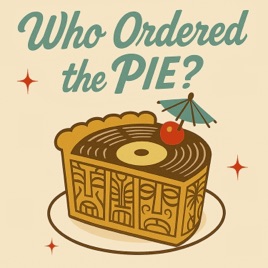
Advertise on podcast: Who Ordered the Pie? - Music history, cocktails, and the stories in between.
Rating
5from
This podcast has
52 episodes
Language
EnglishPublisher
ChristopherExplicit
No
Date created
2025/10/03
Latest episode
2026/10/09
Average duration
22 min.
Release period
8 days
Description
Who Ordered the Pie? is a podcast that slices into the hidden stories behind the songs you know, and the artists who made them unforgettable. Each episode serves up music history with a twist: cocktail recipes inspired by the tales themselves, complete with their own colorful backstories. It’s part deep-dive storytelling, part barstool banter, and always mixed to perfection. If you love the nostalgia of a great record and the kick of a well-made drink, pull up a chair, this is your show.
Unlock Who Ordered the Pie? - Music history, cocktails, and the stories in between. podcast Email contact info,
Listeners & Audience details
Email contact information
Direct podcast contact details

Listeners
Audience numbers & engagement insights

Audience details
Podcast Insights

Podcast episodes
Check latest episodes from Who Ordered the Pie? - Music history, cocktails, and the stories in between. podcast
Episode 50: Something Strange in the Speakers: Creepy Sounds and Studio Legends
2026/10/09
Send us Fan Mail
Have you ever heard something in a song that made you stop, back it up, and wonder, “What the hell was that?”
This week on “Who Ordered the Pie?” we’re exploring the creepy sounds and studio legends hiding inside familiar records. From the haunted streets of The Specials’ “Ghost Town” to the unsettling world of Peter Gabriel’s “Intruder,” we’ll hear how musicians turned studio experiments, unexpected accidents, and a little imagination into something wonderfully strange.
Along the way: The Beatles’ “Blue Jay Way” and “Strawberry Fields Forever,” the eerie cries of Pink Floyd’s “Echoes,” and the infamous scream in Ohio Players’ “Love Rollercoaster.” There’s backward listening, a Phil Collins drum connection, and a chance to hear the sounds yourself before the stories get into your head.
Then we head to the bar for “The Phantom Note,” a gin-and-elderflower cocktail with a quiet herbal mystery in the background.
Listen closely. And maybe leave the hallway light on.
Support the show
Who Ordered the Pie? a music history podcast with custom cocktail pairings.
Show notes, recipes, and extras: WhoOrderedThePie.com
Follow: Apple Podcasts • Spotify • YouTube • Instagram
Episode 49: A Life in Records | 1 Year of Who Ordered the Pie?
2026/10/02
Send us Fan Mail
1 year. A lot of music. And a wife whose suggestion to start a podcast turned out to be an excellent delegation strategy.
For this anniversary episode of “Who Ordered the Pie?” I’m sharing how a lifelong love of liner notes and music trivia became a show about the stories behind the songs.
Go behind the microphone to hear how I handpick songs I believe deserve an audience, find the connections that turn them into episodes, and sneak little jokes into the music. There’s also my 49ers game-day soundtrack, my early-morning “KJAZ voice,” and a first-year highlight: hearing directly from John Sebastian after he listened to his episode.
We’ll raise a traditional 1944 Trader Vic’s Mai Tai to a year of discoveries, unexpected connections, and everyone who’s made this show part of their routine.
Thank you for being my kind of people.
Have a song suggestion, a favorite moment, or something you’d like me to explore?
Visit the Backstage Door at https://whoorderedthepie.com or email [email protected].
Here’s to loud riffs, quiet sips, and the stories in between.
Support the show
Who Ordered the Pie? a music history podcast with custom cocktail pairings.
Show notes, recipes, and extras: WhoOrderedThePie.com
Follow: Apple Podcasts • Spotify • YouTube • Instagram
Episode 48: Right Song, Wrong Timing | The Power Pop Pioneers
2026/09/25
Send us Fan Mail
Before Cheap Trick, The Cars, The Knack and the power pop bands that followed, a handful of artists were already combining loud guitars, huge hooks and ’60s-inspired harmonies into something that would help define the genre.
In this installment of “Right Song, Wrong Timing,” Christopher goes back to the power pop pioneers who had the songs and the sound, but ran into bad timing, record label problems, changing musical trends and some truly bizarre twists of fate.
This episode features Big Star’s “September Gurls,” The Raspberries’ “Overnight Sensation (Hit Record),” Dwight Twilley Band’s “I’m on Fire,” The Rubinoos’ “I Wanna Be Your Boyfriend,” and The Real Kids’ “All Kindsa Girls.”
Along the way, you’ll hear how Alex Chilton and Big Star became one of rock’s most influential cult bands, how Eric Carmen blended Beatles melodies, Beach Boys harmonies and the power of The Who, how “Jaws” helped derail Dwight Twilley’s follow-up to a Top 20 hit, why The Rubinoos played “Sugar, Sugar” to a Jefferson Starship crowd, and how a French music journalist helped The Real Kids make their first record.
The story also crosses paths with The Ramones, Tom Petty, John Lennon, Jonathan Richman and more as we trace the roots of the sound that became power pop.
Then it’s time to turn down the guitars, open the bar, and mix this episode’s featured cocktail, “The Overnight Sensation.”
If you love classic rock, power pop, ’70s rock, Big Star, The Raspberries, music history and the stories behind the songs, this episode is for you.
Support the show
Who Ordered the Pie? a music history podcast with custom cocktail pairings.
Show notes, recipes, and extras: WhoOrderedThePie.com
Follow: Apple Podcasts • Spotify • YouTube • Instagram
Episode 47: Right Song, Wrong Timing | Around the World in Five Great Songs
2026/09/18
Send us Fan Mail
5 songs. 5 countries. Very different stories on opposite sides of the world.
In this edition of “Right Song, Wrong Timing,” Christopher follows Split Enz, Moving Pictures, Jon Astley, Peter Schilling, and Golden Earring through family connections, missed opportunities, and unexpected second chances.
From the Finn brothers’ story behind “I Got You” to the overlooked voices in “What About Me,” the uneasy romance of “Jane’s Getting Serious,” and the strange worlds of “Major Tom (Coming Home)” and “Twilight Zone,” we explore why a memorable song doesn’t always lead to lasting recognition.
Along the way: a producer hears something worth recording during a studio break, a familiar surname causes confusion, and a famously misheard chorus finally comes into focus.
Featured songs:
• Split Enz: “I Got You”
• Moving Pictures: “What About Me”
• Jon Astley: “Jane’s Getting Serious”
• Peter Schilling: “Major Tom (Coming Home)”
• Golden Earring: “Twilight Zone”
This episode’s cocktail is The Layover, a full-strength Jet Pilot riff with 3 rums, citrus, cinnamon, and falernum.
More stories and cocktail recipes: whoorderedthepie.com
Get in touch: [email protected]
Support the show
Who Ordered the Pie? a music history podcast with custom cocktail pairings.
Show notes, recipes, and extras: WhoOrderedThePie.com
Follow: Apple Podcasts • Spotify • YouTube • Instagram
Episode 46: Right Song, Wrong Timing | Canada Comes South
2026/09/11
Send us Fan Mail
Why were some of the biggest Canadian rock bands of the 1980s huge at home, yet barely known in the United States?
In Episode 46 of "Who Ordered the Pie?," Christopher heads north for another installment of "Right Song, Wrong Timing" and follows 5 Canadian bands as they try to turn success in Canada into hits south of the border.
The Kings actually charted higher in the U.S. than in Canada with "This Beat Goes On / Switchin' to Glide," a Bob Ezrin-produced FM rock classic that spent nearly 6 months on the Billboard Hot 100.
Vancouver's The Payolas scored a major Canadian hit with "Eyes of a Stranger," featuring future superstar producer Bob Rock, yet somehow missed the U.S. Hot 100 entirely, despite American rock-radio airplay and an appearance in the movie "Valley Girl."
Honeymoon Suite came even closer, taking "New Girl Now," "Feel It Again," "What Does It Take" and more across the border while touring the U.S. and getting exposure on MTV.
Then there's Platinum Blonde, one of Canada's biggest bands of the mid-'80s. "Crying Over You" went to #1 in Canada, "Alien Shores" became a multi-platinum album, and Rush guitarist Alex Lifeson even played on the record. But in America? A very different story.
And finally, Glass Tiger shows what happened when everything lined up. With songwriter and producer Jim Vallance, backing vocals from Bryan Adams, and "Don't Forget Me (When I'm Gone)," this Canadian band didn't just cross the border. They broke through.
Along the way, we revisit MuchMusic, MTV, the JUNO Awards, Billboard's Hot 100, Canadian radio, Bob Rock, Mick Ronson, Alex Lifeson, Bryan Adams and an era when a band could be a household name in Canada and almost anonymous just a few hundred miles south.
Why did some Canadian hits cross over while others stopped at the border?
Sometimes it wasn't the song.
Sometimes it was the market, the label, the radio station, the timing...
and sometimes it was simply the right song in the wrong place.
Featured artists and songs:
The Kings — "This Beat Goes On / Switchin' to Glide"
The Payolas — "Eyes of a Stranger"
Honeymoon Suite — "New Girl Now"
Platinum Blonde — "Crying Over You"
Glass Tiger — "Don't Forget Me (When I'm Gone)"
Plus: Rock and Hyde, Bob Rock, Mick Ronson, Rush's Alex Lifeson, Bryan Adams, Jim Vallance and more.
And in The Lounge, we're mixing this week's Canadian-inspired cocktail: "Alien Shores."
Episode 46: "Right Song, Wrong Timing | Canada Comes South"
"Who Ordered the Pie?" — music history, the stories behind the songs, and a little something in your glass.
Support the show
Who Ordered the Pie? a music history podcast with custom cocktail pairings.
Show notes, recipes, and extras: WhoOrderedThePie.com
Follow: Apple Podcasts • Spotify • YouTube • Instagram
Episode 45: Sunshine Pop | The Happiest Hits of the '60s and '70s, Part 2
2026/09/04
Send us Fan Mail
Sunshine Pop is back for Part 2, with 4 more ridiculously catchy records from the late ’60s and early ’70s, and some of the strangest stories behind them.
This time, Christopher digs into Edison Lighthouse, The Cyrkle, The Association, and The Grass Roots, and discovers just how much was happening behind some of the happiest-sounding records on AM radio.
How do you score a massive number 1 hit when your band doesn’t actually exist? Why did John Lennon end up naming an American college band? How did Paul Simon help launch that same group, only for The Beatles to later keep them out of the number 1 spot? And how did a song originally written as a gentle waltz become one of the defining pop records of the summer of 1967?
Along the way, there’s a session singer seemingly everywhere at once, a Paul Simon song somebody probably wishes they hadn’t turned down, an all-night recording session, a surprising Leonard Bernstein connection, and a lyrical coincidence that suddenly takes us from Sunshine Pop to a 1980 country hit.
It’s another trip through an era when great melodies, huge harmonies, and unforgettable hooks could make even a breakup song sound like the best day of your life.
And after the music, we head to the bar for a bright, refreshing cocktail inspired by one of the songs in the episode: The Red Rubber Ball.
Support the show
Who Ordered the Pie? a music history podcast with custom cocktail pairings.
Show notes, recipes, and extras: WhoOrderedThePie.com
Follow: Apple Podcasts • Spotify • YouTube • Instagram
Episode 44: Sunshine Pop | The Happiest Hits of the '60s and '70s, Part 1
2026/08/29
Send us Fan Mail
Some songs challenge you. Others just make you feel good.
In Episode 44, we're diving into the bright, ridiculously catchy world of Sunshine Pop with 4 songs that helped define the happiest side of AM radio in the late '60s and early '70s.
The Foundations turn romantic misery into the irresistible "Build Me Up Buttercup." The Hollies bring their unmistakable 3-part harmonies to "Carrie Anne," along with one of the most unexpected instruments ever dropped into a British pop hit. Then things get wonderfully strange with The Archies and "Sugar, Sugar," a number 1 smash recorded by a band that didn't actually exist, promoted on the backs of cereal boxes, and connected in a surprising way to a much heavier hit nearly 20 years later.
Finally, we climb aboard the psychedelic bus with The Partridge Family and "I Think I Love You," where television fiction and real-life pop stardom collided in a way that almost sounds too perfect to have actually happened.
Along the way, we'll uncover the stories behind the singers, songwriters and studio tricks that made these records nearly impossible to forget.
And after all that musical sunshine, we'll head to the bar for this episode's featured cocktail, "The Sugar Rush."
4 songs. 4 great stories. And enough hooks to stay stuck in your head for the rest of the day.
This is "Sunshine Pop | The Happiest Hits of the '60s and '70s."
Support the show
Who Ordered the Pie? a music history podcast with custom cocktail pairings.
Show notes, recipes, and extras: WhoOrderedThePie.com
Follow: Apple Podcasts • Spotify • YouTube • Instagram
Episode 43: Three of a Kind | FM Rock’s Other Great Trios
2026/08/21
Send us Fan Mail
Rush, The Police, and ZZ Top became rock institutions. But what about the other great power trios of early ’80s FM radio?
In Episode 43 of “Who Ordered the Pie?,” we explore three bands whose defining moments arrived in three consecutive years: Triumph with “Magic Power” in 1981, Taxxi with “I’m Leaving” in 1982, and Zebra with “Who’s Behind the Door?” in 1983.
Discover how Rik Emmett’s childhood transistor radio inspired one of Triumph’s greatest songs, why the British trio Taxxi relocated to the San Francisco Bay Area, and how a perfectly timed radio broadcast helped Zebra turn an Atlantic Records rejection into a record deal.
Then we make “The Cocktail Queen,” an equal-parts Canadian Boulevardier named after one of Taxxi’s most memorable songs.
It’s a story of power trios, FM rock, unlikely breakthroughs, and three musicians sounding larger than life.
Support the show
Who Ordered the Pie? a music history podcast with custom cocktail pairings.
Show notes, recipes, and extras: WhoOrderedThePie.com
Follow: Apple Podcasts • Spotify • YouTube • Instagram
Episode 42: Right Song, Wrong Timing | MTV’s Almost Superstars
2026/08/14
Send us Fan Mail
In the early days of MTV, one unforgettable music video could make a band look like the next superstar. In this episode of Who Ordered the Pie?, we revisit five 1980s bands that had the songs, the talent, the image, and the MTV exposure to become household names, but somehow never reached the level everyone expected.
We dig into the stories behind Big Country’s “In a Big Country,” Haircut One Hundred’s “Love Plus One,” Scandal’s “The Warrior,” The Motels’ “Only the Lonely,” and The Hooters’ “And We Danced.”
Why didn’t Big Country’s massive American breakthrough last? What caused Haircut One Hundred to fall apart just as they were becoming stars? Why did Patty Smyth hate Scandal’s iconic “The Warrior” video, and what happened when Eddie Van Halen asked her to join Van Halen? What was really happening in Martha Davis’s life when The Motels recorded “Only the Lonely”? And how did The Hooters go from helping Cyndi Lauper create “She’s So Unusual” to opening the Philadelphia stage of Live Aid?
It’s another installment of our ongoing Right Song, Wrong Timing series, exploring the music history, MTV videos, chart success, behind-the-scenes stories, and bad timing that turned five potential 1980s superstars into some of the decade’s greatest what-ifs.
And because every Who Ordered the Pie? episode deserves something in your glass, we’re pairing this one with The Video Star, our tropical twist on the Pornstar Martini.
Here’s to loud riffs, quiet sips, and the stories in between.
Support the show
Who Ordered the Pie? a music history podcast with custom cocktail pairings.
Show notes, recipes, and extras: WhoOrderedThePie.com
Follow: Apple Podcasts • Spotify • YouTube • Instagram
Episode 41: Jessie's Girl | From Stained Glass to No. 1
2026/08/07
Send us Fan Mail
This week marks the 45th anniversary of Rick Springfield's "Jessie's Girl" reaching No. 1 on the Billboard Hot 100, making it the perfect time to take a deep dive into one of the biggest songs of the 1980s.
What do a stained glass class, a mystery woman, and one of rock's most iconic songs have in common?
In this episode of "Who Ordered the Pie?", Christopher uncovers the incredible true story behind "Jessie's Girl."
Discover how a chance encounter with another man's girlfriend inspired the song, why it almost became "Gary's Girl" or "Randy's Girl," how legendary producer Keith Olsen and guitarist Neil Giraldo helped shape the record, and why RCA Records almost missed the biggest hit of Rick Springfield's career.
You'll also hear the surprising connection to "General Hospital," the song's remarkable 19-week climb to No. 1, the mystery of the real "Jessie's Girl," and a personal story about how Rick Springfield inspired Christopher to pierce his left ear after seeing the cover of "Living in Oz."
As always, the episode ends with a featured cocktail inspired by the story. This week, it's "The Stained Glass," a bright, refreshing drink celebrating the unexpected moment that changed music history.
Here's to loud riffs, quiet sips, and the stories in between.
Support the show
Who Ordered the Pie? a music history podcast with custom cocktail pairings.
Show notes, recipes, and extras: WhoOrderedThePie.com
Follow: Apple Podcasts • Spotify • YouTube • Instagram
Episode 40: Right Song, Wrong Timing | The Guitar Stars Who Almost Took Over the '80s
2026/07/31
Send us Fan Mail
Some guitarists become legends.
Others seem destined for superstardom... until something gets in the way.
In this episode of Right Song, Wrong Timing, we're revisiting five incredible guitarists who had the talent, the songs, the look, and the momentum to become some of the biggest rock stars of the 1980s.
From Charlie Sexton and Lita Ford to Andy Taylor, Robin George, and Aldo Nova, we'll explore the moments when everything seemed to be falling into place, and the unexpected twists that changed the course of their careers.
Some battled image.
Some battled record labels.
Some were caught in changing musical trends.
And one lost the opportunity of a lifetime almost overnight.
Plus, we'll mix up The Tube Screamer, a cocktail inspired by one of the most iconic guitar pedals ever made.
So pour yourself a drink, turn it up loud, and join me as we ask one simple question...
What happened?
Support the show
Who Ordered the Pie? a music history podcast with custom cocktail pairings.
Show notes, recipes, and extras: WhoOrderedThePie.com
Follow: Apple Podcasts • Spotify • YouTube • Instagram
Episode 39: Right Song, Wrong Timing | FM Rock That Almost Conquered the World
2026/07/17
Send us Fan Mail
Turn up the radio and roll the windows down.
This week on Who Ordered the Pie?, we're reopening five more musical case files featuring FM rock bands that had everything it took to become arena legends.
Big guitars.
Huge choruses.
Arena-ready production.
Songs people still crank in the car.
So why didn't they become the next Journey, Foreigner, or REO Speedwagon?
Join me as we investigate the stories behind Shooting Star, Saga, Red Rider, The Outfield, and Donnie Iris. We'll uncover the twists of timing, record label setbacks, changing musical tastes, and unexpected turns that kept these incredible bands from reaching even greater heights.
Along the way, I'll mix this episode's featured cocktail, Josie's Vacation, inspired by one of the most unforgettable songs of the decade.
Here's to loud riffs, quiet sips, and the stories in between.
Support the show
Who Ordered the Pie? a music history podcast with custom cocktail pairings.
Show notes, recipes, and extras: WhoOrderedThePie.com
Follow: Apple Podcasts • Spotify • YouTube • Instagram
Episode 38: Right Song, Wrong Timing | Power Pop's Greatest "What Ifs"
2026/07/10
Send us Fan Mail
Have you ever heard a song and wondered, "How was that band not huge?"
In this brand new recurring series, Christopher reopens five musical case files to investigate artists who had the right song, the right sound, and every reason to become major stars, but somehow never reached the level of success they seemed destined for.
This episode features The Smithereens' "Blood and Roses," Marshall Crenshaw's "Someday, Someway," Michael Penn's "No Myth," The Plimsouls' "A Million Miles Away," and The Producers' "What's He Got." Along the way, you'll hear the stories behind the songs, the chart success, MTV exposure, record label decisions, and missed opportunities that shaped these careers.
You'll also hear Christopher's personal memories of discovering Marshall Crenshaw through Beatlemania and why the missing Valley Girl soundtrack frustrated music fans for years.
Then it's time to close the case files, open the bar, and mix this episode's featured cocktail, "The Power Pop." If you love classic rock, power pop, new wave, MTV, and the stories behind the songs, this episode is for you.
Support the show
Who Ordered the Pie? a music history podcast with custom cocktail pairings.
Show notes, recipes, and extras: WhoOrderedThePie.com
Follow: Apple Podcasts • Spotify • YouTube • Instagram
Episode 37 - My Fourth of July Soundtrack | The Stories Behind the Songs
2026/07/01
Send us Fan Mail
Every Fourth of July has a soundtrack.
In Episode 37 of Who Ordered the Pie, Christopher explores the stories behind the songs that have become part of America's Independence Day celebrations. Discover the surprising history behind Chicago's "Saturday in the Park," Kim Wilde's "Kids in America," Robert Earl Keen's "The Fourth of July," Robert Vaughn & The Dead River Angels' "4th of July," Bruce Springsteen's "4th of July, Asbury Park (Sandy)," Pete Droge's "4th of July," Shooter Jennings' "4th of July," and the unexpected story of Tchaikovsky's "1812 Overture."
You'll learn why one of the most American-sounding songs of the 1980s was written by a British family, how Bruce Springsteen turned Asbury Park into one of rock's most memorable settings, why Steve Poltz's songwriting gave Robert Earl Keen one of his most beloved songs, how Shooter Jennings accidentally wrote the biggest hit of his career, and why the "1812 Overture" became the unofficial soundtrack of American Fourth of July fireworks despite having nothing to do with the holiday.
Plus, Christopher mixes the episode's featured cocktail, the Porch Swing—a bright bourbon lemonade that's crisp, refreshing, and perfect for a warm summer evening.
If you love classic rock, country, Americana, alternative country, music history, and the stories behind the songs, this episode belongs on your Fourth of July playlist.
Support the show
Who Ordered the Pie? a music history podcast with custom cocktail pairings.
Show notes, recipes, and extras: WhoOrderedThePie.com
Follow: Apple Podcasts • Spotify • YouTube • Instagram
Episode 36: Warning Label | How a Sticker Became a Badge of Honor
2026/06/26
Send us Fan Mail
This is Part 2 of our two-part series on the Parental Advisory label and the controversy that changed music forever.
In Episode 35, we explored Prince's "Darling Nikki," the PMRC, and the infamous Filthy Fifteen. Now the story moves from record stores to Washington, D.C.
In 1985, three unlikely allies found themselves defending artistic freedom before the United States Senate: Dee Snider of Twisted Sister, Frank Zappa, and John Denver.
What followed became one of the most fascinating moments in music history.
Why was John Denver one of the strongest voices against warning labels?
How did Dee Snider completely shatter expectations?
What was Frank Zappa's argument against government involvement in music?
And how did a simple black-and-white sticker intended to warn listeners become a badge of honor that helped sell millions of albums?
Join Christopher as he explores the Senate hearings, the creation of the Parental Advisory label, and the unintended consequences that still shape music, media, and free expression today.
Cocktail of the Week: The Warning Label
Here's to loud riffs, quiet sips, and the stories in between.
#ParentalAdvisory #PMRC #DeeSnider #FrankZappa #JohnDenver #TwistedSister #MusicHistory #RockHistory #80sMusic #WhoOrderedThePie #MusicPodcast #RockPodcast
Support the show
Who Ordered the Pie? a music history podcast with custom cocktail pairings.
Show notes, recipes, and extras: WhoOrderedThePie.com
Follow: Apple Podcasts • Spotify • YouTube • Instagram
Podcast reviews
Read Who Ordered the Pie? - Music history, cocktails, and the stories in between. podcast reviews
Ella 145 2025/11/12
Like hanging out with rockstars in a speakeasy
Loving the soulful stories and amazing cocktails!!
Mehduncan 2025/10/21
Love it!
Christopher’s tone, delivery, and knowledge make this podcast captivating even if you don’t consider yourself a music buff.
Goodzilla 2025/10/08
Unexpected stories behind the songs…
Just listened to the first 2 episodes and loving this podcast already! Christopher clearly has a deep knowledge of pop music history and trivia, plus...
Timbo-Drummer 2025/10/07
Episodes 1 - 3
These first 3 episodes show the depth of music knowledge that Christopher has, and how he shares it in a concise fun way. His smooth voice with sprink...
housinger 2025/10/06
Excellent!!!
You still have it! Keep it up brother!
MartiCates 2025/10/06
Who ordered the pie?
Excellent podcast, Christopher has a great voice, loves music, and is an awesome musician. Loved this and will follow all of his podcasts!! Great job ...
Podcast sponsorship advertising
Start advertising on Who Ordered the Pie? - Music history, cocktails, and the stories in between. relevant audience podcasts
You may also like to advertise on these Podcasts
4.79026375
Life is Short with Justin Long
Audible
4.714114348
Bad Friends
Bobby Lee & Andrew Santino
4.7127870
10 to Life
Annie Elise
4.76754463
Criminology
Emash Digital & Mike Ferguson, Mike Morford
4.87505975
The Dr. John Delony Show
Ramsey Network
4.512595664
RedHanded
RedHanded
4.858201918
Sara Gonzales Unfiltered
Blaze Podcast Network
4.922682003
First15 Devotional
First15
4.861421104
The David Pakman Show
David Pakman
4.917101555
DarrenDaily On-Demand
Darren Hardy LLC