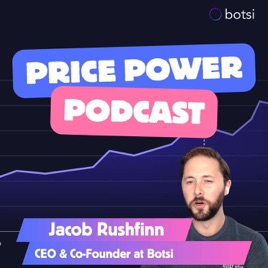
Advertise on podcast: Price Power
Rating
5from
This podcast has
25 episodes
Language
EnglishPublisher
Jacob RushfinnExplicit
No
Date created
2025/10/07
Latest episode
2026/10/01
Average duration
56 min.
Release period
16 days
Description
The Price Power Podcast is for all things growth, retention, and monetization for subscription mobile apps. We talk with amazing leaders in the industry to help share their knowledge with you. Hosted by Jacob Rushfinn, CEO of Botsi.
Unlock Price Power podcast Email contact info,
Listeners & Audience details
Email contact information
Direct podcast contact details

Listeners
Audience numbers & engagement insights

Audience details
Podcast Insights

Podcast episodes
Check latest episodes from Price Power podcast
25: 13 Onboarding Principles for High-Converting Subscription Apps
2026/10/01
Jacob Rushfinn, CEO of Botsi, has spent a decade in consumer apps figuring out how to convert users. He compiled 13 principles for your onboarding flow that will make a difference. These are all from experimentation and research from top apps like Opal, Finch, Headway, Tiimo, Tolan, Zing, and more.
What you'll learn:
• Why the first screen is a drop-off point most teams never measure• How Opal, Rise Science, and Headway hook users before they tap anything• Why story-style intro screens beat any UI pattern you invent• Why simple string personalization beats complex personalization almost every time• How to make quiz questions feel like a conversation instead of a form• Why letting people build something (a pet, a name, a journal entry) raises commitment• How to show users the math on the value they'll get• How to build trust across the whole flow: answer the biggest fear, lead with emotion, back it with numbers• When to prime permission prompts and when to just fire the native one• Why there is no excuse left to skip video, with examples from Lingokids, BoldVoice, and Ladder• How to turn loading screens into selling screens• How to make the free trial impossible to miss, and what to do when users close the paywall anyway
Key Takeaways:- Your first screen is a drop-off point. It can lose 10 to 30 percent of new users before they tap anything. A plain welcome, get started, log in screen works for big brands; everyone else needs a hook that's interesting and easy, like Opal's glowing rock or Finch's "Hatch a new pet" button.
- Ask for the account when intent is highest. Tiimo moved account creation from right before the paywall to right after the welcome screen and lifted both account creation and trial starts. It also stops you from asking for an email and a payment back to back. Test it, or skip account creation until after the paywall.
- Say the user's goal back to them. Ask the goal, ask why it matters, then repeat their words on the next screen, in the plan recap, and in the paywall headline. Zing, Tiimo, and Impulse all do this, and it rarely fails to lift conversion.
- Let people build something. People value what they put work into. Finch has you design a bird, which is fun, low-effort, and raises no privacy concerns. Add presets and shuffle buttons so nobody stalls on a blank text field.
- Show them the math. Turn inputs into a concrete number: Opal's five years of your life, Rise's sleep debt, Headway's 38 book summaries a month. When users hit the paywall, they should already know what they're getting.
- Build trust before you ask for money. Most apps cram trust into the paywall. Better apps spread it across the flow: answer the user's biggest fear (privacy, for Flo), lead with emotion, back it with a number, and repeat your strongest social proof.
- Make the trial impossible to miss. People don't read paywalls. They see a price and leave, even when the trial is visible. Trial reminders, choose-your-trial screens, and multi-page paywalls force users to notice it. When they close the paywall, follow up with a second offer.
- Onboarding doesn't end at the paywall. Don't drop a new subscriber onto an empty home screen. Imprint sends you straight into your first lesson; Balance auto-starts a sleep meditation for people who picked sleep. This is what separates good trial starts from good trial conversion.
Links & Resources- Price Power Podcast: https://pricepowerpodcast.com- Botsi onboarding flow library: https://botsi.com/resources/flows- Retention.blog: https://retention.blog- Jacob on LinkedIn: https://www.linkedin.com/in/jacob-rushfinn/
Timestamps00:00 Why onboarding decides whether your app is worth paying for00:45 1. Hook them on the first screen03:00 2. Borrow UI patterns people already know04:00 3. Ask for account creation when intent is highest05:30 4. Ask the user's goal, then say it back to them07:05 5. Make onboarding questions feel like a conversation08:15 6. Let people build something09:30 7. Show them the math10:30 8. Build trust before you ask for money12:48 9. Earn the permission opt-in14:15 10. Use video, because it's cheap now16:05 11. Turn loading screens into selling screens18:00 12. Make the trial impossible to miss20:20 13. Onboarding doesn't end at the paywall22:13 Recap of all 1324:15 What to test first and which metrics to watch
24: Failed Payments are Free Money w/ Philip Pages
2026/09/17
Philip Pages, founder of Redux Payments, explains why moving off Apple's in-app purchases quietly strips away a retention machine most founders never knew they had, how failed payments actually work, and when payment orchestration is worth the extra complexity.
Philip has looked inside hundreds of app payment accounts, and most of them are leaving real money on the table. He walks through the difference between a customer who wants to churn and a card that simply had no funds that morning; why recovered subscribers stick around for another three to six billing cycles; and the single setting that quietly blows up Stripe accounts. Jacob and Philip also get tactical on the app-to-web paywall pattern that converts, the retry schedule that recovers cards without triggering the card networks, and a meditation app that got back six figures by changing nothing but the timing of its retries.
What you'll learn
• Why Apple's in-app purchase system silently recovers failed payments, and exactly what you give up when you leave it• Why most failed payments have nothing to do with a customer wanting to cancel• How recovered subscribers behave once you win them back (they stay another three to six billing cycles)• Why the "30% down to 5%" margin pitch for web billing is misleading• How to tell whether your app is even ready to test web billing• Why older, Facebook-native audiences convert better on web-to-app flows than younger ones• How to set up web payments without blowing up your Stripe or Paddle account• What chargebacks, early fraud warnings, and approval rates actually do to your account health• How merchant-of-record providers take ownership of your transactions, and what that costs you later• What payment orchestration is, and the revenue point where it starts paying for itself• How one meditation app recovered over $150K by fixing retry timing by locale• How long you should really retry a failed card, and why spamming it backfires• The compliant two-button app-to-web paywall pattern that didn't exist a year ago
Key takeaways
• Apple runs a retention machine you never see. Behind the scenes, Apple retries cards near paydays, fixes bank issues, and serves in-app prompts for up to 60 days. It feels like magic, but it is a system. Move to web and that system is now your job.
• Most failed payments are not people trying to leave. Insufficient funds at one moment in time and random bank rejections make up the bulk of failures. Treating every failure as a lost cause writes off customers who already paid you for months.
• The margin math is messier than the pitch. Providers love to say you'll save 25 to 27 percent. Philip says heavily discount that. Even so, saving 15 percent and reinvesting it in growth can compound fast, so the channel is still worth testing.
• Don't touch web billing before product-market fit. Under a million in ARR with no PMF, the only job is finding PMF. Optimizing payments early is a distraction. Post-PMF, commit real budget or don't bother.
• Cancel your subscriptions. The number one way apps wreck their Stripe account is leaving failed subscriptions open. They stack, they collect chargebacks, and one subscription that should have had a single chargeback ends up with seven.
• Retry timing beats retry volume. One app had 64 percent of failures come from insufficient funds. Retrying by local payday instead of at random recovered over $150K. Brute-forcing the card just gets you flagged by the networks.
• Orchestration is where big brands quietly win. Netflix, Spotify, and other large subscription companies route payments across multiple processors to lift approval rates. Most smaller apps have never even considered it.
• The app-to-web playbook is new, and it works. Two CTA buttons, a rebuilt mini-onboarding before the paywall, and Apple Pay on by default. Philip's word for the pattern Jacob describes: gold. It did not exist a year ago.
Links & resources• Philip Pages on LinkedIn: https://www.linkedin.com/in/philip-pages-a881b5139/• Redux Payments: https://www.reduxpayments.com/
0:00 Intro02:00 Intro and Philip's first company (peaked near $3.5M ARR, then shrank)04:11 Apple's hidden failed-payment machine, and what you lose moving to web07:00 What a failed payment actually is, and why most aren't churn11:05 The real margin math behind leaving the App Store12:16 Why web billing is hitting critical mass now17:20 Matching the right user to the right payment method21:33 Getting started: providers, merchant of record, subscription management25:47 How to not blow up your Stripe account28:43 Chargeback alerts and fighting chargebacks30:40 Merchant of record: owning the transaction, and getting out34:27 Payment orchestration and cascading across processors39:06 When web billing is a mistake (pre product-market fit)44:47 App-to-web compliance and the two-button paywall playbook52:32 A failed-payment recovery teardown (the six-figure meditation app)59:02 How long to retry a failed card01:03:00 The scariest account story, and what Redux Payments does
23: Lifecycle Marketing Will Be Autonomous w/ CEO of OneSignal
2026/09/03
George Deglin, CEO and co-founder of OneSignal, explains why calendar-based lifecycle marketing holds subscription apps back, why SaaS dashboards are losing their place as the primary interface, and what autonomous lifecycle marketing looks like in practice.
George walks through OneSignal's autonomy ladder, from L0 (a traditional SaaS dashboard) to L4 (a self-improving agent). He explains how each level builds customer trust, why behavioral triggers outperform scheduled messages, why email remains overlooked by consumer apps, and why companies worried about token costs should build features that cost more—not less.
What you'll learn:
• Why lifecycle messaging should respond to product behavior instead of a marketing calendar
• Why behavioral triggers outperform scheduled sends by 4x to 9x
• How product and lifecycle-team silos weaken message quality
• Why email is an underused, inexpensive retention and win-back channel
• What George means when he says "dashboards are dying"
• What happened when OneSignal asked 20 customers whether they preferred its dashboard or Claude, Gemini, or ChatGPT
How the L0-to-L4 autonomy ladder moves from assistance to recommendations and independent execution
• Why most companies pursuing ML personalization are optimizing the final 5% before mastering the basics
• Whether AI could mean fewer lifecycle-marketing hires
• How AI inbox filtering will raise the bar for message relevance
• Where app-to-web billing and RCS payment flows could go next
• Why OneSignal won't charge separately for AI—and why George favors expensive AI use cases today
Key takeaways:
• Calendar sends are the default—and the problem. Moving from scheduled messages to behavioral triggers is a larger opportunity than adding AI-generated personalization to a weak foundation.
• Email is inexpensive and still reaches users after they uninstall. The main obstacle is organizational coordination, not technology.
• Dashboards may fade, but product intelligence remains valuable. Users will increasingly operate software through agents while vendors expose more configuration through APIs.
• The autonomy ladder is also a trust ladder: assistance, proactive recommendations, delegated execution, and finally guarded autonomy that knows when to ask for help.
• Complex personalization can move a mature program from 95% to 100%, but many teams are overlooking the fundamentals.
• AI may eliminate tedious lifecycle work and reduce some hiring, while also making effective lifecycle marketing affordable for more companies.
• Today's expensive AI capability may become inexpensive as model costs fall, so George argues for building ahead of the cost curve.
Links & resources
• OneSignal: https://onesignal.com• George Deglin on LinkedIn: https://linkedin.com/in/gdeglin• George's essay on autonomous lifecycle marketing: https://onesignal.com/blog/the-future-of-lifecycle-marketing-is-autonomous/
Chapters
00:00 Cold open and episode introduction01:00 What separates apps that win at lifecycle marketing02:25 The most underused channel in consumer apps03:15 Why teams default to paid media over email04:30 Lifecycle marketing as an extension of the product05:35 Retention, LTV, and who owns it06:55 Change, provocative claims, and pushback07:55 "Dashboards are dying"08:05 Where the idea started with browser and computer use tools10:10 Asking 20 customers: dashboard or agent?11:15 Does every tool become a transactional layer?12:40 Headless software and configuration APIs14:50 The visual feedback loop problem16:40 Previewing an email campaign inside Claude18:05 The autonomy ladder, L0 to L420:00 Moving from assistance to recommendations23:50 What customers are doing with L125:00 Saving customers hours on reports26:00 L2: the recommendation engine27:30 Democratizing customer engagement28:40 Will competitors learn from my data?30:30 AI and one to one personalization32:20 Why triggered messages perform 4x to 9x better34:15 Personalization versus segmentation35:00 The 95% to 100% problem36:25 Will AI replace marketers?40:05 Why cheaper lifecycle marketing creates more companies41:25 Does easier sending lower quality?43:00 AI filtering on the receiving end44:50 Pricing, packaging, and subscriptions46:20 App to web billing49:10 RCS payments inside the conversation51:30 Token costs and why OneSignal won't charge for AI54:30 Wrap
22: 9x ARR, +47% ARPU, the real tests that won with Michael Bardin | Price Power Podcast Ep. 21
2026/08/20
Michal, product growth lead at Applica Agency, explains why moving a paywall to the point of peak anticipation beat waiting for the aha moment, how trial length changes trial starts rather than trial conversion, and why the same paywall test produced opposite results on paid and organic traffic.
Michal walks through three client teardowns. A client went from a buried feature-gate paywall to an onboarding paywall and grew ARR 9x; trial start rate moved from roughly 3% to 16%. Beducated, a sex education web funnel, lifted revenue per user 47% on Meta traffic and 27% on organic after Applica discovered the two channels wanted completely different plan structures. Alux, a wealth and finance content app charging $149 a year, improved day one retention 22% and install-to-paid conversion 26% by mining users' own free-text answers out of Mixpanel and rewriting the onboarding in their words.
What you'll learn:
Why anticipation beats the "aha moment" as a buying triggerWhat a paywall exit-intent survey revealed about price objectionsWhy device buyers felt they were paying twice for a subscriptionHow trial duration moves trial starts but leaves conversion untouchedWhy a 14-day trial beat every discount as an exit-intent downsellHow that downsell came to drive 10-15% of total revenueWhen per-placement paywalls are worth building, and when they're notHow often to paywall a retained free user baseWhy one A/B test can land positive and negative at the same timeWhy plan length is really about how far ahead users can picture themselvesHow a weekly plan works as the web's version of a free trialWhy "Start learning" beat "Subscribe now" for conversion in 2026How to cheaply validate a post-purchase upsell before building oneHow to turn Mixpanel free-text answers into paywall copyWhy fewer options in session one improved day one and day seven retentionKey takeaways: Anticipation peaks before first use, not after. Users had just paid $300 for a device and were hopeful — more hopeful than after their first session, which feels like a mild shock. Waiting for the aha moment meant waiting for intent to decay.
Trial length moves trial starts, not trial conversion. A longer window lowers cancel-anxiety and gets more people to begin; conversion rate holds steady. Trials went 3 days to 7, then added 14 days as an exit-intent downsell at the same conversion rate.
Survey the people who say no. Fewer than 10% of people who closed the paywall cited price. The top reasons were not feeling ready and feeling they'd already paid via the hardware, which redirected the roadmap from discounting to trial duration.
Discounting isn't the only downsell. The winning offer was more time, not less money, priced identically to the original, converting at the same rate.
A single test can produce two opposite results. Beducated's first test looked ambiguous until Applica split it by campaign ID: Meta and organic-influencer traffic needed completely different plan structures. Cold traffic needed a cheap entry point; warm traffic didn't.
Plan length reflects how far ahead users can picture themselves. Removing Beducated's one-month plan for organic traffic didn't hurt conversion — rare. Trusting the influencer, users moved straight to three-month and annual plans.
Settled best practices are worth retesting. A CTA test Michal almost skipped — swapping "Subscribe now" for "Start learning" — lifted conversion 20-50%, a reminder that even settled wins deserve a rerun.
Your users already wrote your best copy. Alux asked users what they wanted to achieve and by when; Applica pulled every Mixpanel answer, split by converters vs. non-converters, and rewrote onboarding in converters' own words.
Focus beats choice in a first session. Alux's home screen offered too many paths; Applica cut it to one goal-based block until 50% completion. Day one and day seven retention both improved.
Links and resources Applica: https://applica.agency Applica case studies: https://applica.agency/case-studies Michal on LinkedIn: https://www.linkedin.com/in/michael-bardin-60b224291/Pulsetto: https://pulsetto.tech Beducated: https://beducated.com Alux: https://alux.com Botsi: https://botsi.com
Timestamps01:00 Intro and what Pulsetto actually is03:30 The paywall was buried behind feature gates04:30 Moving the paywall to the end of the onboarding quiz07:00 Why the industry fetishizes the aha moment08:00 The math nobody runs: if they never see it, they can't buy09:00 The result: 9x ARR09:30 Trial start rate was 3%, trial conversion was 80%10:30 The exit-intent survey and what people actually said11:45 Trial length moves starts, not conversion14:00 RevenueCat Paywall Builder and getting independent of developers15:00 The downsell that was more time instead of less money17:30 When unique per-placement paywalls are worth building20:00 How often to show a paywall to free users22:30 Trial start rate goes from 3% to 16%23:30 Beducated and the web-to-web funnel24:30 +47% RPU on paid, +27% on organic25:00 One test, two completely different results27:00 Splitting the analysis by campaign ID28:00 Removing the monthly plan and nothing happened29:45 The weekly plan as the web version of a trial32:30 The CTA test Michal did not want to run35:00 Post-purchase upsells: PDF first, then Beducated Duo37:00 Why stacking two upsells kills the second one39:20 Alux, a $149 content app that could not lower prices41:00 Mining Mixpanel for what users wrote in their own words43:30 Converter language is the best marketing copy you have45:00 Too many options in the first session47:00 Anything completed beats no completion50:45 +22% day one retention, +26% install to paid51:00 Retention problems are activation problems52:00 Wrap and credits
Jonathan Parra on 4,700 Paywall Tests | Price Power Podcast Ep. 21
2026/08/06
Jonathan Parra, founder of Tapas Growth, explains why app category predicts test results better than the app itself, how to sequence design, packaging, and price tests, and why the ugly paywall keeps winning.
Jonathan has designed close to 4,700 paywalls. He walks through the testing order he uses with clients, the five paywall placements every new app should ship before optimizing anything, and the exit questionnaire that replaced his old discount ladder. He also gets specific on numbers: a healthy app loses half its trial starts, win-back campaigns aimed at those cancelers convert at 5 to 6 percent, and removing a free plan can push conversion from 2 percent to 12 percent while gutting your traffic.
What you'll learn:• Why app category, not app quality, is the first thing Jonathan looks at when predicting a test outcome• How product polish and a clear ICP change the size of the win you can expect• Why he turns down clients he doesn't think he can make money for• How to decide between freemium and a hard paywall using your marginal cost per free user• Why AI apps with real inference costs should start with a hard paywall and a 3 to 7 day trial• How to gate the expensive part of your product and leave the cheap part free• Why design tests come before packaging tests, and packaging before price• How a design winner sets up a price increase that doubles ARPU• What changed in his testing workflow now that LLMs can crunch the data• How device signals like battery level and network type get used as demand scores
Key Takeaways:
• Marginal cost decides your monetization model. If a free user costs you nothing, keep them and monetize later. If every action fires an LLM call or streams video, a hard paywall with a short trial is the honest answer. The middle path is gating the expensive feature and leaving the cheap one open, like charging for photo-to-macros and giving away water logging.
• Design, then packaging, then price. A design winner can double conversion rate. Once you have it, raising price walks conversion back toward where it started while ARPU stays doubled. Price testing first just trades conversion for revenue with no ceiling raised.
• The ugly paywall wins and you have to accept it. Jonathan is a trained UX designer and says CRO is a different game entirely. Dense, loud, in-your-face layouts beat minimal ones often enough that he stopped arguing with the data, especially in the companionship and character AI space.
• Ask instead of guessing. His old exit flow was a fixed ladder: extended trial, then 33 percent off. It cannibalized revenue from people who would have paid more. Now an exit questionnaire asks why they bailed, and the offer matches the answer. Price complaint gets a discount. Trial complaint gets a longer trial.
• Half your trials cancel, and nobody markets to them. Jonathan targets users with an active entitlement and auto-renewal switched off. Those campaigns convert at 5 to 6 percent, which adds 2.5 to 3 points to overall conversion. It's the largest high-intent audience most apps ignore.
• Discount depth is a sequencing decision. Don't open with 80 percent off. Save the steep offers for expired users and Black Friday. A downgrade to a cheaper tier often keeps the customer without cheapening the brand, and a first-year-only discount lets you rebill at full price later.
• Weekly-only pricing is a speed run. ARPU looks great and churn is brutal. Jonathan will use weekly plans as paid intro offers or for genuinely short-use ICPs, but apps that sell nothing else ride viral traffic until the cohorts stop stacking.
Links & Resources• Tapas Growth: https://tapasgrowth.com/• Jonathan Parra on X: https://x.com/jondeparra• Jonathan Parra on LinkedIn: https://www.linkedin.com/in/jondeparra/• Jonathan's guest post on Retention.blog: https://www.retention.blog/p/expert-paywall-tips
Timestamps00:00 Intro: 4,700 paywalls and counting01:00 What Jonathan got wrong early at Superwall03:30 Predicting test results before you run them05:30 Using category benchmarks to diagnose an app07:00 The two times he was wrong, and working for free09:30 Freemium vs hard paywall, decided by cost13:00 Gating the expensive feature, freeing the cheap one14:00 Test order: design, packaging, price17:30 Demand scores from device attributes18:30 Age-based price testing and why it's risky20:30 What changed post-AI in the testing workflow23:30 Why the ugly paywall wins27:30 Building a real exit flow28:30 The questionnaire that replaced the discount ladder31:00 The exact questions he asks34:30 The five paywalls every new app should ship38:30 Trial cancelers: the 5 to 6 percent win-back40:30 Downgrades, discount depth, and brand42:00 Transaction abandon tactics44:00 Winning back expired subscribers48:30 Email, push, SMS, and where the ceiling is51:30 Weekly plans and the TikTok wall54:00 Biggest packaging win: multi-page paywalls
20: Opal Killed the Quiz Funnel. What's up next?
2026/07/14
Opal rebuilt their onboarding to work like a chat thread instead of a quiz, and Jacob walks through the whole thing screen by screen. The rock you crack open on the first tap, the sign-in question that replaced the sign-in buttons, the moment they tell you you'll spend eighteen years of your life looking at your phone, the paywall, and the monthly plan they only offer you if you try to leave.
This is a solo episode, so it goes deeper on the screens than a conversation usually allows. An app at Opal's scale doesn't ship an onboarding redesign without testing it hard first, which makes it a useful thing to study. The question isn't whether it works. It's which pieces of it would work for you.
What you'll learn:
• Why the first screen of your app is probably leaking more users than your paywall is• How Opal replaced the Log in / Sign up wall with a question• Why more login options usually pay for themselves once you scale• The phrasing trick that gets people to answer a demographic question honestly• Why Opal asks about your screen time before asking for screen time permissions• How they split their permission requests apart, and what they put in between• The three-beat setup: 91 days this year, 18 years of your life, then the rescue• How paywall copy pays off a goal the user selected five screens earlier• Why the trial reminder screen has almost nothing to do with reminders• What "design your trial" is really doing to the user's decision• The math behind pulling monthly off your first paywall• The exit-intent monthly offer that almost nobody runs• Why "no payment due now" keeps showing up next to the CTA• What the Law of S****y Clickthroughs says about the future of quiz onboarding• The screen-count test for whether chat onboarding fits your app
Links & resources
• Retention.blog full written breakdown: https://retention.blog• Opal: https://opalapp.com/• Andrew Chen, "The Law of S****y Clickthroughs": https://andrewchen.com/the-law-of-s****y-clickthroughs/• Botsi: https://botsi.com
00:00 Intro: tired of quiz-style onboarding?01:05 Opal's chat-style redesign01:28 The rock you crack open02:34 Why first-screen drop-off compounds03:15 "Have we met before?" instead of Log in / Sign up03:58 Login options and the data reassurance copy04:22 The hybrid quiz/chat question style05:31 "What best describes you?"06:21 Easing into the screen time permission07:44 91 days, 18 years, and the aha moment09:07 Splitting the permission asks apart10:00 The personalized pre-paywall screen11:38 The fist bump commitment prompt12:15 "Two plus hours" and a copy critique13:23 Social proof and the "Reclaim my time" CTA13:55 The trial reminder screen15:47 Design your trial16:13 The math on removing monthly18:06 "Not ready for a year?"18:27 The "no payment due now" checkbox20:08 Post-paywall onboarding and gamification22:15 The Law of S****y Clickthroughs23:27 Why chat UX works right now23:54 Which apps should actually test this25:19 Teaser: the onboarding and paywall library
19: Lessons From Reviewing 100+ Web Funnels w/ FunnelFox CEO
2026/06/25
Andrey Shakhtin, founder and CEO of FunnelFox, explains why web subscriptions convert and monetize better than the app store, how to stand up a minimum viable web-to-app test, and the payment risks that can freeze your revenue once you scale.
What you'll learn:
• Why full-funnel conversion (impression to purchase) runs roughly 2x higher on web than in-app, and how the app store install step explains the gap• Why web LTV is about 2x in-app on annual plans and at least 50% higher on monthly• The two structural reasons web LTV is higher: quiz funnels skew toward older, higher-willingness-to-pay buyers, and you control retention end to end• How owning the payment stack lets you run custom cancellation flows and dunning (failed-payment recovery) that Apple and Google never expose• Why deterministic post-ATT attribution makes web the fastest creative-testing loop you have• Why a web funnel is the cheapest way to validate a product, sometimes before the app exists• Why free trials quietly poison your Meta optimization, and how a $1-$5 paid trial fixes the signal• The unit-economics benchmarks that matter: roughly 40-60% day-zero ROAS and a 6-month payback• Why most "amazing-looking" funnels still fail at the paywall and checkout• How to structure a paywall: outcome-based value, visualization, FOMO, price, then social proof• The real difference between refunds, disputes, and chargebacks, and why only chargebacks threaten your account• How dispute-rate and VAMP (Visa's acquirer monitoring) thresholds can get your PSP to freeze recurring revenue• Why chargeback-alert services and external billing (payment orchestration) are close to mandatory at scale• How an easy refund path plus a 50% save offer lowers chargebacks and protects net revenue• How post-purchase upsells add roughly 20% LTV without triggering disputes
Key Takeaways:
A web funnel is the cheapest validation you have. Test demand, pricing, even a niche for a few hundred dollars a day before committing engineering. Some teams launch with no product at all, then build the app for the niche that converts.
Web's edge is deterministic measurement. With no ATT loss, every purchase ties to an exact creative, so you iterate on message and audience by real numbers instead of inferring from installs.
The full funnel converts about 2x on web. You skip the app store install decision, a friction point where lukewarm users drop before they ever see the offer. Most teams miss it because they optimize to installs.
Paid trials protect your ad signal. A $1-$5 charge proves the card works and sends Meta a real purchase event, so it optimizes toward payers instead of trial-tourists who never convert.
The paywall is where funnels die. After ~100 funnel reviews, it's the most under-built step. "Unlock all features" is not value. Lead with a specific outcome and date, and build it like a landing page.
Chargebacks can freeze everything. Refunds are harmless, but cross a provider's dispute or VAMP threshold and it can lock all stored recurring revenue. Make refunds easy and offer a 50% save to keep subscribers.
Links & Resources
FunnelFox: https://funnelfox.comState of Web-to-App Subscriptions report: https://funnelfox.com/state-of-web2app-2026Andrey Shakhtin on LinkedIn: https://www.linkedin.com/in/andrey-shakhtin/
Timestamps
00:00 Andrey's path: 16 years in mobile, from code to growth to FunnelFox04:30 The minimum viable web-to-app experiment08:00 What scale you need first, and validating a niche with no product10:00 Why web should complement, not replace, your other channels13:30 How web monetization differs from in-app16:00 The report: web LTV and conversion roughly 2x in-app16:40 Why web LTV is higher: older buyers and full retention control19:00 Why the app store install step kills conversion21:00 Organic vs. paid traffic funnels22:30 Free trials vs. paid trials, and the Meta signal25:30 Why web-to-app projects fail28:30 Unit economics: day-zero ROAS and the 6-month payback29:30 Diagnosing a broken funnel against benchmarks36:00 How to structure a paywall that converts41:30 Intro offers and the telecom playbook44:30 Refunds, disputes, chargebacks, and VAMP explained51:00 Defending your payment account: alerts and external billing55:30 The refund hack: offer 50% instead of losing the subscriber57:30 Upsells and lifting LTV ~20%59:30 Biggest pricing win: GLP-1 and $800 order values01:00:30 What FunnelFox does
18: Hybrid Monetization: When and where to start w/ Cristian Rotari
2026/06/11
Cristian Rotari, Monetization Lead at Zing Coach, explains why hybrid monetization is more than bolting ads onto a subscription app, how to layer in-app purchases, affiliates, physical products and partnerships without cannibalizing your core revenue, and when an app is actually ready to start.
He walks through the demand curve idea he picked up from Thomas Petit at Lingokids: a single subscription price treats willingness to pay as binary when it really runs across a wide spectrum, from whales who will buy anything to plankton who will never convert. He covers why ads are a volume business that loses money for most small apps, why AI apps have to think about credits and token costs from day zero, and the cannibalization rule he uses at Zing Coach: promote subscriptions to free users, promote upsells only to people who have already paid.
What you'll learn:
Why hybrid monetization is hard to get real guidance on, even though everyone talks about itHow the demand curve reframes pricing from one number to a spectrum of willingness to payWhy whales and plankton need completely different monetization strategiesWhy freemium, not a hard paywall, is what unlocks both hybrid revenue and organic growthWhen an app is actually ready to add a second monetization model (hint: not day one)Why most apps should start with in-app purchases, not adsHow AI apps break the subscription math when one power user burns thousands in tokens overnightWhy ads only pay off with high daily usage and long sessionsHow to add affiliate revenue with nothing more than an Amazon linkHow Zing Coach structures partnerships like the New York Sports Clubs white-label dealWhy you should sell more to subscribers, not to the free users who already said noHow Zing Coach gets 40% of yearly-plan buyers to take at least one upsellWhy subscription tiers can clash with hybrid and how Spotify avoids the trapCristian's hot take on the trials debateKey Takeaways:
Willingness to pay is a spectrum, not a yes/no. A single subscription price leaves money on the table at both ends. Whales would pay more if you let them; plankton will never subscribe but might buy a one-off. Hybrid monetization exists to capture both.Freemium is the foundation. A hard paywall caps your user base, which caps both hybrid revenue and word-of-mouth growth. When Zing Coach eased its paywall and added a trial, it grew the top of the funnel without losing much subscription conversion.Hybrid is not a day-one move. Nail product market fit and one monetization model first, usually subscriptions. Once you understand and can segment your users, add a second layer, and start with in-app purchases rather than ads.Ads are a volume business. They need high daily active users and long sessions to pay off. Most subscription apps, used once or twice a week, do not have the volume, so ads usually lose to in-app purchases for small and mid-size apps.AI apps are the exception to "go slow." Token costs mean a single power user can spend thousands overnight. These apps need credits and usage limits from the start, so it is the status quo, not an add-on.Stop the cannibalization with a simple rule. Promote subscriptions to free users; promote upsells only to people who already subscribed. Someone who paid has shown intent, so that is who you upsell. Free users who declined have low willingness to pay, and stacking offers on them just lowers subscription conversion.Sell to intent. At Zing Coach, about 40% of yearly-plan buyers take at least one upsell, and conversion drops as plan length and intent drop. The wallet is already out, so monetize that moment instead of leaving it unattended.Tiers need a clear value ladder. Spotify segments by use (individual, family, student) rather than piling on pro and premium feature tiers. Add tiers as extra value on top, never by removing things users expect in the base plan.Links & Resources
Cristian Rotari on LinkedIn: https://www.linkedin.com/in/cristianrotari/Zing Coach: https://www.zing.coachAlice Muir on AI app pricing (referenced in episode): https://pricepowerpodcast.com/episodes/16-how-to-build-a-subscription-app-in-the-ai-era-w-alice-muirTimestamps
00:00 Intro 01:34 What hybrid monetization actually means (and why it is more than ads) 05:34 The demand curve: whales, plankton, and willingness to pay 08:34 Why freemium unlocks both revenue and organic growth 14:34 When an app is ready to add a second monetization model 17:04 AI apps and the token-cost problem 21:04 Why ads are a volume business most apps lose at 28:04 Affiliate revenue and the Amazon link shortcut 33:04 Physical products and brand extensions 35:34 Partnerships and white-label deals 41:04 Avoiding cannibalization: sell to intent 48:34 Subscription tiers and the value ladder 54:04 Hot take on the trials debate 56:04 Biggest win: the Body Scan upsell
Best of Price Power Podcast from the Last 6 Months | Price Power Podcast Ep. 17
2026/05/28
12 guests. 16 clips. One hour of the most tactical advice from the past six months of the Price Power Podcast.
This is a best-of episode — no fluff, just the insights that stuck with me the most from conversations with world-class growth leaders. You'll hear frameworks for strategic friction, activation, pricing, signal engineering, Meta and Google campaign architecture, creative strategy, and referral programs.
Guests featured: Alice Muir, Daphne Tideman, Ekaterina Gamsriegler, Michal Parizek, Barbara Galiza, Ashley Black, Shumel Lais, Marcus Burke, Lucas Moscon, Gabe Kwakyi, Xavier De Baillenx, and Anthony Scarpaci.
00:00 Introduction01:10 Alice Muir — Strategic Friction & the MyFitnessPal Lesson04:19 Daphne Tideman — Time to First Value vs. Time to Core Value10:39 Ekaterina Gamsriegler — When Lowering Your Price Makes Sense15:45 Michal Parizek — 7-Day Cancellation Rate Predicts Revenue25:46 Barbara Galiza — Send Predicted Value or Get Garbage Installs32:03 Ashley Black — Optimize for Deeper Engagement Events38:42 Shumel Lais — Signal Engineering Explained Simply47:24 Shumel Lais — The 10-Conversions-Per-Day Rule51:09 Marcus Burke — Signal Engineering & the Trial Signal Problem1:01:27 Lucas Moscon — Move Away from ROAS, Focus on Blended ROI1:06:18 Marcus Burke — Blended CPA Is Irrelevant, Break Down by Placement1:11:35 Gabe Kwakyi — Creative Hits Drive Paid Social1:16:10 Xavier Baez — How Many Creatives You Actually Need1:20:23 Anthony Scarpaci — The RIGHT Framework for Referral Programs
16: How to Build a Subscription App in the AI Era w/ Alice Muir
2026/05/06
Alice Muir, independent subscription consultant who's worked with Headspace, VSCO, Adobe, SoundCloud, and MyFitnessPal, explains why "higher engagement equals lower profit" is the new reality for AI apps, how to use strategic friction without choking activation, and why most consumers don't actually care that your app is AI-powered.
What you'll learn:
How strategic friction worked for MyFitnessPal, and what they got wrong by gating barcode scanning too lateWhy "protect the learning actions, charge for the outcomes" beats free-vs-paid debatesHow to handle the 90% of installs that never subscribe when free users now cost real moneyWhen hybrid monetization actually makes sense and when it just adds complexityWhy weekly subscriptions are a proxy for usage-based pricing on novelty AI appsWhy margin-qualified acquisition matters more than CAC alone for AI productsHow Flibbo used persona tiers on the paywall to get users to self-identify their willingness to payWhy a fitness app got a 6x paywall lift by removing strikethroughs, countdown timers, and stacked offersWhat the Subscription Stack framework needs to add for the AI eraThe back-of-the-napkin math founders should run before shipping any AI featureWhy consumers may actually be turned off by "AI-powered" positioningKey Takeaways:
Protect learning actions, charge for outcomes. Users should learn what your product does for free. The thing that completes their job is what they pay for.GPU cost is a CAC line item, not a margin problem. If everyone you acquire gets one free generation, that compute cost belongs in your acquisition budget. Run worst-case-scenario math before you ship.Highest engagement is now lowest profit. Traditional subscription thinking inverts when each interaction has a real cost. The Subscription Stack engagement layer needs a full revision for AI apps.Weekly subscriptions are a usage proxy. AI apps see strong initial conversion and terrible retention because users have high intent for short bursts. Annual plans for a song generator are a fantasy.Self-identification at the paywall beats the questionnaire. Flibbo put basic, pro, and max personas on the paywall. Users picked the one that matched their use case.Simpler paywalls outperform copycat paywalls. Stripping countdown timers, strikethroughs, and stacked plan tiles from a fitness web-to-app funnel produced a 6x lift.Consumers don't care about AI as a feature. They care about the outcome. "AI-powered coach" can read as cheap, not premium. Lead with benefit, not technology.Don't add AI just to add AI. If a feature doesn't measurably improve retention or activation, you're paying GPU costs to compress your margin.Links & Resources
Alice Muir on LinkedIn: https://www.linkedin.com/in/alicemuir/Subscription Stack framework: https://phiture.com/resources/subscriptionstack/Andrew Chen on consumer reactions to AI: linkedin.com/posts/andrewchen_when-consumers-dont-care-that-youre-building-activity-7358342997639360512-wqKMThomas Petit RevenueCat article on hybrid monetization: https://www.revenuecat.com/blog/growth/ai-hybrid-monetization/Timestamps 00:00 – Intro 01:25 – Baby raves in Berlin and the new May Day 02:58 – How the playbook changed: from acquisition-first to retention-first 07:25 – Strategic friction and the MyFitnessPal example 10:43 – Hard paywalls vs letting users discover value 11:55 – Protect learning actions, charge for outcomes 17:25 – The 90% problem: monetizing low-intent users 21:36 – When hybrid monetization actually makes sense 26:15 – Apple tax, GPU costs, and the AI app profitability squeeze 28:55 – Why weekly pricing fits novelty AI apps 33:53 – Margin-qualified acquisition for AI apps 39:08 – Flibbo's self-identifying paywall personas 43:55 – The 6x paywall win: stripping out the fluff 47:56 – Revisiting the Subscription Stack for the AI era 51:55 – Switching models to protect margin 53:38 – What founders should get right before adding AI 56:58 – Hot take: consumers don't care about AI
15: How to start with Signal Engineering w/ Shumel Lais
2026/04/22
Shumel Lais, co-founder of Day30 and previously founded Appsumer (acquired by InMobi), explains why most subscription apps feed ad platforms the wrong goal, how precision and recall reshape signal selection, and what a realistic measurement maturity ladder looks like in 2026.
Shumel walks Jacob through the five stages of measurement maturity, from apps that just compare App Store Connect revenue to ad spend, through MMP attribution and cohorted reporting, up to incrementality testing for the largest spenders. He breaks down why signal engineering only makes sense once you have the right foundation in place, shares the 10-conversions-per-campaign-per-day rule of thumb for when to go further down funnel, and unpacks the restaurant booking app mistake that first put him onto the precision/recall framework.
What you'll learn:
Why optimizing to cost-per-trial leaves money on the table for most subscription appsHow Meta's 7-day visibility window forces the signal engineering problemWhy recall, not precision, is the metric most marketers overlookWhy the restaurant booking app example was Shumel's own mistake, and what it taught himHow Meta's event-day reporting can hide renewals inside new purchase countsWhy server-side events struggle more with matching than client-side eventsHow to decide between revenue-value signals and binary convert/no-convert signalsWhy subscription apps are years behind gaming on analytics maturityThe 10 conversions per campaign per day floor before attempting signal engineeringWhen LTV curves become reliable enough to extend payback from 30 days to 6+ monthsKey Takeaways:
Signal engineering is closing the gap between what the platform can see and what you actually care about. Meta sees 7 days. You care about month 3 revenue.Recall is the metric most teams forget to measure. Precision tells you if the users firing your signal convert. Recall tells you what share of your actual converters it captures. A signal with 90% precision and 40% recall tells the algorithm that 60% of your good users are bad.There are five levels of measurement maturity, and most apps skip steps. ASC comparison → platform attribution → MMP → cohorted reporting → incrementality. Signal engineering is a level 3 or 4 exercise. Attempting it earlier wastes the effort.The 10-conversions-per-campaign-per-day rule. Below that, Meta cannot learn from a more selective signal. Above 30 to 40 per day, you are leaving performance on the table by not going further down funnel.Meta reports on event day, not install day. Renewals fire as purchase events, so Meta can claim credit for users who were already paying. Without install-cohorted MMP visibility, you are paying to acquire users you already had.Speed of signal affects matching quality and algorithm learning. Events sent within 24 hours have more matching parameters, and they let Meta decide if a user is good without waiting 7 days for the purchase to come through.The restaurant booking app was Shumel's own mistake. Before Day30, he optimized toward behaviors that correlated with bookings but were not causal. Performance did not move. The fix was cohorts, observation windows, and a binary prediction statement.Measurement problems are not an excuse anymore. In 2026, the tools exist and the playbooks exist. Hiding behind attribution gaps is a choice, as is hiding behind blended CAC when direct CAC is uncomfortable.Links & Resources
Day30: https://day30.aiShumel Lais on LinkedIn: https://www.linkedin.com/in/shumellais/Timestamps00:00 Shumel's background and early mobile agency days00:56 The signal engineering framing and how Day30 landed on it03:30 A basic example: trials vs trials plus behavior05:56 Why signal engineering exists (attribution gap, not just subscriptions)08:45 Signal volume as the second dimension after precision09:30 Defining recall and the photo storage app example15:58 When to send revenue values vs binary convert/not-convert16:41 The restaurant booking app mistake and causation vs correlation19:33 Experiments are still the only real proof20:00 Measurement maturity level 1: no MMP, just ASC22:37 Do you actually need an MMP to start?23:39 Level 3: why MMP matters (Meta's event-day reporting trap)25:37 Level 4: cohorted metrics and aligning on day-30 ROAS26:30 Level 5: incrementality and MMM for the largest spenders27:35 The 10 conversions per campaign per day threshold29:30 Why the MMP matters for signal engineering (measurement, not the signal itself)31:03 MMP vs Conversions API for sending signals33:04 SDK vs server-side: matching and speed36:43 Payback periods and when to extend them40:32 Simple inputs for a basic predictive LTV model42:52 If you're running Meta to CPT today, what do you change first44:41 The quantity vs quality of signal tradeoff46:48 Hot takes: no more hiding behind attribution48:02 Favorite pricing and packaging tactics seen recently50:08 Day30's free signal audit offer
14: Fix Activation Before Growth w/ Daphne Tideman
2026/04/08
Daphne Tideman, growth advisor and consultant for subscription apps, explains why most retention problems are actually activation problems, how to distinguish vanity activation metrics from ones that predict real retention, and why the aha moment should start in your ads, not just your product.
Daphne walks through her evolution from treating activation as a simple funnel step to seeing it as a layered, behavioral process spanning the first 7 to 30 days. She shares real examples from growth audits where onboarding completion rates looked great but users vanished by day two, and breaks down the "time to first value" vs. "time to core value" framework for thinking about activation in stages. She also makes a case for monthly subscriptions as a faster learning tool for startups, and explains why revenue is a terrible North Star metric.
What you'll learn:
Why onboarding completion is often a vanity metric that hides activation failuresHow to identify whether your retention problem is actually an activation problemWhy "any action vs. no action" comparisons overstate the value of weak activation metricsHow to build mini aha moments into onboarding before the paywallHow to use the "time to first value" vs. "time to core value" frameworkWhy monthly subscriptions can help startups learn faster about activationHow to test whether an activation metric is predictive or just correlatedWhen user interviews beat quantitative analysis for defining activationWhy extending onboarding can drop completion rates but improve retentionHow to diagnose activation vs. retention vs. acquisition problemsWhy revenue as a North Star metric leads teams to extract value instead of create itKey Takeaways:
Onboarding completion is a vanity metric. An app had over 90% onboarding completion on both platforms, but most users were gone by day two. The onboarding was too short and easy to click through. When they extended it and built in value-delivering steps before the paywall, completion dropped but retention improved.Your retention problem is probably an activation problem. For most apps, losing users in the first 30 days isn't a retention failure. It's an activation failure. Daphne argues we even mislabel it: "day two retention" and "day seven retention" describe periods when you're still activating users, not retaining them. True retention problems show up when users were active early but trickle off later.Activation should start in the ad. Showing the job to be done and the transformation in your ad creative builds trust before users even open the app. A coding app's best performing ad showed someone coding in a lift, making viewers think "I could find time for that too."Correlation isn't causation in activation metrics. Any action will always look better than no action. The real work is finding which behaviors, at what volume and timing, predict retention across cohorts and channels.Mini aha moments beat one big moment. Instead of trying to engineer a single big aha moment (which is often technically difficult), build multiple smaller moments of perceived value. These can be as simple as a personalized plan, a visual showing the outcome, or a first small win before the paywall.Monthly plans help you learn faster. For startups without much data, monthly subscriptions force users to make a renewal decision every month, which generates faster signal on who is truly activated vs. who is coasting on inertia.Revenue is a terrible North Star metric. It pushes teams toward extracting value from users rather than creating it. Activation and usage metrics better align the team's incentives with user outcomes.Links & Resources
Daphne Tideman's Growth Ways newsletter: https://growthwaves.substack.com/Daphne Tideman on LinkedIn: https://www.linkedin.com/in/daphnetideman/00:00 Intro and Daphne's path from e-commerce to app growth consulting01:20 How activation thinking evolves from 2D to 3D04:20 Common activation mistakes: oversimplifying and picking the wrong metric05:50 Why standard metrics weren't predicting retention07:20 Onboarding completion as a vanity metric: 90% completion, gone by day two10:20 Activation vs. monetization: which to fix first13:20 Building mini aha moments into onboarding and ads17:50 User interviews and the role of emotions in activation20:20 Your retention problem is actually an activation problem23:20 Time to first value vs. time to core value framework27:20 How to test whether an activation metric is real or vanity29:20 Starting with user interviews vs. data when you lack scale31:50 Correlation vs. causation: finding the right activation threshold34:20 Learning from failed experiments36:50 Diagnosing activation vs. retention vs. acquisition problems39:20 Why activation problems are more common than retention problems42:20 Matching subscription models to use cases44:50 Biggest activation mistake apps make right now45:50 Lightning round: pricing wins, hot takes, and best activation results
13: The Four Horsemen of Churn w/ Dan Layfield
2026/03/25
Dan Layfield, author of Subscription Index and former product lead at Codecademy and Uber Eats, explains why churn is the silent ceiling on subscription growth, how to diagnose which type of churn is killing your business, and the pricing trick that can double your LTV overnight.
Dan walks through his four horsemen framework: payment failures, activation issues, pricing and plan mix, and voluntary cancellation. He shares the bottom-up optimization approach he uses with every company, starting with Stripe settings that take 10 minutes to fix.
What you'll learn:
Why your Stripe retry settings are probably wrong and how to fix them in 10 minutesHow to calculate your growth ceiling using churn rate and acquisition numbersWhy payment receipts might be reminding users to cancel every monthHow to price annual plans based on your monthly retention dataHow to build cancellation flows that save 20% of churning usersWhy activation experiments are tricky and often produce dudsWhy quality problems are the easiest growth fixesKey Takeaways:
Churn dictates your ceiling. New users divided by churn rate equals your max subscribers. 1,000 new users with 20% churn = 5,000 subscriber ceiling. Lowering churn raises that ceiling proportionally.Start at the bottom of the funnel. Stripe settings, dunning emails, card updaters can be fixed in minutes and win back 5% of churn. Do these before tackling bespoke activation problems.Annual pricing should match monthly LTV plus one or two months. If average retention is five months, price annual at six months. Looks like a steep discount but doubles LTV.Turn off monthly email receipts. Netflix, Spotify, and Amazon don't send them. That monthly reminder is a monthly prompt to cancel.Cancellation flows should solve the underlying problem. Pausing works when the need is temporary. Downgrading works when they're paying for unused features.Links & Resources
Subscription Index: https://subscriptionindex.comDan Layfield on LinkedIn: https://www.linkedin.com/in/layfield/Timestamps
00:00 Intro and Dan's path from JP Morgan to Codecademy 04:00 Freemium conversion benchmarks: sub-1% vs. good (3%) vs. great (7%) 06:30 The growth ceiling formula 08:00 The four horsemen of churn 12:00 Bottom-up optimization: start with Stripe settings 13:30 Cancellation flow tactics: pause, discount, upgrade/downgrade 19:30 Payment failure quick wins: smart retries, card updater, dunning emails 22:30 The annual pricing trick that doubled LTV at Codecademy 30:00 Activation and the Reforge framework 37:30 Onboarding should show value, not just explain device setup 42:30 Ethical cancellation flows and click-to-cancel legislation 49:30 Screenshot audit: where to start when you're stuck 52:30 Turn off monthly receipts: the easiest churn win 53:30 Lightning round
12: Price Testing for Subscription Apps with Michal Parizek
2026/03/12
Michal Parizek, pricing and growth lead at Mojo, explains how to predict long-term revenue from short-term price test data, why Apple's automatic regional pricing is wrong for most apps, and how to sequence pricing, packaging, and paywall tests for maximum impact.
Michal walks through the 13-month revenue projection model he built at Mojo, which uses seven-day cancellation rates as a proxy for annual renewal rates. He shares how his team raised yearly prices by 50% in the US and Germany with minimal conversion drop, how they tested free trial lengths and found almost no difference between three-day and seven-day trials, and why the ratio between monthly and yearly plan prices matters more than the absolute price point.
What you'll learn:- How to use seven-day cancellation rates to project 13-month revenue- Why Apple's exchange-rate-only pricing leaves money on the table- How to sequence price tests: price first, then packaging, then paywall design- Why the monthly-to-yearly price ratio drives plan share more than absolute price- How hiding the monthly plan pushed yearly share from 60% to 80%- Why free trials still matter for new users, despite advice to remove them- How three-day trials performed as well as seven-day trials at Mojo- Why your first price test should have big price gaps, not small ones- How traffic source mix can distort price test results- Why a 100% price increase was a short-term winner but long-term loser
Key Takeaways:
- Seven-day cancellation rate is a reliable early signal. 20-30% of cancellations happen in the first seven to ten days. Measure that rate per variant, project renewal rates from it, and you can evaluate a price test without waiting months. Mojo validated this against real data and it held.
- Apple's regional pricing is just exchange rate math. No purchasing power, no local context. Look at your top five markets individually, compare conversion funnels by country, and cross-reference competitor pricing.
- Pricing and packaging beat paywall design in impact. Changing price points, plan structures, and introductory offers had more effect than design or copy. Start with pricing, then plan mix, then layout.
- The monthly-to-yearly price ratio drives plan selection. Changing only the monthly price shifted yearly subscriber share significantly. The perceived deal relative to monthly is a strong behavioral lever.
- Don't remove free trials for new users without testing. Mojo tried it based on popular advice and saw revenue decline. Test it for your app.
- Start price tests with big jumps. Test $40 vs $60 vs $80, not $50 vs $48 vs $52. Find the zone first, refine later.
- Revisit cohorts months after shipping. Mojo's 100% price increase looked great short-term but cancellation rates spiked. The 13-month projection caught it.
Links & Resources- Michal Parizek's Botsi blog post: https://www.botsi.com/blog-posts/pricing-experiments-the-backbone-of-mojos-monetization-success- Michal Parizek on LinkedIn: https://www.linkedin.com/in/michalparizek/
Timestamps0:00 Intro1:03 Using seven-day cancellation rates to predict 13-month revenue3:25 Building the report template and data pipeline6:13 Validating the renewal rate prediction model10:03 Benchmarks for new apps without renewal history12:09 Why Apple's automatic price tiers are wrong13:33 How to research and set regional prices17:10 Relationship between pricing, packaging, and paywall design21:15 Sequencing: price first, then packaging, then design23:55 Why paywall layout tests that touch plan visibility are most impactful26:41 Free trial strategy and length testing31:03 Paid trial options as an emerging trend33:16 The biggest mistake: not having enough data volume35:56 Raising prices 50% in the US and Germany38:46 Start with big price gaps, refine later40:11 Don't be afraid to test prices
11: Lessons from a Founder: What Sasha Learned Launching a Mental Health App
2026/02/25
Sasha, founder of Anticipate (a mental health app), explains why she accepted an overly broad problem statement during validation, how she used Reforge's product-market fit narrative framework to test hypotheses without building, and what she learned after eight rounds of iteration that still didn't land product-market fit.
Sasha came into this with a real edge: years of marketing technology and data consulting for companies like Flo Health gave her the insight to use behavioral data for mental health. But translating deep domain expertise into a focused, sellable product turned out to be a different problem entirely. She walks through the specific moment her PMF interviews led her astray, why the Blue Ocean Strategy canvas revealed she was charging for features users get for free elsewhere, and the five pieces of advice from advisors that finally helped her reframe everything.
What you'll learn:
• Why emotionally compelling answers in user interviews can mislead you into solving problems too large to tackle• How Reforge's PMF narrative framework structures hypothesis validation before a single line of code is written• Why product-market fit interviews need to go past the top-level pain and drill into specific, solvable sub-problems• How the Blue Ocean Strategy canvas revealed Sasha was charging for features available for free• Why willingness to pay and perceived value are not the same thing, and why conflating them kills monetization strategy• How Apple in-app events can give early-stage apps a meaningful boost in rankings and visibility• Why Reddit feedback, brutal as it is, beats feedback from friends and family every time• How to identify your real competitors by talking to people who don't use any product in your category• Why going viral before you understand your retention is more dangerous than growing slowly• How Gamma's "ruthless focus on the first 30 seconds" applies to any early-stage product• Why "hell yes" should be the bar for every slide in your demand validation deck before you build anything• How to layer in analytics tools incrementally rather than setting up a full stack before you need it
Key Takeaways:
Don't take big emotional truths at face value. When Sasha asked users about mental health, they told her they never wanted to experience a crisis again. That's real. But it's so large and ambiguous that no small startup can solve it. She should have pressed further — what specific behaviors or sub-problems sit underneath that fear? One reachable problem beats ten important ones.
Sell before you build. A slide deck that walks users through a problem and proposed solution is a much cheaper way to iterate than building product. If you're not getting "hell yes" reactions slide by slide, the product wouldn't have landed either. Change the deck first.
Willingness to pay is not the same as value. Some use cases are genuinely valuable to users but they'll never pay for them because they see the data as theirs, or because it's available elsewhere for free. Knowing which features fall into which bucket before you write your pricing page saves a lot of pain.
Your real competitors are probably not in your app category. Anticipate doesn't compete with Headspace or Calm. It competes with Apple Health, fitness apps, and the mental math people already do in their heads. Talking to non-customers revealed this, and it completely changed the product strategy.
Be deliberate about your first 100 users. A Reddit launch spike or a Product Hunt bump feels like traction, but the signal is noisy. The first users should be chosen for the quality of feedback they can give, not for their contribution to MRR. Get 10 people who genuinely love the product, understand why, then figure out how to find 100 more of them.
Virality is math, not magic. If viral growth is part of the strategy, it has to be built into the product and marketing engine from the start. A one-off spike from the wrong audience will tank your retention cohorts and give you data that doesn't mean anything.
Build your analytics stack incrementally. Start with your database. Add simple app open events mapped to user IDs. When you know what's missing, layer in Amplitude for product analytics and AppsFlyer for attribution. Don't install tools you don't have a clear use for yet.
Prepare for the long run. One piece of advice Sasha received that stuck: figure out how long you can stay in the game without damaging your quality of life. Early-stage building is a long game. Sustainability matters.Links & Resources:
Reforge (Product-Market Fit Narrative Course): reforge.comBlue Ocean Strategy: blueoceanstrategy.comRob Snyder / Harvard Innovation Labs (Path to PMF): search "Rob Snyder Harvard Innovation Labs PMF"Prolific (user research panel): prolific.comAmplitude (product analytics): amplitude.comAppsFlyer (mobile attribution): appsflyer.comGamma (AI presentation tool): gamma.appAnticipate App: https://apps.apple.com/us/app/anticipate-ai-therapy-notes/id6746043684Sasha on LinkedIn: https://www.linkedin.com/in/aliaksandralamachenka/0:00 Beginning1:21 Intro and Sasha's background in MarTech and mental health2:20 How the Anticipate idea was born from behavioral data4:41 Using Reforge's PMF narrative framework before building8:26 The PMF interview mistake: accepting a big ambiguous problem14:38 The flight analogy for finding specific, solvable problems15:22 Should you research less and build faster?20:47 Why you should start with demand, not a product21:51 Willingness to pay vs. perceived value in consumer apps23:37 Being intentional about your first users27:21 Why Reddit feedback is actually valuable31:49 Current growth channels and why Sasha paused scaling34:51 Five pieces of advice from advisors40:10 Blue Ocean Strategy: mapping competitors and finding gaps45:21 Why non-consumers are the most important interview group47:21 Who Anticipate's real competitors actually are56:18 How to set up analytics step by step as a small team1:01:15 Gamma's "first 30 seconds" strategy and why it matters1:02:51 Sasha's next steps and final advice for founders
Podcast sponsorship advertising
Start advertising on Price Power relevant audience podcasts
You may also like to advertise on these Podcasts

4.737121980
The Eric Metaxas Show
Metaxas Media
4.682401276
The Daily Beast Podcast
The Daily Beast, Joanna Coles
4.834891999
Conservative Review with Daniel Horowitz
Blaze Podcast Network

4.87687824
Monsters Among Us
Derek Hayes | Audioboom Studios

4.827571695
Earn Your Happy
Lori Harder | YAP Media

4.89021965
Catholic Sprouts: Daily Podcast for Catholic Kids
Nancy Bandzuch
4.847052000
Pat Gray Unleashed
Blaze Podcast Network

4.813252012
The Jeff Cameron Show ~ Warchant.com
Jeff Cameron Show

4.819462000
Football Ramble
Stak

4.922961162
Dropping Bombs
Brad Lea: CEO, Entrepreneur, and Host of The Bottom Line