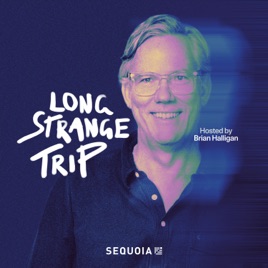
Advertise on podcast: Long Strange Trip: CEO to CEO with Brian Halligan
Rating
4.4from
This podcast has
21 episodes
Language
EnglishPublisher
Sequoia CapitalExplicit
No
Date created
2025/11/11
Latest episode
2026/10/08
Average duration
61 min.
Release period
19 days
Description
The CEO rulebook is getting rewritten. Brian Halligan, Sequoia partner and co-founder and longtime CEO of HubSpot, sits down with some of the CEOs who are defining the new one—from hypergrowth AI-native startups to 150-year-old behemoths. Whether you’re an early-stage founder or a scale-up CEO, Brian will be digging for advice you can use on the long strange trip of your own CEO journey.
Unlock Long Strange Trip: CEO to CEO with Brian Halligan podcast Email contact info,
Listeners & Audience details
Email contact information
Direct podcast contact details

Listeners
Audience numbers & engagement insights

Audience details
Podcast Insights

Podcast episodes
Check latest episodes from Long Strange Trip: CEO to CEO with Brian Halligan podcast
Luca Ferrari: The Operating System Behind Bending Spoons
2026/10/08
Luca Ferrari is co-founder and CEO of Bending Spoons, a serial acquirer of AOL, Vimeo and Evernote, Airtable, etc, that buys to hold forever, and whose only real edge is that it operates software companies better than almost anyone else.
Bending Spoons got 800,000 job applications last year and hired fewer than 300 people. Luca runs hiring the way a quant runs a portfolio — hundreds of signals tested against future performance — and he's blunt about what the data says. Harvard and Stanford barely predict anything. Interviews are the worst signal in the process unless they're scripted. The best candidates were politically active as teenagers and stopped in their 20s. He hires for slope over experience, which is why a 25-year-old routinely shows up to run a company Bending Spoons just bought, and why he thinks experienced hires from big tech lose motivation and struggle to adapt. He also explains why Bending Spoons has no executive team, why the burden of proof always sits with whoever wants to add complexity, and why he stayed in Milan on purpose.
I called three founders whose companies Luca acquired before this interview. All three, unprompted, said the same thing: exceptionally high integrity. His answer about where that comes from is the most honest closing I've had on this show.
Chapters:
0:00 – Introduction
1:13 – The Bending Spoons model: buy to hold forever, then rebuild from the ground up
8:07 – 800,000 applicants, fewer than 300 hires: industrializing talent density
13:45 – Hiring like a quant trader: hundreds of signals, scripted interviews
21:45 – Why strategy and talent trump org structure
25:34 – Leader or manager? Head in the clouds, feet on the ground, but never both at once
30:38 – Slope over experience: why 25-year-olds run the companies Bending Spoons buys
41:08 – Radical candor, the 360 that found Brian's bugs, and picking one flaw a year
47:00 – No exec team, no sacred org chart: whoever is CEO should rewrite the system
51:27 – Question everything, add nothing: the burden of proof is on whoever adds complexity
57:08 – Why Milan? The uncool is cool; the world needs more than one Silicon Valley
1:01:16 – Never lie, never omit: the high-integrity code
1:04:02 – Brian's takeaways
Databricks’ Ali Ghodsi Never Wanted to Be CEO. Now He’s Among the Best
2026/09/17
Ali Ghodsi never wanted the CEO job. In 2015, Databricks had a wildly successful open source project, $1.5 million in revenue, and a board quietly interviewing other candidates behind his back. He got the seat as a trial run. They didn't even give him a CEO salary. When I had Ben Horowitz on this podcast and asked him who the best CEO in Silicon Valley is outside his own portfolio, he didn't hesitate. He said Ali.
We get into how he actually runs the place: find the single biggest bottleneck in the company, then put an absurd, disproportionate amount of attention on it for two or three years. That's how the Lakehouse category got built, back when the strategy consultants, his own sellers, and most of the internet were laughing at the name. Ali breaks down the playbook he ran against Snowflake, why he's said no to phenomenal executives who still hold a grudge about it, and what he learned shipping code himself.
He's also blunt that conflict aversion disqualifies you from this job. I over-indexed on being liked at HubSpot. Ali doesn't.
0:00 – Introduction
1:22 – The secret CEO search and why the board bet on a founder
4:11 – Professor or CEO? Always taking the harder option
8:18 – Build your own playbook and pour everything into one bottleneck
12:16 – Killing PLG and learning what great enterprise sellers actually have
19:09 – Hiring ahead of the curve: sales leaders, execs, and back-door references
27:02 – The Snowflake rivalry: study your enemy, never copy them
33:22 – Lakehouse: conviction, ridicule, and the case for second acts
41:02 – The killer instinct and why conflict-averse CEOs fail
44:10 – Dunbar's number and rethinking the org chart around AI
48:00 – AGI is already here — enterprises just use it as a chatbot
52:55 – Does he still code? Two days for a connector vs. three quarters
57:18 – A day in the life, and why the Monday meeting isn't theater
1:04:53 – Why Databricks will go public, just not yet
1:08:09 – Get over conflict aversion, or don't be CEO
1:11:07 – Brian's takeaways
The Philosopher CEO | Clay Co-Founder Kareem Amin
2026/07/23
I had Kareem Amin all wrong. When Clay first crossed my radar, I thought he was too laid-back: no chip on his shoulder, not the hungry founder I expected to win. Clay has since exploded.
Kareem builds from what he calls "a place of wholeness" rather than lack — nothing to prove, no enemy to beat. It makes him sound like a philosopher, but the operating instincts underneath are sharp. He spent roughly five years wandering before Clay clicked, and his takeaway is that the hard part of building isn't working hard — it's the courage to commit to one idea and stop listening to everyone else, customers included. He flipped every assumption in his market: sell to technical "go-to-market engineers," charge for usage instead of seats, pick power over simplicity.
We both created categories, in opposite ways. I flogged "inbound marketing" with a book, a conference, and relentless content. Kareem coined "go-to-market engineering" and then refused to take credit, letting agencies own it because a category has to be bigger than you. We also get into his "momentum detective" theory of the CEO job, why he's deleting his standing one-on-ones, and why apologizing is one of his sharpest tools. There's no single way to run a company. Kareem is my proof.
Kalshi’s Tarek Mansour vs. the Federal Government
2026/07/09
Tarek Mansour calls himself a paranoid risk manager - the guy who can list 20 ways a hot air balloon will go down before it leaves the ground. Then he bet his entire company on suing its own regulator.
Kalshi spent years walking through the desert. The CFTC pocket-vetoed its election markets ahead of the 2022 midterms, people left, and the company took a layoff while the government piled on audits and enforcement actions. Death by a thousand paper cuts. Instead of pivoting, Tarek and co-founder Luana Lopes Lara sued the federal government against the guidance of nearly all their investors and advisors. They won, three and a half weeks before the 2024 election, and Kalshi now claims 95% U.S. market share in prediction markets.
We get into how two co-founders run 150 people with nearly everyone reporting directly to them, why it’s intentionally chaotic, why the two of them disagree by design, and Tarek's poker-player theory of expected outcome vs. outcome. He also breaks down his obsession with marketing timing - like launching the Timothée Chalamet spot 12 hours after the Knicks news broke - and his "hole in the ship" rule: a founder has to be the one staring at the leak.
Tarek and Luana's dynamic reminded me a lot of me and Dharmesh at HubSpot: total opposites, and one plus one equals three.
David Senra: Mute the World and Build Your Own
2026/06/04
David Senra has spent a decade reading the biographies of 400+ founders for his podcast Founders - and lately he's started interviewing the living ones face to face. He joins me to share what all of them actually have in common, and it isn't what Silicon Valley thinks.
His one word is focus — what he calls "mute the world and build your own." He walks through Dana White buying the UFC for $2 million and turning it into a nearly $8 billion TV deal by ignoring everything outside his own arena; why Daniel Ek believes founder-problem fit matters more than product-market fit. We get into the idea that the best founders are driven by control, not money - and why selling your best company and trying to recapture the magic at 60 almost never works.
David’s perspective on overcoming negative self-talk: at some point you have to change your fuel source from something that punishes you to something that generates.
If you've ever wondered whether the founder mythology is real, David has read more of the source material than anyone alive.
Notion’s Ivan Zhao: The Refounder
2026/05/21
Ivan Zhao, founder and CEO of Notion, joins me to introduce a new contender in the founder mode debate: jazz mode. Ivan has a different take than Jack Dorsey's circular org chart or Brian Armstrong's player-coach approach. He thinks hierarchy is human nature, and that you can't flatten it away but you can build a company that improvises like a jazz band instead of marching in formation. Notion has roughly 60 ex-founders on staff and a deliberately decentralized structure to make that work.
We get into why Ivan rebuilt his engineering org around a barbell — super junior ICs paired with very senior architects — which is the opposite of what most AI-pilled CEOs are doing right now. He explains why building with language models is "more like brewing beer than engineering a bridge," and how Notion's first candidate interview no longer involves a resume.
Ivan is the king of refoundings. He's done it twice, once from a small apartment in Kyoto with five employees left, once from Cancun the day he got early access to GPT-4. When I was running HubSpot, I described our scale-up years as boring compared to what's happening now. Ivan's advice for any CEO who's calcified and wondering if it's time to blow it up: feel the AGI first, then trust your body when it tells you to move.
00:00 Introduction
02:22 From Founder Mode to AI Org
11:00 Hiring for Taste and Agency
24:28 Refounding Notion in Kyoto
30:27 Craft Versus Commerce
32:26 When to Refound
34:07 GPT-4 Refounding Shock
45:35 Leadership and Founder Energy
53:17 Sales Culture and Closing Thoughts
Surviving Twitter's Growing Pains: Ex-CEO Dick Costolo
2026/05/07
Dick Costolo took over as CEO of Twitter in 2010, inheriting what he calls "the drama queen of hypergrowth companies." Hired as the adult in the room behind founders Jack Dorsey and Ev Williams, Dick spent five years dragging Twitter from a chaotic collective into a public company, and learned a scale-up CEO playbook in the process.
We get into how he killed group decision-making and replaced it with what he calls "bias to yes"—only your direct manager can tell you no. Why he stopped solving problems with processes ("the launch checklist was 17 pages long") and started solving them with DRIs and operating control. How he managed by walking around the engineering floor at 9:30 PM to figure out what was actually getting built. And the Steve Jobs trick he stole from Pixar for finding out what's really going on inside a team.
Dick is candid about the misses, too, including trying to buy Instagram for around $700 million before Facebook did, and his own struggles to fire fast. When I was running HubSpot, I fired slow almost every time and regretted it. Dick did better, but he'll tell you it never gets easier.
If you're scaling past 150 people and feeling the organizational barnacles build up, this one's for you.
What Founders Can Learn About Excellence From MIT President Sally Kornbluth
2026/04/16
Sally Kornbluth is president of MIT and one of the best crisis leaders I've come across. Within a year of starting the job, she got summoned – not invited – to testify before Congress alongside the presidents of Harvard and UPenn. You know how that went. The others didn’t make it. Sally did, and she came out stronger.
We spend a lot of time on sustaining meritocracy, which I think is one of the hardest things for any scaling CEO to pull off. Sally has a line I can't shake: if you take a lick of the lollipop of mediocrity, you suck forever. That's how MIT has operated for 150+ years. We get into how you actually hold the bar as you scale, why most founders drop it without realizing it, and what to do once you've dropped it.
We also get into the crisis playbook – staying calm on the outside when you're screaming inside, why explaining is losing, and why having a board that's truly behind you is the most underrated variable in whether you survive. The board backing her was the pivotal moment, full stop.
Other things we cover: what managing PhD students taught her about leading without being overbearing, the 5:1 praise ratio and why it doesn't cost you anything, how she told the federal government "no thanks" on their higher ed compact, and what AI actually means for education, including why writing is still thinking.
Jack Dorsey: Every Company Can Now Be a Mini-AGI
2026/04/02
Jack Dorsey (Block CEO) and Roelof Botha (Sequoia partner and Block board member) join to discuss a bold claim they wrote about recently: the traditional corporate hierarchy isn't just inefficient — it's obsolete. Jack made one of the toughest calls in recent business history: cutting 40% of his workforce and rebuilding the company from the ground up around what he calls an AI "intelligence layer." We get into how that conversation went down, the math they used to land on a number, and why he's convinced that acting from a position of strength beats reacting from one of weakness.
Jack breaks down his vision for simplifying into just three roles, and what it means to replace a pyramid org chart with a circle — AI at the center, and people at the edge. Roelof, who helped think through the restructuring, shares his perspective on how AI-native startups are building differently, and what CEO qualities are timeless.
I've eliminated org charts before. I know how hard this is. But Jack is doing something I never had the tools to pull off. If you're a founder wondering whether your hierarchy is working for you or against you, this one will make you uncomfortable in the best way.
Oura’s Tom Hale: What People Don’t Tell You About Being CEO
2026/03/26
Tom Hale didn't originally set out to be a CEO - then he put it on his bucket list to prove something to himself. Now he runs Oura, the Finnish health tech company behind the most talked-about wearable on the market - the Oura ring. In this conversation, we get into what the job actually feels like from the inside (spoiler: the kibble-to-champagne ratio is not what you think), and Tom shares some of the sharpest frameworks I've heard for scaling a company through the 200-to-2,000 employee gauntlet.
We dig into Oura's controversial pivot to a subscription model - the Reddit flames, the one moment Tom almost blinked, and why he's now calling it an unqualified success. He breaks down the asymmetry between work and headcount that causes politics to metastasize in growing companies, what he looks for in middle managers to keep bureaucracy from setting in, and how he thinks about staying close to customers as layers accumulate between you and them.
We also get into the Gucci partnership, what a Roman emperor has to do with it, and the unexpected retail insight that came out of it. And Tom shares why he sleeps soundly despite Apple being the 800-pound gorilla in wearables.
If you're a founder navigating the messy middle of company building, this one is worth your time.
The Most Founder Mode CEO Working Today Isn’t the Founder: Opendoor’s Kaz Nejatian
2026/03/12
Kaz Nejatian reveals how he left Shopify to pull off a highly unusual feat: refounding a struggling public company in just 16 days. From first attempting to take the company private and then becoming CEO with an unwavering commitment to prioritizing product, Kaz shares his unconventional playbook and approach to life.
We go deep on why most enduring companies are built on "first derivatives" of their core business and not the obvious thing everyone focuses on. Kaz explains why he reads the Bible every day, how overriding life's defaults requires going full force (not halfway), and why founder mode means taking responsibility for outcomes, not processes.
He breaks down the mechanics of the Opendoor turnaround, why he tethered his compensation to stock performance, and how he’s making the company AI-native. Essential listening for understanding true founder mode, or for anyone building something that matters.
Ben Horowitz On What Makes a Great Founder
2026/02/26
A16z’s Ben Horowitz joins me for a raw, unfiltered conversation on what actually breaks founder CEOs, and what separates the great ones from the rest.
We unpack founder mode, where it works and where people are taking it too far. Ben shares why overly deferring to experienced executives creates politics and fiefdoms, but avoiding senior talent altogether is just as risky. Founder mode is not about micromanaging. It’s really about taking responsibility for outcomes and having the confidence to manage people who may have more experience than you.
Ben goes deep on “constructive confrontation” and why running away from the truth to preserve feelings is one of the most dangerous things you can do in a tech company. He explains why bad news has to travel fast, how decision debt paralyzes organizations, and why hesitation, not lack of intelligence, is what usually gets CEOs replaced.
We also dive deep into hiring, especially the VP of Sales role founders mess up more than any other. Ben breaks down why great sales leaders qualify you in the interview, why references matter more than charisma, and why selling a hard product builds a different kind of operator.
Along the way, we cover the psychology of being a first-time CEO, what Zuckerberg, Jensen, and Elon actually have in common, why culture is defined by behavior not values, and why feeling like you don’t know what you’re doing is more normal than most founders admit.
Bayer’s Bill Anderson: Turning a 168 Year-Old Tanker Like a Speedboat
2026/02/12
Bill Anderson runs Bayer, a 160-year-old pharmaceutical giant that had 100,000+ employees when Bill took the helm. In just two years after becoming CEO, he flattened 11 layers of management, expanded managers' direct reports from 6 to 90, and eliminated annual budgeting in favor of 90-day cycles.
Bill offers up some gems on how to scale without becoming bureaucratic, explains why "professional managers" kill startups, why peer feedback beats manager reviews, and why bureaucracy isn’t a virus that infects healthy companies but rather something that grows from within the heart of your org chart.
If you're scaling from 100 to 1,000 employees and want to avoid the death spiral that slows most growing companies, this is essential listening. Bill's created a playbook for organizational transformation that challenges what you think you know about building companies.
The Wartime CEO: Vlad Tenev of Robinhood
2026/01/29
In this episode, Vlad Tenev pulls back the curtain on what it takes to lead through the kind of crises that would break most CEOs. From waking up at 5 AM to raise $3 billion in a few hours during the GameStop frenzy to navigating a 90% stock price drop, Vlad shares how he stays unflappable when everything is falling apart.
We go deep on why "it's always wartime" should be your default mindset, not the exception. Vlad breaks down how he maintains breakneck speed at scale, why he limits planning to days instead of weeks, and how product events create forcing functions that keep thousands of employees moving with startup urgency. He discusses the counterintuitive truth that, if you need something done fast, you should give it to your busiest person.
We also explore the mechanics of rebuilding trust after very public failures, why co-CEOs might actually work better than investors think, and how Vlad stays connected to customers despite leading 15,000 employees.
This conversation is essential listening for any founder trying to build resilience, any operator at a scaling company, or anyone who wants to understand what separates good CEOs from legendary ones.
Harvey CEO Winston Weinberg: Why You Should Reinvent Yourself Every 4 Months
2026/01/15
This might be my favorite episode yet.
Harvey’s Winston Weinberg is the canonical 2026 hypergrowth CEO. He takes us inside what it's really like to scale from zero to $190M run rate in just a few years. What stands out? His obsessive intensity and willingness to do uncomfortable things on a weekly basis.
Winston shares how he cold-messaged thousands of lawyers to land his first customers, why he deliberately chose the hardest enterprise law firms as his first target customers, and how he thinks about hiring and org structure when everything breaks every four months. We also explore his unconventional background - he wasn't a developer, was new to the legal industry, and figured out sales from scratch.
It's raw, honest, and incredibly practical for any founder navigating (or hoping to navigate) the chaos of hypergrowth.
Podcast reviews
Read Long Strange Trip: CEO to CEO with Brian Halligan podcast reviews
Daniel_Kim23 2026/06/20
Must-to-have for founders
It’s beyond my expectation. This pod reveals enormous amount of wisdom, insights and aspirations from established or scaled founders and CEOs. Each of...
RoxWM 2026/03/10
I love it! (+ feedback)
This is my favorite podcast! Obviously this is meant for CEOs/founders but as a VP level operator who reports up to a CEO at a high growth tech compan...
SteveFoxProp 2026/03/05
Brian rules
Great pod
Jack-Hannah 2026/02/28
More startup founders please
Winning concept - guest calibre is excellent and it’s cool that Brian can relate things back to his personal experience. Lean into the founder access ...
Jesse Docherty 2026/01/20
Great insights but flow could be better.
I recently started listening to this podcast and ripped through all of the episodes because of the good content. I do enjoy it a lot and I hope it con...
Nakentnsooswnnrntif 2026/01/20
Good Questions
I have really enjoyed listening. One thing Brian does good at is probing answers and really getting down to root cause or experience. However, Brian c...
Someonealreadytookmynamr 2026/01/19
Fantastic
Halligan is awesome. Great guests and super insightful conversations! Keep up the great work! Long Strange Trip is definitely on my weekly ‘must li...
Thomas J Myers 2025/11/13
Way more than just lessons for business leaders
If you’re a founder or business leader, you probably know about Brian Halligan. I think it’s safe to say that he’s one of the greats.
Whats really n...
MRD2222 2025/11/13
Good formula
The ceo to ceo angle is interesting. It’s clear Brian’s questions come from his Hubspot experience. I’m in!
Podcast sponsorship advertising
Start advertising on Long Strange Trip: CEO to CEO with Brian Halligan relevant audience podcasts
You may also like to advertise on these Podcasts
4.920391996
Brant & Sherri Oddcast
Brant Hansen

4.92001923
The Wright Report
Bryan Dean Wright
4.672732000
Timcast News
Timcast Media

4.6221662000
Mark Levin Podcast
Cumulus Podcast Network

4.6432771245
Verdict with Ted Cruz
Premiere Networks

4.619772871
All Ears English Podcast
Lindsay McMahon and Michelle Kaplan

4.814621637
The Big Honker Podcast
Andy Shaver & Jeff Stanfield
4.813262012
The Jeff Cameron Show ~ Warchant.com
Jeff Cameron Show
4.834901999
Conservative Review with Daniel Horowitz
Blaze Podcast Network

4.662832000
The Dr. Laura Podcast
Dr. Laura Schlessinger & SiriusXM