1882146616
The Star River Podcast

Advertise on podcast: The Star River Podcast

Rating
★★★★★
4.5
from
2 reviews
This podcast has
25 episodes
Language
English
Explicit
No
Date created
2026/03/03
Latest episode
2026/09/29
Average duration
41 min.
Release period
12 days

Description

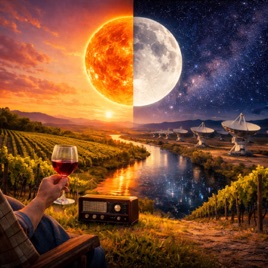
The Star River: Astronomy, Culture, and the Cosmic Connection We are all travelers on a single current - a River of Space and Time flowing from ancient suns into the distant future. On The Star River, we don’t just watch the universe pass by; we wade into the stream. Hosted by Eric Loyd (the Astropotamus), this podcast bridges the gap between the technical and the transcendent. We explore our inextricable link to the Cosmos through the lenses of astrophotographers, the melodies of musicians, and the insights of world-class astrophysicists and celestial explorers. The Ritual of the Glass Every episode begins with a ritual: sharing a local drink to ground ourselves in the present before we navigate the infinite. From the physics of light to the silence of the high desert, we seek to understand the current that moves through us all. What to Expect: Deep Space Science: Exploring the VLA, the James Webb Space Telescope, and the cutting edge of Black Holes and Active Galactic Nuclei.Astro-Culture: Interviews with educators, artists, and authors inspired by the night sky.The Human Element: Stories of wonder, heritage, and the "First Light" moments that change us forever. You are already in the River. Join us as we navigate its bends, its shallows, and its sudden falls. Raise a glass, find your place in the flow, and let’s see where the current takes us. Connect with the Current: Website: https://thestarriver.comJoin the Conversation: Call 855-DEEP-SKY to ask guest questions or share your own "Star River" story. The Astropotamus listens to every message and you might just find him on the other end! Keywords & Topics: Astronomy Interviews, Journey through Time, Space Exploration, Cosmic Connections, Radio Astronomy, Deep Space Imaging, Dark Sky Tourism, Astrophotography Tips, Backyard Astronomy, Citizen Science, Space & Philosophy, Human Heritage, Science and Art

Unlock The Star River Podcast podcast Email contact info,
Listeners & Audience details

Email contact information

Direct podcast contact details

Listeners

Audience numbers & engagement insights

Audience details

Podcast Insights

Podcast episodes

Check latest episodes from The Star River Podcast podcast


Chasing Stars in the City Lights with Jessica Dowell
2026/09/29
How does an observatory thrive amidst urban lights? Charting the CourseExplore the challenges and triumphs of the University of New Mexico Observatory, nestled in the heart of Albuquerque. Observatory Director Jessica Dowell and her husband, Jayce Dowell discuss the observatory's history, outreach efforts, and the quest for a darker sky site. "The goal is to give them the experience I had as an undergrad, which inspired me to be an astronomer." - Jessica Dowell Waypoints00:02:53 - The Ritual: Sharing a Drink 00:11:08 - Challenges of Light Pollution and City Expansion 00:22:20 - Visual Astronomy and Public Outreach 00:31:04 - Dreams for the Observatory 00:38:00 - Public Reactions to Observing Nights 00:45:30 - Optical Telescopes and Research Instruments 00:52:00 - Historical Context and Future Plans CurrentsThe observatory's 72-year-old building faces encroaching city lights and infrastructure.Friday night open houses engage the public and students with telescopes and starry skies.Efforts to restore a 26-inch telescope for research and educational purposes.Balancing accessibility and research goals in a changing urban landscape.The importance of community outreach and fundraising for the observatory's future. Where the River Took UsEncroaching city lightsPublic outreach and educationRestoration of old telescopesDark sky sitesADA accessibilityRadio astronomy vs. optical astronomy LinksUniversity of New Mexico ObservatoryAlbuquerque Astronomical SocietyLong Wavelength ArrayDark Sky International Join the CurrentSo visit the University of New Mexico Observatory's website, grab your drink for The Ritual, and join us as we take a trip down Jessica and Jayce Dowell's tributary of the Star River!
Seeing the Entire Sky at Once in Radio Waves with Dr Jayce Dowell
2026/09/01
What does it mean to look at the the entire sky all at once in radio waves? Charting the Course This episode dives into the world of radio astronomy with Dr. Jayce Dowell, research Assistant Professor in the Department of Physics and Astronomy at the University of New Mexico (UNM) and a leading scientist for the Long Wavelength Array (LWA). Unlike the VLA the LWA explores the entire visible sky all at once, and electronics and software give it unique abilities and views of the universe. I met him at the LWA-2 facility at the Sevilleta National Wildlife Refuge. "The LWA is all about looking at low frequencies. So light comes, light goes in, a variety of frequencies of wavelengths, depending on how you like to think about it." - Dr. Jayce DowellWaypoints00:02:34 - Touring the Long Wavelength Array at Sevilleta National Wildlife Refuge 00:07:56 - Electronic Beamforming, All-Sky Imaging, and LWA Resolution 00:15:03 - LWA Ground Planes, Lightning Protection, and Air Force Experiments 00:24:12 - Inside the LWA Electronics Shelter: Fiber, Cable Delays, and Calibration 00:30:55 - RF Shielding, Custom Boards, FPGA Digitizers, and GPU Processing 00:43:45 - Formal Introduction to Dr. Jayce Dowell and the Long Wavelength Array 00:50:24 - LWA TV: All-Sky Images and Watching the Radio Sky 00:56:13 - Growing the LWA Network and Building a Backyard Station 01:00:04 - Software-Defined Radio, Hydrogen Line Astronomy, and Amateur Radio 01:07:25 - Seeing a Different Universe: Searching for Exoplanet Magnetospheres 01:14:59 - A Lunar Far-Side Radio Array and the Cosmic Dawn 01:18:18 - Dr. Jayce Dowell's Career Path and the Origins of His Work with LWA CurrentsThe LWA captures low-frequency radio waves, providing a different perspective on celestial objects.Interference from Earth and the ionosphere pose significant challenges for radio astronomy.The LWA's ability to detect solar flares and Jupiter's radio emissions highlights its scientific value.The concept of the LWA Swarm aims to expand the array's capabilities by involving multiple institutions.Citizen science projects like e-Callisto allow individuals to contribute to solar monitoring.Where the River Took UsDaguerreotypesEpoch of reionizationCosmic dawnVLBA (Very Long Baseline Array)InterferenceIonosphereLinksSevilleta National Wildlife RefugeLWA TVe-CallistoNASA Sunrise missionJoin the CurrentSo explore the LWA's unique view of the cosmos, grab your drink for The Ritual, and join us as we take a trip down Dr. Dowell's tributary of the Star River! About Dr Jayce DowellDr. Dowell is a Research Assistant Professor in Physics and Astronomy at the University of New Mexico and a core scientist behind the Long Wavelength Array (LWA). Specialized in low-frequency radio astronomy, Jayce focuses on understanding cosmic phenomena ranging from solar radio bursts and planetary ionospheres to cosmic rays and transient radio sources. Beyond observational research, he plays a key role in the software development, data processing pipelines, and operations that keep the LWA stations (LWA1 at the VLA and LWA-SV in Sevilleta) capturing the long-wavelength universe. Watch LWA TV and see the sky like you've never seen it!
How to See the Surface of a Star: New Mexico’s Secret Super-Telescope with Professor Michelle Creech-Eakman
2026/08/18
What does it take to see the surface features of distant stars or track satellites in deep space? In this episode we sit down with Professor Michelle Creech-Ekman, Professor of Physics and Project Scientist at New Mexico Tech. From her roots in North Dakota to her pivotal work at JPL on the Keck Interferometer, Dr. Creech-Ekman shares her journey and her current groundbreaking project: the Magdalena Ridge Observatory Interferometer (MROI). Perched 10,500 feet high in central New Mexico, the MROI is a engineering marvel. We dive deep into the tech behind this massive optical and infrared array, including: High-Precision Engineering: Custom Belgian-built altitude-altitude mounted telescopes and Italian "squashed" domes that can be relocated across 28 stations in just four hours.Extreme Resolution: How "optical trombones" in a light vacuum delay line allow the array to achieve spatial resolution down to half a milliarcsecond—roughly 90 times sharper than the angular size of Betelgeuse.Cutting-Edge Science: The observatory's historic milestone of reaching first fringes on July 12th, and its mission to image starspots, track expanding supernovas, and monitor objects in geosynchronous orbit. Plus, Dr. Creech-Ekman reflects on her passion for inspiring the next generation of scientists, the importance of human spaceflight, and why maintaining a sense of wonder is vital. Tune in for an inspiring conversation on human ingenuity, big tech, and reaching for the stars! BONUS - find out what the shape of a wire suspended between two poles is called!
Transitioning from the VLA to the Rest of New Mexico
2026/08/04
As we pull up stakes on the Plains of San Augustin and wrap up our time with the Karl G. Jansky Very Large Array, let's take a quick pit stop to reflect on our journey so far and set the stage for what's coming next on the Enchanted Frequencies Mission to New Mexico. In this interlude episode, I preview the next leg of the expedition: 🏔️ Magdalena Ridge Observatory Interferometer (MROI): Bleeding-edge optical and infrared astronomy at 10,600 feet.📡 The Long Wavelength Array (LWA): Listening to the universe at the lowest radio frequencies from vast fields of dipole antennas.🎓 University of New Mexico Observatory: Bridging academic science, student training, and community stargazing.🔭 The Grand Finale with John Briggs: A marathon sit-down with the astronomical historian and founder of the Magdalena Astronomical Lyceum. Take a breath, catch up on any VLA episodes you've missed, refresh your glass, and get ready for the next bend in the river! Join the Community & Support Outreach: 🌌 Explore More: Visit thestarriver.com for episodes, reviews, and to join our Discord community!🍸 The Deep Sky Hotline: Have a cocktail/mocktail recipe for my space-themed fundraiser booklet or a question for a future guest? Call 855-DEEP-SKY (855-333-7759) and leave me a message! Clear skies, and we'll see you in the dark!
Can a Star Make a Cookie? (And How We Search for Alien Tech) with Dr. Chenoa Tremblay
2026/07/28
Can a star make a cookie and searching for techno- and bio-signatures to find signs of extraterrestrial life. What do cosmic cookies, giant space spectrometers, and artificial intelligence in deep space have in common? They're all part of the daily work of Dr. Chenoa Tremblay, project scientist with the SETI Institute, Breakthrough Listen, and the National Radio Astronomy Observatory (NRAO). In this episode of The Star River Podcast, host Eric Loyd sits down with Dr. Tremblay to explore the cutting edge of astrochemistry and the modern search for extraterrestrial intelligence (SETI). From her unconventional journey starting out in laboratory chemistry testing dirt samples to hunting for complex molecules and technosignatures with world-class radio telescopes, Chenoa shares a mind-bending look at how we listen to the universe. In this episode, we explore: Cosmic Chemistry: How stars bake the ingredients for life - and cookies!Physics in the Vacuum: Why atoms actually grow bigger in the near-vacuum of interstellar space.Technosignatures vs. Biosignatures: Why SETI is looking for cosmic "Wall-E" robots and technological waste rather than little green men.The Power of Radio Astronomy: How arrays like the VLA, MeerKAT, and more process massive streams of data to hunt for artificial signals.The Human Side of Science: Transitioning from lab tech to lead scientist, and making space science accessible to everyone. With a quick detour to the Wow! signal, and a fast jaunt to Asteroid (514107) 2015 BZ509, grab your favorite drink, join us for the Ritual, and take a trip down Dr. Tremblay's tributary of the Star River!
Flecks of Matter on a Spinning Rock: Finding Joy in Smallness with Corrina Jaramillo-Feldman
2026/07/21
What happens when you leave the high-stakes, "level-10 emergencies" of political campaign management to find your center among the stars? In this episode, I sit down with Corrina Jaramillo-Feldman, Senior Public Information Officer for the National Radio Astronomy Observatory (NRAO) VLA, VLBA, and ngVLA. Together, we navigate her fascinating, meandering journey from running statewide campaigns to translating the invisible, silent data sets of radio astronomy for the global public. As I continue my Enchanted Frequencies series of episodes from New Mexico, I saved the best for last. Corrina opens up about occupying the liminal spaces of identity, the liberating power of "cheerful nihilism" under a pitch-black Santa Fe sky, and the exciting future of the Next Generation Learning Center at the VLA. It's a deep, soulful conversation about public policy, workforce development, and remembering the sacred magic of being small. "I love being reminded that we are just like flecks of matter on a spinning rock in an infinite universe, because it makes bad things feel less huge, and I think it makes good, special moments feel really sacred." The "Cheerful Nihilist" Perspective: Discover how a childhood solar system book and a spooky, dark house on a Santa Fe mountain shaped Corrina's unique, joyful framework for handling life's heaviest moments.Sneak Peek at the Future of Space Education: Learn how the upcoming Next Generation Learning Center at the VLA is going K-12, expanding into adult trades, and transforming New Mexico into a premier global hub for workforce development.A Call to Action for Citizen Science: Hear Corrina's passionate defense of the permanence of science funding, why your phone calls to representatives matter, and how everyday people can protect the future of space exploration. Whether you are looking to reconnect with your own sense of wonder or want a fascinating peek behind the curtain of the world's most advanced radio telescopes, this conversation is the perfect antidote to the noise of everyday life. From political campaigns to the hum of the cosmos, Corrina's journey reminds us just how beautiful and liberating it is to be small. So grab a glass of your favorite drink, settle in for our Ritual, and join us on the banks of the river for an unforgettable journey into the deep cosmic stream. You won't want to miss this splash! Remember that the Deep-Sky Hotline is always open at 855-DEEP-SKY (855-333-7759) if you want to leave a question or share your own stargazing rituals. If you want to join the crew, unlock our private Discord channels, and claim one of the few remaining limited-edition Enchanted Frequencies mission stickers, head over to astropotamus.com/support. Until the next bend in the River, clear skies, and I'll see you in the dark!
What's Dance Got to Do With It? Signe Mason, Part 2
2026/07/14
Gather around the campfire, fellow Star River navigators! In this episode, we sit down with Signe Mason, an Operations Specialist at the world-renowned Very Large Array (VLA) in New Mexico and an astrophysics researcher simulating black holes at Northwestern University for part 2 of her journey down the River. I continue my conversation with Signe, from the outdoor patio at the Capital Bar and Grill in Socorro, complete with interruptions, sirens, and train horns. Now with more people! The editing on this one got a little wonky because I actually ended part 1 prior to our break, but it was a better place to split the conversatios. So in this "end of part 1 plus part 2,", we look at what made young Signe tick, why astrophysics was the farthest thing from her mind, and how she thinks that overcoming adversiy is what makes us thrive. Don't forget to listen to part 1 of my conversation with Signe, where the River starts its journey, and the bar was quieter! Grab a drink, join the current, and see where the river continues takes us. Episode Highlights:Dance: What does ballet have to do with running the receivers at the VLA?Perserverance: Did you know that overcoming crushing, emotional and physical defeat can make you a better person? Signe does.The Future: It won't be long after this episode airs that Signe starts the next chapter of her life. Find out what it will be. Remember that the Deep-Sky Hotline is always open at 855-DEEP-SKY (855-333-7759) if you want to leave a question or share your own stargazing rituals. If you want to join the crew, unlock our private Discord channels, and claim one of the few remaining limited-edition Enchanted Frequencies mission stickers, head over to astropotamus.com/support. Until the next bend in the River, clear skies, and I'll see you in the dark!
Not Today, Satan: Managing the VLA Telescope with Signe Mason, Part 1
2026/07/07
Gather around the campfire, fellow Star River navigators! In this episode, we sit down with Signe Mason, an Operations Specialist at the world-renowned Very Large Array (VLA) in New Mexico and an astrophysics researcher simulating black holes at Northwestern University. Recording live from the outdoor patio at the Capital Bar and Grill in Socorro, complete with interruptions, sirens, and train horns, we dive deep into the fascinating, behind-the-scenes reality of what it actually takes to manage 27 massive radio telescope dishes operating 24/7. From the daily gamble of scheduling multi-million dollar observations to navigating late-night "bumps in the night" in the control room, Signe pulls back the curtain on a life lived at the edge of human knowledge. Grab a drink, join the current, and see where the river takes us. Episode Highlights: Babysitting the VLA: What it’s like to sit in the operator's chair balancing weather algorithms, 10 computer screens, and millions of dollars of scientific equipment."Not Today, Satan": The ultimate power of hitting the manual override button when human intuition beats the automated telescope software.The Spooky Side of Science: Braving the eerie quiet of a midnight shift in the middle of nowhere, complete with an unexpected control room "horror movie" jump-scare.The Sound of the Sky: Stick around until the very end of the episode to hear a raw field recording of the massive telescope dishes mechanically slewing against the howling New Mexico wind. Remember that the Deep-Sky Hotline is always open at 855-DEEP-SKY (855-333-7759) if you want to leave a question or share your own stargazing rituals. If you want to join the crew, unlock our private Discord channels, and claim one of the few remaining limited-edition Enchanted Frequencies mission stickers, head over to astropotamus.com/support. Until the next bend in the River, clear skies, and I will see you in the dark!
The Parking Lot Conversation with Lorenzo and Richard
2026/06/23
What happens when two VLA workers get interviewed without warning in the parking lot of the VLA? Let's find out. This was in the parking lot of the U.S. National Science Foundation Very Large Array without notice. After the hubbub of the open house had faded for the day, but right as people were starting to arrive for the Star Party and set up their telescopes, one of the workers telling people where to park yelled out, "hey, podcast guy! Can I be on your podcast?" After figuring out that he was only half joking, I surprised him by saying "yes." It was recorded on my mobile phone. There was a lot of wind. It messed with the microphones on my phone and there are times when the conversation is hard to hear. I suggest headphones. Warning, this was a pretty raw conversation. I debated editing out some of the edgier parts, but decided that not to. The conversation we had was the one you'll hear, including the swearing. This is 27 minutes of real, raw conversation recorded in the parking lot of the VLA with Lorenzo Pina and Richard Harding. Two of the blue-collar workers who make it all happen.
Blue Collar Astronomy: Maintaining the VLA with Shane Baca
2026/06/09
You heard about Shane Baca in the previous episode, and now it's time to hear from Shane himself. "When they cross the cattle guard out here on the way in, they gotta take their watch and they gotta turn it back forty years." Pull up a chair to the campfire, grab a drink for our Ritual, and let's do a deep dive into what it takes to keep 27 (plus a spare) 240-ton radio telescope receiver dishes running, while also dealing with the grounds, the parking lot, pest removal, making sure the lights are on (of off, as need be), and the toilets are clean. Shane is the facilities manager of the VLA, and his story is more than you might think it is. Shane's tributary of the Star River is one of pride and a deep belief that science doesn't happen without grease and railroad spikes. I think, after listening to him speak with me from the break room of the control building at the VLA in April, you'll agree. Whether you are an experienced radio astronomer or a casual backyard stargazer, this conversation bridges the gap between the science we all hear about and the mechanics, welders, electricians, and plumbers that make it all happen. Connect with the Current: Official Website: thestarriver.com Join the Conversation: Call 855-DEEP-SKY to share your "Star River" story, ask a guest a question, or leave feedback for the Astropotamus. Follow the Journey: Find on social media @Astropotamus. Topics & Keywords: Blue Collar, Shane Baca, VLA, radio frequency interference, time travel, Astrophotography, Astronomy Education, Science Communication
Enchanted Frequencies: Shane Baca Trailer
2026/06/02
Hello, fellow Navigators! Pull up a chair next to the campfire for a quick mid-stream check-in. My day job has been an absolute mountain of work this week, so I am letting our next full-length episode drift just a tiny bit further down the stream to get the proper editing and polish it deserves, launching next Tuesday morning instead. This quick teaser gives you a behind-the-scenes preview of my the next episode of my special series, Enchanted Frequencies, where we explore the universe through radio waves and invisible cosmic signals. And through my visit to the Land of Enchantment, New Mexico! We'll look at the blue-collar heart of astronomy with Shane Baca, the facilities manager at the Very Large Array. Shane manages a crew of 65 mechanics, rail workers, and fabricators who roll up their sleeves to move massive 240-ton telescope dishes across the desert. I've even included a brief clip of our conversation to whet you appetite. Remember that the Deep-Sky Hotline is always open at 855-DEEP-SKY (855-333-7759) if you want to leave a question or share your own stargazing rituals. If you want to join the crew, unlock our private Discord channels, and claim one of the few remaining limited-edition Enchanted Frequencies mission stickers, head over to astropotamus.com/support. Until the next bend in the River, clear skies, and I will see you in the dark!
VLBA Space Exploration: From Books to Black Holes with Dr. Justin Linford
2026/05/26
You don't need an elite academic pedigree to have a meaningful relationship with the universe; you just have to be curious, dedicated, and a little bit crazy. Dr. Justin Linford shares his journey along the Star River with me, in person, at the Very Large Array in New Mexico. For the very first time on The Star River Podcast, I packed up my gear and traveled 2,000 miles to the high desert of New Mexico for a live, face-to-face interview. Sitting in the break room inside the iconic Very Large Array control building, I shared a cup of desert water and a deep conversation with NRAO scientist Dr. Justin Linford. Rather than getting bogged down in dry mathematics and complex equations, Justin opens up about the heart behind his science. "Anybody can do science. You just have to be curious and dedicated and a little bit crazy." -Dr. Linford Sneaker Net: Why continent-spanning telescope arrays still rely on shipping physical hard drives via FedEx to move petabytes of deep-space data.Blazars: How supermassive black holes blast powerful jets of energy straight down Earth's line of sight.Radio Noise: The unexpected challenges of radio astronomy, including rogue military satellites. We trace his personal path to the stars. From discovering a simple constellation book as a third-grader under the pristine, dark skies of Gallup, all the way to his work tracking the ferocious currents of supermassive black holes. Ultimately, this episode is a moving, grounded reminder that the universe isn't just for academics; it proves that pure curiosity is the only credential you truly need to explore the cosmos. So pull up a camp chair, pour a drink for our Ritual, and join a conversation between friends that bridges the gap between the backyard stargazer and the frontiers of science. Connect with the Current: Official Website: https://thestarriver.comJoin the Conversation: Call 855-DEEP-SKY to share your "Star River" story, ask a guest a question, or leave feedback for the Astropotamus.Follow the Journey: Find on social media @Astropotamus. Keywords: Radio Astronomy, VLBA, Very Large Array, National Radio Astronomy Observatory, NRAO, Supermassive Black Holes, Stargazing New Mexico, Space Exploration, Astrophotography, Astronomy Education, Science Communication
Introduction to Season Two: The Enchanted Frequency
2026/05/22
Gather 'round the campfire, Navigators. Welcome back to the banks of the Star River! After a six-week winter thaw, the current is officially moving again. In this special Season 2 teaser, I detail my recent 2,000-mile expedition into the stark, whisper-quiet high desert of New Mexico in search of the Enchanted Frequency. From chasing the ghostly glow of the Zodiacal light under heavy, pristine dark skies to standing among the massive dishes of the world’s most iconic observatory, Season 2 is a deep dive into how we connect with the universe when the lights go out. Inside this episode: The Return: Shaking off the winter clouds and setting the stage for the journey ahead.The Hotline: Long-time listener Mark calls in from the city lights of Ohio to ask a question that bridges the gap straight into the desert.The Tease: A sneak peek at next Tuesday’s full-length premiere, featuring my first-ever face-to-face interview, at the VLA with NRAO radio astronomer Dr. Justin Linford. 📞 Join the River: Call 855-DEEP-SKYThe hotline is officially open! Share your backyard stargazing rituals, ask a burning cosmic question, or tell us what the sky looks like from your campsite. Call 855-DEEP-SKY (855-333-7759) to have your voice become part of the River. 🌌 Claim Your Limited-Edition Mission Sticker!To celebrate The Enchanted Frequency mini-series, the first 25 fellow Navigators to step up and support the show will receive a high-quality, weather-resistant Enchanted Frequency mission sticker mailed straight to their house with a handwritten note from me, the Astropotamus. Head over to astropotamus.com/supportChoose your level of support and Join the Crew By joining the crew, you’ll also unlock access to our private Discord channels, where I will be dropping my raw New Mexico astrophotography files, audio, pictures, drone videos, and more over the coming weeks. So mark your calendars for Tuesday morning, Navigators. Check your gear, warm up the dew heaters, and get that drink ready for our Ritual, because we're headed into some of the darkest skies, and one of the most radio-quiet areas in America: New Mexico. The Land of Enchantment. Until the next bend in the River... clear skies, and I'll see you in the dark!
The New Mexico Mission: Returning Home
2026/04/25
In this final "transition" episode, Eric (The Astropotamus) packs his bags and heads home from the Land of Enchantment. Returning with dozens of hours of audio from the deep heart of the Southwest, he pauses to reflect on the voices recorded, the connections made, and the shared Rituals that anchored this mission. "I am a time traveler, and I'm leaving New Mexico not the same person who arrived." Coming soon to the Star River: The Builders: Impromptu conversations with the VLA rail and maintenance crews.The Visionaries: Deep dives with the scientists and controllers of the VLA, VLBA, and MROI.The Historians: A pilgrimage to the Magdalena Astronomical Lyceum.The Navigators: Future-facing science at the LWA and UNM Observatory.The Ancestors: Reflections on the final Gathering of Nations Powwow after 46 years. Whether you are a backyard imager, a professional radio astronomer, or a dreamer following the drums, join Eric as he re-joins his "normal" life after a transformational experience on the Star River. Episodes resume once this massive amount of audio has been edited into the stories they deserve. There are a few surprises along the way as well, some of which are simply *amazing*. Please join us in the River for these episodes; you won't want to miss them! Connect with the Current: Official Episode Website: https://thestarriver.com/episodes/land-of-enchantmentJoin the Conversation: Call 855-DEEP-SKY to share your Star River story, ask my guest a question, or leave feedback for the Astropotamus.Follow the Journey: Find on social media @Astropotamus. Until the next bend in the River, clear skies, and I'll see you in the dark! Topics & Keywords: Astronomy, VLA, Very Large Array, New Mexico, Astrophotography, Science Communication, Indigenous Astronomy, Gathering of Nations, Radio Astronomy, Finger Lakes Wine, Space Philosophy.
The New Mexico Mission: Standing in the Middle of Silence and the Darkness of the Skies
2026/04/18
In this special "transition" episode, Eric (The Astropotamus) packs his bags and heads for the Land of Enchantment. Before diving into interviews with the scientists of the Southwest, he pauses to bridge the gap between two worlds: the green, frost-nipped vineyards of Upstate New York and the red, silent dust of the Plains of San Agustin. "I am a time traveler. By the time you hear my voice, I’m already standing in the high desert of New Mexico." In this journey down the River, we explore: The Ritual: A final glass of Keuka Springs Riesling serves as an anchor between the "Terroir of the Soil" and the "Terroir of the Cosmos."The Ears of the Plains: A visit to the Very Large Array (VLA). Discover why a dried-up ancient lakebed is the perfect place to listen to the violent heart of the universe, and why radio astronomy is as much "heavy industry" as it is high science.The Skin of the Sky: The Long Wavelength Array (LWA) and the "Radio Quiet Zone," where we learn that to hear the universe, we must first learn to silence ourselves.The Human Lens: A preview of our visit to the University of New Mexico Observatory and the "Sweet Spot" of astronomy where photons finally meet the human eye.Ancestral Currents: Reflecting on the Gathering of Nations Powwow and the deep, indigenous history of the stars as relatives, guides, and a "River of Milk" in the sky. Whether you are a backyard imager or a dreamer following the drums, join Eric as he re-introduces himself to the stars. Connect with the Current: Official Episode Website: https://thestarriver.com/episodes/land-of-enchantmentJoin the Conversation: Call 855-DEEP-SKY to share your Star River story, ask my guest a question, or leave feedback for the Astropotamus.Follow the Journey: Find on social media @Astropotamus. Until the next bend in the River, clear skies, and I'll see you in the dark! Topics & Keywords: Astronomy, VLA, Very Large Array, New Mexico, Astrophotography, Science Communication, Indigenous Astronomy, Gathering of Nations, Radio Astronomy, Finger Lakes Wine, Space Philosophy.

Podcast reviews

Read The Star River Podcast podcast reviews


4.5 out of 5
2 reviews

Podcast sponsorship advertising

Start advertising on The Star River Podcast relevant audience podcasts


What do you want to promote?