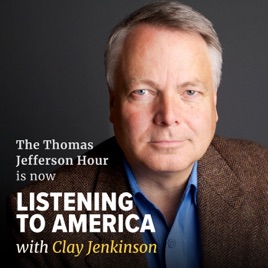
Advertise on podcast: Listening to America
Rating
4.6from
This podcast has
543 episodes
Language
EnglishPublisher
Listening to AmericaExplicit
No
Date created
2006/11/26
Latest episode
2026/04/20
Average duration
55 min.
Release period
8 days
Description
Listening to America aims to "light out for the territories," traveling less visited byways and taking time to see this immense, extraordinary country with fresh eyes while listening to the many voices of America's past, present, and future. Led by noted historian and humanities scholar Clay Jenkinson, Listening to America travels the country's less visited byways, from national parks and forests to historic sites to countless under-recognized rural and urban places. Through this exploration, Clay and team find and tell the overlooked historical and contemporary stories that shape America's people and places. Visit our website at ltamerica.org.
Unlock Listening to America podcast Email contact info,
Listeners & Audience details
Email contact information
Direct podcast contact details

Listeners
Audience numbers & engagement insights

Audience details
Podcast Insights


Podcast episodes
Check latest episodes from Listening to America podcast
Clay's Take on Current Events
2026/04/20
Beau Breslin interviews Clay on current events. First, the successful launch on April 1st of Artemis II, America's first space mission to the moon in more than 50 years. The launch's success was not particularly unexpected, but our relief was palpable when it was nearly flawless. Second, Ken Burns' latest documentary is a three-part study of the life and achievements of Henry David Thoreau. Clay was one of the featured historians in the film. Beau wanted to know what it was like to sit across from the great Ken Burns in an interview. And third, the future of the 14th Amendment, guaranteeing birthright citizenship to all children born in the United States. The Supreme Court recently heard arguments on the topic, though the decision is not expected until late June. This podcast was recorded on April 2, 2026.
The Iran War and the U.S. Constitution
2026/04/13
Clay and frequent guest Beau Breslin of Skidmore College try to place Donald Trump's war in Iran in the context of American history with a particular emphasis on the war powers language of the U.S. Constitution. The Founders considered war so grave that they did everything in their power to make sure it was not undertaken without the broad support of the American people. Wars must begin in Congress, and particularly the House of Representatives. The House enjoys the power of the purse to fund wars or refuse to fund them. In the last 60 years, presidents have gone to war with decreasing Constitutional respect, but no previous war was undertaken without some level of consultation with Congress. So far, Congress has voted against at least three war powers resolutions that might have put some controls on our incursion into the Middle East. This episode was recorded on March 5, 2026.
The Future of America's National Monuments
2026/04/06
Clay's conversation with Dr. Susan Ryan of the Crow Canyon Archaeological Center in Cortez, Colorado, about the history of the National Monuments and Antiquities Act, signed into law by President Theodore Roosevelt on June 8, 1906. The Monuments and Antiquities Act gives the president of the United States virtually unlimited authority to designate national monuments on America's public lands by executive order alone. Teddy Roosevelt named the first 18, beginning with Devils Tower in Wyoming, and, at the end of his second term, established the Grand Canyon National Monument, covering more than 800,000 acres. Most subsequent presidents have designated National Monuments, including Donald Trump in his first term. Dr. Ryan says this vast grant of presidential authority has always been controversial, particularly now, and there are stirrings of a test case that will reach the Supreme Court sometime in the next couple of years. Can a subsequent president reduce the size of a National Monument or remove it altogether? And what oversight does Congress have or should it have in these matters? This podcast was recorded on February 23, 2026.
#1697 The State of the Union as Political Theater
2026/03/30
Frequent guest host David Horton welcomes Thomas Jefferson to the podcast to discuss political theater and State of the Union addresses. Although Jefferson was a master of political theater, he chose not to take his annual State of the Union messages in person to Congress. He sent his messages by courier and assumed Congress would study them at their convenience. After Jefferson makes his views clear, Clay Jenkinson breaks character to discuss the uses and abuses of modern State of the Union addresses. It was Ronald Reagan who began the tradition of the president pointing to extraordinary Americans in the gallery to honor their service and sacrifices, or to lament their sufferings. Donald Trump's recent 2026 State of the Union Message was much more like a reality television show than anything in previous administrations, including a sustained celebration of the U.S. Olympic hockey program. This program was recorded on February 25, 2026.
Assessing America's National Parks & Public Lands at 250
2026/03/23
Clay's conversation with Char Miller, an endowed professor of environmental history at Pomona College and author of more than a dozen highly regarded books. How did America develop its public lands? Who were the key players in the formation of National Parks, Monuments, Forests, Wildlife Refuges, and Game Preserves? How fragile is the public domain at a time when the Trump administration seeks to scale back, privatize, and permit mining and other industrial activities? The conversation includes a segment on Native American sovereignty, the Land Back Movement, and the work of David Treuer, who has suggested that the National Parks and Monuments be returned to Native ownership or, at a minimum, Native co-management. The discussion also assessed the future of the Colorado River system, including the status of Glen Canyon Dam in Arizona. This episode was recorded on January 27, 2026.
New Ken Burns Documentary on Henry David Thoreau
2026/03/16
Clay's conversation with Erik and Christopher Ewers, the directors of the upcoming three-part documentary on the life and achievements of Henry David Thoreau, the New England radical and the author of Clay's favorite American book, Walden. Five years in the making, with dozens of interviews and fabulous footage of Concord, Massachusetts, and the environs of Thoreau's famous cabin at Walden Pond, this documentary will be the definitive treatment of Thoreau. The directors tell Clay that he is, as they put it, "all over the film," as one of the more significant talking heads. Thoreau was one of the most original and morally courageous of American writers. He denounced slavery with a pure flame of disgust, opposed America's war of expansion against Mexico, defended John Brown after he raided Harpers Ferry, and even suggested some careful monkeywrenching in his book A Week on the Concord and Merrimack Rivers. Thoreau went to the woods to live deliberately and to undertake an experiment in simplicity and minimalism. He wrote some of the most famous sentences in American history, including, of course, "the mass of men lead lives of quiet desperation." This podcast was recorded on February 13, 2026.
Is a Constitutional Convention Even Possible?
2026/03/09
Clay's conversation with historian Beau Breslin about the nuts and bolts of a constitutional convention in America. Neither Clay nor Beau thinks such a convention is likely, given the constitutional conservatism of the American people, but if Americans chose to hold one around the 250th birthday of the United States, how would it be organized? How would we choose delegates to ensure, this time, that they truly represent our multicultural demographics? How would we avoid letting the lobbyists, professional politicians, and the media distort the process and ruin the project? Would it be possible in our time to enforce a secrecy rule among the delegates? What sort of civics training would we want them to undergo, and by whom? If we drafted a new constitution, what would the ratification process look like? As they discuss, Thomas Jefferson urged us to tear up the Constitution once every 19 years. This episode was recorded on February 12, 2026.
Downsizing and Henry David Thoreau
2026/03/02
Guest host Russ Eagle interviews Clay about his ambitious downsizing project. For several decades, Clay has explored the world of Thoreau's great book Walden, which calls on us to reduce the clutter of our material lives to open our spiritual arteries. Simplify, simplify, and minimize, says Thoreau. Finally, Clay decided to undertake the purge. So far, he has given away 3,000 books to a public library system in east central North Dakota, with plans to donate at least 2,000 books a year for the next 5 years. The question is, is Thoreau right that there is liberation in repurposing excess material baggage, that one crosses an invisible boundary, and that it is possible in this way to achieve a higher order of being? Towards the end of the conversation, Clay explains how the downsizing project inspired him to make a Mind Map of the authors and subjects that still matter greatly to him. With the help of ChatGPT, Clay produced a manuscript featuring 52 of his intellectual heroes, with appropriate AI-generated portraits of each author. This episode was recorded on January 18, 2025.
The Crisis of the Public Lands
2026/02/23
Clay joins journalist Jonathan Thompson, publisher of The Land Desk on Substack and author of Sagebrush Empire: How a Remote Utah County Became the Battlefront of American Public Lands. Thompson, who is currently living in Greece, begins by providing a European perspective on what is happening in the United States — the assault on NATO, the flirtation with taking Greenland from Denmark, the overreach of the Immigration and Customs Enforcement service, and European bewilderment about America's intended place in the world community. Most of the conversation is about the crisis of public lands in America — the push to open more of the public domain to resource extraction, the calls for privatizing parcels of BLM land in the West, and the recent revocation of grazing permits for the American Prairie Reserve in eastern Montana. And oh yes, the future of the Colorado River. This episode was recorded on January 28, 2026.
Was it Shakespearean Tragedy or Greek Tragedy?
2026/02/16
Clay interviews the award-winning historian Joe Ellis about America's tragic legacy of slavery, and about the dispossession of American Indians from their sovereign homelands. Professor Ellis has often argued that what happened with respect to African Americans was Shakespearean tragedy — in other words, if the better angels of American life had prevailed, things might have turned out differently; but that the dispossession and cultural genocide America wrought with Native Americans was probably inevitable. Clay has repeatedly challenged that view, and Joe Ellis suggested that Listening to America feature a serious discussion of how things might have turned out differently in both cultural intersections. The problem of what Clay calls "the Myth of Inevitability" is that it lets white America off the hook. If it could not have turned out any other way, perhaps we don't need to wring our hands too much. It's a critical discussion of agency and complicity in America's problematic history. This episode was recorded on December 15, 2025.
Mount Rushmore: Its Back Story and the Continuing Controversy
2026/02/10
Clay welcomes author Matthew Davis to talk about his new book, Biography of a Mountain: The Making and Meaning of Mount Rushmore. How did it happen that a mountain in the heart of the Black Hills of South Dakota, in land sovereign to the Lakota Indians, came to be the canvas on which Gutzon Borglum carved four monumental figures in American history: Washington, Jefferson, Lincoln, and Theodore Roosevelt? Should it matter to us that Borglum was a member of the KKK? Why are there no women, no African Americans, no Native Americans carved up there? What is the future of Mount Rushmore, and who, by the way, was this obscure New York lawyer, Charles E. Rushmore, who visited the region in 1885? We give considerable attention to Gerard Baker, the Hidatsa Native who served as superintendent at Mount Rushmore from 2004 to 2010 and revolutionized how we interpret the site. This episode was recorded on November 24, 2025.
Nat and Mikey Survived!
2026/02/02
Clay interviews the adventurous Brits Nat and Mikey, school teachers who got it into their heads to float the entire Missouri and Mississippi River corridor. They began on August 5, 2025, and completed their journey in the second week of January 2026. They floated more than 3,000 miles from Three Forks, Montana, to the Gulf of Mexico, where they pulled their canoe out of the water for the last time. When Clay caught up with them in mid-January, they were luxuriating in a New Orleans hotel. But the big news is that Nat and Mikey's great adventure is not over! They are now going to hitchhike to California, then fly to South America for further exploration. Towards the end of the podcast, they tried Velveeta for the first time, with the usual British condescension towards one of America's great food groups. This episode was recorded on January 18, 2025.
Ten Things About Foreign Policy in the Age of Jefferson
2026/01/26
Clay's favorite guest, Dr. Lindsay Chervinsky, makes her first 2026 appearance to discuss foreign policy in the administrations of George Washington, John Adams, and Thomas Jefferson. America's recent incursion into the sovereign nation of Venezuela raises questions about the war powers in America. The Founding Fathers were adamant that Congress (not the executive) must initiate wars, and vote funds to pay for them, too. We discuss the crisis of the French Revolution in America, Washington's famous Farewell Address in 1796, the Quasi-War with France during the John Adams administration, and Adams' heroic decision to seek peace rather than war with the French Republic. We explore Jefferson's idealism as voiced in a letter he wrote in 1799 and his famous First Inaugural Address in 1801. Jefferson believed it was too late in the world's history to solve our disputes through bloodshed, and yet he sent marines and a naval squadron to North Africa to bloody the nose of the Pasha of Tripoli. This episode was recorded on January 5, 2026.
The Sinking of the Edmund Fitzgerald, 50 Years Later
2026/01/19
Clay joins author John U. Bacon of Ann Arbor, Michigan, whose book, The Gales of November: The Untold Story of the Edmund Fitzgerald, takes a new look at the sinking of the Fitzgerald on November 10, 1975. Four years in the making, Bacon's research unearthed new material on the catastrophe, in which all 29 crew members (all men) perished when the Edmund Fitzgerald went down. Was there crew error or hubris in Captain Ernest McSorley? Was the great 729-foot ship structurally unsound? Or was it just a perfect storm? The winds rose to 100 miles per hour that day, and the waves were sometimes 60 feet or more high. The Fitzgerald settled on the bottom of Lake Superior more than 500 feet below the surface. It has been visited several times since, but the Canadian government, whose territorial waters the incident occurred in, severely restricts visitation because it regards it as a gravesite. This episode was recorded on November 24, 2025.
Venezuela, Thomas Jefferson and American Ideals
2026/01/12
Clay and guest host David Horton of Radford University discuss the global implications of America's recent incursion into the sovereign nation of Venezuela. For the first segment of the program, Horton asks President Thomas Jefferson about the foreign policy crises of the early national period. After the break, Horton asked Clay to break character to contextualize the recent raid in the larger sweep of American history. Have there been similar incidents in previous decades? How will the kidnapping of the dictator Maduro affect America's standing in the world? Who gets to decide what foreign leaders to leave in place, and which to depose? What are the constitutional implications of this sudden military incursion? Is the post-World War II liberal world order crumbling? And what comes next? This episode was recorded on January 7, 2026.
Podcast reviews
Read Listening to America podcast reviews
Maizie daisy 2026/03/25
Great podcast for history nerds like me 👍🏼
I listened to my first podcast today on the National parks with Char Miller and it was such a great conversation. I appreciate both Char and Clays kno...
Caper127 2026/04/21
Subject matter is great
But I find the host to be an egotistical blowhard.
Trot87 2026/04/04
Very disappointing
The Thomas Jefferson Hour was a rare source of optimism and inspiration. Listening to America is just another overly pessimistic political show that p...
vfaler 2025/10/28
Informative Interesting Show
One of my favorite podcasts.
Cfeman 2025/09/16
Very enjoyable
Just recently discovered this podcast. Started with episodes from late 2016. Intend to listen to them all. Recent reviews say this becomes more politi...
midway-through 2025/06/24
Listening
Thank you for seeking out these conversations.
mharrisARCH 2025/04/15
brilliant re-make of the TJH
While I truly miss the Thomas Jefferson hour, I quite understand that it had somewhat ran its course, and that the highly fascinating yet complex Mr. ...
Food guy 88 2025/05/04
Trash
This guy could be good if this guy and his guests would leave politics out of it.
Lcgoezzzz 2024/12/16
Love this show
Such a calming, interesting podcast. I love the historical quotes that come up, inspiring.
KUCH182 2024/10/27
Informative discussions
Although I preferred the TJ hour format, I still find the discussions highly informative and have enjoyed Clay's reports from the road during his Stei...
Podcast sponsorship advertising
Start advertising on Listening to America relevant audience podcasts
You may also like to advertise on these Podcasts

4.9144300
Best Damn Coach Podcast: Conversations for coaches, mentors, and service providers to grow a profitable coaching business
Amanda Walker

540941
WIN ALL DAY - with Coach JC
Coach JC
4.7473113
China Unscripted
Chris Chappell
4.680600
As The Story Grows
Bryan Patton

4.757728
Open Goal - Football Show
Open Goal - Football Show

4.9219618
Podcasting Business School
Adam Schaeuble, Online Business Coach for Podcasters.

4.5922673
Big Picture Science
Big Picture Science

4.9148604
Australian Birth Stories
Sophie Walker

4.41846341
Decoding TV
Decoding TV

4.939748
Mercy Culture
Mercy Culture