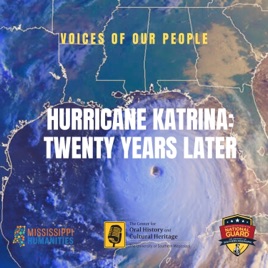
Advertise on podcast: Mississippi Moments Podcast
Rating
4.6from
This podcast has
638 episodes
Language
EnglishExplicit
No
Date created
2009/04/17
Latest episode
2025/08/31
Average duration
28 min.
Release period
66 days
Description
Mississippi Moments, a weekly radio program airing on Mississippi Public Broadcasting, is a partnership between the University of Southern Mississippi Center for Oral History and Cultural Heritage, the Mississippi Humanities Council, and MPB.
Unlock Mississippi Moments Podcast podcast Email contact info,
Listeners & Audience details
Email contact information
Direct podcast contact details

Listeners
Audience numbers & engagement insights

Audience details
Podcast Insights


Podcast episodes
Check latest episodes from Mississippi Moments Podcast podcast
Voices of Our People: Hurricane Katrina: Ep. 4 - Lessons Learned
2025/08/31
In the twenty years since Hurricane Katrina, numerous storms and tornadoes have brought death and destruction to our nation. But for Mississippi, no other event has had as much of an impact, with the possible exception of Hurricane Camile.
Anyone who lived here during that time has a Katrina story and while some of the details have faded in the decades that followed, the emotional trauma remains just below the surface.
Within a month of Katrina, the Center for Oral History and Cultural Heritage began planning an oral history project to preserve those stories while the details were fresh and the trauma apparent.
In this episode, we hear from National Guard leaders who used their Katrina experiences to guide them through subsequent catastrophes. And we discuss disaster preparedness with historians and how the proposed elimination of FEMA could affect our state in the future.
To those conversations, we add the stories of individuals who used their trauma as a catalyst for change.
Hosted by Bill Ellison
Produced by Ross Walton
Executive Producer Dr. Kevin Greene.
Written by Ross Walton, Isabel Loya, Jerra Runnels, Andrew Leib, and Holli Parker.
Additional interviews were conducted by Isabel Loya, Jerra Runnels and Andrew Leib.
Special thanks to the Center for the Study of the National Guard and the Mississippi Humanities Council.
Voices of Our People: Hurricane Katrina: Ep. 3 - Crawling from the Wreckage
2025/08/30
As the wind and rain began to die down, people crawled from the wreckage to survey the damages left by Hurricane Katrina. The most common description of what they found was "a warzone."
First came the first responders seeking, listening, for survivors. Then came the Mississippi Army National Guard. They were soon joined by community and business leaders desperately searching for sources of water, food, and fuel to pass along to those in need.
Then came an army of volunteers from across the nation and around the world: from the American Red Cross and countless faith-based and philanthropic groups, to individuals with trucks, trailers, tools, and big hearts.
As the focus moved from rescue to recovery and finally to rebuilding, the physical and emotional stress began to show on even the most stalwart individuals as people returned to pick up the pieces from amongst the debris.
In this episode, we hear from key decision-makers from the Mississippi National Guard, along with community leaders, fire chiefs, bankers, nurses, and volunteers.
To their memories, we add stories of hope, despair and frustration, from individuals determined to rebuild their homes, lives, and livelihoods.
Hosted by Bill Ellison
Produced by Ross Walton
Executive Producer Dr. Kevin Greene.
Written by Ross Walton, Isabel Loya, Jerra Runnels, Andrew Leib, and Holli Parker.
Additional interviews were conducted by Isabel Loya, Jerra Runnels and Andrew Leib.
Special thanks to the Center for the Study of the National Guard and the Mississippi Humanities Council.
Graphic Design and Social Media: Isabel Loya
Voices of Our People: Hurricane Katrina: Ep. 2 - Riding the Storm Out
2025/08/29
Early in morning of Monday, August 29, 2005, Hurricane Katrina made landfall near the Louisiana / Mississippi state line and the eyewall passed over the cities of Bay St. Louis and Waveland as a Category 3 hurricane. A 27 foot storm surge with sustained winds of 120 mph made for a devastating one-two punch that rocked even the most storm-hardened shelters and wiped away 90% of all structures within six miles of the beach.
Joining us for the interview today we have Dr. David Holt, Associate Professor of Geography in the School of Biological, Environmental and Earth Sciences and coordinator of the Sustainability Sciences BS program at USM, and Dr. Deanne Stephens, Co-Director of the Center for the Study of the Gulf South at USM.
To their expertise, we add the raw accounts of city officials, firemen, nurses, and everyday people who share their stories of survival and tragedy during those harrowing hours when life and death hung in the balance.
Hosted by Bill Ellison
Produced by Ross Walton
Executive Producer Dr. Kevin Greene.
Written by Ross Walton, Isabel Loya, Jerra Runnels, Andrew Leib, and Holli Parker.
Additional interviews were conducted by Isabel Loya, Jerra Runnels and Andrew Leib.
Special thanks to the Center for the Study of the National Guard and the Mississippi Humanities Council.
Voices of Our People: Hurricane Katrina: Ep. 1 - Preparing for the Worst...
2025/08/28
On the afternoon of Friday, August 26, 2005, the National Hurricane Center changed the predicted landfall of Katrina from the panhandle of Florida to Mississippi. As the storm continued to increase in size and intensity, Federal, State, and local officials, began planning for the worst case scenario.
For Gulf Coast residents, it was a familiar dilemma: to stay or to go? Boarding up homes and businesses, packing up and heading north was a costly effort that too many times, proved unnecessary. Afterall, it had been some 36 years since Hurricane Camile, the yardstick by which all hurricanes were measured, had devastated the Gulf Coast. What were the odds that Katrina could cause that level of destruction?
In our first episode, we look back on the days leading up to Hurricane Katrina. We examine the choices that were made and why. We hear first-hand accounts by key decision makers of the Mississippi Army National Guard including Major General Harold "Hac" Cross, Major General Bobbie Ginn, and Major General Janson "Durr" Boyles.
We also hear from Dr. David Holt, Associate Professor with the School of Biological, Environmental and Earth Sciences and Coordinator of the Sustainability Sciences BS program at USM, and Dr. Deanne Stephens, Co-Director of the Center for the Study of the Gulf South at USM.
To these voices, we add the stories of Mississippians from all walks of life, recorded shortly after the storm. From these raw accounts of survival and resiliency, we will hopefully gain a deeper perspective of how they prepared to meet the moment that fateful weekend in August of 2005.
Hosted by Bill Ellison
Produced by Ross Walton
Executive Producer Dr. Kevin Greene.
Written by Ross Walton, Isabel Loya, Jerra Runnels, Andrew Leib, and Holli Parker.
Additional interviews were conducted by Isabel Loya, Jerra Runnels and Andrew Leib.
Special thanks to the Center for the Study of the National Guard and the Mississippi Humanities Council.
Voices of Our People: Hurricane Katrina - Ep. 0 Series Introduction
2025/08/27
On August 25th, 2005, Hurricane Katrina crossed over South Florida and into the Gulf, where it quickly strengthened into a massive category 5 storm. Gulf Coast residents watched with increasing alarm as it became obvious that Mississippi was in the crosshairs of this once-in-a-generation weather event.
As President George W. Bush declared a state of emergency and evacuations were ordered for New Orleans and the Mississippi Gulf Coast, emergency crews, equipment, and supplies, were prepositioned for the rescue and recovery efforts that would follow.
Key to those efforts would be the Mississippi National Guard. Already stretched thin due to deployments in Iraq and Afghanistan, Adjutant General Harrold "Hac" Cross knew we would need assistance from other states to meet the moment.
When the storm made landfall near the Louisiana-Mississippi state line early on the morning of August 29, those who were unable or unwilling to evacuate experienced sustained winds of 120 miles per hour and a 27 foot wall of water. Many clung to trees or floating debris, desperate to survive.
By the time Hurricane Katrina left Mississippi, no part of the state was left untouched. All 82 counties were declared disaster areas. On the Gulf Coast, some 90% of the buildings within a half mile of the shoreline were wiped away, leaving 238 people dead, 67 missing, and billions of dollars in damages.
As massive as the storm itself was the rescue and recovery efforts. Relief agencies and philanthropic groups from around the world descended on Mississippi with truckloads of food, water, and other desperately need supplies. Rescue and relief would take weeks, recovery efforts would take years.
Even before the power was fully restored, the Center for Oral History and Cultural Heritage at the University of Southern Mississippi began planning for an oral history project to preserve for future generations, the shared impact of what our people had just experienced. Over the next five years, the Center would collect some 400-plus interviews to be used for museum exhibits, presentations, books, radio programs, and even a stage play.
In this four-episode podcast series, produced by the Center for Oral History and Cultural Heritage, and the Center for the Study of the National Guard at USM, with support from the Mississippi Humanities Council, we will mine that collection for stories of survival and resilience. To those stories we will add new interviews with key decision-makers and scholars to gain some new perspectives on the lasting legacy of Hurricane Katrina.
I'm your host Bill Ellison, inviting you to take this journey with me as we witness the ferocity of nature and the resilience of our citizens.
Mississippi Moments Presents: Voices of Our People - Hurricane Katrina: Twenty Years Later.
Hosted by Bill Ellison
Produced by Ross Walton
Executive Producer Dr. Kevin Greene.
Written by Ross Walton, Isabel Loya, Jerra Runnels, Andrew Leib, and Holli Parker.
Additional interviews were conducted by Isabel Loya, Jerra Runnels and Andrew Leib.
Graphic Design and Social Media: Isabel Loya.
Special thanks to the Center for the Study of the National Guard and the Mississippi Humanities Council.
MSMO Presents: Dogwood - The Sean Cooley Story
2025/05/29
To celebrate the publication of an important new book Dogwood, A National Guard Unit's War in Iraq, by Dr. Andrew Wiest of the Dale Center for the Study of War and Society, we present this one hour special podcast episode.
In 2003 US and coalition forces unleased Operation Iraqi Freedom to overthrow the regime of Saddam Hussein, expecting an easy victory and a short war.
After a quick seizure of Baghdad, though, the nation of Iraq dissolved into disarray, with an insurgency, led by both Saddam loyalists and foreign jihadists, spiraled out of control.
The deteriorating situation meant that the US would need more forces in Iraq, and quickly, which resulted in the mobilization of National Guard units from all over the country.
As part of that mobilization the 155th Brigade Combat Team from Mississippi would be activated and made ready for war. Their efforts to bring peace to the heart of the insurgency at a remote forward operating base codenamed Dogwood would result in the loss of some of their best and brightest.
This is the story of one such Guardsman, Sergeant First Class Sean Cooley, during his deployment to Iraq in 2005. In this podcast episode, Dr. Andrew Wiest provides in-depth context to the story and we learn of the sacrifice and legacy of this remarkable young man as told by his wife and friends.
Introducing - Voices of Our People: WWII - Premiering Sept. 30
2024/09/20
From the producers of Mississippi Moments comes a new 10 episode long form podcast,
Voices of Our People: WWII. Follow this link to subscribe or search your favorite podcast directory:
https://directory.libsyn.com/episode/index/id/32993807
From the Center for Oral History & Cultural Heritage at USM, comes a new history podcast combining the best of our extensive Oral History collection and in-depth analysis of the major events that have fundamentally shaped modern society.
In Season 1 of Voices of Our People, The COH&CH, in partnership with the Dale Center for the Study of War & Society at USM and the Mississippi Humanities Council, presents a new 10 episode exploration of the greatest conflict of the 20th Century, World War II.
Hosted by Bill Ellison, Voices of Our People: WWII will premier on Monday, Sept. 30, with a new episode each subsequent Monday through Dec. 2--five days before the 83rd anniversary of the Pearl Harbor attack.
About the Center for Oral History & Cultural Heritage
Since 1971, the COH&CH has collected and preserved the stories of Mississippi from all walks of life. In sharing their memories, the over 4,000 and counting contributors to our collection have given the Center--and all of Mississippi--a precious gift that remains long after they pass on. Our collection has proven an invaluable resource for researchers, journalists, teachers, students, documentarians, and museums.
About the Dale Center for the Study of War & Society
As one of the top military history programs in the country, the Dale Center for the Study of War & Society houses a distinguished academic community with expertise in how conflict affects communities, soldiers, and non-combatants. The Dale Center expands on the field of military history, with its traditional focus on leaders, strategies, and operations, and seeks to identify and understand the social and cultural consequences of war.
About the Mississippi Humanities Council
With funding from the State of Mississippi through the Mississippi Department of Archives and History, the Mississippi Humanities Council creates opportunities for Mississippians to learn about themselves and the larger world and enriches communities through civil conversation about our history and culture.
MSMO Classic - Fatal Friendly Fire, A Double Tragedy
2023/05/29
On this Memorial Day, we look back at episode #615 from May 2019.
Jim Swager of Brookhaven joined the US Army shortly after his 18th birthday, three months before D-day. In this episode, he shares his memories of the journey from Mississippi to the battlefields of France as part of the 103rd Infantry, Cactus Division. Although he weighed a mere 130 lbs. his captain made him a machine gunner and assigned him a BAR. The Browning Automatic Rifle was a 30-caliber light machine gun used extensively by Allied forces during WWII. Swager recalls the challenge of lugging the twenty-pound weapon across Europe.
During the war, Swager always enjoyed meeting other Mississippians and remembers how he and his buddy from Iuka survived a German artillery barrage together. In the chaos of war, soldiers are sometimes mistaken for the enemy by friendly forces and pay the ultimate price. Swager gets emotional when he discusses how another friend was killed doing night reconnaissance.
The Nazi government sent millions of Jews and other so-called undesirables to concentration camps for forced labor and eventual extermination. Swager describes the barbaric conditions of one such camp they helped liberate near the end of the war.
WARNING: This episode contains graphic descriptions of violence and atrocities.
MSMO Classic - Jackson's Sports Journalist Pioneer
2023/05/24
Today we look back at a classic MSMO from April of 2016. Carl Walters of Laurel landed his first newspaper job in the 1920s working as a printer's assistant. In this episode, he recalls how his love of sports led him to become a sports writer. Later, Walters began working for the Meridian Star. He discusses how the Meridian paper broke new ground by being the first to segregate the sports news into its own section. Walters became the first sports editor for the Jackson Daily News in 1946.
Walters reflects on his career as a sports editor and columnist with pride and the innovations we take for granted today, such as the Fall Football Preview Guide. Walters was inducted into the Mississippi Sports Hall of Fame in 1993. You can learn more by visiting their website. http://msfame.com/hall-of-fame/inductees/carl-walters-sr/
Southern Miss Legend - Coach PW Underwood
2023/05/08
This week we look back at the storied career of USM football coach, P. W. Underwood in this MSMO classic from March of 2016.
After playing football for Southern Miss, P.W. Underwood returned to Hattiesburg as an assistant coach in 1963. In this episode, he remembers the team ranked number 1 in defense, three years out of four.
When Underwood was named head football coach for Southern Miss six years later, he knew some changes needed to be made. At that time USM was known as The Generals and the mascot was a character named General Nathan after Confederate General Nathan Bedford Forrest. That year Underwood signed Willie Heidelburg, the first black player for a major Mississippi school and felt it was time to find a new mascot and establish some new traditions. He recounts the programs and processes he put in place to accomplish those goals.
After a humiliating loss to Ole' Miss the year before, USM was given no chance of winning their 1970 rematch. Coach Underwood recalls how the Eagles were able to beat the odds.
V2 Rocket Scientists Design Engine Test Facility in Mississippi
2023/04/18
Bernard Tessman and Karl Heimburg worked for Dr. Werhner von Braun in Nazi Germany on the V-2 rocket program. After WWII, 118 rocket scientists were brought over from Germany to work for the US Army. In this episode, Tessman and Heimburg remember those early days launching V-2 rockets in White Sands, New Mexico and the decision to locate the Redstone Arsenal in Huntsville, Alabama.
After President Kennedy announced the goal of putting a man on the moon by the end of the decade, the decision was made to build a rocket test facility in Hancock County, Bernard Tessman led the design team. He recalls the swampy conditions of the Pearl River basin.
In a podcast extra, Heimburg explains why the decision to build the Hancock County facility was based on unrealistic expectations. Today, the isolated location of the Stennis Space Center allows for the testing of larger engines.
Coach David Dunaway - Overcoming Adversity thru Sports
2023/04/05
In this MSMO Classic episode from January 2016, we look back at the inspiring life and career of Coach David Dunaway.
Coach Dunaway grew up in Tylertown during the Great Depression. In this episode, he recalls how the town became his substitute family after his parents split up. Dunaway worked all through school to support himself and still found time to participate in sports. He credits the guidance he received from his coach and teachers for his decision to pursue a career in coaching/teaching at the junior high level.
Dunaway graduated high school in 1944 at the age of 17. He remembers playing for Mississippi State in the first college football game he ever saw, alongside State football legend, Shorty McWilliams.
The Toxic Dump Wars of Noxubee County
2023/03/27
Today's MSMO classic discusses efforts by outside business interests to turn Noxubee County into a toxic dumping ground.
In 1983, a hazardous-waste disposal company attempted to build a toxic waste dump in the town of Shuqualak in Noxubee County, Mississippi. In this episode, Martha Blackwell describes how local citizens organized to fight back and were able to have a five year moratorium placed on chemical disposal sites in Mississippi.
In 1991, after the moratorium expired, plans were announced to construct three toxic waste facilities in Noxubee County. Blackwell recalls how she learned about a hazardous-waste dump to be constructed on her neighbor's land. She details how their group fought to keep these facilities out of Noxubee county and why they felt that having three high capacity sites would lead to waste from across the country being brought to Mississippi for disposal.
In a podcast extra, Blackwell credits the Choctaw Indians with preventing the plans to construct a dump site on reservation land. Originally published on August 3, 2015.
Women On the Job: Railroading During WWII
2023/03/20
After the Japanese bombed Pearl Harbor and American entered the war, young men joined the military in droves leaving big holes in the work force. Women stepped up to fill those jobs traditionally held by men, helping out on the home front and showing what they were capable of in the process.
For Women's History Month, We look back at this classic MSMO episode from February 1, 2016, featuring the story of Bonnie Stedman of McComb who went to work for Illinois Central right out of high school.
Stedman recalls typing orders for the trains, changing light bulbs, and even working as a switch man. Her memories of the challenging and sometimes hazardous work are compelling and heartwarming.
The 761st Tank Battalion w/ Dr. Douglas Bristol
2023/02/27
Today, we are look back at Episode #485, which features James Jones of Laurel discussing his time with the 761st Tank Battalion during WWII.
The 761st Tank Battalion was the first armored combat group made up of African American soldiers. Prior to this time, black men rarely served in combat roles in the U.S. Military and were generally relegated to menial labor jobs like stevedores. After being given the opportunity to serve under General George S. Patton in the European Theater, the 761st distinguished themselves as a brave and effective combat force in face of enemy fire.
Joining me for the interview today is Dr. Douglas Bristol.
Douglas Bristol, Jr. is the Buford "Buff" Blount Professor of Military History and a Fellow of the Dale Center for the Study of War and Society at the University of Southern Mississippi. The Smithsonian, Duke University, and the Gerald R. Ford Presidential Library have awarded him post-doctoral fellowships. He is a member of the Editorial Board for the Quarterly Journal of the Army War College, Parameters. He has published two books: Knights of the Razor: Black Barbers in Slavery and Freedom and Integrating the U.S. Military: Race, Gender, and Sexuality since World War II. His current book project is War as Labor: Black GIs in Army Service Forces during World War II. His interviews have been included in the Christian Science Monitor and the New York Times along with the PBS documentary Boss: The Black Experience in Business
Podcast reviews
Read Mississippi Moments Podcast podcast reviews
georgialuvsdopeydave 2021/03/07
Please keep it up as long as you can!
Very much enjoy listening to vintage interviews. Mississippi is important. More Americans need to know it.
WCH___ 2020/02/25
WCH
History done right! Great Podcast.
Gladesgator 2019/09/09
Great.
Love the podcast!
NanaJHP 2017/11/18
Mississippi moments
The stories are quick looks at events and people who have made Mississippi the wonderful place it is to live.
Shufflufogus 2012/06/08
A fascinating and revealing look at Mississippi history as told by the people that lived it.
Mississippians from all walks of live give their personal stories on a wide range of topics. You will be surprised and entertained.
Podcast sponsorship advertising
Start advertising on Mississippi Moments Podcast relevant audience podcasts
You may also like to advertise on these Podcasts
4.847052000
Pat Gray Unleashed
Blaze Podcast Network

4.813252012
The Jeff Cameron Show ~ Warchant.com
Jeff Cameron Show
4.913541949
Wholesaling Inc with Brent Daniels
Find distressed properties for pennies on the dollar and turn them for huge profits!

4.819462000
Football Ramble
Stak
4.922961162
Dropping Bombs
Brad Lea: CEO, Entrepreneur, and Host of The Bottom Line
4.921791077
The Carl Jackson Podcast
Salem Podcast Network

4.8167482000
The GaryVee Audio Experience
Gary Vaynerchuk

4.827561497
Talkin' Yanks (Yankees Podcast)
Jomboy Media

4.818372000
The Cabral Concept
Dr. Stephen Cabral

4.98331800
The Adam Mockler Show
MeidasTouch Network