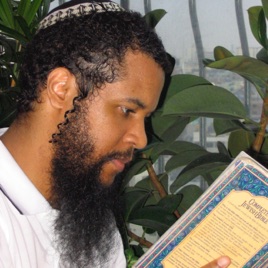
Advertise on podcast: Complete Parashah Library (Messianic)
Rating
3.2from
This podcast has
105 episodes
Language
EnglishExplicit
No
Date created
2009/10/13
Latest episode
2026/01/10
Average duration
37 min.
Release period
1 days
Description
These 105 podcast episodes represent the complete 54 Parashat HaShavua (Weekly Torah Portions) as produced by myself, Torah Teacher Ariel. Visit my home site at TetzeTorah.com for more Messianic resources. While you are there, we invite you to fill in your name and email address to subscribe to Ariel’s Weekly Messianic Newsletter to receive the written commentaries delivered to you by email, and as a bonus, you will also receive the email-exclusive written commentary to the Haftarah portion!
Unlock Complete Parashah Library (Messianic) podcast Email contact info,
Listeners & Audience details
Email contact information
Direct podcast contact details

Listeners
Audience numbers & engagement insights

Audience details
Podcast Insights

Social media
Check Complete Parashah Library (Messianic) social media presence


Podcast episodes
Check latest episodes from Complete Parashah Library (Messianic) podcast
01 B'resheet (Part A) - In the beginning - Genesis 1:1-6:8
2026/01/10
The Signature of God “In the beginning God….” I can remember growing up, listening to rabbis’ and preachers’ sermons using the first four words of our parashah for this Shabbat, B’resheet. There is quite a bit to contemplate within that first verse, they always told me. In fact, some say, the opening phrase pretty much sums up the foundation and purpose for our existence. In this first of two sections, I want to examine some of the details for the creation perspective. “In the beginning God….” Were it not for this foundational starting point we would be left with very little direction in our lives. Unlike that of HaShem, our existence is finite. We have beginnings, and we need to be able to trace our simple beginnings to something substantial. Even the non-believing scientists espouse to this fact, by the presence of various evolutionary models that all purport a beginning “Somewhere…. Out there….” By beginning with HaShem, however, the authoritative groundwork is laid, whereby we can build a solid purpose for our existence, even as meager tenants of his creation. To be sure, as we shall soon find out, one of the primary reasons for man’s creation was to rule over the fish, birds, animals, and over all the earth (1:26). Modern scientists would like for us to believe that we are all some fantastic jumbled mass of preconceived amino acids that supposedly grew intelligence in the course of a few million years. They claim that we have simply evolved and crawled from the “primordial soup”, into the awareness of being able to scientifically study, in depth, our own simple beginnings. But the opening verses here in Genesis not only diametrically oppose that hypothesis, they don’t even afford us the luxury of scientific research. The narrative takes for granted the fact that all things came to be by the power of God, without going into any scientific studies to prove it! Beginning with HaShem changes our viewpoint from that of scientific observation, to one of absolute faith, grounded in the Word of God. A scientist, who refuses to objectively deal with a supernatural creation, is a scientist who refuses to deal with a supernatural God! By removing God from the equation, mankind effectively dulls his own conscience towards the responsibility of his own actions, good or bad—if there is “no God”, then ultimately, there is no need to answer to anyone but “myself”. In this way, the Torah teaches that mankind ultimately destroys himself, and becomes a fool. The mercy of the Holy One offers us an authoritative beginning, complete with purpose and structure for our lives. When God begins something, its destined purpose is made sure.
01 B’resheet (Part B) - In the beginning - Genesis 1:1-6:8
2026/01/10
Spiritual Power The word translated as “hovered”, in verse two of chapter one, is “m’rachefet." The root word is “rachaf," and conveys the sense of “shaking,” “moving,” or “fluttering,”[1] as when a bird softly relaxes its flight to alight upon its young. It adequately describes the actions of the Ruach (Spirit) as he lovingly and closely watches over the created substance. How so? Well, this verb, although found three times in Scripture, is defined as “hovering” only one other time in the entire TaNaKH: “He found his people in desert country, in a howling, wasted wilderness. He protected him and cared for him, guarded him like the pupil of his eye, like an eagle that stirs up her nest, hovers over her young, spreads out her wings, takes them and carries them as she flies.” (Deuteronomy 32:10-11) This beautiful illustration of the protective power of the Spirit, in relation to his children, Am Yisra’el (People of Isra’el), as they traveled through the wilderness reminds me of the same Spirit that hovered over the waters at the beginning of creation. The word translated “hovers”, in our above verse, is the same root as the one used in Genesis 1:2, “rachaf”. In fact, to strengthen the connection between the two applications, the Haftarah to B’resheet is Isaiah 42:5-43:10. A “haftarah” is a prescribed reading portion from the prophets and writings, chosen to compliment the Torah portion. In this passage, we read in the opening seventeen Hebrew words, a summary of the first chapter in Genesis: “Thus says God, ADONAI, who created the heavens and spread them out, who stretched out the earth and all that grows from it, who gives breath to the people on it and spirit to those who walk on it….” Omniscience at Work Unlike the evolutionist models, we find in the Torah, a Creator that is intimately interested in his creation. He doesn’t just whip something together, via cosmic dust and proton-charged molecules, and then abandon it to “evolve” on its own. His beginnings, as stated above, carry with them, meaning and divine purpose. Reading further into our parashah, HaShem goes on to create: 1. Light and Darkness on the first day 2. Firmament and sky on the second day 3. Dry land and seas, grass, plants and trees on the third day 4. Stars, planets, sun and moon on the fourth day 5. Marine life and birds, livestock and crawling animals on the fifth day 6. Male and female on the sixth day 7. A time of rest and refreshing on the seventh day The sequence of events is not randomly initiated like the evolutionary models suppose. Everything is done with a super-intellect at the helm. Our galaxy is not just spinning along, drifting through the universe with no one to chart its course. Our LORD, ADONAI Tzva’ot (the LORD of Hosts) was there at its birth, and he will be there when it comes to an end, orchestrating every minute detail. When all of his creation has run it’s chosen course, he will be there to facilitate another new beginning. I have spent quite a bit of time discussing the details of creation versus evolution, and the consequences of choosing the wrong system. However, believe it or not, that was not the primary thrust of my commentary. I want to briefly talk about the decision to sin, from a different angle. This brings me to the second part of my commentary: man’s choices.
02 Noach - Noah - Genesis 6:9-11:32
2026/01/10
Noach walked the invisible road of faith, just like everyone else, who names the name of ADONAI, is expected to walk! He wasn’t some super-human faith hero, endowed with abnormal amounts of trust! He was, in fact, singled out to receive a prophetic word about the impending judgment that was to befall all of mankind. Yet, once he received the instructions to begin building the ark, the word was out! He obediently acted in faith, with regards to HaShem’s instruction (Genesis 7:22) and the impending calamity, which was, as of yet, unseen (Hebrews 11:1a, 7b)! The remaining mass of humanity wasn’t asked to build the ark, they were only instructed (via Noach’s preaching, 2 Peter 2:5) to get into the ark. HaShem promised that any who would “run to the tree” of safety, that is, to the ark that Noach was building, would find life. Moreover, the very same floodwaters that destroyed that wicked and perverse generation, were the very same waters that floated the ark to safety! But the same Adversary, who was at work in the Garden, was the same one at work in the world of Noach’s day also. In the Garden, he tricked mankind into “running to the tree” when God said “stay away”; in Noach’s situation, the Adversary tricked mankind into “running from the tree” that God said to “run to!"
03 Lekh L'kha (Part A) - Get yourself out - Genesis 12:1-17:27
2026/01/10
In the fourth century, when the organized Church decided to divorce herself from her spiritual mother, Judaism, she unwittingly planted the seeds of anti-Judaism. Anti-Judaism is not to be confused with Anti-Semitism. The former is the dislike or disinterest of Jewishness and Judaism specifically; the latter is the dislike or disinterest in the Semitic race altogether. By the way, both fall into the category of violating the verse in examination and both are disrespectful to Father Avram and displeasing to HaShem! Over the centuries, this seedbed has blossomed into a full-grown weed called Replacement Theology. This heretical belief fosters the mistaken idea that “God gave up on the Jews when they corporately rejected his Son Yeshua, and instead, adopted the newborn Gentile Church as his chosen people. The unfortunate Jews were left to face the curses of the Torah, and the Wrath of an angry Father, while the Church inherited (spiritually of course) most of the blessings and promises to the Jews, as pronounced in the Torah.” Fortunately, this theological framework is neither blatantly taught to Christians, openly favored by the same, nor endorsed by HaShem!
03 Lekh L'kha (Part B) - Get yourself out - Genesis 12:1-17:27
2026/01/10
May I suggest (under the guidance of the Apostolic Scriptures) that the Memra of YHVH appeared to Avram in such a way as to allow Avram to address him as a servant would address his earthly master in respect? Did Avram see a man? Did he see the LORD? I can't be dogmatic either way. But one thing is sure: Avram believed the unbelievable, but it was to the Word of the LORD, the Memra, that he addressed his objective faith! Surely HaShem saw into the heart of the patriarch and recognized the appropriation of the choices that lay before him. What is more, only the LORD himself can supernaturally open the eyes of a man to allow him to make a choice between choosing his Messiah or rejecting him. Avraham chose to lay hold of the Promise given in Genesis 12:1-3 by seeing at the heart of such a promise a glimpse of the Messiah who would bring it to pass!
04 Vayera (Part A) - He appeared - Genesis 18:1-22:24
2026/01/10
To neglect circumcision (b’rit milah) is to neglect the chosen sign of the covenant, and consequently, it is rejection of the covenant itself. It was to become a unique marker, outwardly identifying those males of the offspring of Avraham, as inheritors of the magnificent promises that HaShem was making with this man. It does not serve to secure those promises through personal effort. What is more, the sign of circumcision was to be an indicator that the participant was adopting the same faith that Avraham possessed! The promises were of faith (read Romans chapter 4 carefully). To be 100% sure, the Torah says that the promises were given to him before he was circumcised (Ibid. 10, 11)! This is why, after HaShem promised that his seed would be as numerous as the stars (15:5, 6), Avraham was credited with being righteous—because he believed the unbelievable!
04 Vayera (Part B) - He appeared - Genesis 18:1-22:24
2026/01/10
In essence, “works of the law” refer to those “group requirements” as outlined and delegated by each individual group functioning under the prevailing Judaisms of Paul’s day. Rav Sha’ul (Apostle Paul), missionary to the Gentiles, had to defend the correct Torah viewpoint in his letters addressed to the Churches at Galatia (specifically chapter 5), as well as to the one in Ephesus. Circumcision, a shorthand way for Paul to say "conversion to Judaism/becoming a Jew", was historically misused, but there is no reason for us to continue in such a misunderstanding. Nor is there any reason for the emerging Torah communities to shrink back from that which God has clearly given, provided we maintain our primary identity as that of one firmly grounded in Mashiach.
05 Hayyei-Sarah - Sarah’s life - Genesis 23:1-25:18
2026/01/10
The portion contains some rather somber notes, as it records the deaths of Sarah, Avraham, and Yishma’el. Sarah lived to be 127 years old, the Torah tells us. In all of this time, we hear of only one semi-direct revelation to her from HaShem, and that is when she overheard the conversation between her husband and God, about Yitz’chak, and laughed. Other than that, we don’t have any recorded Scriptures indicating her direct contact with the Almighty, in the same manner as her husband. Why is this significant? Because it shows that even though she did not have the exact same revelations from HaShem that Avraham did, surely she had a genuine, living relationship with her God! This is proven by the quality of faith and support that she displayed towards her husband, amidst his unbelievable callings. Packing up and leaving the only home she had known for 65 years (she being 10 years his junior when they left; see 12:4; 17:17b), following him to lands unknown, and allowing him to take their son of promise to a distant mountain to slay him. All of these real-life circumstances required a considerable amount of patience and faith from someone such as Sarah.
06 Tol’dot (Part A) - History - Genesis 25:19-28:9
2026/01/10
The Torah has quite a bit to teach us about history and offspring. To be sure, it has been aptly noted that “a person that knows not from whence he came, will be ill-equipped to properly deal with where he is going to.” Our current portion gives us the beginning of the fast-paced story of two brothers, ‘Esav (Esau, also called Edom), and Ya’akov (Jacob), and their ongoing struggle to become the men that they feel they deserve to be. It is an interesting tale, complete with deception and disappointment. Rivkah, Yitz’chak’s wife, gives birth to twins, who grow to become individuals with quite opposite character traits. The elder, ‘Esav, is a skilled hunter, a rough, hairy man, with a flair for cooking tasty game. He winds up being favored by his father. On the other hand, the younger, Ya’akov, is a tenderhearted, dweller of tents, smooth-skinned and quiet; he becomes the favorite of his mother.
06 Tol’dot (Part B) - History - Genesis 25:19-28:9
2026/01/10
It is the desire of HaShem that we should indeed inherit the blessings intended for us! He told Avraham of the future inheritance and blessings of his offspring (Genesis 17:1-8), Yitz’chak of the future inheritance and blessings of his offspring (26:3-5), and later (in the next parashah), we will once again read about HaShem reminding the young man Ya’akov, about the future inheritance and blessings of his offspring. Why does HaShem remind us about the inheritance and blessings that are ours? I might imagine that it is because he doesn’t want us to forget about them. More than that, it is a reminder to us of his limitless, unbridled love and concern for us, even though we don’t deserve such things. But along with these promises, he wants us to also be reminded that it is his authority and grace alone that makes our glorious history a reality! To be sure, Ya’akov and his mother Rivkah got themselves into a real mess trying to secure what they both knew belonged to them.
07 Vayetze - He went out - Genesis 28:10-32:3
2026/01/10
What Ya’akov needed in his life was a mirror, someone or something to show him the greed and selfishness of his own heart. He needed to be able to see the inner-workings of his own selfish heart, in order to move on past this time of trials in his life. This was provided for him in the person of Lavan.... How can we apply this Torah lesson to our lives today? We already know that the Torah itself works in our lives as a mirror, highlighting the “way in which we should walk”—a way that should be pleasing to our heavenly father. In fact the book of James (whose Hebrew title is Ya’akov), informs us that the man who “looks into the mirror of the Torah” and fails to heed its instruction (do what it says), is like a man who beholds his face in a real mirror, walks away, and immediately forgets what he just saw (James 1:21-25). But sometimes HaShem uses everyday experiences to act as his mirror of truth, showing us exactly where we need to concentrate our energies of correction.
08 Vayishlach - He sent - Genesis 32:4-36:43
2026/01/10
The Torah says that when the unknown assailant failed to defeat Ya’akov, then he struck the socket of Ya’akov’s hip, causing it to go into disjoint. “The man said, “Let me go, because it’s daybreak” (vs.27a) But by now, Ya’akov had come to the realization that this was no ordinary man. It was not some desert robber, or bounty hunter, or even a demon—it was none other than a representative of the One who could see into his own hollow soul and cause the supernatural change that Ya’akov knew he so desperately needed! For this very reason, rather than let go of this man, Ya’akov clung to him for dear life! He had finally come to the place where he knew he could not—would not—run any further! He knew now inside of himself, that this was the only One who could rescue him from his own fearful self! So, despite the all-night struggle, he mustered up enough strength to say within himself, “I will not! I refuse to let you go! I have spent all of my life running in fear from the things that I could not control! I have nowhere else to turn for help! So I will NOT let you go! I will not let you go UNTIL YOU BLESS ME!” This was the breaking of the man Ya’akov. This was the moment when HaShem recognized that he was genuinely a humbled man, in desperate need of a Savior.
09 Vayeshev - He continued living - Genesis 37:1-40:23
2026/01/10
The lessons today should be obvious: HaShem masterfully orchestrated every single event of Yosef’s life, bringing him into a position where he would be the key player in the provision and leadership of the young tribe of Isra’el. It was necessary to allow Yosef to experience the pain and suffering at the hands of his brothers, in order that the ultimate plan of HaShem, a plan that promised blessing and inheritance, might come to pass! So it was this way also for our own Savior Yeshua. He had to suffer shame and humiliation at the hands of his own flesh and blood, in order that the Will of the Almighty would be fulfilled. The life of Yeshua was “sacrificed” so that the lives of his brothers might be saved! We shall see also that the life of Yosef was “sacrificed” so that the lives of his brothers might be saved! "To be sure, in the case of both Yosef and Yeshua, their immediate families weren’t the only ones who would benefit from the sacrifice. The entire land of Egypt, and surrounding communities, were about to witness the provision of Almighty God, as he worked through the obedience of Yosef, a humble, anointed son of Isra’el…. "Likewise, the entire world this time has witnessed (and shall witness again soon) the provision of Almighty God, as he worked through the obedience of Yeshua, his humble, anointed, ONLY-BEGOTTEN Son...."
10 Mikketz - At the end - Genesis 41:1-44:17
2026/01/10
Yes, the Torah is a document filled with the lives of imperfect men, trusting in the providence and grace of a perfect God. Yosef once again allows his brothers to make for Kena’an with provisions for their family, but this time, unknown to his brothers, he manipulates a plan to further develop their character. Acting, I believe, under the guidance of HaShem, he singles out Binyamin and places his personal goblet in his pack. Upon learning of the turn of events, the brothers are speechless. This was the moment that Yosef was waiting for, the moment when his brothers finally had come to the place of total desperation, a place of utter helplessness. HaShem had cornered them, Yosef realized, and there was nowhere else to hide. This is the place where an individual needs to find himself, in order to accept the provision and blessing that HaShem has in store for him. By reaching the end of their rope, so to say, they are faced with the opportunity to fall on the mercy and grace of the One that they figured would be of no significant place in their lives. Someday, according to the book of Zechariah chapter 12, this is the place that the Nation of Isra’el will ultimately have to come to as well, as they face the brother that they forsook almost 2000 years ago.
11 Vayigash (Part A) - He approached - Genesis 44:18-47:27
2026/01/10
Up to this point, Yosef (Joseph) had remained unknown to his brothers. The Spirit of the Holy One was guiding him as he put his brothers through various tests of integrity and humility. Although at times it seemed rather cruel to treat them with such harshness, in fact, this was the crucible that would serve to break them down. They needed to learn a very valuable lesson, one that would transform them into the God-ordained family that they needed to be. To be sure, if Yosef’s brothers failed to learn how to put off hate, jealousy, bitter-ness, and resentment, countless more unnecessary suffering might have taken place, and their father Isra’el would have gone to his grave with a grieving soul. Yosef has orchestrated a scenario by which the brothers have reached a position of “checkmate” so to say: if they allow the “guilty” Binyamin to remain with Yosef, their father will surely die; if they attempt to defy Yosef by taking Binyamin back to their father, they all might die. Whether or not Yosef, the brothers or Binyamin realized it, HaShem had cornered them and now a reckoning must take place! The guilty brothers must come to grips with the sibling they abandoned long ago.
Podcast reviews
Read Complete Parashah Library (Messianic) podcast reviews
pauldunlap 2021/02/04
Great teaching.
I can observe. I am included in G-D’S people in Messiah Y’shua. What a wonderful podcast and encouragement for ethnic Jews and non-Jews alike. One new...
CalmMom. 2018/11/01
Deceiving missionary
Get this podcast out of the “Jewish” category you liar and deceiver. Jews don’t bother you practicing your religion, why are you going to them with yo...
KimFBFL 2016/05/15
Mis-categorized
Messianic Christianity does not belong in the "Judaism" category. Jews are still waiting for the Messiah. Please do not mislead people that this is J...
David Israel 2014/08/21
Please stop stealing space in the Jewish category
There aren't a lot of Jews looking for Jewish podcasts. Stop exploiting our small population to boost your podcast ratings. You'd be at the bottom of...
saltwind78 2014/08/04
Not Jewish
Whatever this “ Torah teacher “ teaches, it isn’t Jewish. The theology is clearly Christian.
It seems to be an attempt to draw Jews into a program of...
High Concept 2014/03/30
Christian podcast by Christian missionaries
Not a Jewish podcast. "Messianic Judaism" is another term for "Jews for Jesus," a Baptist-funded group which seeks to convert Jews to Christianity.
waiting patiently... 2013/04/19
Not Judaism
If you believe in Jesus you are not Jewish. That doesn't mean you can't practice your religion however you want, but it is Christianity not Judaism. T...
milehighdjguy 2011/09/09
Don't listen to the haters. This podcast is worth every moment.
If you want to study the fundamental roots of Judaism as a believer in Yeshua (Jesus) then you can do no wrong by giving this your ear. This podcast h...
j1fox 2010/09/28
no longer a listener
Ariel,
I would like to thank you for your efforts in creating this material. As a christian seeking his Hebraic roots, I found many things that I was...
iPhonerarooni 2010/03/11
In the wrong category
I have no problem with this fellow believing whatever he chooses. However, this is a Christian, not a Jewish podcast, and does not belong in this cat...
Podcast sponsorship advertising
Start advertising on Complete Parashah Library (Messianic) relevant audience podcasts
You may also like to advertise on these Podcasts

4.9264982000
Morning Wire
The Daily Wire

4.518767374
American Scandal
Audible

4.689331209
Get Sleepy: Sleep meditation and stories
Slumber Studios

4.79026375
Life is Short with Justin Long
Audible

4.714107348
Bad Friends
Bobby Lee & Andrew Santino

4.7126170
10 to Life
Annie Elise

4.76755462
Criminology
Emash Digital & Mike Ferguson, Mike Morford

4.87501973
The Dr. John Delony Show
Ramsey Network

4.512577662
RedHanded
RedHanded

4.959762000
Legal AF by MeidasTouch
MeidasTouch Network