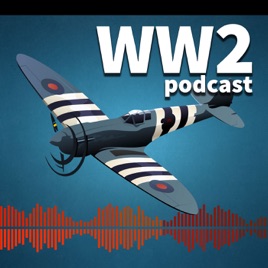
Advertise on podcast: The WW2 Podcast
Rating
4.6from
This podcast has
306 episodes
Language
EnglishPublisher
Angus WallaceExplicit
No
Date created
2015/04/01
Latest episode
2026/04/20
Average duration
50 min.
Release period
9 days
Description
A military history podcast that looks at all aspects of WWII. With WW2 slipping from living memory I aim to look at different historical aspects of the Second World War.
Unlock The WW2 Podcast podcast Email contact info,
Listeners & Audience details
Email contact information
Direct podcast contact details

Listeners
Audience numbers & engagement insights

Audience details
Podcast Insights



Podcast episodes
Check latest episodes from The WW2 Podcast podcast
303 - The Link Trainer
2026/04/20
Before the Second World War, learning to fly by instruments was one of the most difficult and dangerous skills a pilot had to master. Training had to be done in real aircraft, often in poor weather, and accidents were common.
In the late 1920s, an American inventor named Edwin Albert Link came up with an ingenious solution. His Link Trainer, sometimes called the "Blue Box," allowed pilots to practise instrument flying safely on the ground using a mechanical flight simulator.
By the time the war began, these machines had become an essential part of pilot training, and hundreds of thousands of Allied airmen first learned instrument flying inside one.
To explore the story of the Link Trainer, I am joined by Robby Houben from the Belgian Royal Military Museum, which holds several examples of these remarkable machines. Robby also has an excellent video on his youtube channel - Two Dudes Talking Tanks - which looks at the Link Trainer in the museum.
patreon.com/ww2podcast
Task Force Hogan
2026/04/15
My guest today is William Hogan, and we are going to be talking about the remarkable story of his father, Sam Hogan, and the men of Task Force Hogan.
At just twenty-eight, Sam was one of the youngest lieutenant colonels in the US Army, commanding a battalion of Sherman tanks in the Normandy Campaign only weeks after D-Day. From the hedgerows of France through to the Battle of the Bulge and on into Germany, his unit fought at the sharp end of some of the toughest fighting in north-west Europe.
William has written about his father's experiences in 'Task Force Hogan: The World War II Tank Battalion That Spearheaded the Liberation of Europe'.
patreon.com/ww2podcast
A Canadian in Stalin's Army
2026/04/01
How does a Canadian end up fighting in the Soviet Red Army during the Second World War?
My guest today is Scott Bury, and we're going to tell the remarkable story of his relative, Maurice Bury — a Canadian citizen who found himself caught in Eastern Europe when war broke out. Drafted into the Red Army in 1941, he fought against the German invasion, survived a brutal POW camp, escaped, joined the resistance in Nazi-occupied Ukraine, and was later forced back into the Soviet army for the final push into Germany.
It's a story that takes us through some of the most complex and brutal parts of the Eastern Front.
Scott has explored Maurice's experiences in three books: Army of Worn Soles, Under the Nazi Heel, and Walking Out of War. He's also the host of the podcast Beyond Barbarossa, which looks at the history of the Eastern Front in the Second World War.
patreon.com/ww2podcast
Exploding Rats and the Devices of SOE
2026/03/22
James Bond may have Q Branch supplying him with ingenious gadgets, but during the Second World War the agents of the Special Operations Executive had something just as remarkable — the SOE Camouflage Section.
This secret unit developed ingenious ways to hide weapons, radios, explosives and documents inside everyday objects, from oil cans and firewood to record players and tubes of toothpaste, helping agents operate behind enemy lines under the watchful eyes of the Gestapo.
My guest today is Craig Moore, whose book Exploding Rats and Other Devious Devices of SOE: The Camouflage Section 1941–1945 explores the remarkable work of this little-known wartime unit and the ingenious devices they created to keep agents alive and operational in occupied Europe.
patreon.com/ww2podcast
Berlin, 1939-45
2026/03/15
In this episode, I am joined by Ian Buruma to talk about life in Berlin during the Second World War. Rather than focusing on the regime at the top or the battles fought far from the city, we look at how ordinary people experienced daily life as war, repression, bombing, and fear increasingly shaped everything around them.
Our conversation centres on what it meant to survive in wartime Berlin, how behaviour and attitudes changed over time, and how the city moved from uneasy normality to catastrophe after Stalingrad and as the Red Army approached. We also discuss the experience of forced labourers in the city, including Ian's father, who was among the hundreds of thousands trying to stay alive under brutal conditions.
Ian is the author of Stay Alive: Berlin 1939–1945, which looks at life in the German capital from the outbreak of war to its collapse in 1945, focusing on how ordinary people coped as survival gradually became the central concern.
patreon.com/ww2podcast
The Long Death of Adolf Hitler
2026/03/08
In April 1945, as the Third Reich collapsed around him, Adolf Hitler died in the Führerbunker in Berlin. It is one of the most famous deaths in modern history and yet, in many ways, one of the least securely witnessed. There was no public body, no official announcement at the moment it happened, and no single, uncontested account. What followed was confusion, rumour, investigation, and decades of speculation.
Today I am joined by historian Caroline Sharples to talk about the death of Hitler itself. Why it unfolded as it did, how news of his death was received, how governments and intelligence services tried to verify what had happened, and why uncertainty and myth filled the vacuum almost immediately.
Caroline is the author of 'The Long Death of Adolf Hitler: An Investigative History', a study of the aftermath of April 1945 and the cultural and political consequences of a death that was widely anticipated but never conclusively seen.
patreon.com/ww2podcast
Pearl Harbor: Japan's Greatest Disaster
2026/03/01
Pearl Harbor is often remembered as a stunning Japanese success, a perfectly executed surprise attack that changed the course of the Second World War. But what if that familiar story is wrong?
In this episode, I am joined by now regular of the podcast Mark Stille to rethink one of the most famous events of the war. His book Pearl Harbor: Japan's Greatest Disaster argues that the attack was not a masterstroke at all, but a tactical disappointment, an operational failure, and ultimately a strategic catastrophe for Japan.
Mark's book is also available on Audible and Spotify.
patreon.com/ww2podcast
British Brigadiers, 1940
2026/02/15
For this episode, I am joined by Philip McCarty to discuss his book Point of Failure: British Army Brigadiers in France and Norway, 1940 .
It is a study of the brigadiers who served in France and Norway in 1940. Rather than focusing on campaign narratives, Philip examines the men who held this rank. Their backgrounds. Their training. The influence of networks, regimental culture and staff college upon their careers. And what happened to them after the defeats in France and Norway?
This is a fresh way to approach the early-war British Army, offering insight into how the institution thought about leadership, promotion, and responsibility at a moment of intense pressure.
patreon.com/ww2podcast
295 - Inside the Siege of Warsaw
2026/02/08
In September 1939, during the German invasion of Poland, American photographer and film-maker Julien Bryan became the only foreign journalist to remain inside Warsaw during the Nazi siege. While other correspondents fled, Bryan stayed in the city, documenting the Siege of Warsaw from the streets, hospitals and civilian shelters as German bombs fell.
Bryan's photographs and film captured the impact of the Second World War on civilians, showing wounded men, women and children, devastated neighbourhoods, and the resilience of ordinary Polish people under attack. His footage became some of the first uncensored images of Nazi aggression shown in the United States and Western Europe, shaping how the war in Poland was understood abroad.
In this episode of the WW2 Podcast, I am joined by historian Pete Zablocki, host of the History Shorts Podcast and author of a recent article on Julien Bryan for WWII History Magazine. We explore why Bryan chose to stay in Warsaw, how he worked under constant danger, how his photographs and film escaped occupied Poland, and why his record of the 1939 Siege of Warsaw remains historically vital today.
patreon.com/ww2podcast
Churchills Forgotten Generals: Slim, Auchinleck & Savory
2026/02/01
Today, we are heading back to the Burma campaign, but through a slightly different lens. Rather than focusing on a single battle or operation, we examine three men who shaped how the war in Burma was fought and ultimately won.
When people think of British commanders in the Far East, one name usually stands out: Bill Slim. His leadership of the Fourteenth Army and the victories at Imphal, Kohima and the advance into Burma rightly secure his place among Britain's most successful wartime commanders. Claude Auchinleck is also well known, though more often for the Middle East than for his crucial role in India during the later war years.
But there is a third figure who is far less familiar, Reginald Savory. He was not a battlefield commander in the popular sense, but his influence on training, doctrine and the transformation of the Indian Army was profound. Without the changes he helped drive, the victories of 1944 and 1945 would have looked very different.
Today, I am joined by Alan Jefferys and Raymond Callahan, authors of Churchill's Forgotten Generals: Victors in Burma. In the book, they bring these three careers together, showing how Auchinleck, Slim and Savory were shaped by the Indian Army, how they learned from early defeat, and how their combined efforts turned Burma from disaster into success.
What makes this story so compelling is that it is not just about command at the front. It is about institutions, training, morale and the hard work of learning how to fight a modern jungle war.
patreon.com/ww2podcast
Allied POWs in WWII
2026/01/15
This episode looks at a very different side of the Second World War. Not the battlefield, but captivity. It focuses on the experiences of Allied prisoners of war held in German camps and how they tried to survive, adapt, and maintain a sense of purpose behind barbed wire.
I am joined by Midge Gillies, author of The Barbed Wire University. A newly revised edition was released in 2025. Her book explores the lives Allied POWs led in captivity, from the routines and hardships of camp life to the ways prisoners supported one another and resisted the effects of long-term imprisonment. Education forms part of this story, but it sits alongside a wider picture of how men coped with boredom, uncertainty, hunger, and the psychological strain of captivity.
Together, we discuss how prisoners organised themselves, how knowledge and skills were shared, and what these improvised communities reveal about resilience and identity under extreme conditions.
patreon.com/ww2podcast
The War Chest of Colonel Kreps
2026/01/11
In this episode, I talk with Erik Kreps about a remarkable family mystery. Erik's grandfather, Colonel Kenneth Ray Kreps, served in the Second World War, and after returning home, he sealed his wartime belongings in a chest with the instruction that it was not to be opened until after his death. For decades, the chest remained closed, and no one in the family knew what it contained.
After Colonel Kreps died, the chest was put into storage and almost forgotten. At one point, it was nearly auctioned off, which could have meant the contents were lost forever. Instead, it was saved, and when it was eventually opened, it revealed letters, photographs, medals, and documents that reshaped Erik's understanding of his grandfather and the life he lived during the war.
You can find Erik on X at @Veiled_Valor where he shares updates about the discoveries along with occasional posts about others connected to the story. Here is a link to a set of slides featuring images of the chest contents and further material on Colonel Kreps.
patreon.com/ww2podcast
Far East RAF Liberators
2026/01/01
RAF Liberator bombing operations in India, Burma, and Thailand remain one of the least explored air campaigns of the Second World War. Flying long-range missions from Bengal, RAF crews attacked Japanese targets across Southeast Asia, including the infamous Thailand-Burma Railway, under demanding and often dangerous conditions.
In this episode of the WW2 Podcast, I am talking to historian Matt Poole, author of Far East RAF Liberators: Attacking the Japanese: Roy Andrews and 215 Squadron. Together, we explore this campaign through the experiences of Roy Andrews, a Royal Australian Air Force wireless operator and air gunner who flew with RAF 215 Squadron on B-24 Liberator bombers during the final months of the war.
Between October 1944 and April 1945, Roy Andrews flew bombing, strafing, and air-sea rescue missions over Burma and Thailand. By viewing the wider RAF air war through the lens of one airman, this episode examines long-range Liberator operations, low-level attacks, and daily life on a forward airfield in India, offering a personal perspective on an often overlooked chapter of the Second World War.
patreon.com/ww2podcast
Your WWII Questions Answered
2025/12/24
For this episode of the podcast, we are doing something a little different. Rather than focusing on a single subject, we open the floor to your questions.
Over the past few weeks, podcast patrons were invited to submit questions they had always wanted to ask about the Second World War. These range from strategy and leadership to memory, myth and the smaller details that continue to provoke curiosity today.
To help answer those questions, I am joined by two returning guests.
John McManus is a military historian specialising in the United States Army in the Second World War. He is the author of numerous books and is known for combining operational history with the lived experience of soldiers on the ground.
Also joining the discussion is Kevin Hymel. Kevin is a historian and biographer of General George S Patton, with the third volume of his trilogy due for publication in 2026. He is also an experienced battlefield tour guide.
John and Kevin are the hosts of the podcast WW2 Live, which features a regular segment called 'Stump the Chumps' in which listeners submit challenging or unusual questions. That format inspired this episode.
Together they take on a wide range of listener questions, offering thoughtful and often surprising insights into how the Second World War was fought, remembered and understood.
patreon.com/ww2podcast
Charles De Gaulle
2025/12/15
Charles de Gaulle remains one of the most distinctive figures to emerge from the Second World War. Soldier, writer, leader in exile, and later the creator of the Fifth Republic, he played a central role in reshaping modern France. His relationship with Winston Churchill, their shared struggle during the war, and the influence both men continued to wield long after the fighting ended make him a fascinating subject.
In this episode, I speak with historian Richard Vinen, author of Last of the Titans: Churchill and de Gaulle. His book explores the lives of de Gaulle and Churchill and sets their wartime partnership within a wider story of national identity, political power, and the long shadow of past greatness. Richard guides us through de Gaulle's early years, his outlook as a soldier, his time in London, and the reasons he became such a commanding presence in French public life.
Last of the Titans: Churchill and de Gaulle is also available as an audiobook on Audible.
patreon.com/ww2podcast
Podcast reviews
Read The WW2 Podcast podcast reviews
Kh600rr 2026/04/05
Very thorough and insightful
Great series I’ve been enjoying for years.Angus is very knowledgeable.
J Clam 2026/03/31
Got to tell you this:
My father was a captain at 21 in the 80th infantry. After the third time wounded in combat, then repaired, he was transferred to Paris to become the h...
cdgcfgfjg 2026/02/14
Ww2 podcast
So glad I found this podcast. My uncle was killed in May 1945 at Pyanbwe fighting with the Kings Own Scottish Borderers. Thankyou for your informat...
Addcghhikffk 2026/03/08
Ehh
Content is good, but it’s SO dry, and the host ramble on and don’t give enough actual info
Amdyfyn 2025/11/12
American in WW2 Canada flight training
My Dad was trained in Canada before the US entered and then joined the US Army Air Corps. It gave him great preparation as an eventual highly decorate...
Dr. Winder 2025/11/13
Great when great guests
This podcast is really interesting and good about going in depth! Angus is great at talking to the guests, my only complaint is the guests that monolo...
SilentErr0r 2025/10/09
Great Material
The content is great and easy listening.
Andrew Kinsel 2025/07/20
Andrew Kinsel
I love this show! Thank you for your great work and I can tell you love it - it shines through.
Catsssssssss67 2025/09/11
Weak
Not good and boring 🥱
🤬😰😱🥵🫣
TruckerCorey95 2025/08/25
I want to love this podcast…
I want to love this podcast but I only get a few minutes into each episode before it’s too frustrating to go on. The host often rambles on and seems u...
Podcast sponsorship advertising
Start advertising on The WW2 Podcast relevant audience podcasts
You may also like to advertise on these Podcasts

4.4371061566
The Megyn Kelly Show
SiriusXM
4.888901269
Fearless with Jason Whitlock
Blaze Podcast Network

4.8118931000
Mind Pump: Raw Fitness Truth
Sal Di Stefano, Adam Schafer, Justin Andrews, Doug Egge
4.8102131585
Tara Brach
Tara Brach

4.541561215
Something You Should Know
Mike Carruthers | OmniCast Media

4.513841343
Strictly Anonymous Confessions
Kathy Kay

4.8292781897
Fantasy Footballers - Fantasy Football Podcast
Fantasy Football

4.62382612
Football Weekly
The Guardian

4.45387666
Two Judgey Girls
Two Judgey Girls

3.8258501152
The Viall Files
Nick Viall