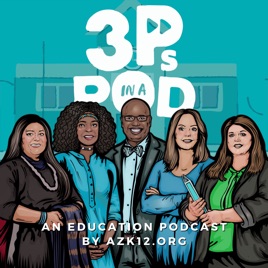
Advertise on podcast: 3 Ps in a Pod: An Education Podcast
Rating
5from
This podcast has
231 episodes
Language
EnglishPublisher
Arizona K12 CenterExplicit
No
Date created
2017/11/09
Latest episode
2025/05/15
Average duration
35 min.
Release period
14 days
Description
Join the conversation about education in Arizona. Featuring educators and leaders from Arizona and far beyond, 3Ps in a Pod explores the practice, policy, and passion of education in our state. You'll find us discussing classroom management, technology integration, mentoring practices, and much more, all to work toward the best ways to support our students.
Unlock 3 Ps in a Pod: An Education Podcast podcast Email contact info,
Listeners & Audience details
Email contact information
Direct podcast contact details

Listeners
Audience numbers & engagement insights

Audience details
Podcast Insights

Social media
Check 3 Ps in a Pod: An Education Podcast social media presence


Podcast episodes
Check latest episodes from 3 Ps in a Pod: An Education Podcast podcast
The Art and Science of Mentoring (More Than Mentoring, Part 9)
2025/05/15
On this final episode in this series on More Than Mentoring, we welcome Arizona K12 Center Executive Director Daniela Robles and Assistant Director of Induction and Mentoring Kathleen Paulsen back to the podcast.
They reflect on themes through this season and discuss the role of mentors and what formal mentorship means for the enhanced practice and sustainability of educators across Arizona.
Daniela recognizes how there is both an art, that includes the relationship component of mentoring, and a science, that leans into data collection and student learning, to mentoring. Balancing these appropriately requires intellectual preparation, she notes. Daniela and Kathleen then unpack what intellectual preparation is and what that looks like for both mentors and the teachers they mentor.
Daniela and Kathleen close this episode by sharing their encouragement and thoughts as we close one school year and look ahead to the next.
Continue your learning
After listening to this episode, use the reflection guide to explore how you might further connect students to community and co-design learning opportunities unique to your location. Find the reflection guide at this link.
Learn more about the Arizona K12 Center at azk12.org.
Inside the Mentor-Mentee Connection (More Than Mentoring, Part 8)
2025/05/08
On this episode of 3Ps in a Pod, we continue our conversation with mentor Inez Ramirez, NBCT, from Maricopa Unified School District — this time, with one of her teacher mentees, Anthony Gonzalez.
Through the episode, Inez and Anthony share with host Juliana Urtubey, NBCT, and discuss with each other how they worked together through the past year and the ways Inez' instructional mentoring support has had a deep impact on Anthony and his students.
Inez and Anthony's conversation centers on some specific ways that they have been working to strengthen Anthony's instructional practices. This dynamic mentor-mentee duo guides us through their year-long learning journey together and touches on specific elements of Anthony's practice that they have focused on to create a more engaging environment for students and strengthen the impact of Anthony's teaching on his students.
The podcast closes with Anthony reflecting on the past school year and the ways he has built his "toolbox." He shares with us how others are helping him to reflect and continue to grow as he learns how to apply new skills in his instructional practice. Anthony reminds us of the importance of reflection as we continue to grow and evolve as professionals and calls us to be open to learning and talking about our practice.
Continue your learning
After listening to this episode, use the reflection guide to explore how you might further connect students to community and co-design learning opportunities unique to your location. Find the reflection guide at this link.
Learn more about the Arizona K12 Center at azk12.org.
Mentorship in Action with Inez Ramirez (More Than Mentoring, Part 7)
2025/05/01
On this episode of 3Ps in a Pod, you will meet Inez Ramirez, NBCT, a mentor with the Maricopa Unified School District. Inez walks us through her role as an instructional mentor for beginning teachers and the ways mentoring supports teachers in her district. She shares how she not only differentiates the support she provides but the various ways that she meets the needs of her mentees and maximizes their time spent connecting. Host Juliana Urtubey, NBCT, and Inez reinforce that the mentor-mentee support structures are built on trusting relationships.
As a mentor through the Arizona K12 Center's Arizona New Teacher Support Program, Inez worked on a case study about her mentorship of one teacher in particular this past year. She shares a bit about how she worked with that teacher, Anthony Gonzalez. Inez also provides advice on how to avoid stressors that are inevitable for teachers. Anthony's growth demonstrates the ways instructional mentoring can help strengthen the impact of early career educators.
Be sure to tune in to the next episode when we will hear from both Inez and her mentee Anthony about their work together through the past year.
Continue your learning
After listening to this episode, use the reflection guide to further explore and apply the power of mentoring. Find the reflection guide at this link.
Learn more about Joellen Killion's work Are You Coaching Heavy or Light? and Coaching heavy, coaching light: How to deepen professional practice.
Learn more about the Arizona K12 Center's professional learning opportunities and mentoring and induction support at azk12.org.
Mentoring Pre-Service Teachers (More Than Mentoring, Part 6)
2025/04/24
So far in this series on More Than Mentoring, we've been talking about mentoring you receive as a classroom teacher. On today's episode, we step inside Northern Arizona University's College of Education and talk with two faculty about how they mentor student teachers.
Bobby Macias and Ashley Esparza are both teach and support pre-service educators at NAU. They share with host Juliana Urtubey, NBCT, about the current realities of supporting pre-service educators and the conversations they are having with those they support. As we explore the mentoring components of pre-service support, Bobby talks about reflective practice and the ways educators strive to meet the needs of every student. Ashley discusses how to model authentic reflection in practice as a way of making this practice more authentic for pre-service students.
Ashley and Bobby also provide a deep dive into how they support pre-service educators and the incredibly rich experience that students in NAU's education programs have an opportunity to experience. They detail the collaborative supports available to pre-service educators in order to help them be fully prepared for a successful entry into their career. Juliana also explores what Ashley and Bobby have had the opportunity to learn as they mentor future educators and the ways in which we are learning to sustain educators and teachers in classrooms. Bobby and Ashley wrap up this episode with how they feel that mentorship supports educators in the field and the impact that this has on students.
Continue your learning
After listening to this episode, use the reflection guide to explore how you might further connect students to community and co-design learning opportunities unique to your location. Find the reflection guide at this link.
Learn more about the NAU education program at nau.edu/college-education.
Learn more about mentoring and educator support offered by the Arizona K12 Center at azk12.org.
Mutual Mentorship: Colleagues as Coaches (More Than Mentoring, Part 5)
2025/04/17
Emmett Burnton and Ryan Donovan are two teachers both working in the social studies department at Boulder Creek High School in Deer Valley Unified School District. Not only colleagues, Emmett and Ryan have become mentors and coaches for each other. In today's episode, 3Ps in a Pod hosts Kathleen Paulsen, NBCT, and Marlys Weaver talk with these outstanding educators about how they mentor each other to be their professional best and continue to evolve their practice.
Both teachers were also recognized for their teaching practice by the Arizona Educational Foundation. Emmett is the 2025 AEF Teacher of the Year, while Ryan is a 2025 AEF Ambassador for Excellence.
Emmett and Ryan share with Kathleen and Marlys how they connected at Boulder Creek and how their strengths differ and compliment each other. They also reflect on other educators and moments that guided their teacher development.
Both teachers explore in depth how they work to develop intentional and thoughtful lessons and assessments. They discuss their reflective practice and how it has positively impacted students.
Emmett calls us to think about mentorship in a way that creates deep relationships. These relationships help us really see our students and our peers in meaningful ways. Ryan shares about the value of protected time for collegial support and mentoring and the professional growth that results. He asks us to think about a mentor relationship as an opportunity for open dialogue and not about spending time focusing on deficits.
Continue your learning
After listening to this episode, use the reflection guide to explore how you might further connect students to community and co-design learning opportunities unique to your location. Find the reflection guide at this link.
Here are a couple additional resources mentioned in this episode:
Dr. Carol Dweck's on growth mindsets
About Parker J. Palmer
The Courage to Teach: Exploring the Inner Landscape of a Teacher's Life by Parker J. Palmer
Learn more about the Arizona K12 Center at azk12.org.
Mentoring and Professional Learning (More Than Mentoring, Part 4)
2025/03/27
Join Kathleen Paulsen, assistant director of induction and mentoring at the Arizona K12 Center, as she connects with long-time educator and author Joellen Killion. They take a deep look at mentoring and induction and talk about what continues to inspire and drive Joellen's work.
Joellen is a renowned leader in education with 30 years of experience in the design, implementation, and evaluation of professional learning. Joellen has served as a senior advisor to Learning Forward and is also the author of several books. On the podcast, Kathleen specifically discusses Joellen's article "Coaching Light Coaching Heavy" and how it informed and changed the way in which she views mentoring, induction, and her own professional learning.
Joellen starts the podcast by talking about the magic that results from high-quality professional learning and the impact that this has on students. She also talks about her "why" and what pushes her to continue to support the field.
Joellen and Kathleen discuss the feedback element in the professional growth process and the impact that this can have both on teachers and students. Joellen calls us to start by asking the person we are in community with what they would like to learn? This can be an entry point that leads to greater results and deeper understanding.
Joellen also pushes us to think past not only using teacher retention as a measure of success, but to look at measuring the success of a mentoring program through the student's success. She explains to Kathleen what this could look like in practice and how making students the primary goal of mentoring might play out in school buildings. Kathleen also emphasizes the delicate balance of building mentor-mentee relationships as well as supporting students in the classroom through mentees.
Continue your learning
After listening to this episode, use the reflection guide to explore how you might further connect students to community and co-design learning opportunities unique to your location. Find the reflection guide at this link.
Learn more about Joellen's work through some of these links:
Original Article: Are You Coaching Heavy or Light? by Joellen Killion
Updated Article: Coaching heavy, coaching light: How to deepen professional practice by Joellen Killion
Assessing Impact: Evaluating Professional Learning by Joellen Killion
The Feedback Process: Transforming Feedback for Professional Learning by Joellen Killion
Learn more about the Arizona K12 Center at azk12.org.
Mentoring for Different Learning Needs (More Than Mentoring, Part 3)
2025/03/20
Dr. Andy Kahn of Understood.org returns to 3Ps in a Pod to talk about what to know about students with learning and thinking differences and also how mentors can help teachers in supporting these students, all on this third episode of our series on More Than Mentoring.
Dr. Kahn asks both teachers and mentors to have a working knowledge of our classroom and students in a holistic and meaningful way. Mentoring cannot only help teachers prepare for the content and logistical elements of what needs to be delivered in the classroom but also for the emotional aspect as well. Mentoring is a way to support a growth mindset, set teachers on a path for success, and set students on a successful path of learning and growing as well, he shares.
3Ps Host Juliana Urtubey, NBCT, and Dr. Kahn also explore Universal Design of Learning and how this approach can support early career teachers as well. Dr. Kahn provides realistic examples of how UDL can be applied to our practice to support learners and mentees and create environments that help to remove the stigma some students experience and lower demands teachers may experience.
Dr. Kahn reinforces the idea of modeling what we expect from our learners. He asks us to stay mindful of modeling how we navigate through moments of need or dysregulation and navigate executive functions; we are establishing the environment that we hope our learners and mentees will feel comfortable demonstrating back. Dr. Kahn asks us to evaluate our practice: if we are asking mentees or learners to do more than we are willing to do ourselves, then we need to reassess and determine what we are asking and why.
Dr. Kahn leaves us with thoughts around flexibility that unlock learning opportunities that will serve our students in ways that help them feel safe, engaged and support lifelong learning.
Continue your learning
After listening to this episode, use this reflection guide to further explore how you can connect this episode to your work.
Learn more about the resources mentioned in this podcast at understood.org.
Learn more about the Arizona K12 Center at azk12.org.
Being a Mentoring Teacher with Sarah Brown Wessling (More Than Mentoring, Part 2)
2025/03/06
Join host Juliana Urtubey, NBCT, on this episode of 3Ps in a Pod as she connects with Sarah Brown Wessling, NBCT, an Iowa-grown educator who is as passionate as ever about what she does and finding ways to make deep connections. In this second episode of our series "More Than Mentoring," Sarah explains how she collapses the space between mentor and teacher in order to be in a collaborative relationship with her mentees.
Sarah Brown Wessling is a high school English teacher and the director of the National Teacher of the Year program, which gives her the opportunity to work with the state teachers of the year. She is a fierce advocate for the profession and a mentor who embodies curiosity and kindness.
Sarah pushes us to explore our teaching identity and to examine how we mentor teachers to ensure we aren't telling teachers how to establish a teaching identity but supporting them in discovering their own teaching identity through reflection. She also explains why and how she crafts invitations for learning and how that impacts trust, autonomy, respect, and community.
Sarah and Juliana talk deeply about developing relationships and how limiting our idea of mentoring to specifically timed meetings can limit those relationships. Mentors, whether working with students or adults, should consider establishing connection points that allow for rolling and continuous conversations. Sarah coaches us to be the most interested person in the room and ask questions that will support growth. She shares that questions are like "pulleys" and, when we are genuinely curious, questions pull us closer.
Don't forget that Sarah reminds us that listening is leadership and a gift. Often those we are listening to have the answer in themselves and just need the encouraging nudge of hearing their words back to them to know they are seen and that they are moving in the right direction.
Continue your learning
After listening to this episode, use the reflection guide to explore your approach to mentoring. Find the reflection guide at this link.
Learn more about the Arizona K12 Center at azk12.org.
Let's Talk Mentoring (More Than Mentoring, Part 1)
2025/02/27
Welcome to this new 3Ps in a Pod series on More Than Mentoring!
In this first episode, host Marlys Weaver welcomes Arizona K12 Center Executive Director Daniela Robles and Assistant Director of Induction and Mentoring Kathleen Paulsen to explore instructional mentoring, how it's different than coaching, and what this work can do for teachers, mentors, and school communities.
Kathleen and Daniela both share how they came to instructional mentoring before actually having the title of a mentor or coach, either by reaching out to help new teachers in their school or to support National Board Certification candidates. They also share about what they see as the differences between instructional mentoring and coaching and how expanding and enhancing habits of mind through mentoring allows us to better serve all students.
As Kathleen and Daniela unpack what it means to be a successful mentor, they walk through the role of the mentor, the support they provide, and why mentoring training is a critical element in ensuring mentors are prepared to support other adults in their building. Being a successful mentor is not about the mentor's success in the classroom but about helping other teachers realize their classroom rhythm and finding success in their classroom.
Daniela asks listeners to reflect on our life's work as education professionals. She asks us to reflect on who we are, how teacher leadership transfers inside and outside the walls of our classrooms, and to be mindful of staying assets-focused. Kathleen shares about how consistency is mentoring support across a system is what can have exponential impact on teachers and systems and encourages listeners to examine their systems.
Continue your learning
After listening to this episode, use this episode-specific reflection guide to explore how you might further connect students to community and co-design learning opportunities unique to your location.
Here are links to resources mentioned in this episode and additional resources to expand your learning.
Arizona Beginning Teacher Induction Standards
Jim Knight
Elena Aguilar
Article: The Arizona K12 Center's Approach to "Robust Mentoring" in Induction
Podcast: What's All the Hype about Cognitive Coaching?
Original Article: Are You Coaching Heavy or Light? by Joellen Killion
Updated Article: Coaching heavy, coaching light: How to deepen professional practice by Joellen Killion
Arizona K12 Center's Approach to Induction and Mentoring Arizona K12 Center Customized Support for Induction and Mentoring Learn more about the Arizona K12 Center at azk12.org.
Promises and Perils of AI in Education with Ken Shelton
2025/02/06
We'll have a full season of 3Ps in a Pod starting soon. In the meantime, here's a special episode of 3Ps in a Pod with Ken Shelton, an expert on artificial intelligence (AI) in education and author of The Promises and Perils of AI in Education: Ethics and Equity Have Entered the Chat.
Marlys Weaver of the Arizona K12 Center and Dr. LeeAnn Lindsey of the Arizona Institute for Education and the Economy, co-host this episode. Dr. Lindsey also co-hosted the four-part AI in Education podcast series last spring and was part of the team that created the guide Generative Artificial Intelligence in K-12 Education: Guidance for Arizona Schools and School Systems.
Ken has worked in education for more than 20 years and holds a Master of Arts in education with a specialization in educational technology as well as new media design and production. Generative AI, he explains, does have both benefits and significant challenges. He explores several of the issues with AI. Many of these grow out of AI being built by humans, who bring their own perspectives and biases. This not only can include AI programs being built by teams with a lack of diversity in general but also education AI programs being build by teams that include few or no classroom practitioners. For educators to use generative AI programs responsibly to support students, those programs must be designed for our learners' reality.
When people use AI without understanding the biases that can come with a particular program, that AI tool can cause more harm than good, Ken explains. He shares newsworthy examples of chatbots that have shared incorrect and troublesome information with students. This leads into a conversation about how educators select AI tools. Often, educators may select AI tools because students may seem more engaged with technology, but Ken offers several questions educators can use when deciding when and how to use AI. These include asking why you're using a tool or program in a particular way, "What is the learning, experiential or educational goal or purpose of using an AI tool?" and "What problem does this solve that you can't address with other available resources?"
Ken and Dr. Lindsey also discuss how "performatively engaging" technology can be for students. Ken recommends that educators do not confuse activity with engagement. AI tools can appear "fun," as Dr. Lindsey notes, but to be used responsibly and effectively, Ken states that educators must frame AI use around educational goals and the experiences educators want students to have to reach those goals.
Ken closes the episode talking about the things that AI can do better than humans and what humans will always be able to do better than AI. He then shares the positives that can come from AI use in schools.
At an upcoming series on AI in Education, Ken Shelton will work with teachers in going beyond the tips and tricks of AI use and building an ethical approach that serves all students. Learn more and register at azk12.org/AIinEd.
Learn more about the Arizona K12 Center at azk12.org.
Removing Barriers to Post Secondary Opportunities: Students and Staff (Healthy and Thriving Environments for Strong Connections and Strong Schools, Part 8)
2024/12/05
While we focus on K-12 education at the Arizona K12 Center, today on 3Ps in a Pod, we're talking about a particular pathway for high school graduates. Today, Amanda Schmidt, a senior development director with NAU Advancement, joins us to talk about ways to remove or lower barriers to post-secondary education and how, as a community, we can all participate in helping others achieve success by lowering financial barriers.
Amanda shares about why she encourages students to lead with curiosity when considering post-secondary possibilities and the importance of reaching out to find out what support may exist. There are many avenues available to support students as they attempt to navigate funding and potential gaps in their funding. Amanda offers several suggestions for how students can fill these gaps while pursuing opportunities.
As students are investigating what they may want to pursue post-secondary, Amanda suggests starting by being radically honest about what brings you joy and what ignites your passion. She also encourages potential students or program participants to explore the supports that may exist at the place or program you are exploring and ensure they also align with your values.
On this podcast, listeners will learn more about the various arms of support designed to assist students pursuing a college or university path. Amanda explains how completing the FAFSA can be a way of sourcing needs-based funds but should also be a point of asking further questions.
Amanda and 3Ps host Juliana Urtubey, NBCT, also explore how we can be a part of the community that helps move future generations of students forward and what large impacts that community generosity can have on students.
Continue your learning
After listening to this episode, use the reflection guide to explore how you might support removing barriers to post-secondary opportunities. Find the reflection guide at this link.
Here are other related resources to today's episode:
NAU Foundation: https://www.foundationnau.org
Contact Amanda Schmidt about making a donation [email protected]
NAU Financial Aid: https://nau.edu/office-scholarships-financial-aid/
Learn more about the Arizona K12 Center at azk12.org.
Lifting Experiences and Opportunities Through Strong Partnerships (Healthy and Thriving Environments for Strong Connections and Strong Schools, Part 7)
2024/11/21
Have you been wondering about how we can more deeply connect students to their local communities? Have you been curious about exploring how to co-construct learning opportunities with students? On this seventh episode of our 3Ps in a Pod series on "Healthy and Thriving Environments for Strong Connections and Strong Schools," we are investigating ways to strengthen the connection between students and community.
Leading the potential for bridging connections between students and the community is Josh Schachter, director and founder of CommunityShare, based in Tucson. Learning from Josh's experience in this work, he shares with us how he and his team set out to build a "human library" and help others make meaningful connections.
Josh and 3Ps host Juliana Urtubey, NBCT, explore the need that CommunityShare fills through its rich and diverse resources and experiences. Josh shares how his team has developed a "learning ecosystem", how we can tap into deep funds of knowledge by lifting the assets of families, and the impact that authentic engagement has on students and the community.
CommunityShare cares deeply about teachers and invests in them and their leadership skills through the Educator Fellowship Program. Through the support provided, teachers have an opportunity to learn more about redesigning learning experiences while developing their own caring network of peers. The program affords teachers a chance to explore their mindsets, work on a concrete project, and then spend the length of the fellowship co-designing the learning experience with a community partner.
Josh encourages us to start where we are and then be open to how projects can scale up and expand. He also calls on us to expand the way that we think about education and how this might impact economic mobility. CommunityShare seeks to bring people together to work on challenges and build networks based on what does unite individuals.
Continue your learning
After listening to this episode, use the reflection guide to explore how you might further connect students to community and co-design learning opportunities unique to your location. Find the reflection guide at this link.
Learn more about CommunityShare at communityshare.org.
Learn more about the Arizona K12 Center at azk12.org.
Fostering Environments to Strengthen School Experiences for All (Healthy and Thriving Environments for Strong Connections and Strong Schools, Part 6)
2024/11/14
Liberatory Design is an approach to changing what is and creating a whole ecosystem that best supports all students. It is a process and practice to create designs that help interrupt inequity and increase opportunity for those most impacted by oppression.
In this episode, host Juliana Urtubey, NBCT, talks with Kathleen Osta from National Equity Project about Liberatory Design. Kathleen and Juliana explore the 12 mindsets of Liberatory Design and how they support collaborative work. These mindsets must be applied with intentionality and can support healing, being seen, and humanizing our spaces. The Liberatory Design Mindsets support us in reconnecting with one another as full human beings, which allows us to then bring our best thinking forward and design systems in innovative ways. Kathleen calls on us to think about how we create and tend to the conditions where together we are not only taking actions to learn but to also transform power. She reflects on how we talk about complex issues without blame or shame, come together to define the problem, and create new ways of doing things. Including those closest to a problem to generate a solution helps interest holders to feel seen and understood. This can shift the culture of a space and deepen relationships.
Continue your learning
After listening to this episode, use the reflection guide to explore what new strategies you might want to try and how you will intentionally create an environment that explores curiosities you might have about fostering deep relationships with families/caregivers and the community. Find the reflection guide at this link.
Here are other related resources to today’s episode:
Learn more about Liberatory Design at liberatorydesign.com
Learn more about National Equity Project
More about the Stanford D School and Liberatory Design
Learn more about the Arizona K12 Center at azk12.org.
Cultivating Deep Relationships in Schools and Beyond: Caregivers and Communities (Healthy and Thriving Environments for Strong Connections and Strong Schools, Part 5)
2024/11/07
In this episode, we welcome back Principal Jose Lara from Gilbert High School in Anaheim (California) Union School District and Chief Executive Officer Dr. Teresa Hill of Tucson Values Teachers and a former coach and principal. They build upon the previous episode's conversation, this time exploring the impact of deep relationships with families and caregivers and how these help influence school climate and culture.
Dr. Hill and Principal Lara also explore what community means and how to build community among parents/caregivers. They discuss ways we can build deeper relationships and shift culture by building on assets. Principal Lara also discusses being inclusive in our language and honoring the many family structures that support our students.
3Ps host Juliana Urtubey, NBCT, engages both guests in deep conversation about moving from transactional to more relational interactions and engagements with families/caregivers and community members. Dr. Hill and Principal Lara both offer ways that they have been successful in building relationships with families and community members through common happenings. By viewing these engagements as opportunities to engage and build relationships, we can shift the dynamics of interactions and strengthen the connections all interest holders experience. Principal Lara and Dr. Hill also give us ideas of next steps to make our spaces more inclusive of families, parents, caregivers, and community members.
We invite you to join Principal Lara and Dr. Hill as they paint a picture of their vision for healthy and thriving schools and take a few minutes to dream freely and paint a picture of what this vision looks like in your context.
Continue your learning
After listening to this episode, use the reflection guide to explore what new strategies you might want to try and how you will intentionally create an environment that explores curiosities you might have about fostering deep relationships with families/caregivers and the community. Find the reflection guide at this link.
Here are other related resources to today's episode:
Learn more about Gilbert High School at gilbert.auhsd.us.
Learn more about Tucson Values Teachers at tucsonvaluesteachers.org.
Learn more about the Arizona K12 Center at azk12.org.
Cultivating Deep Relationships in Schools and Beyond: Students and Staff (Healthy and Thriving Environments for Strong Connections and Strong Schools, part 4)
2024/10/31
The way principals help support deep relationships with staff and students is essential to student learning. In this episode, we explore how the relationships between staff and students can create positive environments for teaching and learning. That's what we're exploring in this fourth episode in our series on Healthy and Thriving Environments for Strong Connections and Strong Schools.
Principal Jose Lara from Gilbert High School in Anaheim (California) Union School District and Chief Executive Officer Dr. Teresa Hill of Tucson Values Teachers and a former coach and principal reflect on how to foster these relationships in today's episode.
Together, Principal Lara and Dr. Hill explore how they build a sense of belonging for both staff and students. They explore teacher voice, communication with staff, and building trust amongst staff to best support students. Principal Lara also shares about the importance of having fun and joy with staff to get to know each other and create a positive community.
They both emphasize the intentionality that building relationships requires and detail their approaches to supporting students to build healthy peer-to-peer relationships through teaching and modeling. They also reflect on how students can rise to high expectations with a supportive environment and structures. This requires cultivating hope and helping students see each other's humanness.
In our next episode, we'll continue talking with Principal Jose Lara and Dr. Theresa Hill – this time about relationships between schools and parents/guardians and community.
Continue your learning
After listening to this episode, use the reflection guide to explore what new strategies you might want to try and how you will intentionally create an environment that is inclusive of all kids/students. Find the reflection guide at this link.
Here are other related resources to today's episode:
Principal Lara mentioned the book Tattoos on the Heart: The Power of Boundless Compassion by Father Greg Boyle. Find it at shophomeboy.com.
Learn more about Gilbert High School at gilbert.auhsd.us.
Learn more about Tucson Values Teachers at tucsonvaluesteachers.org.
Learn more about the Arizona K12 Center at azk12.org.
Podcast reviews
Read 3 Ps in a Pod: An Education Podcast podcast reviews
Mrs. Buzan 2018/09/25
The Positive Lounge
I love that this podcast is so positive and up-to-date. Every week revolves around a trending topic and even though some of this touch on important, s...
CatASU16 2018/07/18
Entertaining, educational and hits the spot!
Full of valuable information and insight. I’m relatively new to this podcast, but so far I love the frequency, the variety of topics, the length and ...
MoHo93 2018/06/27
Great Resource!
I think this podcast is a great resource for teachers to go to for insight on different topics to support them and their students in and out of the cl...
Hannah_Williams 2018/06/26
Love this Podcast!
Such a great podcast for teachers by teachers! Can't wait to binge listen.
MrsGPhysics 2018/06/21
Educator to Educator Awesomeness
It is wonderful to hear real solutions and suggestions from practicing educators, from our colleagues. The realistic view of the job of educating chil...
Mrs Johnson1 2018/06/21
Restorative Practice
This gave me a different perspective of the “problem” child. Getting to know the why?
AmieBTucson1989 2018/06/20
Fantastic
I LOVE having real, applicable discussions, strategies, and stories shared in such an accessible format. This is a high-quality professional resource ...
MTHGRADGVSU 2018/06/20
Great!
A great way to learn about all things important in the world of education!
Bear3212 2018/06/20
Great listen!
I really enjoy hearing all about current issues that can be directly applied to my practice.
Chitown55 2018/02/15
Way to go!
These podcasts are great! It’s so important for teachers to be thoughtful and engaged in policy that matters to their work. Public schools and the st...
Podcast sponsorship advertising
Start advertising on 3 Ps in a Pod: An Education Podcast relevant audience podcasts
You may also like to advertise on these Podcasts

4.61467
It's Just A Game
Rayan, Wilf, and Ivan
56398
Inspire Vision Podcast
Talk 4 Radio
4.659303
Inner Confidence Podcast
Inner Confidence

4.4197256
Beverly Hills 90210 Show
Beverly Hills 90210 Show

4.915393
Lady Carnarvon's Official Podcast
Highclere Media
4.730101
New England Soccer Weekly
Cumulus Providence

59397
Meditation Jam with Maria Rinné, Igniting guided meditations, guests and life!
Meditation Jam with Maria Rinné

4.720368
The Nifty Thrifty Dentists
Dr. Glenn Vo
4.3846104
Heaven Bent
Tara Jean Stevens
4.8120173
Appendix N Book Club
Jeff Goad, Ngo Vinh-Hoi, and special guests