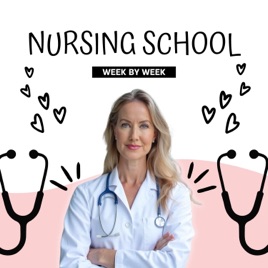
Advertise on podcast: Nursing School Week by Week
Rating
4.7from
This podcast has
46 episodes
Language
EnglishPublisher
Nurse MelanieExplicit
No
Date created
2020/07/03
Latest episode
2025/04/03
Average duration
23 min.
Release period
44 days
Description
Get the inside scoop on nursing school from someone who's been through it! Join nursing student Melanie each week for expert tips on studying smarter, passing exams, mastering clinicals, and landing your first nursing job. Whether you're tackling Fundamentals or prepping for the NCLEX, this podcast gives you the strategies and support to succeed.
Unlock Nursing School Week by Week podcast Email contact info,
Listeners & Audience details
Email contact information
Direct podcast contact details

Listeners
Audience numbers & engagement insights

Audience details
Podcast Insights

Podcast episodes
Check latest episodes from Nursing School Week by Week podcast
Head-to-Toe Physical Assessment: Listen & Learn! [Rewind]
2025/04/03
Send us a text
Mastering the Head-to-Toe Physical Assessment in Nursing
Hey there, future nurses! In this episode, I’m bringing back one of the most popular and highly requested episodes—a full, step-by-step head-to-toe physical assessment, demonstrated on my then-fiancé (now husband!).
I’ll walk you through each step, explaining not just what to do but why it matters. We’ll talk about the difference between subjective and objective data, the essential tools you’ll need, and how to structure your assessment based on different body systems. Plus, I’ll throw in some quiz questions along the way to test your knowledge!
Performing a thorough physical assessment is one of the most important skills you’ll develop as a nursing student and new nurse. The more you practice, the more confident you’ll feel in clinicals and beyond.
Alright, let’s get started—grab your stethoscope, and let’s go!
📌 Episode Breakdown:
00:00 – Introduction & Why This Skill is Essential
00:19 – The Importance of a Thorough Physical Assessment
01:42 – Subjective vs. Objective Data: What’s the Difference?
02:17 – Must-Have Tools for Your Assessment
02:54 – How to Structure Your Assessment by Body System
04:22 – Quick Quiz: Test Your Knowledge!
06:38 – Performing the Full Physical Assessment
09:10 – Head & Neck Examination
11:52 – Heart, Lungs & Abdomen Assessment
15:25 – Extremities & Skin: What to Look For
17:48 – Final Quiz & Wrap-Up
Save 20% on a Picmonic subscription, or try it for free.
Connect with me on:
Instagram: @NursingSchoolWeekbyWeek
YouTube: https://www.youtube.com/@nursingschoolweekbyweek
Facebook: https://www.facebook.com/nursingschoolweekbyweek
LinkedIn: https://www.linkedin.com/in/nurse-melanie-88085b34a
Blog: https://www.nursingschoolweekbyweek.com/blog/
Head over to the website and leave a voicemail (you might hear it on a future episode!)
Don’t forget to subscribe so you never miss an episode!
Mastering Bedside Shift Report: A Nursing Student’s Guide to ISBAR
2025/03/28
Send us a text
Mastering the ISBAR Method: How to Give a Clear, Confident Bedside Shift Report
Giving a bedside shift report can feel intimidating, but it’s a skill every nursing student needs to master. In this episode of Nursing School Week by Week, I walk you through the ISBAR method—Identify, Situation, Background, Assessment, and Recommendations—so you can communicate clearly, concisely, and professionally during handoff.
I’ll share my own experiences with shift reports, break down each ISBAR component step by step, and explain why bedside reporting is worth the extra effort. You’ll learn how it boosts patient safety, improves teamwork, and enhances patient satisfaction—plus, I’ll give you practical tips on handling sensitive patient information and navigating tricky situations with confidence.
By the end of this episode, you’ll feel prepared to walk into your next clinical shift and deliver a professional, well-structured bedside report without the stress. Stick around for a quick pod quiz at the end to test what you’ve learned!
Episode Breakdown:
🩺 00:00 Introduction + My Experience with Shift Reports
📋 00:25 Why Shift Reports Matter
🔍 00:52 What is ISBAR?
🛠️ 01:31 Step-by-Step Guide to ISBAR
🏥 01:53 The Benefits of Bedside Shift Reporting
💡 03:59 Practical Tips for Giving Reports with Confidence
📖 04:41 Deep Dive: Breaking Down ISBAR Components
🎧 06:32 Pod Quiz & Recap
🔥 14:55 Final Tips + Encouragement
📚 16:48 Wrap-Up & Additional Resources
Listen now and take the stress out of bedside shift reports! 🎙️
Save 20% on a Picmonic subscription
PicmonicAn audiovisual system with unforgettable stories to help you remember EVERYTHING you need to knowDisclaimer: This post contains affiliate links. If you make a purchase, I may receive a commission at no extra cost to you.Connect with me on:
Instagram: @NursingSchoolWeekbyWeek
YouTube: https://www.youtube.com/@nursingschoolweekbyweek
Facebook: https://www.facebook.com/nursingschoolweekbyweek
LinkedIn: https://www.linkedin.com/in/nurse-melanie-88085b34a
Blog: https://www.nursingschoolweekbyweek.com/blog/
Head over to the website and leave a voicemail (you might hear it on a future episode!)
Don’t forget to subscribe so you never miss an episode!
The BEST Nursing School Schedule
2025/03/20
Send us a text
Feeling overwhelmed trying to keep up with nursing school lectures, clinicals, and exams while balancing work and life? You’re not alone! In this episode of Nursing School Week by Week, I’m giving you a step-by-step Nursing School Study Schedule—the exact system I used to get straight A’s and pass the NCLEX while working part-time and being a mom to five kids.
You’ll learn:
✅ How to structure your study time to stay ahead in nursing school
✅ The biggest study mistakes that waste hours (and what to do instead)
✅ Proven study strategies that help you retain information faster
✅ How to balance nursing school with work, family, and life—without burnout
This isn’t just another list of study tips—this is a full nursing school study plan that includes:
📅 A daily and weekly study schedule
⏳ Time management strategies that actually work
📝 The best study methods for long-term retention
💡 Why passive study techniques (like highlighting and re-reading) are a waste of time
💪 How to use active learning to make information stick
And because I know how crucial it is to have a system in place, I’ve put together a detailed, hour-by-hour study schedule that you can tweak based on your personal workload. I’ll even cover when to review lectures, how to use Picmonic and Anki flashcards effectively, and how to prep for exams without cramming.
💡 Want even more study strategies? Be sure to listen to Season 4, Episode 9: "My Insanely Effective
Understanding Hypophosphatemia: Recognition, Diagnosis, and TreatmentEndocrine experts distinguish Hypophosphatemia from osteoporosis & osteomalaciaListen on: Apple Podcasts Spotify
PicmonicAn audiovisual system with unforgettable stories to help you remember EVERYTHING you need to knowDisclaimer: This post contains affiliate links. If you make a purchase, I may receive a commission at no extra cost to you.Connect with me on:
Instagram: @NursingSchoolWeekbyWeek
YouTube: https://www.youtube.com/@nursingschoolweekbyweek
Facebook: https://www.facebook.com/nursingschoolweekbyweek
LinkedIn: https://www.linkedin.com/in/nurse-melanie-88085b34a
Blog: https://www.nursingschoolweekbyweek.com/blog/
Head over to the website and leave a voicemail (you might hear it on a future episode!)
Don’t forget to subscribe so you never miss an episode!
Electrolytes Made Simple (Part 3): Calcium, Magnesium & Life-Threatening Imbalances Explained
2025/03/13
Send us a text
Mastering Electrolytes: Understanding Calcium and Magnesium in Nursing
In this final installment of the Electrolytes series at Nursing School Week by Week, the focus is on calcium and magnesium. The role of calcium extends beyond strong bones to muscle contractions, nerve transmission, and blood clotting, while magnesium maintains muscle and nerve functions. Detailed signs of imbalances such as Chvostek's and Trousseau's signs for hypocalcemia and symptoms of hypercalcemia and hypermagnesemia are discussed. Practical case studies emphasize the critical application of lab values in real clinical scenarios. Key strategies for patient education and ways to handle electrolyte imbalances through diet, medication, and IV fluids are elaborated. The episode also provides tips from successful nursing students, stressing the importance of understanding the mechanisms behind electrolyte levels and continuous practice. The discussion concludes with real-life case scenarios for deeper insight into how imbalances impact patient care and the importance of vigilant nursing assessments.
00:00 Introduction to the Final Electrolyte Series
01:03 Understanding Calcium: Beyond Strong Bones
03:52 Magnesium: The Unsung Hero of Electrolyte Balance
06:11 Electrolyte Review Questions
08:33 Life-Threatening Electrolyte Emergencies
11:15 Diet and Electrolyte Balance
17:32 Patient Education on Electrolytes
24:11 Case Studies: Real-Life Electrolyte Imbalances
32:06 Key Takeaways and Conclusion
Try Picmonic for Free, or save 20% on a subscription with this link.
Understanding Hypophosphatemia: Recognition, Diagnosis, and TreatmentEndocrine experts distinguish Hypophosphatemia from osteoporosis & osteomalaciaListen on: Apple Podcasts Spotify
Connect with me on:
Instagram: @NursingSchoolWeekbyWeek
YouTube: https://www.youtube.com/@nursingschoolweekbyweek
Facebook: https://www.facebook.com/nursingschoolweekbyweek
LinkedIn: https://www.linkedin.com/in/nurse-melanie-88085b34a
Blog: https://www.nursingschoolweekbyweek.com/blog/
Head over to the website and leave a voicemail (you might hear it on a future episode!)
Don’t forget to subscribe so you never miss an episode!
Potassium: The Heart’s MVP – Essential Electrolyte for Nursing Students | Episode 2 of Electrolytes 101
2025/03/07
Send us a text
Mastering Potassium: Essential Knowledge for Life-Saving Nursing
In this episode of Nursing School Week by Week, the focus is on the critical role of potassium in the body. The discussion includes the importance of potassium for heart function, recognizing the dangers of both hyperkalemia (high potassium levels) and hypokalemia (low potassium levels), as well as the symptoms and causes of these imbalances. Practical tips are provided on how to manage these conditions, including administering potassium supplements, monitoring heart rhythms, and understanding emergency treatments. Listeners will also benefit from a pod quiz testing their knowledge on essential points covered in the episode.
00:00 Introduction to Potassium
00:51 Understanding Potassium's Role in the Body
02:11 Recognizing and Managing Hypokalemia
06:10 Recognizing and Managing Hyperkalemia
10:48 Potassium Quiz and Key Takeaways
13:39 Conclusion and Next Steps
Try Picmonic for Free, or save 20% on a subscription with this link.
Connect with me on:
Instagram: @NursingSchoolWeekbyWeek
YouTube: https://www.youtube.com/@nursingschoolweekbyweek
Facebook: https://www.facebook.com/nursingschoolweekbyweek
LinkedIn: https://www.linkedin.com/in/nurse-melanie-88085b34a
Blog: https://www.nursingschoolweekbyweek.com/blog/
Head over to the website and leave a voicemail (you might hear it on a future episode!)
Don’t forget to subscribe so you never miss an episode!
Electrolytes Made Easy: Hyponatremia & Hypernatremia Explained for Nursing Students
2025/03/01
Send us a text
Understanding Electrolyte Imbalances in Nursing Practice
In this episode of Nursing School Week by Week, host Melanie breaks down the critical concept of electrolytes, focusing on their imbalances and the associated dangers. She emphasizes the real-world implications for nursing practice and provides detailed information on the four key electrolytes: sodium, potassium, calcium, and magnesium. The episode covers symptoms, causes, and nursing interventions for both hyponatremia and hypernatremia, including practical scenarios and pod quiz questions to reinforce learning. Melanie also shares tips for recognizing and managing these conditions effectively in clinical settings, preparing nursing students for exams and real-life nursing challenges.
00:00 Introduction to Electrolytes
01:52 Understanding Sodium: The Brain's Best Friend
02:22 Hyponatremia: Low Sodium Levels
05:03 Real-World Scenario: Hyponatremia
06:42 Pod Quiz: Test Your Sodium Knowledge
09:50 Hypernatremia: High Sodium Levels
14:26 Pod Quiz: Test Your Hypernatremia Knowledge
17:27 Conclusion and Next Steps
Try Picmonic for free, or get 20% off a subscription with this link!
Connect with me on:
Instagram: @NursingSchoolWeekbyWeek
YouTube: https://www.youtube.com/@nursingschoolweekbyweek
Facebook: https://www.facebook.com/nursingschoolweekbyweek
LinkedIn: https://www.linkedin.com/in/nurse-melanie-88085b34a
Blog: https://www.nursingschoolweekbyweek.com/blog/
Head over to the website and leave a voicemail (you might hear it on a future episode!)
Don’t forget to subscribe so you never miss an episode!
First Semester Success Guide: What to Do NOW to Prepare for August
2025/02/18
Send us a text
Preparation Tips for Nursing Students: Insights from Nurse Melanie
In this episode of Nursing School Week by Week, I share essential tips to help you prepare for nursing school. I cover how mastering time management and organization skills with the use of digital and paper planners can be a game-changer. I also explain the importance of setting up an organized workspace and creating a study schedule. You'll hear my advice on refreshing prerequisite knowledge such as anatomy, physiology, and medical terminology. I stress the significance of building a support system, preparing mentally and emotionally, and maintaining self-care routines. Additionally, I offer practical tips on managing finances, gathering essential supplies, meal prepping, and navigating transportation. Leverage apps and technology to aid in your studies. Overall, my goal is to help you set the groundwork for a successful nursing school journey.
00:00 Welcome to Nursing School Week by Week
00:33 Mastering Time Management and Organization
04:47 Creating a Productive Study Environment
10:34 Refreshing Key Prerequisite Knowledge
17:39 Preparing Mentally and Emotionally
24:29 Gathering Essential Supplies
28:07 Final Tips and Encouragement
Nursing Exam Cram Sheet for the NCLEX-RN
Understanding Hypophosphatemia: Recognition, Diagnosis, and TreatmentEndocrine experts distinguish Hypophosphatemia from osteoporosis & osteomalaciaListen on: Apple Podcasts Spotify
PicmonicAn audiovisual system with unforgettable stories to help you remember EVERYTHING you need to knowDisclaimer: This post contains affiliate links. If you make a purchase, I may receive a commission at no extra cost to you.Connect with me on:
Instagram: @NursingSchoolWeekbyWeek
YouTube: https://www.youtube.com/@nursingschoolweekbyweek
Facebook: https://www.facebook.com/nursingschoolweekbyweek
LinkedIn: https://www.linkedin.com/in/nurse-melanie-88085b34a
Blog: https://www.nursingschoolweekbyweek.com/blog/
Head over to the website and leave a voicemail (you might hear it on a future episode!)
Don’t forget to subscribe so you never miss an episode!
Mastering Cardiac Meds: Your Ultimate Nursing Guide
2025/02/11
Send us a text
In this episode of 'Nursing School Week by Week', we dive deep into cardiac medications, breaking down complex pharmacology concepts into bite-sized pieces. We start with an overview of the main categories: diuretics, antiarrhythmics, and anticoagulants, using various analogies to make them memorable, like plumbers for diuretics and electricians for antiarrhythmics. We discuss specific medications such as ACE inhibitors, ARBs, beta blockers, calcium channel blockers, and diuretics, detailing their mechanisms, common side effects, and useful mnemonics. We also tackle the intricacies of digoxin, heparin, and warfarin, explaining their usage, monitoring parameters, and safe practices. Essential nursing considerations, patient education tips, and the importance of individualizing care are emphasized throughout. Finally, we conclude with a pop quiz to reinforce learning and provide a Cardiac Medications Cheat Sheet for practical use in clinicals.
The episode is sponsored by PicMonic, a tool for enhanced memory retention.
Head to PicMonic to save 20%!
Head to NursingSchoolWeekbyWeek.com to get the free Cardiac Medications Cheat Sheet.
Understanding Hypophosphatemia: Recognition, Diagnosis, and TreatmentEndocrine experts distinguish Hypophosphatemia from osteoporosis & osteomalaciaListen on: Apple Podcasts Spotify
PicmonicAn audiovisual system with unforgettable stories to help you remember EVERYTHING you need to knowDisclaimer: This post contains affiliate links. If you make a purchase, I may receive a commission at no extra cost to you.Connect with me on:
Instagram: @NursingSchoolWeekbyWeek
YouTube: https://www.youtube.com/@nursingschoolweekbyweek
Facebook: https://www.facebook.com/nursingschoolweekbyweek
LinkedIn: https://www.linkedin.com/in/nurse-melanie-88085b34a
Blog: https://www.nursingschoolweekbyweek.com/blog/
Head over to the website and leave a voicemail (you might hear it on a future episode!)
Don’t forget to subscribe so you never miss an episode!
Go to Nursing School for Free
2025/01/14
Send us a text
Nursing is one of those few degrees that you can get for free, if you play your cards right.
And this is one of those times when it pays to do some research, because besides paying for your first house, college will probably be your biggest expense in life.
Paying out of pocket for nursing school is expensive. Average costs range from $12,000 to $35,000 for an associates degree in nursing; and a bachelor’s degree is $30,000 to $80,000. And if you go to a private college for nursing, you could be looking at more like $120,000! That’s a lot of money.
But there are other options. There are scholarships, grants, military options, tuition reimbursement, and loan forgiveness programs. We are going to talk about all of those options today, and I will let you know which ones are my favorite for going to nursing school for free, and which one I definitely don’t recommend.
Get 20% off Picmonic:
https://www.picmonic.com/insiderhookup/nursingschoolweekbyweekLAN25
Picmonic is an audiovisual learning system with unforgettable stories and characters to help you remember EVERYTHING you need to know for school. Check it out for free!
Get 20% off TruLearn:
https://truelearn.referralrock.com/l/weekbyweek/
Connect with me on:
Instagram: @NursingSchoolWeekbyWeek
YouTube: https://www.youtube.com/@nursingschoolweekbyweek
Facebook: https://www.facebook.com/nursingschoolweekbyweek
LinkedIn: https://www.linkedin.com/in/nurse-melanie-88085b34a
Blog: https://www.nursingschoolweekbyweek.com/blog/
Head over to the website and leave a voicemail (you might hear it on a future episode!)
Don’t forget to subscribe so you never miss an episode!
Home Health Nursing For The Win
2024/04/03
Send us a text
The difference between working in a hospital and working home health is night and day. I’m going to be talking about my experience as a home health nurse, what a day in the life looks like. I’m going to touch on some myths about home health nurses, kind of the reputation that they have and if I think that that’s warranted or not. And how it compares to working in the hospital. These are just things to kind of tuck in your back pocket if you’re going through nursing school right now, or if you’re about to go through nursing school. And if you’re anything like me, I had no idea what kind of nursing I wanted to do after I graduated. Some of my friends knew exactly what they wanted to do and I always envied that. But that was not me, and I think in some ways, I’m still looking. You know, but I don’t think there’s any shame in that. I think it’s good to be curious, and I hope I’m forever curious and forever learning. And that’s what I’m doing right now. I’m learning about different specialties within nursing, and that is the beauty of nursing.
Get 20% off Picmonic: https://www.picmonic.com/insiderhookup/nursingschoolweekbyweekLDC24
Get 20% off TruLearn: https://truelearn.referralrock.com/l/weekbyweek/
Use code: "weekbyweek"
Get 20% off Lecturio subscription: Use code: "nursingschoolwbw20" for a 20% discount on all nursing premium plans.
Connect with me on:
Instagram: @NursingSchoolWeekbyWeek
YouTube: https://www.youtube.com/@nursingschoolweekbyweek
Facebook: https://www.facebook.com/nursingschoolweekbyweek
LinkedIn: https://www.linkedin.com/in/nurse-melanie-88085b34a
Blog: https://www.nursingschoolweekbyweek.com/blog/
Head over to the website and leave a voicemail (you might hear it on a future episode!)
Don’t forget to subscribe so you never miss an episode!
FALLS
2023/10/01
Send us a text
Today we're talking about a basic one but a big one. We’re talking about falls. We're gonna get into what constitutes a fall, because it may not be exactly what you think a fall is but it would still count as a fall. We're gonna get into what makes a person more likely to have a fall; we're gonna get into what we as nurses can do to help prevent falls, and we're also going to touch a little bit on the good and bad of placing so much importance on preventing falls.
Get 20-30% off Picmonic: https://www.picmonic.com/insiderhookup/nursingschoolweekbyweekLI423
Get 20% off TrueLearn: https://truelearn.referralrock.com/l/weekbyweek/
Understanding Hypophosphatemia: Recognition, Diagnosis, and TreatmentEndocrine experts distinguish Hypophosphatemia from osteoporosis & osteomalaciaListen on: Apple Podcasts Spotify
Connect with me on:
Instagram: @NursingSchoolWeekbyWeek
YouTube: https://www.youtube.com/@nursingschoolweekbyweek
Facebook: https://www.facebook.com/nursingschoolweekbyweek
LinkedIn: https://www.linkedin.com/in/nurse-melanie-88085b34a
Blog: https://www.nursingschoolweekbyweek.com/blog/
Head over to the website and leave a voicemail (you might hear it on a future episode!)
Don’t forget to subscribe so you never miss an episode!
Night Shift vs Day Shift (Part 2)
2023/09/05
Send us a text
Let's continue talking about the pros and cons of working night shift vs day shift as a new nurse.
Get 20% off a Lecturio Nursing subscription with Discount Code: nursingschoolwbw20
First up, on the day shift, there are more meds to give. So, that can be good if you’re trying to practice your skills, but bad just because it’s more work and it’s going to take longer to do each of your med passes. Especially that first morning med pass. That’s when the patients are getting the bulk of their medications.
And you can have the full gamut of pills, IV bag meds, IV push meds, plus topical medications, all in one med pass, for one patient in the morning. So if you’re doing that for 5 or 6 patients, for one med pass, that can take up a lot of your time and can be stressful to feel like you have to rush rush rush to get it done.
And there were times, only on day shift, when I started my shift at 7am and it was 9:30-10am and I was being called away to do something else, and I’m like, “I can’t. I still am not done with my morning med pass.
You know, my meds are an hour and a half late.” And that’s not ok, but I was just so busy that that’s what the situation was honestly. And that was very stressful to me because I don’t wanna be late on my med pass. I want to give my patients their meds when they’re due because that’s what’s best for my patients.
So it’s very stressful when you feel like you’re just one person, but you’re being given the workload of three people. Especially when you’re a new nurse. You know, maybe a seasoned nurse would not have been late giving those meds, but as a new nurse, that was just my reality. And that was very stressful. But yeah, on night shift, you typically have a lot less meds to give.
And if you’re in clinicals, you can look this up in your patient’s orders, if you get a chance, just compare what medications they’re getting during the day (especially that first morning med pass) versus what they’re getting at night. And it’s almost always a lot less at night.
Connect with me on:
Instagram: @NursingSchoolWeekbyWeek
YouTube: https://www.youtube.com/@nursingschoolweekbyweek
Facebook: https://www.facebook.com/nursingschoolweekbyweek
LinkedIn: https://www.linkedin.com/in/nurse-melanie-88085b34a
Blog: https://www.nursingschoolweekbyweek.com/blog/
Head over to the website and leave a voicemail (you might hear it on a future episode!)
Don’t forget to subscribe so you never miss an episode!
Night Shift Nursing vs Day Shift
2023/08/30
Send us a text
Today I want to talk about the differences between day shift vs night shift for nurses. Maybe you’re on the fence, you don’t know if you want to work day shift or night shift when you graduate, so I want to go over the pros and cons of each to help you make your decision.
Check out Lecturio for incredibly helpful videos and so much more! Get 50% off a subscription through August!
http://lectur.io/nursingschoolweekbyweek
After August, you can still get 20% off Lecturio with this code: nursingschoolwbw20
Now I have worked both day shift and night shift on a med surg unit and in the emergency room, so I feel like I can talk to the pros and cons of both.
Alright, so first up, I definitely have to mention that if you’re in it to make more money, then the night shift is the obvious way to go. Because you’re gonna get that night shift differential, which is usually, some places do it differently. Some places do it like just a set amount per hour more, like 7 dollars more per hour if you’re working on the night shift; then other places will give like 1.25 times your base hourly rate. But either way, you’re gonna make more on the night shift.
And when I calculated it out, it was basically a car payment every month. So about $600 more per month than what I would have made on the day shift. So that’s pretty significant. And if you’re working night shift on the weekend, then you’re gonna get even more cause you’re gonna get that weekend shift differential in addition to the night shift differential. So that’s what I tried to schedule myself when I was working nights. I would try to make it on Friday, Saturday, and Sunday night so I would get both of those differentials to maximize the pay. Cause if you’re there, putting in the time, you might as well get paid the most you can possibly make.
Alright, another difference between day shift and night shift, is that, and this can be seen as either a pro or a con, depending on how you look at it, but during the day shift there are more doctors around, more physical therapists, more occupational therapists, more social workers around, and more management around.
So this can be a good thing, because if an emergency situation arises or if you need to change verify an order, then the doctor is just a chat or a phone call away. Or if the patient starts going downhill fast, you can reach out to the doctor easily and you don’t feel like, you know, you have to wait until it’s an absolute emergency because you don’t wanna wake up the doctor in the middle of the night, and what if they get mad at you and yell at you? You’re not as worried about that because the doctors are alread
Connect with me on:
Instagram: @NursingSchoolWeekbyWeek
YouTube: https://www.youtube.com/@nursingschoolweekbyweek
Facebook: https://www.facebook.com/nursingschoolweekbyweek
LinkedIn: https://www.linkedin.com/in/nurse-melanie-88085b34a
Blog: https://www.nursingschoolweekbyweek.com/blog/
Head over to the website and leave a voicemail (you might hear it on a future episode!)
Don’t forget to subscribe so you never miss an episode!
Stroke - Case Study
2023/08/18
Send us a text
You just graduated from nursing school, and now you're working as a nurse in the emergency department. The EMTs bring in a 26 year old female with generalized weakness of the left lower and upper extremities, and a sudden headache. What do you do? Can you complete all 5 critical actions, or will you carry out a dangerous action? Learn the most important things to do for stroke patients as a nurse.
Check out TrueLearn for an NCLEX program that perfectly integrates with Picmonic!
https://truelearn.referralrock.com/l/weekbyweek/
Get 30% off a Picmonic subscription, or just get one free Picmonic every day!
Understanding Hypophosphatemia: Recognition, Diagnosis, and TreatmentEndocrine experts distinguish Hypophosphatemia from osteoporosis & osteomalaciaListen on: Apple Podcasts Spotify
Connect with me on:
Instagram: @NursingSchoolWeekbyWeek
YouTube: https://www.youtube.com/@nursingschoolweekbyweek
Facebook: https://www.facebook.com/nursingschoolweekbyweek
LinkedIn: https://www.linkedin.com/in/nurse-melanie-88085b34a
Blog: https://www.nursingschoolweekbyweek.com/blog/
Head over to the website and leave a voicemail (you might hear it on a future episode!)
Don’t forget to subscribe so you never miss an episode!
Stroke
2023/08/03
Send us a text
Today we are focusing on Strokes, or Brain attacks. This is one of those conditions that is so important for us nurses to know the signs and symptoms of, because your patient could have a stroke at any point. They could come into the ER with a suspected stroke, or they could be recovering on the med-surg unit, about to be discharged, and then have a stroke. So it can happen at any time, and we want to make sure we know what to look for. We also want to make sure we know what their baseline looks like, so we have something to compare any changes to. This is one reason why, when you’re in nursing school clinicals, your instructors will stress that you do a bedside shift report, or at least that you go into the patient’s room and do the physical assessment within the first hour of your shift starting. Because if you don’t go in there for four hours, and then when you finally do, they have slurred speech and limited arm movement, you’re not going to know if that’s what they were like before your shift, or if those are new changes.
Connect with me on:
Instagram: @NursingSchoolWeekbyWeek
YouTube: https://www.youtube.com/@nursingschoolweekbyweek
Facebook: https://www.facebook.com/nursingschoolweekbyweek
LinkedIn: https://www.linkedin.com/in/nurse-melanie-88085b34a
Blog: https://www.nursingschoolweekbyweek.com/blog/
Head over to the website and leave a voicemail (you might hear it on a future episode!)
Don’t forget to subscribe so you never miss an episode!
Podcast reviews
Read Nursing School Week by Week podcast reviews
J'aime mon mec 2026/01/22
Melanie, please come back!
Excellent, we need more!
Tommy Feijoo 2026/01/14
Nothing could’ve prepared me like this did.
Melanie is such a good resource for anyone in school or wanting to go to school.
Tplace84 2025/10/12
More episodes
Your explanations are really great and thorough and worthwhile. Please record more 🙏🏻🥺
Jordane2026 2025/10/12
So helpful!!
Currently using your electrolyte podcasts to study while I take notes. I will be more than prepared for my lecture coming up this week! Thank you so m...
GreenbeeBSNRN 2025/08/07
Not just for nursing students!
I’m been a BSN, RN for 8 years and still find Nurse Melanie’s show helpful. I like her explanations and gives me hints for other ways to educate patie...
Elizabeth98020 2025/07/30
All Star Nursing Podcast
This is a wonderful podcast that shares important information in a fun and concise way. I am enjoying it as a soon-to-be nursing student in 2026 to ge...
RNStudent@47 2025/07/04
Great Find!
I stumbled upon this podcast by accident and it has been so helpful! Her voice is soothing, the information is so helpful! Thank you
jessi alvey 2025/05/07
Nursing student help!
As a second semester nursing student, I’m so grateful for this podcast. I feel like I’ve been thrown into so much in nursing school and it feels impos...
RJCformerEMT 2025/04/17
Great at integrating multiple topics
This show does a great job of explaining a lot of information at a measured pace, with quizzes that make you pay attention.
The highest recommendatio...
Gh0121 2024/03/07
Love the Podcast!
I love this podcast so much. Getting prepared for nursing school but I was a flight paramedic for many years. Only thing to note in the Sepsis Case St...
Podcast sponsorship advertising
Start advertising on Nursing School Week by Week relevant audience podcasts
You may also like to advertise on these Podcasts

3.967524
Steiny and Guru
Audacy

4.8450262
Discover the Word Podcast
Our Daily Bread Ministries
4.3212139
Murph & Markus Podcast
KNBR | Cumulus Media San Francisco

4.6177378
Diego Ruzzarin
Diego Ruzzarin

4.7147224
In Good Company with Nicolai Tangen
Norges Bank Investment Management

4.712601247
The Action Network Sports Betting Podcast
iHeartPodcasts

4.8255149
Date Night With the Woods
Mission Bible Church

5221271
Jase & Lauren
Nova Podcasts

4.864568
Ghost Bunny
Bridget Marquardt

3.9824495
AITApod (Am I The A**hole Podcast)
Danny Vega