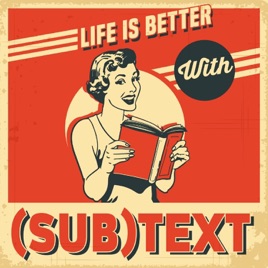
Advertise on podcast: Subtext: Conversations about Classic Books and Films
Rating
4.9from
This podcast has
224 episodes
Language
EnglishPublisher
Wes Alwan and Erin O'LuanaighExplicit
No
Date created
2020/08/07
Latest episode
2026/10/11
Average duration
41 min.
Release period
17 days
Description
Subtext is a book club podcast for readers interested in what the greatest works of the human imagination say about life’s big questions. Each episode, philosopher Wes Alwan and poet Erin O’Luanaigh conduct a close reading of a text or film and co-write an audio essay about it in real time. It’s literary analysis, but in the best sense: we try not overly stuffy and pedantic, but rather focus on unearthing what’s most compelling about great books and movies, and how it is they can touch our lives in such a significant way.
Unlock Subtext: Conversations about Classic Books and Films podcast Email contact info,
Listeners & Audience details
Email contact information
Direct podcast contact details

Listeners
Audience numbers & engagement insights

Audience details
Podcast Insights

Social media
Check Subtext: Conversations about Classic Books and Films social media presence


Podcast episodes
Check latest episodes from Subtext: Conversations about Classic Books and Films podcast
A Map-Like Imagination in the Poetry of Elizabeth Bishop (“First Death in Nova Scotia”)
2026/10/11
In the cold, cold parlor of Elizabeth Bishop’s “First Death in Nova Scotia,” a child is lifted up to say goodbye to her little cousin Arthur, laid out beneath chromographs of the British royal family and beside a loon shot and stuffed by Arthur’s own father. The title is a small lie: the first death in Nova Scotia was that of Bishop’s father, which she was too young to remember. What the child sees instead is a world sorted into hot and cold, near and far—the brilliantly colored, distant royals; the white, frozen bird keeping its own counsel; red glass eyes “much to be desired.” What does a preserved, aestheticized death invite us to feel, and what does it hold at a distance? Wes & Erin continue their reading of Bishop’s poems.
Upcoming Episodes: “Planet of the Apes” (1968); Graham Greene’s “The Power and the Glory.”
Pre-order Erin’s forthcoming book “Avail” here: http://subtextpodcast.com/avail
For bonus content, become a paid subscriber at Patreon or directly on the Apple Podcasts app. Patreon subscribers also get early access to ad-free regular episodes.
Also from Wes: Curtain Times, a calendar of Boston theatre, classical, talks and readings.
Follow: Twitter | Facebook | Website
Transcript
0:11 Erin: Welcome to part three of our discussion of the poems of Elizabeth Bishop. Today we're going to be focusing on First Death in Nova Scotia. Wes, I was just wondering, were you familiar with this poem at all before I suggested it?
0:26 Wes: No, not at all. And I have to admit that I've been actually thinking about the poem, but the title that's been in my head is Last Death in Nova Scotia. Odd transposition.
0:40 Erin: Not really. I think the title. You're anticipating my first point, which is going to be that the title is a bit of a lie. If we know anything about Bishop's biography, which we do because we covered it. Her previous parts. Right. The first death in Nova Scotia that she would have experienced, though she wouldn't have remembered it, was the death of her father. Did you enjoy it? This is one of my favorite.
1:01 Wes: Yes, it's great.
1:02 Erin: Yeah. It's not among the best known of her poems, but I mean, every single one is really a gem. This is from Questions of travel from 1965. That collection has two sections to it. One called Brazil, which is obviously Brazilian poems, and then one called Elsewhere. And this is in the Elsewhere section, of course. Should I start out just by reading it and then we'll dive in?
1:29 Wes: Yeah.
1:31 Erin: First Death in Nova Scotia. In the cold, cold parlor, my mother laid out Arthur beneath the chromographs Edward, Prince of Wales with Princess Alexandra and King George with Queen Mary. Below them on the table stood a stuffed loon, shot and stuffed by Uncle Arthur, Arthur's father. Since Uncle Arthur fired a bullet into him, he hadn't said a word. He kept his own counsel on his white frozen lake, the marble topped table. His breast was deep and white, cold and caressible. His eyes were red glass, much to be desired. Come, said my mother, Come and say goodbye to your little cousin Arthur.
I was lifted up and given one lily of the valley to put in Arthur's hand. Arthur's coffin was a little frosted cake and the red eyed loon eyed it from his white frozen lake. Arthur was very small. He was all white, like a doll that hadn't been painted yet. Jack Frost had started to paint him the way he always painted the maple leaf forever. He had just begun. On his hair a few red strokes. And then Jack Frost had dropped the brush and left him white forever. The gracious royal couples were warm in red and ermine. Their feet were well wrapped up in the ladies ermine trains.
They invited Arthur to be the smallest page at court. But how could Arthur go Clutching his tiny lily with his eyes shut up so tight and the road steep in snow.
3:14 Wes: Really great. You should try to say, stood a stuffed loon, shot and stuffed three times really fast.
3:22 Erin: I know.
3:24 Wes: Stood a stuffed loon, shot and stuffed. What kind of people put. I was gonna say taxonomy. That's not right. What's the word for stuffed?
3:33 Erin: Taxidermy.
3:34 Wes: Taxidermy. Taxidermy. At a funeral or at a viewing or whatever it is. It's a little insensitive, don't you think? A little. Uncle Arthur fired a bullet into him and it's like, wait, did Uncle Arthur kill the little boy or did he kill the loon? Sorry.
3:53 Erin: I know. What is this connection? Yeah, I mean, I think this is the invasion of death into the normal. You know, the normal life of the domestic scene. So this loon is ordinarily there in some kind of Canadian flowchart going down from the. You know, the British royal family to the stuffed loon on the table.
4:15 Wes: Canadian flow chart. Canada is pretty far down the chart.
4:23 Erin: But in the accident of proximity, you know, some really interesting kind of mental association is happening. Which sort of. Everything in the poem operates through this kind of association. I think even between the different stanzas. This is a poem of 1, 2, 3, 4, 5 stanzas of 10 lines each. Short lines. They're trimeter lines. I just was noticing a lot of sort of surprisingly logical jumps. And, of course, it occupies, for the most part, the child's mind. Or it's kind of like a tunnel view where you have the adult looking through the mind of the child looking at the scene.
So that kind of associative logic is childlike as well. Like, there must be something that Arthur has to do with these pictures on the wall, though. I actually think that that connection with Arthur being a page at court must have been suggested by the mother. That's at least my reading, because it's immediately refuted by the child with that. But. And that logical refutation which suggests that the mother said, oh, Arthur's going off to be page. Of course, I guess the mothers also made the association between Arthur and these images. I don't know.
5:31 Wes: I hadn't thought of that. But it's a very poignant moment whether or not that's been put into her head by an adult or whether she's just thought of that herself as if the royal scene represented part of heaven or something like that. But in the beginning. Let's talk about these chromographs. And I looked this up, and it's. Technically, they're what there's a different word for this. And I forgot.
5:56 Erin: Chromolithography.
5:57 Wes: Yes. Okay. Chromolithograph. These very colorful pictures in contrast to the whiteness of the boy and the loon. Although I guess he's still got a little color. We'll talk about. You might have to explain that to me a little bit, but. Yeah. What is the. Maybe we should speak of this. The general significance and the specific significance. Why do people have these representations of royalty in their homes? It's a very middle class sort of thing. I remember my older sister, who's like 11 years older than me, who we, you know, we all lived in England and Ireland and she went to school in England and she had an English accent by the time she came to the United States.
But she had all these little pewter figures of all the royalty in England. And it's kind of a little. A single. I don't know what you call it. You know, kind of little shelves that you put on the wall, small, small pewter figurines, but all in a. All the king, all the royalty, and a little. Whoever lived in a little house together, so to speak. I don't think they'd get along very well. They didn't, but. What is that? I don't know if this is a trite question. It's like I'm asking what the fascination with royalty is, but we kind of know that. But you know what I mean.
7:05 Erin: Well, I have something in common with your sister. I do love souvenirs of Tudor royalty, at least. And I do have a couple of things from the Queen's Jubilee, because I was over there, luckily, right after her jubilee, when all this stuff was being sold. And then shortly thereafter, she passed away. So I picked up a few things. I do like them. I think the important thing is that these are colored. I mean, the color is an important part of the last stanza. But I think that for the most part, these chromographs or chromolithographs, a lot of times they were, I guess, like hand painted.
The really well done ones could be mistaken for art, for a painting. And so that made them a little bit suspicious, I think. But also they were used because they're so highly colored. They were used in things like advertisements, like tourist advertisements showing a beautiful view of someplace. And they were also used in children's books, so an illustrated book of maybe fairy stories or something that would appeal to children. I think that association in particular is what's prevalent here.
8:08 Wes: Right.
8:08 Erin: The child's name is Arthur. He's also a junior. So this sort of idea of faint idea of succession and these images on the wall which are obviously part of British Canadian culture, this is. Their monarch is still very distant at the same time. So. And that distance perhaps creating a kind of mythology or the desire to have these people say artificially close. The only way that they. That a Canadian would be likely to see these. These royal figures is through one of these chromographs. And I think that that idea of distance and closeness as well as of hot and cold, the hot and cold poles in Bishop are really important. Right. And even in this book, the book itself, Questions of Travel, which I mentioned has these two sections which are kind of like poles, Brazil and elsewhere. There's a hot and cold association between those two.
9:04 Wes: Right.
9:04 Erin: Brazil being the hot place and elsewhere as just a general marker of some kind of remote other being cold. I started to read this whole poem through that kind of vector with cold associated with remoteness and heat with closeness. Of course, not a groundbreaking connection, but
A Map-Like Imagination in the Poetry of Elizabeth Bishop (“The Moose,” Part 2)
2026/08/24
A poem about a map opens North and South, the first collection of the great twentieth century poet Elizabeth Bishop, and since, maps have been associated with her poetic vision—at once telescoping and binocular—and with the polarities and preoccupations of her work. The map’s privileged, sweeping, bird’s eye view of the earth is also hand-held, man-made, intimate. Depending on its level of minuteness or obsession, it can contain the tiniest details as well as, let’s say, the whole enchilada. And though it purports to be scientific and objective, it is representational and therefore subjective, particular, imaginative, and personal. For several episodes, Wes & Erin will be reading a selection of some of Bishop’s most anthologized poems, starting with “The Moose” as expressions of, among other things, her map-like imagination.
Upcoming Episodes: Nolan’s adaptation of “The Odyssey”; more Elizabeth Bishop poetry: “First Death in Nova Scotia,” “One Art.”
Pre-order Erin’s forthcoming book “Avail” here: http://subtextpodcast.com/avail
For bonus content, become a paid subscriber at Patreon or directly on the Apple Podcasts app. Patreon subscribers also get early access to ad-free regular episodes.
Also from Wes: Curtain Times, a calendar of Boston theatre, classical, talks and readings.
Follow: Twitter | Facebook | Website
Transcript
0:11 Erin: Welcome to part two of our discussion of the poems of Elizabeth Bishop. We are currently about. Oh, I'm okay. I'm proud of us. We're just about halfway through the Moose. That's not bad compared to our usual record. We're not halfway through stanza one. We're going. You know, it's about a bus trip. It's encouraging us to pick up the pace a little bit and get to our next stop. So we were just going to pick up with the woman in stanza 13 climbing into the bus.
0:41 Wes: Before you say that, I just want to make one little observation.
0:44 Erin: Oh, sure.
0:45 Wes: Just that we get right as soon as the light goes out, it's then that we get the barking of a dog and the smell of salt. First it's the smell of salt hay and then it's the barking of a dog. So smell is introduced. And is that the first time sound is really introduced in any. You know, we get the bus starting and all that, but I think that's right. It's very visual up to that point, I think. And then as soon as we lose the light, we get these new sensory modalities. The collie just supervised this dog, gives us a nice bark, and presumably we can't even see him. We just hear him. So I just love that. I just. I love the transition into darkness. It's so.
1:26 Erin: Yeah.
1:26 Wes: I don't know how else to say it.
1:28 Erin: Yeah.
1:28 Wes: And it's then that we. This really is the midpoint of the poem because now we're going to make this transition into the world of the bus, I guess. As the woman climbs in, we have
1:41 Erin: the ship's port lantern, as you said, being an indication that it's now nearly or fully dark outside.
1:47 Wes: She says red light swims through the dark.
1:50 Erin: Yeah. I'm assuming that at this point a bus would have some form of illumination, at least for when it's stopped and the doors open for people getting on and off the bus. Right. It would. It would light up on the inside interior. Yeah.
2:03 Wes: Yeah.
2:03 Erin: Or at least maybe it would stop, certainly if it were stopping at a station or a little, you know, whatever those things are called. Those little. Yeah, there's a word for it.
2:14 Wes: We need something to see the freckles by.
2:16 Erin: Right. We need something. Exactly. But wherever they would be stopping would have some form of street light illumination or something of that order. Anyway.
2:26 Wes: But it's interesting you say this, because I didn't picture a bus station at any point in this. And I just imagine people along the side of the road.
2:34 Erin: Right. But if it were a course, it
2:38 Wes: couldn't be that way.
2:39 Erin: Well, I don't think it's a station. I think it would be a stop with a. You know, like a lean to. You know, what are those things that just.
2:44 Wes: Yeah, sure.
2:45 Erin: That just protect you from the elements.
2:47 Wes: Yeah. Bust down.
2:48 Erin: Right.
2:48 Wes: Yeah.
2:49 Erin: And that would probably have at least a street light. But anyway, then we get the moonlight. Maybe my favorite. Oh, it's so hard to say, but maybe my favorite image in the poem is the hairy, scratchy, splintery moonlight and mist caught in them like lambswool on bushes in a pasture. Just. There's nothing. There's no image greater than that. That's unbelievable.
3:13 Wes: There's kind of a more wildness to this. Right. The image now, the hairiness and scratchiness and splinteriness. It's a bit less Domesticated, I guess, than the previous part of the poem.
3:27 Erin: That's a really good point. I hadn't thought of that. Even a suggestion of danger, like the lamb running.
3:34 Wes: I just thought, this is where the hobbits are entering Fangorn Forest.
3:39 Erin: Yes. Yeah, yeah, the New Brunswick.
3:41 Wes: But you go a little bit more. It's a little wilder and more primal. I think once you. Even if you're on a bus, once you get into the woods, there's something different about it.
3:52 Erin: That's right.
3:53 Wes: But yeah, you're right. The idea that the moonlight could get caught in that. That's a great image.
3:59 Erin: Something giving chase to the lamb would cause it potentially to get a little ensnared in the chase.
4:06 Wes: It's as if Lambswool has, you know, a lamb is brushed up on the bramble or whatever and left its wool so that. So the moonlight, instead of making this cosmic journey and landing on articulating the environment, has been subordinated to the environment. Right. It's become. It's been captured by these hairy woods. It's caught on it and, you know, a piece of it has come off from being caught on something that's scratchy and splintery. So that. That. Yeah, this is the great reversal. And that's the place where you can really get some good sleeping. Yes, right.
4:44 Erin: Yes. And where dreamy things can happen.
4:47 Wes: Divagation. Yeah, wanderings.
4:51 Erin: I looked that up. Wandering, straying or digressing from a main course, path or topic. So like a digression as long as
4:59 Wes: the bus stays on track.
5:00 Erin: Yeah, that's right.
5:01 Wes: You do whatever you want with your mind.
5:02 Erin: That's right. And the night. I just looked on Google Maps while I was writing my little notes in the margins. And if you were to take a bus today from Great Village to Boston, it would take like 10 hours. So it definitely is a, yikes, full course of the night on this night bus. So I love what happens in stanza 16, which begins in the creakings and noises, an old conversation not concerning us, but recognizable somewhere back in the bus. So I really love that it's grandparents voices, she says, uninterrupted talking. This is where the I becomes an us.
And this is a characteristic of a bishop. I think she's rather reluctant to use an I, capital I in a poem. She's more likely to use a we or an us. And here it's as if they're all part of the same family now in the bus and the adults. It's almost like everybody on the bus who isn't a grandparent is a child and the adults in the back are talking and we are all, oh, that doesn't concern us. Just go to sleep. It's none of your business. Just stop eavesdropping on us. Right, so there's some community that's been formed already by the people who are not the grandparents talking.
Do you get that impression?
6:20 Wes: Yeah, it's a bit confusing. So, yeah, let's try to figure it out. Because it. So it begins. A dreamy divagation begins in the night. She doesn't say, I started dreaming or they started dreaming or we started dreaming. Although it seems almost like it's collective. Right. So that the bus is dreaming or everyone on the bus is dreaming together, which kind of lines up with the not concerning us later on, the gentle auditory slow hallucination. So that's a very interesting idea. Right. The dream is usually associated with subjectivity. Right. The cogito and Descartes.
Right. The dream tells us that we might have trouble distinguishing reality from what's in our own minds. And we in our own minds are very potentially cut off from reality. But it's a. It's an alienated individual position here. The dream is. Seems to be collective. And perhaps it's collective because it's partly real. Right. Is that the conversation? I thought, okay, there's a conversation going on in the back of the bus and it is old people talking. But as you're lying back, you could sort of. You can't hear exactly what they're saying. And you might have that kind of half dream, Right.
Where you're. The dream is kind of lined up with or intertwined with what's going on in reality. So she's hearing in the conversation of the old people, her grandparents voices. Is that the way you took this? Or. Or they, they're hearing the grandparents voices or. Yeah. How do we, how do we interpret this?
7:54 Erin: I interpreted it as, you know, people of the age of grandparents having a real conversation. But the idea that one could be having an auditory. I mean, we are given the word auditory slow hallucination. So the idea that there could be an auditory hallucination or kind of half dream of one's own grandparents having a conversation, or it may be superimposed on a real conversation kind of inaudible going on on the bus. I never noticed this before. The G in grandparents is capitalized. So it does seem to sit to suggest the speaker's particular grandparents rather than.
8:30 Wes: Oh, I was going to. I thought you were going to say archetypal grandparents.
8:34 Erin: Oh, yeah, I suppose it could be yeah, it could be read that way, too. I think all of these things are true, right?
8:40 Wes: Yeah.
8:40 Erin: I mean
A Map-Like Imagination in the Poetry of Elizabeth Bishop (“The Moose”)
2026/08/17
A poem about a map opens North and South, the first collection of the great twentieth century poet Elizabeth Bishop, and since, maps have been associated with her poetic vision—at once telescoping and binocular—and with the polarities and preoccupations of her work. The map’s privileged, sweeping, bird’s eye view of the earth is also hand-held, man-made, intimate. Depending on its level of minuteness or obsession, it can contain the tiniest details as well as, let’s say, the whole enchilada. And though it purports to be scientific and objective, it is representational and therefore subjective, particular, imaginative, and personal. For several episodes, Wes & Erin will be reading a selection of some of Bishop’s most anthologized poems, starting with “The Moose” as expressions of, among other things, her map-like imagination.
Upcoming Episodes: Nolan’s adaptation of “The Odyssey”; more Elizabeth Bishop poetry: “First Death in Nova Scotia,” “One Art.”
Pre-order Erin’s forthcoming book “Avail” here: http://subtextpodcast.com/avail
For bonus content, become a paid subscriber at Patreon or directly on the Apple Podcasts app. Patreon subscribers also get early access to ad-free regular episodes.
Also from Wes: Curtain Times, a calendar of Boston theatre, classical, talks and readings.
Follow: Twitter | Facebook | Website
Transcript
0:11 Erin: A poem about a map opens north and south, the first collection of the great 20th century poet Elizabeth Bishop. And since maps have been associated with her poetic vision, at once telescoping and binocular, and with the polarities and preoccupations of her work. The map's privileged, sweeping, bird's eye view of the earth is also handheld, man made intimate. Depending on its level of minuteness or obsession, it can contain the tiniest details as well as, let's say, the whole enchilada. And though it purports to be scientific and objective, it is representational and therefore subjective, particular, imaginative and personal.
Over the next few episodes, we'll be reading a selection of some of Bishop's most anthologized poems, starting with the moose as expressions of, among other things, her map, like imagination. This is Erin O'Luanaigh. And this is Wes Alwan, and you're listening to Subtext. Wes, have you ever seen a moose in the wild?
1:12 Wes: I have not, but I have seen Instagram videos of them and people getting too close, and I've heard that they actually are quite dangerous.
1:23 Erin: Oh, perfectly harmless.
1:24 Wes: As cute as they look. So not safe as houses. Which is a very surprising line, unless you think that houses maybe aren't as safe as they seem or ought to be. But that's something we'll talk about later. How about you?
1:38 Erin: I have not. And I actually, it's become a running joke among certain friends of mine that I haven't seen a moose because I long to see a moose in the wild. This is my dearest wish.
1:52 Wes: Is that the first time anyone said that in history? I long to see.
1:56 Erin: I don't know.
1:57 Wes: It's a good first line for a poem, actually. Why do you long. Long to see a moose in the wild?
2:03 Erin: Really? Maybe because of the poem. I don't know. I just really want to, but I. Maybe this will become significant without getting too personal or maybe with getting too personal. With apologies to the listeners. Ten years ago now, when my grandfather passed that summer, my grandmother wanted to go up to Maine and revisit certain places that she had been with him. And we ended up going to Acadia. And I was so excited to see. Am just. I got it into my head that I had to go to Acadia and see a moose. And I even bought a sweatshirt. I'm not wearing it right now. I looked down to see if I was wearing it. It's the same size and shape as this one. This is a Yankees, 1996 World Series sweatshirt.
2:42 Wes: It's not a Rocky and Bullwinkle sweatshirt, is it?
2:45 Erin: No, no, no. It's an acadia and it has a. It has a moose on it. And so I bought it the first day that I was there and I was like, this is my sweatshirt and it has a moose on it. And I'm gonna. I'm gonna see a moose. And I did not see a moose. And then I. I bought a moose sweatshirt in, I think Grand Teton, and I was like, I'm gonna see a moose. And I did not see a moose. And then I lived obviously many years in Utah, and things would happen. Everybody knew I wanted to see a moose. And I would go to these trails where you could see moose. And I would like be going up a trail and someone would be coming down saying, there are moose up there. We just saw a moose. You just saw baby moose. I'd get all excited and I would. I would run up and it was gone and people would taunt me.
3:32 Wes: So you don't want to see like a magic white hart or something like that?
3:38 Erin: No, no, I just want to see him. Even the garden variety moose? No, no. Just a humble moose will hide itself from me when. When it knows that I am after it.
3:49 Wes: Because they are a goofy, right? Are they majestic? Are they goofy looking? Are they both?
3:55 Erin: I think they're both. And I think that kind of qual quality is really well captured in the poem. No, I mean that quality of if not being then looking safe as houses or being a gargantuan size, and yet having. I know this is a female moose, which I believe is called a cow, as opposed to a bull. Right. But the bulls, even their horns have that hand like quality to them. You know, it looks kind of like an outstretched hand.
4:22 Wes: Interesting.
4:24 Erin: Yeah. They're not majestic.
4:25 Wes: Yeah, I think that's important to the poem. It's not some obviously majestic creature, although it is large and there is majesty in it in the poem, but it's not the typical majesty that you can just get from, oh, look at this beautiful animal.
4:41 Erin: Yeah. And this is kind of why I brought up my grandfather. There was some connection for me as I think there is something quite personal going on with the moose at the end, other than the shared experience of everybody in the bus, all of that. Like there's something bigger than us, more than us, and yet familiar in a way. And it's magical in a sense, because to see it is kind of a rare thing. Yet it also comes out of the landscape that she's that she's grown up in and that she's part of. I think there's a. Yeah. A lot of interesting dualities going on.
5:17 Wes: Okay. So maybe you can read the whole thing and then you could give a little bit. Or we could give a little bit of the biographical background because this is a bus trip she actually took. Right.
5:26 Erin: Yeah.
5:27 Wes: The significance of Nova Scotia, which is where she's departing from in the poem and all of that stuff. But. Yeah. Do you want to start by reading?
5:35 Erin: Sure. The moose from narrow provinces of fish and bread and tea, home of the long tides, where the bay leaves the sea twice a day and takes the herrings long rides where if the river enters or retreats in a wall of brown foam depends on if it meets the bay. Coming in the bay, not at home, where silted red sometimes the sun sets facing a red sea and others veins the flats. Lavender rich mud and burning rivulets. On red gravelly roads, down rows of sugar maples, past clapboard farmhouses and neat clapboard churches, bleached ridged as clam shells, past twin silver birches through late afternoon a bus journeys west, the windshield flashing pink, pink glancing off of metal, brushing the dented flank of blue beat up enamel, down hollows, uprises and waits patient, while a lone traveler gives kisses and embraces to seven relatives and the collie supervises goodbye to the elms, to the farm, to the dog.
The bus starts. The light grows richer. The fog shifting, salty, thin, comes closing in. Its cold round crystals form and slide and settle in the white hen's feathers in gray glazed cabbages on the cabbage roses and lupins like apostles. The sweet peas cling to their wet white string on the whitewashed fences. Bumblebees creep inside the foxgloves and evening commences. One stop at Bass river, then the economies, lower middle, upper five islands. Five houses where a woman shakes a tablecloth out after supper. A pale flickering gone the Tantramar marshes and the smell of salt hay.
An iron bridge trembles and a loose plank rattles but doesn't give way. On the left a red light swims through the dark. A ship's port lantern. Two rubber boots show illuminated, solemn. A dog gives one bark. A woman climbs in with two market bags. Brisk, freckled, elderly. A grand night. Yes, sir. All the way to Boston. She regards us amicably. Moonlight as we enter the New Brunswick woods. Hairy, scratchy, splintery moonlight and mist caught in them like lamb's wool. On bushes in a pasture the passengers lie back, snores some long sighs. A dreamy divagation begins in the night, a gentle auditory slow hallucination in the creakings and noises, an old conversation not concerning us but recognizable somewhere back in the bus, grandparents, voices uninterruptedly talking in eternity, names being mentioned.
Things cleared up finally. What he said, what she said, who got pensioned. Deaths, deaths and sicknesses. The year he remarried, the year something happened, she died in childbirth. That was the son lost when the schooner foundered. He took to drink. Yes, she went to the bad when Amos began to pray, even in the store and finally the family had to put him away. Yes, that peculiar affirmative. Yes, a sharp indrawn breath, half groan, half acceptance. That means life's like that, we know it. Also death talking the way they talked in the old featherbed, peacefully on and on, dim lamplight in the hall, down in the kitchen, the dog tucked in her shawl.
Now it's all right now, even to fall asleep, just as on all those nights. Suddenly the bus driver stops with a jolt, turns off his lights. A moose has come out of the impenetrab
Curses and Colonizers in “The Mummy” (1999) – Part 2
2026/08/03
The very apparatus of the mummy’s tomb—his body locked in box upon box, his organs apportioned to canopic jars, hieroglyphic inscriptions on every surface—suggest the complexity of the undertaking. What might these two strands of the mummy’s DNA—in Shakespearean terms, part-Antony, part-Cleopatra—reveal about the relationship between colonizer and colonized, and about our own desires, fears, and guilt? Wes & Erin continue their discussion of the 1999 film, “The Mummy.”
Upcoming Episodes: Elizabeth Bishop poetry, including “The Moose”
Pre-order Erin’s forthcoming book “Avail” here: http://subtextpodcast.com/avail
For bonus content, become a paid subscriber at Patreon or directly on the Apple Podcasts app. Patreon subscribers also get early access to ad-free regular episodes.
Also from Wes: Curtain Times, a calendar of Boston theatre, classical, talks and readings.
Follow: Twitter | Facebook | Website
Transcript
0:12 Erin: Welcome to part two of our discussion of the 1999 masterpiece, The Mummy, directed by Stephen Sommers, who is obviously, you know, the Orson Welles of the 90s
0:25 Wes: and also known for such movies as Van Helsing.
0:29 Erin: That's also a movie.
0:30 Wes: I like the Mummy Returns and Odd Thomas and GI Joe.
0:38 Erin: Oh, there it is.
0:39 Wes: Rise of Cobra.
0:41 Erin: There it is. Yeah. That's probably the greatest. That's probably his Magnificent Ambersons. Just to say a little bit more. Also in defense of this film, I think it's just fun. Right. You had fun watching this, I'm assuming. Yeah. There's something about it, to me that. Not just because we're talking about origins and stuff like that, that is a kind of, er, movie or the ultimate movie in terms of the fact that movies are just. There's something about them that is fundamentally silly and they're in a certain respect, like the silliest art form. And of course that makes me want to say something also about mummies as the ultimate representations of film itself, which has, I think, been a point made by people like André Bazin and, you know, all sorts of.
Susan Sontag in On Photography talks about this. Right. Just the idea of the photographic image as the preservation of dead people is. Is often the case.
1:35 Wes: And it's. You know, the chemical processing of film is like embalming.
1:40 Erin: Yeah, exactly.
1:41 Wes: Lots of parallels.
1:43 Erin: I'm just. I'm trying very slowly to construct a justification for why we are covering this on subtext. No, but I. But also. And I should. I should have said this at the beginning of the last one. This is my Gimme. My. My summer fun. In the same spirit of doing Elf at. At Christmas, I think I wanted to do a silly summer blockbuster. And of course they're also doing another. Another Mummy film soon with Brendan Fraser and Rachel Weisz. Finally. She'll be back. So it's also in honor of the resurrection of the career of Brendan Fraser.
2:16 Wes: He's going to be £300 in this one.
2:18 Erin: That'll be great.
2:19 Wes: Rachel. Rachel Weisz has to roll him around. I'm sorry.
2:23 Erin: So mean. That would. That would still be fine with me.
2:28 Wes: I just going to be called Beached.
2:35 Erin: So mean.
2:36 Wes: The I love the whale.
2:38 Erin: Yeah.
2:38 Wes: I cried, like, audibly at a theater.
2:44 Erin: He's so great.
2:45 Wes: Yeah, he's great.
2:46 Erin: But anyway, back to the conversation here about what? Did I say something about Picnic at Hanging Rock. Oh, this film is kind of like the inverse of Picnic at Hanging Rock. I thought in that Picnic is about the victory of the colonized over the colonizer that you eventually get destroyed by or defeated by the forces that you try to control. You get defeated in your attempts to fashion a narrative. Yeah. What is unknowable overtakes you and destroys your efforts at a kind of mental containment.
3:19 Wes: And again, it's contact with, like, a primal origin.
3:23 Erin: Exactly.
3:24 Wes: So in a way, it's the origin of your high level of consciousness, in a way. But it's primal. And so it can defeat that.
3:30 Erin: Yeah. And this is why the Mummy is. It's almost like a fantasy that you can feel secure as a colonizer, that you will eventually figure it out, that there is something to be figured out, that ultimately all of this has a logic that you can solve the puzzle. In fact, solve it twice over.
3:47 Wes: Right.
3:48 Erin: Because you have the first. The puzzle is about bringing the mummy to life, even though it can sometimes be accidental. There's an effort of piecing something together when the mummy comes to life. And then one has to also finish solving the puzzle or solve a second puzzle in order to then kill the mummy or send it back to the underworld or whatever the. The explanation is. And along the way, one also has to at least avoid, if not defeat, the fallout of the curse. So, yeah, so it's a fantasy about overcoming all of that. And I think the idea that makes this very psychologically suggestive is just that this, the mummy, is the puzzle that comes with its own kind of solution, in the way that Picnic at a Hanging Rock is the opposite of that, in that it's stubborn and it can't be solved.
And I think the Evelyn character seems to embody this herself in that she has this maternal figure who's Egyptian, her father is English. So whatever drama is taking place with the mummy is also internalized somehow. Again, this is played with more in the Mummy Returns, which makes it stupid and weird. It turns out that Evelyn is actually the reincarnation of the pharaoh's daughter. So there's this whole Elektra dynamic thing that ends up going on. It's really, really, really ridiculous. But the female figure in the original 1932 Boris Karloff mummy, as I already said, she also has this dual heritage, this dual nature.
And so the implication of that seems to me to be the idea that we have the desire to understand our own origins. So she's both puzzle and puzzle solver, and we want to figure ourselves out in order to resolve something that in us is unresolved. I think the curse, too, operates on the same logic in a way. Like I was thinking about how the curse is kind of like a conspiracy theory. You know way more about this than I do. I know this is an interest of yours, but you're applying a kind of faulty abduction to what you think is the fallout of something that has, rather than a sort of conspiratorial, systematic explanation, it has a magical explanation.
So this idea of logic and mystery, or logic and magic, or the known and the unknown being sort of right next to each other for the purposes of one solving the other and therefore making you feel at peace and no longer cursed, no longer suffering under some lack of knowledge or understanding.
6:13 Wes: Right.
6:13 Erin: You figured it out. You've defeated these forces in yourself. That seems to be the kind of psychological underpinning in talking about abduction, which
6:21 Wes: I'm actually reading about right now. We're doing the philosopher Peirce on our show. So inference to the best explanation. You're making me think about her first reading of the spell. Is it a spell? That we would call it. Right. She's a curious seeker of knowledge, really. Really. She's not trying to give a theory of anything literally. Right. She's just out of curiosity, reading what's in the book. But if you were to make a comparison to abduction, it's almost like it produces its own theory in reality. And the theory is the. Is the backstory.
So what it does is it raises something from the dead. It's almost like breathing life into some theoretical entity that comes back to haunt you or something like that, that attacks me. And in the case of the conspiracy theory, Right, the theorized entity is a intelligent designer of a sort, but a malicious one, a persecutory one. And you get that in this case, right? There's a persecutory entity is aroused by one's curiosity.
7:25 Erin: Yeah. Just another complication to this is the fact that the mummy has been cursed to go after whoever awakens it by some sort of overarch. I mean, in this film, it's the idea that Imhotep has violated the pharaoh's mistress and he's sentenced to the Hom-Dai and all that stuff. But the mummy itself wants to be found. So that's why this is like a perfect little puzzle box for a colonizer's self Exoneration, because the mummy wants to come back to life. So it's a curse that wants you to trip the tripwire and it wants to play itself out. So it almost has this self fulfilling prophecy or self determinism element to it as well.
8:06 Wes: Right.
8:07 Erin: It's just another way I think of twisting such a thing. I mean, it's an angle that, that the films get at which the actual Curse of the Pharaohs, as it was publicized in the 20s, that angle wasn't there. But it seems like this is the further twist to get it to make Americans and, and British people and all that like, feel, feel like they're not responsible somehow or that this has some, some will to get a toehold in the human world again, that you're almost being used as a pawn in their scheme.
8:36 Wes: It's interesting that Imhotep, he's sentenced to the worst possible punishment, but there's a real like escape clause to that, which is if you're resurrected, you get to have. Be all powerful and destroy the world and get your girlfriend back. Is that the deal?
8:54 Erin: Because you got your girlfriend?
8:55 Wes: Maybe it's worth, maybe it's worth a try. Okay, I'll take that bargain.
9:03 Erin: Right.
9:03 Wes: It's an odd sort of curse and it's an odd sort of risk to take. And it speaks to the perils of vengeance. Right. If vengeance goes too far, it can, can come back at you with a vengeance. Sorry, that was another aspect of the movie that I thought was really interesting. This, which I thought you were kind of getting a little bit there, which is the oddly risk of ris
Curses and Colonizers in “The Mummy” (1999)
2026/07/29
As a cinematic monster, the mummy seems less an embodiment of revenge against colonial forces than a figure invented by colonialism itself. On the one hand, the mummy represents mystery, romance, magic, and the East. His wrappings suggest to the imagination that he’s not just dead, but wounded—ripped from a lost time and a broken narrative. Conveniently for the colonizer’s psyche, the mummy actually longs for someone to violate his tomb and wake him—not least so that his curse can lay systematic waste to its victims. And that brings us to the other hand: the mummy as a scientific and historical artifact, an ancient puzzle which requires anthropological, archeological, and linguistic knowledge to solve. The very apparatus of the mummy’s tomb—his body locked in box upon box, his organs apportioned to canopic jars, hieroglyphic inscriptions on every surface—suggest the complexity of the undertaking. What might these two strands of the mummy’s DNA—in Shakespearean terms, part-Antony, part-Cleopatra—reveal about the relationship between colonizer and colonized, and about our own desires, fears, and guilt? Wes & Erin discuss the 1999 film, “The Mummy.”
Upcoming Episodes: Elizabeth Bishop poetry, including “The Moose”
Pre-order Erin’s forthcoming book “Avail” here: http://subtextpodcast.com/avail
For bonus content, become a paid subscriber at Patreon or directly on the Apple Podcasts app. Patreon subscribers also get early access to ad-free regular episodes.
Also from Wes: Curtain Times, a calendar of Boston theatre, classical, talks and readings.
Follow: Twitter | Facebook | Website
Transcript
0:11 Erin: As a cinematic monster, the Mummy seems less an embodiment of revenge against colonial forces than a figure invented by colonialism itself. On the one hand, the Mummy represents mystery, romance, magic, and the East. His wrappings suggest to the imagination that he's not just dead, but wounded. Ripped from a lost time and a broken narrative, conveniently for the colonizer's psyche, the Mummy actually longs for someone to violate his tomb and wake him, not least so that his curse can lay systematic waste to its victims. And that brings us to the other hand, the Mummy as a scientific and historical artifact, an ancient puzzle which requires anthropological, archaeological and linguistic knowledge to solve.
The very apparatus of the mummy's tomb, his body locked in box upon box, his organs apportioned to canopic jars, hieroglyphic inscriptions on every surface suggest the complexity of the undertaking. What might these two strands of the Mummy's DNA, in Shakespearean terms, part Antony, part Cleopatra, reveal about the relationship between colonizer and colonized and about our own desires, fears, and guilt? Today, we're discussing the 1999 film the Mummy. This is Erin O'Luanaigh. This is Wes Alwan, and you're listening to Subtext. So, Wes, I have two questions to start us off today.
The first is, is this the silliest thing we've covered on the podcast to date, or was elf sillier?
1:41 Wes: That's a good question. It depends on what you mean by silly. Elf is sillier, but this is the most frivolous choice we've made.
1:54 Erin: I'm trying to figure out if you're mad at me for selecting this or if our listeners are going to be mad at me.
2:00 Wes: I hadn't seen it, except it might have been on in the background when I met my father when I was around 22, and he had hundreds and hundreds of VHS tapes of various movies that he had pirated. And there was always a movie on in the background when I was hanging out with my siblings. And I vaguely remember scenes from this because they were on in the background, but I had never actually seen the movie, and it didn't. I like mummy film. Horror films in general don't appeal to me, but mummy films especially, for some reason.
2:28 Erin: Oh, no.
2:30 Wes: So, yeah, it's not the kind of thing I would end up watching on my own, but it's an interesting. I could see, you know, I started. I saw immediately why it would be up your alley. Because of, like, screwball ish comedy. Right. It operates in two dimensions, so that was interesting.
2:45 Erin: This came out when I was 8 years old. We had this local video store that I used to go to to rent movies. When you walked in the door, there was a huge cardboard. I guess the technical term for it is a standee. You know, those big cardboard displays that they'll have in movie theaters or wherever to publicize a film? There was a huge display of the Mummy with different characters and right when you came in. So to me, it's sort of the ultimate summer blockbuster film because that was the thing you saw whenever you came in. And more often than not, you know, I was suggestible enough to think, oh, I could go for watching the Mummy again.
Super fun to watch at a sleepover or on a summer night. So I love this film. I mean, I'm gonna try to expand our conversation to talk about the mummy in general, which I do think is kind of an interesting concept. And maybe we could talk about why you find mummies particularly uninteresting. But that leads me to my second question.
3:41 Wes: You can analyze me a little bit.
3:43 Erin: Leads me to my second question, which is, are mummies scary? And maybe this is why you don't like them. Because I think I have an answer to this, and I think yours is going to be the same. I don't know.
3:53 Wes: Yeah, I don't know. I was thinking about this film in relation to other horror films, including Alien, because we did that one. And. And I think it's a great film. And also the Exorcist, which I think is a great film. I was thinking, well, I'm not entirely opposed to horror. I'm not into horror films, but I'm not entirely opposed to it. And those two films have, like, a solid thematic essence to them involving relationships like, you know, Regan on the verge of puberty and an absent father and then an alien. The relationships between the ship members kind of alienated.
And then this lack of a paternal authority. Just. Just like there is in the Exorcist and the ship computer called Mother. There's always a mother thing going on. It's hard not to think of that with the Mummy as well. But. So I was thinking. I'm not into jump scare films. I don't get. Although, you know, I guess I went to see it. Is that what it's called? The Clown?
4:52 Erin: Yeah.
4:53 Wes: Terrifying movie. And I actually did enjoy the. You know, because the audience would jump and then we'd all laugh at being kind of taken in. So. So maybe I do. You know, this is not. It's not very. A very fruitful analysis. We're conducting here. I'm too conflicted. But. But mummies in particular. Let's get to the point. Are mummies in particular scary? I don't think so. Horror movies used to scare me as a kid, big time. The Exorcist scared the crap out of me because even though I wasn't religious at that point, part of me believed in the devil just, just in sanctuary and I couldn't deal with it.
And then other horror films, it like got into my bones in a way they just can't do as an adult. So in general, I don't think I can be scared in the deeper way that I used to be scared when I was a kid. And then this, you know, because this is also romantic comedy, I find it hard to be. To find any of it scary. Exactly. So, yeah, say more what you mean about scary and whether mummies are scary.
5:48 Erin: I just don't think they're scary. And that's one of the reasons why I like this movie. Right. Is because it's not scary. I mean, I don't like horror movies either. Right. But I like that. I like the Mummy as a concept. It's interesting to think of it in the Universal monster movie context and the Mummy as a monster. You could approach that from a lot of different angles. It's, you know, it's a dead body come to life. I mean, I think there's elements of the zombie in the Mummy. There's elements of the vampire and the Mummy in certain ways much, much closer to the vampire.
But maybe we could tweeze that out a bit. I think the Mummy as a monster figure is scary, if you really think about it, which is a way of saying that it's not scary. So that's why you need, you know, the accompanying curse. Though maybe you can't really separate the Mummy from the curse, but you know, the Mummy that can unhinge its jaws and become sand and at some point Imhotep's little mummy army is climbing on the walls. That becomes a bigger part of the Mummy Returns, which is a truly bad film. I love it, but it's a truly bad film. So I didn't make us do that.
Peeling the flesh off of people's bones and then also you have to throw in the scarabs. So you basically need this entire cast of supporting scary things, I think, in order to make the Mummy work as a horror film. I don't quite think of this as a horror film. I mean, part of it is also just the way that the CGI has aged Technically, of course, it has horror tropes, but it's just not that scary to me. Maybe what's kind of scary about it, in a thinky way, is related to the main reading of mummies that I'm interested in exploring, which are. Which is something like the mummy as a colonial fantasy.
The colonizer goes into a place that doesn't belong to them, and then they start literally and metaphorically exhuming the culture that they've entered, either to leech off of it or destroy it. And then there's this curse idea. So they awaken this curse, which it seems anti colonial, like it's payback for disturbing the mummy. But in fact, it really kind of serves the colonizer in a way, because the mummy actually wants to come back to life. It actually wants you to disturb it. It wants you to fall into the trap of the curse. So the colonizer is kind of, in that sense, exonerated from the act of meddling in the first place and from colonizing in the first place by the psychology of this curse or the psychology of the mummy wanting to return to life.
And then the colo
Existence and Expectancy in “Waiting for Godot” (Part 2)
2026/06/29
Who is Godot? Whether God, objet a, or an abstraction from any object that is supposed to resolve dramatic suspense, it is clear that Vladimir and Estragon imagine him to be an agent of salvation (even if they can’t remember exactly what it is that needs saving). Perhaps the name is meant to satirize any states of expectancy—aspirational, libidinal, political, or religious—insofar they seem to be a means to a kind of spiritual completion that is impossible. Except, arguably, in the imagination, including its refinements in the products of the arts. If Samuel Beckett is too cool to provide us with ordinary entertainment and edification, does he mean to bore us, berate us, or do nothing at all? Erin & Wes pass time by discussing “Waiting for Godot,” and whether frustrating expectations is sometimes better than either violating or gratifying them.
Upcoming Episodes: The Mummy
Pre-order Erin’s forthcoming book “Avail” here: http://subtextpodcast.com/avail
For bonus content, become a paid subscriber at Patreon or directly on the Apple Podcasts app. Patreon subscribers also get early access to ad-free regular episodes.
Also from Wes: Curtain Times, a calendar of Boston theatre, classical, talks and readings.
Follow: Twitter | Facebook | Website
Transcript
0:11 Wes: Okay. Welcome to part two of our discussion of Waiting for Godot. Erin, you wanted to say something about the typical characterization of them as tramps.
0:24 Erin: Yeah. Do you think they're as characters gaining a little bit from the association with, you know, as I've already talked about Laurel and Hardy, but also maybe Chaplin.
0:34 Wes: Yeah, I think that's meant to be an association. Yeah. Beckett actually talked about them. Right. As tramps, even though it's not referenced in the play itself. But he was involved in the production where he. I think. I think he gave some guidance on this, on their appearance and what they were supposed to be. But.
0:53 Erin: Yeah, I see. Yeah. I mean, again, I want to just argue that the comedy read is really the best way I've found to understand this is the trajectory of the Tramp. Often is this sort of dilation of time and funny business. I mean, you have in the figure of the Tramp the idea of someone who is always going, always moving and yet going nowhere. The ending, such as it is, you know, the famous idea that Godot never comes or that nothing, nothing amounts to anything in the end, is actually predicted in the Tramp trope, in which Tramp trope.
1:35 Wes: I was going to get a tramp stamp, but I decided on getting a tramp stamp.
1:38 Erin: I decided on the Tramp trope. But at the end of these little escapades, you know, these little serial adventures in the life of the Tramp, what happens? Nothing. Right. He might have a delusion of grandeur. Something might happen to him. You know, there'll be a little bit of a plot for the 20 minute silent film or whatever that he's engaged in. And then usually at the end, disappointment, back on the road, back where he began. No salvation, no social climb, no actual progress, but just movement. So movement without progress is kind of the life of the Tramp.
2:16 Wes: So at this point, right, they've just talked about, had an absurd conversation about whether to commit suicide and who should go first, you know, depending on so that the branch doesn't break for the second one and then leave them alone. And Estragon says, don't let's do anything. It's safer. And then Vladimir says, let's wait and see what he says. As if Godot is going to tell them whether they should commit suicide, or in what order they should commit suicide. Or maybe whether that there's some reason not to commit suicide. Estragon. Says who? Godot. Estragon. Good idea. Let's wait till we know exactly how we stand, says Vladimir. Do you want to go back and forth for a second here?
3:00 Erin: Sure. On the other hand, it might be better to strike the iron before it freezes.
3:05 Wes: I'm curious to hear what he has to offer. Then we'll take it or leave it.
3:09 Erin: What exactly did we ask him for?
3:11 Wes: Were you not there?
3:12 Erin: I can't have been listening.
3:14 Wes: Oh, nothing very definite.
3:16 Erin: A kind of prayer.
3:19 Wes: Precisely.
3:20 Erin: A vague supplication.
3:23 Wes: Exactly.
3:25 Erin: This is funny. And what did he reply? That he'd see that he couldn't promise anything.
3:32 Wes: That he'd have to think it over
3:34 Erin: in the quiet of his home, consult
3:36 Wes: his family, his friends, his agents, his
3:41 Erin: correspondence, his books, his bank account, before taking a decision. It's the normal thing, is it not? I think it is.
3:52 Wes: I think so too. All right, so that's fun.
3:58 Erin: These are really, really fun to read out loud.
4:01 Wes: Yeah. So strike. Yeah. So you can see all the comedy in here. Strike the iron before freezes instead of while it's hot.
4:11 Erin: The anticipation of the end.
4:15 Wes: Yeah. What did we ask him for? Nothing very definite. A kind of prayer. Precisely.
4:22 Erin: Right.
4:22 Wes: So it's not definite, but it's precise. It's vague, but exactly.
4:28 Erin: Will he come tomorrow, Surely.
4:31 Wes: Yeah. That he couldn't promise anything. But anyway, so we. We get the idea that they don't know what exactly they're waiting on. What's. It's. It's very vague. And they. They even use the word vague. And the word prayer is used. And other times the word save is used. And savior. So there's some religious association here as well.
4:51 Erin: What's funny too, is in the middle of all this, it strikes me, on page 11, Vladimir says, your worship wishes to assert his prerogatives. And prior to this, I think on the very first page.
5:02 Wes: Yeah. Where did your worship sleep tonight? Or something like that.
5:05 Erin: Right, your highness? Yeah. And because of what happens with the stickiness of language with Vladimir, he starts calling even before they decide to play at Pozzo and Lucky on day two, or in the second act, he has already started calling estragon pig, a use of the term that Pozzo uses for lucky. So one wonders if, you know, the day before this they were. Vladimir was contaged by someone who was calling someone else your highness and your worship in a. In a sort of sarcastic way or something like that.
5:41 Wes: Interesting. Yeah.
5:42 Erin: We intuit in Act 2 that he picks up on some turns of phrase from Pozzo, but. Yeah, but it's funny that it comes up in the midst of this theological conversation which doesn't occur in Act 2. So those words, I think, aren't used at all in Act 2. But maybe from the beginning, Vladimir has come into this conversation already ruminating on this idea of the thieves being saved. And that's what suggests the sarcastic your worship phrase to his mind, rather than some other characters that we haven't seen in act minus one.
6:16 Wes: It seems to me to sort of reverse their roles a bit, because Vladimir is actually the one more in charge. And he has a name which is more. There's more half to it. Right. There's actually been princes, Russian princes named Vladimir and Estragon. Again, it's a name of an herb. Yeah. You get a sense Vladimir is more in charge. So it's a weird inversion to. Suggests that Estragon is in charge. But of course, you know, there is a sense in which the person who doesn't seem to be in charge is in charge. And in fact. Right. The diminutives that they have for each other.
Gogo and Dee Dee. Right. Estragon, Gogo. And of course he wants to go all the time, but he can't, because they're waiting for Godot, which is almost like a combination of their names. Go and D. Go DD sounds like D almost sounds like this. It's like this, this, or here. Here versus Go. Go. Stasis versus motion and what Freud would call secondary process, and the kind of fixing something in one's attention and rational thought and planning, which certainly Vladimir has, versus just impulse, which is what Estragon seems to have. So to sort of say your highness or your worship is to raise the question of who's in charge.
Is it executive function that's in charge, or is it impulse and instinct that's in charge?
7:42 Erin: To give maybe credence to your idea that Estragon is maybe secretly the one in control or in charge. Pozzo's name is confused with Godot. And Gogo certainly sounds more like Godot than Didi does. Though I like your idea that the name kind of combines the two in a way so that we could say that, you know, Pozzo is the more obviously dominant one of that pair. Godot, say in the pair that he's A part of. With the boy is certainly the dominant. And then Gogo, Estragon would be along that axis. Though, of course, these dynamics shift in Act 2. I mean. Yeah. From the beginning, Vladimir is saving Estragon, or trying to save Estragon from these people that apparently beat him up all night.
8:25 Wes: Right.
8:26 Erin: Which is, like, really sad, but also
8:28 Wes: really funny because he transgresses in some way. Vladimir suggests he's doing something to.
8:33 Erin: To antagonize them.
8:34 Wes: Yeah. So the idea that there's something impulsive about Estragon that gets a natural response. So what happens when Pozzo and Lucky arrive? Well, it's kind of a relief. Okay. You know, it's like, okay, something interesting is going to happen in this play. And it's kind of a traveling vaudeville act. It's more pronounced than the vaudeville act that we've already been witnessing and more extreme. And in a way, Pozzo and Lucky seem to be exaggerated versions of Vladimir and Estragon. So, Right. There's a kind of a bit of a master slave dynamic, maybe with Vladimir and Estragon, but it's very pronounced with Pozzo and Lucky.
Lucky is literally his slave. And you can think of Pozzo as a harsh superego or as a. If you're thinking about it intrapsychically or on a social level as, you know, feudal lord or master. There's
Existence and Expectancy in “Waiting for Godot”
2026/06/23
Who is Godot? Whether God, objet a, or an abstraction from any object that is supposed to resolve dramatic suspense, it is clear that Vladimir and Estragon imagine him to be an agent of salvation (even if they can’t remember exactly what it is that needs saving). Perhaps the name is meant to satirize any states of expectancy—aspirational, libidinal, political, or religious—insofar they seem to be a means to a kind of spiritual completion that is impossible. Except, arguably, in the imagination, including its refinements in the products of the arts. If Samuel Beckett is too cool to provide us with ordinary entertainment and edification, does he mean to bore us, berate us, or do nothing at all? Erin & Wes pass time by discussing “Waiting for Godot,” and whether frustrating expectations is sometimes better than either violating or gratifying them.
Upcoming Episodes: The Mummy
Pre-order Erin’s forthcoming book “Avail” here: http://subtextpodcast.com/avail
For bonus content, become a paid subscriber at Patreon or directly on the Apple Podcasts app. Patreon subscribers also get early access to ad-free regular episodes.
Also from Wes: Curtain Times, a calendar of Boston theatre, classical, talks and readings.
Follow: Twitter | Facebook | Website
Transcript
0:11 Wes: Who is Godot? Whether God objet a or an abstraction from any object that is supposed to resolve dramatic suspense, it is clear that Vladimir and Estragon imagine him to be an agent of salvation, even if they can't remember exactly what it is that needs saving. Perhaps the name is meant to satirize any states of expectancy, aspirational, libidinal, political or religious, insofar as they seem to be a means to a kind of spiritual completion that is impossible, except arguably, in the imagination, including its refinements in the products of the arts.
If Samuel Beckett is too cool to provide us with ordinary entertainment and edification, does he mean to bore us, berate us, or do nothing at all? Today we pass time by discussing waiting for Godot and whether frustrating expectations is sometimes better than either violating or gratifying them. This is Wes Alwan. And this is Erin O'Luanaigh, and you're listening to Subtext. So, Erin, I had suggested this just because I thought it might pair with Withnail and I, which we just did. I didn't think about it very carefully. It was just an association.
And then I thought, well, also, it's something we should do, because my mom wrote her master's thesis on this at Trinity in Ireland, and for some reason she was fascinated with Beckett. I've always been afraid of doing it. Just vague associations of the avant garde and boredom. You didn't sound super excited to do it. What's your experience with the play?
1:51 Erin: I didn't like it when I was younger, I'll admit. I was recalling the other day that I was taking a class. It must have been on 20th century lit. And the final was a, you know, Blue Book exam. And we had covered a bunch of plays, and the question required us to choose one of three plays to analyze. We had to pick one and then write about it. And after the exam, just in talking with people, you know, when you're all kind of staggering out of a room, I discovered I was the only one who didn't choose Beckett.
2:28 Wes: So is that because it's. Yeah. Why is that?
2:33 Erin: I think I thought in my ignorance, or maybe in my perceptiveness, I thought it was both too easy and too difficult to write about, because I think that probably what everybody else did was they were smart to choose Beckett, and. And they did an allegorical reading which was maybe a little bit more straightforward. Is that the right way to go in terms of a really deep understanding of the play? Probably not. Was it the smart thing to do in a three hour Blue Book exam. Probably I wasn't perceptive enough to see the comedy in it. And I think the extent to which this is played for humor, I think really determines the extent to which I'm going to appreciate an adaptation of it.
So the version available online from 2001 I find to have some moments of greatness, of course, and the performances are great, but mostly dour and really difficult to get through and really bleak. And the little glimpses that I've seen from the Patrick Stewart, Ian McKellen Broadway adaptation from 2013, and I think they also did an earlier one. That one seems to me like a version of Godot that I would really enjoy because I think ultimately it is sort of a black comedy version of Laurel and Hardy or Chaplin, and the humor makes it work. So probably when I was in college, I didn't understand how funny it was or how funny it could be.
4:00 Wes: Yeah. And so this 2001 version, this was Barry McGovern and Johnny Murphy and Alan Stanford, director Michael Lindsay-Hogg. And was it BBC? Is that.
4:12 Erin: Yeah, I think so.
4:14 Wes: Yeah. So, yeah, I really like that. It's, it's. I thought it was very good. You know, Rainn Wilson was recently in a. They did a production in la. There's no video.
4:23 Erin: Yeah, yeah, I heard that.
4:25 Wes: But they have some little teaser videos that are really interesting.
4:29 Erin: Did you take a look at any of the videos from the McKellen Stewart?
4:33 Wes: No, no, I wish I had. I didn't know about it. I didn't really didn't look at. I looked at the, you know, the one BBC one, but I didn't do a lot of research into different productions because I spent so much time with the play, which I think benefits a lot from being produced. It's not the most satisfying reading experience. I know you've taken an acting class because I know you've done some acting, right? And you can get. You do an acting class and they give you an exercise and they say, say one word over and over again, but with different emotions.
You can do a lot with little. I was going to say Beckett's giving us very little, but that's not true. Famously, they say it's the play where nothing happens twice. Right. Because everything is repeated in the second half. But quite a bit does happen. It's just that a lot of it is verbal and it's wordplay and it's unclear. I don't know. How do you capture this? How do you capture this quality of the play?
5:37 Erin: It's routine based it's like vaudeville act. That's why I think comedy works for it.
5:43 Wes: It's like who's on first for the whole.
5:45 Erin: Yes. I mean, very much so. Very much so. It's Abbott and Costello, it's Laurel and Hardy. I mean, there's also quite a lot physically that is done in the play. Physical routines, the hat, the boots, falling down, trying to hold themselves up, falling down again. You know, there's a lot of business, comedy, business. Anyway, I ultimately, I think in spending a lot of time with the play, I came to a much greater appreciation of it than I had expected. And I also found it far funnier than I was expecting to find it primed, as I was sort of halfway through by looking up some of those clips from the McKellen Stewart adaptation which people said was too funny.
You know, they were making it too funny and it should have been sadder or bleaker or something. That seemed to be at least one wing of the critical consensus about that adaptation. But I started to think, really, unless you want to be punished severely in your theater going experience, really, this should be, I think, done in a comedic way. And that seemed to be the heart of it.
6:48 Wes: Absolutely. There's plenty in the wordplay and stage directions to suggest that, yeah, you should play it up. Do a lot of this with humor. Yeah. And play it up. And you can do, you know, with much of the dialogue, you can make decisions that play it up even further. And I would say, yeah, I agree with you. The way to go is to play it up and try to breathe some life into what is otherwise potentially very sparse. Right. Put a few leaves on that tree, so to speak. In a way, it is a. It does enact desolation. Right. And it enacts timelessness and placelessness.
Perhaps you can read it. Perhaps it's just allegory, which means the characters are, in a way just ciphers for something else, which is another form of desolation. There's not enough plot for the average person and there's not enough investment. You're not induced to enough investment in the characters to have some strong emotional reaction for them or to be induced by them. Right. So there's a lack of pathos, maybe, is the way to put it, Unless you go for the comedic element. But it's interesting. Yeah. Is it an allegory?
8:05 Erin: I hope not. I hate allegory.
8:08 Wes: Why do you hate allegory?
8:10 Erin: I don't know. A one to one relationship doesn't interest me. Or the allegorical reading has infected so much of art. There's this idea, I think, that people have increasingly, with, I don't know, maybe we're contributing to it with the podcast. I hope not. But people are out there trying to retrieve information easily. The CliffsNotes version of something. They want to know, what is this really about? And this is particularly pernicious in. In poetry, you know, what is the poem really about? As though everything is just these two levels. There's the veneer and then there's whatever is underneath it.
And that's the level that you have to access. And you can ignore the veneer entirely and just sort of capture the meaning underneath. And that's the way that you have of rather, that's the way in which you can master the material. So suddenly you figured it out. You have the secret knowledge. And I think increasingly, no matter how complex or interesting or multivarious the potential interpretations of a work of art, people are looking for that sort of snappy way to get their arms around something. So people are trying to boil things down to a sort of an allegorical or something that looks like an allegorical read to me.
And so that's. I think it flattens it, I think, to say that this play is allegorical on the on
The Romance of Self-Destruction in “Withnail and I” (1987) – Part 2
2026/05/18
Wes & Erin continue their discussion of the cult classic “Withnail and I,” and whether our capacity for sublimation suffers less from the crisis of modernity than from our attempts to transcend it.
Upcoming Episodes: Waiting for Godot, The Mummy
Pre-order Erin’s forthcoming book “Avail” here: http://subtextpodcast.com/avail
For bonus content, become a paid subscriber at Patreon or directly on the Apple Podcasts app. Patreon subscribers also get early access to ad-free regular episodes.
Also from Wes: Curtain Times, a calendar of Boston theatre, classical, talks and readings.
Follow: Twitter | Facebook | Website
Transcript
0:11 Wes: Welcome to part two of our discussion of Withnail and I. We just got done discussing Danny and some of his commentary and the parallel between the end of the friendship between Withnail and Marwood and the end of the 60s thought we'd move on to the character of Monty and ultimately to a little bit what I want to discuss about romanticism and the urban versus the rural divide. But I thought maybe we should just start with Monty, since he's such a great character. They go, so Monty's with Nail's uncle and they go to his place to get the key to the cottage.
Their solution? They're going to solve everything by going out into the country. Little do we know, but behind the scenes, Withnail has actually kind of sold marwood to the uncle, who's promised him some action if they can get the key, which sets up Monty's coming out to the countryside to intrude on them. Yeah, every scene with Monty in it is just fabulous. And some of the dialogue, his pomposity and then, as you mentioned before, double entendre. So, for instance, do you like vegetables? I've always been fond of root crops, but I only started to grow last summer.
I happen to think the cauliflower more beautiful than the rose. Withnail mentions geraniums. Monty says, little traitors. I think the carrot infinitely more fascinating than the geranium. The carrot has mystery. Flowers are essentially tarts, prostitutes for the bees. There is, you will agree, a certain je ne sais quoi, something very special about a firm young carrot do help you anyway.
1:55 Erin: Yeah, what I love about his place is you look around the room and you realize that there's cauliflower in a vase rather than flowers, and then other vegetables are decorating the room in various places.
2:07 Wes: So.
2:07 Erin: Yeah, and it's very old fashioned English looking. So it sort of combines the brocade and the tapestries and the medieval looking England with gardening and having all these vegetables around and stuff. So he's sort of a synthesis of these wonderful English cultural touchstones in this one room. I think that when he says little traitors to Withnail's idea that he grows geraniums, I think he's calling Withnail a traitor for growing flowers.
2:39 Wes: Oh, I thought he was calling the geraniums traitors.
2:42 Erin: I wasn't sure about that. Yeah, the way that he said it, I thought it could be that. That they're traitors for growing geraniums. So there's something traitorous to one's sex about being interested in women.
2:54 Wes: Oh, yeah.
2:55 Erin: You know, that was the symbolic implication I took.
2:58 Wes: No, I think that's a good surmise.
3:01 Erin: One Withnail is going to be a pimp of Marwood just as he's a pimp, you know, over his geranium patch. Or whatever. But there's a lot about root vegetable. You know, I was thinking there's a lot about peeing in the film. There's a lot about time. We've covered all the. All the other drugs and stuff like that. But then there's a good bit about carrots. There will even be a marijuana carrot of sorts. Yeah. And he's cooking onions. He ends up killing the rats with onions. So more root vegetables.
3:29 Wes: Didn't think of that. Yeah. So when Monty comes out to the country, Right. So initially they hear him outside and they're afraid because they're worried about the poacher at this point, little do they know Monty is, at least for Marwood, the one that they should actually be afraid of. And then, of course, the, you know, they find out it's Monty ultimately. And then the next morning, our sense of what the cottage is, is transformed. I think it is almost like a rebirth because when they first get to the cottage, they've come from their squalid flat in London, Camden Town.
And of course, they're telling everyone they're, you know, in the. And the boondocks that they're not. It's not the boondocks. That's not the right term for it. But anyway, in the countryside that they're not actually Londoners, so that they won't be hated for being Londoners. But what I think they would get, thought they would get out of that has turned out to be very disappointing. You get some scenes where Marwood can appreciate the countryside, but that's a very small part of it. They end up at a cottage that there's no heat and there's no water and they're burning fire furniture to get by and they don't have any food.
And ultimately the farmer brings them a chicken they have to kill and then cook in the oven seated in a seated position.
4:48 Erin: But like unaccommodated man.
4:50 Wes: Yeah.
4:51 Erin: Poor bare forked animal.
4:54 Wes: Yeah.
4:55 Erin: This is. Again, they're a little shrunken down person. They can deal with it seems they could strangle a chicken.
5:01 Wes: Right. Although Withnail fantasizes about having shot it and then is very fond of the gun while they're there and they go out fishing to shoot fish. It sort of becomes a right. Survival's once again at stake. You get the sense in the beginning of the film it's desperate and their very survival is at stake because of the condition of the flat and the fact that they have no money. And then they get to the countryside and it's the same thing. Although the contrast with how things go once Monty's there. Making them breakfast in the morning gives you the impression that, okay, this is self imposed.
They just bring the squalor and the deprivation with them. They're at a perfectly fine cottage. It is what it is. It's in the countryside. But the sense of it having been so dire is really about them. So in the morning, there's Monty making up a really nice breakfast. And they, of course, could have just gone, I guess, grocery shopping at any time.
6:00 Erin: Well, that's. That's the one thing. Yes, definitely, and certainly they could do much better. But I also wondered how much of it had to do with the lack of money and preparation, not understanding what was in the cottage or what wasn't in the cottage. Monty's come up with a bunch of things in the car, it seems, but, yeah, they're just. They're just sort of hopeless when Monty's there. Just immediately becomes really cozy and lovely and. Yeah. And I think there's something too, about. As I mentioned, Monty's apartment in London is. Or his house in London, I guess, is a fantasy of Englishness.
And then they come up to the cottage and the cottage has portraits of George V and Mary of Teck on either side of the fireplace. So there's a. It's an older England that they've gone into. They go into the Crow and Crown, I think it is. It's the pub where they meet the. The poacher and the old English army man, who himself is, you know, very much a type similar to the. The guy I love in the Brendan Fraser Mummy, the 1999 mummy, which we should cover on the podcast at some point. It's one of my favorites. You know, the old guy, the old military man who's living out this fantasy, still believing that he's engaged in a war or something like that, who lies
7:12 Wes: about having been in the military.
7:14 Erin: Withnail with nail. Yeah.
7:16 Wes: And he says, oh, yeah, I could tell. And then, yeah. Asks where he's stationed. He's like, Ireland. He's like, oh, crack at the Mick.
7:24 Erin: Crack at the Mick. Which I take to be, you know, there's, you know, Withnail's stories, which he repeatedly invents, do show tremendous aptitude as an actor. He's always playing a role or putting on a kind of a disguise. But then also, the way that Withnail sort of advances the plot or the improvised plot twists that he comes up with do seem very associative. I took that to mean that he or I took the Ireland idea as being Adopted from the Irish guy that had confronted them in the pub in Camden. So that he's getting back at the Irish somehow by imagining this military past where he used to just. Right. So there's a wish fulfillment element to all of his little improvisations, no matter how ridiculous they are. He also says he's currently a journalist and that they're doing a story on the. On the town and small town life.
8:20 Wes: Right, right.
8:20 Erin: And then later he says that they're going to set a movie there, which is, you know, kind of more on the nose wish fulfillment.
8:26 Wes: But we are multi millionaires.
8:29 Erin: We're multimillionaires. Right. Which maybe Withnail is. He just can't access any of the money because his father's alive, withholding it from him.
8:38 Wes: Yeah. We get the sense that he's going to end up all right financially if he's still alive. And in a way, like his uncle. Right. His uncle had aspirations as well when younger and now he's fine, he's gotten his money from somewhere, but.
8:51 Erin: Yeah, that's right, that's right. Yeah. So maybe Monty is more psychologically, perhaps, just as threatening to Withnail as to Marwood. Not quite, but almost. Oh, yeah. So in the crow and crown, there are pictures of Elizabeth and Philip on the walls and there's an image of her coronation garb. So that would be the 50s. It is like they've stepped back in time. So there's something. If they're flat is the 60s and they have to escape the flat in order to find someplace that hasn't been destroyed by them in some way.
9:24 Wes: And I think that's pre modern. Right. So this is part of the romanticism. It's modernity and the urban are alienated and
The Romance of Self-Destruction in “Withnail and I” (1987)
2026/05/10
It’s 1969, and as drug guru Danny tells us, “the greatest decade in the history of mankind is over.” There will, he says, be many refugees, and the film’s implication is that Withnail—who combines self-importance and lofty ambition with substance abuse and urban squalor—will not be one of them. Marwood, by contrast, has seen the writing on the wall, in the form of the salacious tabloid stories that, while they threaten to outcompete the world’s attention for the arts, ultimately can’t be used to excuse the pair’s failure to find work as actors. Countering this attentional collapse perhaps requires getting serious: leaving bohemian pretensions behind—and along with them, as Marwood finds out in their jaunt to the countryside—a backward-looking romanticism that can be used as a cover not just for artistic paralysis but upper class predations, both economic and sexual. Wes & Erin discuss the cult classic “Withnail and I,” and whether our capacity for sublimation suffers less from the crisis of modernity than from our attempts to transcend it.
Upcoming Episodes: Waiting for Godot, The Mummy
Pre-order Erin’s forthcoming book “Avail” here: http://subtextpodcast.com/avail
For bonus content, become a paid subscriber at Patreon or directly on the Apple Podcasts app. Patreon subscribers also get early access to ad-free regular episodes.
Also from Wes: Curtain Times, a calendar of Boston theatre, classical, talks and readings.
Follow: Twitter | Facebook | Website
Transcript
0:11 Wes: It's 1969, and as drug guru Danny tells us, the greatest decade in the history of mankind is over. There will, he says, be many refugees. And the film's implication is that Withnail, who combines self importance and lofty ambition with substance abuse and urban squalor, will not be one of them. Marwood, by contrast, has seen the writing on the wall in the form of the salacious tabloid stories that while they threaten to out compete the world's attention for the arts, ultimately can't be used to excuse the pair's failure to find work as actors.
Countering this attentional collapse perhaps requires getting serious, leaving bohemian pretensions behind. And along with them, as Marwood finds out on their jaunt to the countryside, a backward looking romanticism that can be used as a cover not just for artistic paralysis, but upper class predations, both economic and sexual. Today we discuss the cult classic Withnail and I, and whether our capacity for sublimation suffers less from the crisis of modernity than from our attempts to transcend it. This is Wes Alwan. And this is Erin Olonick, and you're listening to Subtext.
Okay, Erin, I didn't ask you before I suggested this movie whether you had seen it or not, and I was curious about whether you'd seen it and whether you liked it, but I thought I'd wait until the podcast to learn that. So, yeah. So what's the answer to that?
1:46 Erin: I was trying to figure out if I had seen it before and my memory. I don't think I'm making this up. I think I tried to watch it and got repulsed and stopped watching it because of the whole matter in the sink thing. But I really liked it and I thought it was hilarious. As long as you don't eat anything while you're watching it, I think it's okay. But the curve at the beginning was just getting over the few gross things going on, which all kind of happen at the beginning of the film. But did you see this, like, around the time that it came out, or what's your experience with it?
2:19 Wes: I saw this in the 90s. My friend John Lebec showed it to me. I think we should dedicate this episode to John Lebeck, who liked the character that Withnail is based on, passed away young, and I think in some ways there are situations. I lived with Lebeck and he was my best friend for a long time. There were times in my life where I think we didn't quite reach the level of Withnail and Marwood in terms of squalor and dissolution. But I think we were trying. We were trying to get there. And I think there's a kind of romance in that or there's a romanticization of that, and maybe that has something to do with its association with being a down and out artist.
It's much more romantic if you can make the artist part of that work. But otherwise it just becomes, well, what is it they're feeling in the beginning of the movie? You know, terror, I think at least Mara would nail is more angry, I think. But anyway, this kind of story, yeah, it does have an appeal to me. I'm a big fan of Orwell's down and out in Paris and London, for instance. I don't know if you've read that there's another book called Keep the Aspidistras Flying by Orwell, which is the same sort of quality. The down and out story, it's not quite like this, but Bukowski, I think we talked about this before and you're not a fan, but his stories can be very much like this.
They're autobiographical and it's about him being a boozer and trying to be a writer.
3:56 Erin: But.
3:56 Wes: Yeah, so I think part of the thing I was trying to think about rewatching this was. And it has been a long time, I think I saw it in the 90s and I saw it again at some point. I think this is the third time, but it's probably more than a decade since I've seen it. But I was trying to think, what is it that's so appealing about a story like this, if it is appealing to people? And then what is it that can appeal to people about putting themselves in this state, in this position? And then the larger question of how this is related to 60s counterculture, because, of course, it's set in 1969 and they've come to an end of an era. And the final stages of this relationship, I think, in a way are meant to represent the end of the 60s and everything, the good and bad of it.
4:44 Erin: Well, what I find appealing about it is just the dialogue. There are just so many funny lines. The hysterical moment where the police officer screams, get in the van.
4:54 Wes: Yeah. That is.
4:59 Erin: I had to pause it because I was laughing so hard.
5:02 Wes: Just completely loses it.
5:04 Erin: Yeah, yeah.
5:05 Wes: In the shrillest. Yeah, the shrillest possible voice. Completely loses control of himself.
5:13 Erin: Good cop, crazy cop or bad cop, crazy cop. I don't know what. What they're doing there, but for me, the film seemed to be less about this idea of what it means to be an artist per se, and instead this hopelessness about becoming a man, that there was no route to maturity, that the future had been foreclosed for Marwood and Withnail in some way. And I think their particular artistic endeavor. So acting is about that same process. It's also about adopting another identity. Of course, they're male actors, so it's a male identity putting on another man or another life or another role, and therefore, perhaps training oneself in what it means to be that other man or in what it means to be a man in general.
And then that's played upon, it seems, with these gay jokes that pervade the film with the idea of being maybe subject to other men or under the influence of other men, or even this actorly idea of putting on another man becomes this kind of joke in which they're putting on Monty. Monty himself is a former actor, I suppose. I don't know. Maybe. As I say that, I'm thinking, well, that really is about the artist's life. What probably just characterizes it more than anything is that one is subject to outside approval regard. Very little is under one's control when one is an artist.
So. But I was more interested in this idea of manhood, masculinity and feeling like everybody wants to, yeah, screw you over and what that might mean. And kind of turning that into a joke about all the meanings of that phrase, which I'm putting politely, more politely than the film does.
6:58 Wes: Yeah. I think there's something there about the way in which a certain kind of aesthetic relationship to the aesthetic and to artistic ambitions leaves one vulnerable. Right. They get called a ponce. That's a big deal. By the Irishman in the bar. What's the name of the pub again?
7:17 Erin: There are so many great pub names. There's the King Henry, the one with the two Cs.
7:23 Wes: It's the mother black cap. They're called ponces at that point. Jake the poacher says to Marwood that he's a prancing tit and that he wants working on. Although the poacher turns out to be a bit more benevolent than they thought and ends up bringing them a rabbit in the end. So there's a certain amount of paranoia. I mean, there's a lot of paranoia in this, but there's the realistic, what turns out to be persecution by Monty, or at least towards Marwood. Monty turns out, really is after him sexually, even if it's going to mean burglary, as he puts it, which is great.
But I Think there's two components there. One is being a bit more upper class. And so being a ponce. That sort of slur is not just about sexuality, although it is. It's about being a limousine liberal. That's actually a very poor way to put it. Or maybe it's more after the times, actually, at least the times in which the movie was made, that sort of accusation. But it's about being effete and not manly. So I think that's the relationship. That's the sort of position that being actors puts them in. It's not a manly thing to do. It's more feminine.
I think that's the idea. Part of the movie is about the dangers of the romanticization of that sort of aspiration. You know, when we see Monty in the countryside, he has all these romance, right. The countryside itself, when they take that trip, there's supposed to be something romantic about it, right. In the larger sense, it's getting into the countryside and into a rural scene. Wordsworth and Keats and all that. And Monty himself has all this flowery talk, but it's a cover up for lust. It's a cover up for sexual persecution. And that's what romanticization of this sort potentially opens you.
Opens you up to. So I think
The Ethics of Seeing in Susan Sontag’s “On Photography” (Part 2)
2026/03/23
Photography is a technology of contradictions. It is at once mechanical and mysterious, even magical. It furnishes evidence of presence while being a token of absence. It can show us proof but can’t, without accompanying narration or context, make us understand. And perhaps most perplexing of all, it is an imperialistic technology which, paradoxically, atomizes the world and democratizes all events and experiences, making each viewer of photographs the owner of a facsimile-world in his or her head. Wes & Erin discuss two essays from Susan Sontag’s collection, “On Photography,” “In Plato’s Cave” and “America, Seen Through Photographs, Darkly,” and ask what constitutes photography’s “ethics of seeing,” and whether Sontag suggests an alternative comportment towards the camera, the subject, and the photographic image.
Upcoming Episodes: Withnail & I; Waiting for Godot
Pre-order Erin’s forthcoming book “Avail” here: http://subtextpodcast.com/avail
For bonus content, become a paid subscriber at Patreon or directly on the Apple Podcasts app. Patreon subscribers also get early access to ad-free regular episodes.
Also from Wes: Curtain Times, a calendar of Boston theatre, classical, talks and readings.
Follow: Twitter | Facebook | Website
Transcript
0:12 Erin: Okay. Welcome to part two of our discussion of two essays from Susan Sontag's collection on photography. We're covering In Plato's Cave and America Seen Through Photographs Darkly, which I've been bringing in a little bit primarily, but we've just been talking about In Plato's Cave. And I want to continue talking about the implied ethics, I want to call it, of Sontag's critique of photography by speaking of the ways in which photographs inure us. I think Sontag is very subtly setting up a shadow of that in which she's implying that there might be a different relationship to photography which we could somehow inculcate in ourselves.
I wonder if we can use this essay, in other words, to spin out some theories about what Sontag would say is a more ethical relationship to the photographic image. I think there's a suggestion in a couple of places what that might be. Well, she has this idea, as we've already covered, that there is something aggressive and therefore imperialistic about photography, and also that it flattens and democratizes the world at the same time. And therefore, in a strange sort of way, I think her middle Ground, or what she might be very subtly advocating for, is a kind of aristocracy of images.
A word which I'm not sure I'm totally comfortable using. And I don't want to put words in her mouth, but a curation of images which suggests a kind of hierarchical relationship. So the place that I'm getting this. And you'll tell me if I'm crazy for drawing this conclusion, but the place that I'm getting this is when she talks about. Photographs are themselves packaged. They're a way of packaging the world, and they somehow invite packaging. And then she talks about a photograph working well in a book. Because unlike a painting, which is not smooth and not printed out, a photograph already is smooth and printed.
So when it's reproduced in a book, it keeps much of its essential quality. And she says, but still, the book is not a wholly satisfactory scheme. For putting groups of photographs into general circulation. The sequence in which the photographs are to be looked at is proposed by the order of pages, but nothing holds readers to the recommended order or indicates the amount of time to be spent on each photograph. Chris Marker's film, a brilliantly orchestrated meditation on photographs of all sorts and themes, suggests a subtler and more rigorous way of packaging and enlarging still photographs.
Both the order and the exact time for looking at each photograph are imposed. And there is a gain in visual legibility and emotional impact. So that's where. That's where I'm getting this curation scheme from. You have a bunch of photographs in a book. You might open it up and flip through, and you're almost, you know, your eyes are kind of glazing over. You're not really looking at anything. You're not giving an equal amount of time to distinct images. And so she's implying that when photographs are in a film in which each photograph is given a set amount of time by some.
Some director or some curator of these images who's forcing you to look at just say one photo for 15 seconds and then the next photo for 20 seconds. That this creates a different kind of relationship to the image and the person who is making this film. Curating this selection, determining the order, determining the amount of time allotted to each individual photograph is doing you a service, it seems. That's kind of what she's implying about this Chris Marker film, in which there's an imposed order. And she says, as a result, a gain in visual legibility and emotional impact.
So to me, that implies that there is a better way to consume images. And that is by having someone who presumably knows More than we do curating that experience of images. For us, there might be some sort of curatorial relationship which is better than our current democratized, willy nilly relationship with images. Do you see where I'm getting this aristocratic.
4:24 Wes: Yeah. So there's not a lot in this essay that's positive. You know, we'll get to the way it concludes in a second. Which seems pretty globally negative. I mean, right? There are hints of the positive when she says, for instance, that after looking at Holocaust photos, I felt irrevocably grieved, wounded, but a part of my feelings started to tighten. Something went dead, something is still crying. So that's actually just a mixed picture right there. Grief, I think, would be a positive effect and would serve the ethical. Right. So one question is, to what extent can photography serve the political and the ethical?
To what extent can it arouse conscience? And then to what extent does it arouse all these other feelings, like manic defenses in the sense of possessing the world and that other stuff? And the point that you're focusing on, which I think is early on in the essay. Right. Gets at the fact that a more curated relationship to images could have a more positive effect. And then we have to ask ourselves, you know, what kinds of effects are we thinking of? Are we thinking of the aesthetic, the moral, the political? Do we need them to be sequenced for us and into film form?
Or is it enough to be in a museum and to have photographs by great artists? Of course, she's going to have quite an interesting critique of Diane Arbus in the next essay, and I've only read the first two essays of this book. So given that you've read the whole book, is there a more expansive, positive picture that she gives for photography?
6:02 Erin: Okay, no. And I think that's why I'm interested in trying to find the flip side of this critique. It might be that it simply just opens up a whole other can of worms, like who gets to curate? Who decides? Is it simply that there is some aristocracy of artists implied by this, say, this film director who's curated these images and set times for them? She finds this effective. So is it that artists are the ones who can curate these for us? Well, not really, because then she also has Arbus as an artist photographer. She's selecting subjects and choosing what to photograph.
And Sontag has problems, as do I, with some of those selections. So I've set a sort of impossible task for us, which is to try and figure out what Sontag might have said or might be saying in some sort of shadow, of this essay, about what a positive relationship to photographs might be. Yeah, so it's all speculative, but there is an idea of refusal as well, of refusal of looking or a refusal to inure ourselves, which seems implicit in the. At the end of Plato's Cave and the discussion of understanding, the way the
7:14 Wes: essay wraps up, which is actually quite negative. She makes a few different negative points about photography. One is so on my page 16, she'll say the ethical content of photographs is fragile. And they're fragile because the pathos of pastness kind of swallows them up. She'll say the particular qualities and intentions of the photographs tend to be swallowed up in the general pathos of time past. So whether it's a photograph from 1900 that might have had some emotional effect back then to us, just might look old timey. And the old timeiness of it is more interesting to us than whatever pathos is there in the subject matter of the picture.
And then she gets into the sort of incorporation of photography into institutions of control, like with the police, for instance, or bureaucracy. We photograph, we have to have a photographic id. And despite all that, she'll say there's an informational value to pictures in those bureaucratic contexts. But for most people, she'll say the informational value of pictures is on the same order as that of fiction. And she compares a tabloid like the Daily News to Le Monde, which runs no photographs. And the suggestion here is that by giving us pictures, the tabloid, in fact is farther away from truth than just the written word.
And I think there's something to that. So that's what I take as the first of a kind of one, two punch at the end of the essay, a negative view of things. And then the other is more generally about photography fragmenting the world and getting at, I think, what you were. You just mentioned, which is the kind of foreclosure of genuine understanding because it makes the world seem more available than it actually is. We give ourselves the illusion of knowing things by way of the camera, the photograph. But we're denying the depth behind that surface.
And so for that reason, I think she says, this is page 18 in my book. Basically, they can never give us political or ethical knowledge. So while it can goad conscien
The Ethics of Seeing in Susan Sontag’s “On Photography”
2026/03/17
Photography is a technology of contradictions. It is at once mechanical and mysterious, even magical. It furnishes evidence of presence while being a token of absence. It can show us proof but can’t, without accompanying narration or context, make us understand. And perhaps most perplexing of all, it is an imperialistic technology which, paradoxically, atomizes the world and democratizes all events and experiences, making each viewer of photographs the owner of a facsimile-world in his or her head. Wes & Erin discuss two essays from Susan Sontag’s collection, “On Photography,” “In Plato’s Cave” and “America, Seen Through Photographs, Darkly,” and ask what constitutes photography’s “ethics of seeing,” and whether Sontag suggests an alternative comportment towards the camera, the subject, and the photographic image.
Upcoming Episodes: Withnail & I; Waiting for Godot
Pre-order Erin’s forthcoming book “Avail” here: http://subtextpodcast.com/avail
For bonus content, become a paid subscriber at Patreon or directly on the Apple Podcasts app. Patreon subscribers also get early access to ad-free regular episodes.
Also from Wes: Curtain Times, a calendar of Boston theatre, classical, talks and readings.
Follow: Twitter | Facebook | Website
Transcript
0:12 Erin: Photography is a technology of contradictions. It is at once mechanical and mysterious, even magical. It furnishes evidence of presence while being a token of absence. It can show us proof, but can't, without accompanying narration or context, make us understand. And perhaps most perplexing of all, it is an imperialistic technology which paradoxically atomizes the world and democratizes all events and experiences, making each viewer of photographs the owner of a facsimile world in his or her head. Today we're discussing two essays from Susan Sontag's collection on photography in Plato's Cave and Seen Through Photographs Darkly, and asking what constitutes photography's ethics of seeing and whether Sontag suggests an alternative comportment towards the camera, the subject, and the photographic image.
This is Erin O'Luanaigh. This is Wes Alwan, and you're listening to Subtext. So, Wes, just coincidentally, I've been printing out tons of photographs over the last few days of my sister at various stages of her life because I'm the maid of honor for her wedding and I'm throwing her bridal shower. So, you know, we had decided to cover these essays. And then just over the last couple days, I happened to be looking through old family photo albums anyway, so it's been a strange thing to read these essays in tandem with that. And I've been thinking about how attached I am.
I wouldn't say that I take a lot of photos, but I love photos. I love photos of family. I have photos everywhere, and various apartments I've lived in have always been covered in photos. I just wonder what your relationship is. You don't strike me as someone who takes a lot of photos either. Do you have a lot of photo albums? Are there certain photos that you love looking at? Do you have attachments to photos?
2:10 Wes: I do have some photo albums and I used to curate those much more actively when I was in my 20s and maybe 30s, but because it's become much less common to actually, you know, there was a time when you had to take your disposable camera to the. To the pharmacy and have them do their magic. And you.
2:32 Erin: I'm going to the pharmacy after this to pick up. Oh, really? Yeah, because I'm making displays which are for the bridal shower, so I have to go pick up prints from CVS for the first time in years. Just later this afternoon.
2:48 Wes: Amazing. That's the.
2:49 Erin: The coincidences that. Bizarre.
2:51 Wes: Yeah. You know, and then you'd have to wait a couple weeks or whatever, and it was. But sad to say, I think the. What do you even call them? What's the thing? You keep your photos in the binder. Those are in storage. And I've digitized everything. I digitized everything. And I digitized a bunch of my mom's photos that she had kind of lying around because I wanted some of those. But she would always. She's always worried about me taking her photos. You know, like, it was always a thing with my mom and me. Like, she accused me of stealing her books, which I.
Which I did, and taking the taking as a kid, you know, like taking her books out of her room and putting them in my room or out of the living room and just putting them on the shelves in my room. But anyway, yeah, now I have a digital collection, and I can't say that I spend a lot of time looking at that, except for pictures of my cat. Those are like the main pictures that I take if I go on a vacation. So recently I was in Tucson and went up to Mount Lemmon and did various things. So I'll take a few photos. How do I put this? I don't take a lot.
I don't like the way it. It's, you know, for reasons that Sontag talks about, the way it interrupts the experience, or it feels like I'm trying to behave in an acquisitive way towards the experience or commodify it. And also, I don't know what the point is exactly. I mean, you see people taking so many photos. It's like, how would you ever have the time in your life to go back and look at all the photos that you're taking? No one's going to even have the time. It goes into the cloud, the cloud storage, and that's it. And it's reassuring to know that it exists there.
So you have that you could go back to it, but she probably won't.
4:39 Erin: It occurred to me that a lot of what Sontag covers in the essays is just even more apparent now with the iPhone. And so a lot of this seems to me to be super relevant. But one of the phenomena that I've been talking about with a friend of mine in relation to this. Yeah, just these thousands and thousands of images that live on our phones or on our computers is, I think, this further, I don't know, democratization of experience that she's talking about, which is, you know, how you go into. Into iphotos and it'll show you. Well, first of all, everything is organized by date.
There are maps, too. Like, you could look at the map of the world and see the photos that you've taken in different locations. But specifically this on this date function where it will show you what you were doing on the same day a year ago, five years ago, whatever. And Facebook does this too, right? With Facebook memories, which I was obsessed with for a while, probably around the time that it first rolled out or when I first noticed it, which might have been a long time afterwards. And it had this curious effect, specifically the days in which it would.
There was nothing that you had posted on that day in all the years that you've had Facebook, if you, if you know it's today is March 2nd, if there was nothing that you ever did on March 2nd that you posted on Facebook about it would tell you you have no memories on this day, which I thought was, you know, chilling. And it would. It almost spurs you to want to. I mean, it doesn't for me, but it would spur you to want, know what you were doing on that day or to post something so that next year, on March 2, you would have something that, you know, some evidence that you existed on that day.
But in, in relation to this, this democratization, it's as if all of these photo apps now want every day to be like an anniversary or a birthday. Every day becomes a significant day. So insofar as every experience a photograph, as Sontag says, becomes flattened. Everyone who's. Who's photographed is a celebrity and therefore everyone is a celebrity and therefore nobody's a celebrity. This tying it to a date so that you might be, you know, 50 years ago. You might be photographed every, every year on your birthday and every year at school picture day or something like that.
And other than that, maybe you don't have. And graduation, maybe you don't have very many everyday photos of your life now. It's as though every day of the year is some kind of big event. And if you don't have a photograph from that specific date, there's this black hole in your photographic record. The attempt to capture everything in your life and therefore give meaning to every moment of your life. And obviously the flip side of that is taking away meaning in every moment of your life. That creep, it just seems to get more and more like, I wonder what the next step is beyond that.
Once, once every day has become an anniversary, you know, is it going to show you what you were doing hour by hour, minute by minute, where you were what. When you go places, will it ping on your phone? Your past photographs from that particular street corner, Starbucks, hotel, me get pen, I
7:42 Wes: need to write these ideas down, because I can get AI to Vibe code this for me.
7:49 Erin: I don't know what the point of any of this is, just that, yeah, I was really interested in this idea of an imperializing democracy that Sontag pinpoints. And that's kind of the. Where I wanted to begin. But I'm going about it in a very weird way.
8:03 Wes: Yeah, that's interesting. A kind of leveling that between experiences that becomes overpowering or subjects us. Is that the idea?
8:12 Erin: Yeah. She makes the point very subtly. She says on page seven, this is in Plato's cave. From its start, photography implied the capture of the largest possible number of subjects. Painting never had so imperial a scope. The subsequent industrialization of camera technology only carried out a promise inherent in photography from its very beginning, to democratize all experiences by translating them into images. It's a bit of a stretch, but I just noted the proximity in the paragraph. I mean, they're a sentence apart from each other. Imperial and democratize.
So the sense that it's a. It's that photography is attempting to colonize the whole world. But what it's doing really is setting up the pseudo world of images which stands in pa
The Music of Longing in “Amadeus” (1984) – Part 2
2026/03/09
Are Mozart’s gifts a glitch in divine accounting? Or are his flaws attendant on or even the result of his genius? And how can we account for the glitch in Salieri’s design, which permits longing to go unanswered by talent? Wes & Erin continue their discussion of the 1984 film “Amadeus,” directed by Milos Forman.
Upcoming Episodes: Susan Sontag’s On Photography; Withnail & I; Waiting for Godot
Pre-order Erin’s forthcoming book “Avail” here: http://subtextpodcast.com/avail
For bonus content, become a paid subscriber at Patreon or directly on the Apple Podcasts app. Patreon subscribers also get early access to ad-free regular episodes.
Also from Wes: Curtain Times, a calendar of Boston theatre, classical, talks and readings.
Follow: Twitter | Facebook | Website
Transcript
0:12 Erin: Okay. Welcome to part two of our discussion of Amadeus. We just got done. Sort of are still talking about Mozart's relationship to the divine and whether or not he might be something like a Christ figure. And I just wanted to talk about Salieri's own relationship with his father. We hear that his father is a man of commerce. And so Salieri, he seems to relate to God in this way, in this economic system kind of way where every prayer should be immediately rewarded and the hard work of self denial should result in God's favor. That, you know, he's making these sort of long term investments in asceticism and self denial that should see a return through the genius that God will give him and the ability to sing to him.
And so some of that seems to be a result of his relationship with his father, who is not at all interested in music. And Salieri seems to think, and even asks the priest, who we haven't even mentioned is his interlocutor through the entire film, because the whole thing is one long flashback told from Salieri's perspective. You know, wouldn't you have thought this was a sign that this miracle had happened? And the miracle, of course, is his father choking on something, probably a meatball and dropping dead. And that frees Salieri up to pursue his musical career, which his father had previously denied.
So I don't know. I just. I don't know that there's. There's much to be said about this that we haven't already said. But I'm so interested in this paternal relationship with Salieri and God, Salieri and his father, of the two being so diametrically opposed to each other in one way. Well, in terms of Salieri's relationship to them, right. Like he so doesn't care for his father that he thinks of killing him off as this huge convenience. And yet he's so in love with God and with wanting to sing to God that he gives up his whole life for his love of that paternal figure.
Of course, it's also about his own narcissism and self glorification and looking like a really big and important person. But I don't know, I find it really knotty and difficult to untie that twin strand of these two father figures in his life.
2:40 Wes: The two father figures being his father and the.
2:43 Erin: And God.
2:44 Wes: And God. Okay.
2:45 Erin: Yeah.
2:45 Wes: Yeah. It's interesting, he says about his father. How could I tell him what music meant to me? That's when, you know, he tells his father he wishes he could be like Mozart. And the father says, why? Do you want to be a trained monkey? You'd like me to drag you around doing tricks like a circus freak? Sam, I have a homicidal feeling. How could I tell him what music meant to me? And, yeah, music is everything. Music is a religious experience for him. It's his way of connecting to God. And so it means more than commerce or a practical profession.
And the miracle is that. Yeah, the first miracle is that his father dies. And we get no sense that he's sad about his father's death or that he has any sort of familial feeling, you know, typical feeling towards his. Towards his father, any love. And it's interesting he uses that word, that little transition, you know, where it's. Do you know what happened? A miracle that occurs twice in the film. The second time is when Joseph yawns. Emperor Joseph yawns, so he says. And then. And then. Do you know what happened? A miracle. With that yawn, I saw my defeat turn into victory.
Mozart was lucky the emperor yawned only once. And before that, he's really getting into the music. It's the Marriage of Figaro. So he says. The restored third act was bold, brilliant. The fourth was astounding. I saw a woman disguised in her maid's clothes, hear her husband speak the first tender words he has offered her in years simply because he thinks she is someone else. There's another really great song that. That is premised on this idea. You know the song where someone puts out a classified ad to find love and it turns then the person who responds to it is his wife.
4:45 Erin: Oh, you mean if you're into peanuts in pina coladas
4:51 Wes: getting caught in the rain. Yeah. So, anyway, I don't know which one is better. Marriage of Figaro or that one. But anyway.
4:59 Erin: So, yeah, it's hard to talk about. Okay.
5:01 Wes: So offered. We hear her husband speak the first tender words he has offered her in years simply because he thinks she is someone else. I heard the music of true forgiveness filling the theater conferring on all who sat there perfect absolution. God was singing through this little man to all the world, unstoppable. Making my defeat more bitter with every passing bar. There's this really interesting juxtaposition in Salieri between his ability to appreciate the music and to feel almost gratitude towards it. To have this very, very authentic, appreciative relationship to Mozart's music and yet to have crippling envy at the same time.
And you see it at various points in the film where Mozart asks him, what'd you think of that? And he responds honestly, like, it's amazing. He doesn't hide that. He doesn't try to conceal that. And as part of his revenge plan against Mozart, he can't help himself. He can't help but completely appreciate and inhabit the music and even see its kind of divine nature. Right? One observation was that it contains longing. This other observation is that it contains forgiveness another sort of divine element. He makes the immediate switch from that to his envy and desire for revenge.
And the miracle, of course, it's not a religious miracle. The religious miracle in this is replaced by the miracle that serves envy or malice or the eradication of whatever gets in his way. Whatever gets in the way of his plan to make music his life. In the first case, it was his father, and now it's Mozart. His father was the impediment. Mozart is the impediment. And the miracle is the removal of that impediment. The miracle is an expression of divine authority, right? Divine power. Something that shows up in the world and breaks the rules of the laws of nature or something like that, and so forth and therefore is illustrative of God's power.
The miracle is just some chance circumstance that gets rid of an obstacle. So I thought you were talking about Father. It's not like Mozart is a father figure to him exactly except insofar as he worships him as an artist and a musician. But they do certainly stand in parallel here in being these impediments to his success which he has. To which she has to remove. Very Oedipal, as they would say in the psychoanalytic community.
7:49 Erin: Right.
7:50 Wes: Kill. Kill the father.
7:51 Erin: Right. Yeah. Well, that's a really interesting idea, that. It's almost as if Salieri is so unbothered by his own father's death because God is his. It's like a case of secret parentage, right? God is his real father because he has this extra hereditary gift that doesn't seem to really come from his father. Right. It's almost this sort of switched at birth type of thing or. And, of course, Salieri's whole identity. Well, switched at birth is maybe right, because it's as if Salieri's whole identity is about actually being this secret, divine, anointed, special boy, right.
Who likes himself because everybody likes him. He's following what he thinks is this divinely appointed mission. And then maybe the entrance of Mozart. I like this idea that he's almost kind of like a father figure, but maybe it's also this. He was really the one who was. You know, Salieri maybe really was his father's son all along. And it was like Mozart again, the sibling thing. Like, you know, oh, suddenly you have this. You find out God had a second family or something like that. And those kids all, you know, like, we're these super high achievers.
And you previously at the very. Thinking of yourself as being at the very end of the bell curve, you know, suddenly look to your left and discover that there's a whole lot more empty space. And then that other kid from that other family way into it.
9:32 Wes: The people who this has happened to kind of. But, yeah.
9:35 Erin: Oh, gosh.
9:36 Wes: Well, not finding out they have a second family, but when the parent moves on and has another family with a different, you know, with a stepmother, and then that new family is all shiny and pretty and highly accomplished, and the one that the father left is. Is not.
9:53 Erin: Of course. Of course. Right, well. And that. That would stand to reason, especially if the first family was a. Was sort of the means by which the father established himself. Right, right. Yeah. And then. Then he gets to sort of start over with a fresher. A person he feels he deserved. I just rewatched First Wives Club, so the.
10:12 Wes: I don't think I've seen it.
10:13 Erin: Oh, my gosh. And it's like, it's good. It's one of those movies that I just. I discovered that my best friend had never seen it. And I was like, how do you even know anything about me if you've never seen this movie? It's so, so important to me.
10:27 Wes: This is from 1996. Okay.
10:29 Erin: Yeah. If you look at the cast list, you understand Keaton.
10
The Music of Longing in “Amadeus” (1984)
2026/03/03
If an understanding of music implies a love of structure, perhaps the musician’s relationship to his art mirrors the one he has with authority, both human and divine. Salieri, whose father was a man of commerce, sees God as a kind of bank manager who records prayers and sacrifices as payments on a long-term loan of musical talent. Salieri’s economics work just fine until the arrival of Mozart, who seems to have put up no collateral—he’s ”a giggling, dirty creature” in the words of Salieri—but has received the equivalent of a billion-dollar loan. Are Mozart’s gifts a glitch in divine accounting? Or are his flaws attendant on or even the result of his genius? And how can we account for the glitch in Salieri’s design, which permits longing to go unanswered by talent? Wes & Erin discuss the 1984 film “Amadeus,” directed by Milos Forman.
Upcoming Episodes: Susan Sontag’s On Photography; Withnail & I; Waiting for Godot
Pre-order Erin’s forthcoming book “Avail” here: http://subtextpodcast.com/avail
For bonus content, become a paid subscriber at Patreon or directly on the Apple Podcasts app. Patreon subscribers also get early access to ad-free regular episodes.
Also from Wes: Curtain Times, a calendar of Boston theatre, classical, talks and readings.
Follow: Twitter | Facebook | Website
Transcript
0:11 Erin: If an understanding of music implies a love of structure, perhaps the musician's relationship to his art mirrors the one he has with authority, both human and divine. Salieri, whose father was a man of commerce, sees God as a kind of bank manager who records prayers and sacrifices as payments on a long term loan of musical talent. Salieri's economics work just fine until the arrival of Mozart, who seems to have put up no collateral. He's a giggling dirty creature, in the words of Salieri, but has received the equivalent of a billion dollar loan.
Are Mozart's gifts a glitch in divine accounting? Or are his flaws attendant on or even the result of his genius? And how can we account for the glitch in Salieri's design which permits longing to go unanswered by talent? Today we're discussing the 1984 film Amadeus, directed by Miloš Forman. This is Erin O'Luanaigh, this is Wes Alwan, and you're listening to Subtext. So, Wes, do you think that Salieri murdered Mozart?
1:17 Wes: Are we talking historically or are we talking within the world of the film?
1:24 Erin: Let's say both.
1:25 Wes: Well, historically, as far as I know, it's very inaccurate. Yeah, Salieri was very successful. And there's no evidence he was worried about Mozart.
1:34 Erin: Well, there's a little evidence.
1:36 Wes: Okay, all right, well, you have to tell me about it. So within the world of the film, is he an unreliable narrator? That really honestly didn't occur to me, but I guess it's possible. What do you think?
1:47 Erin: Well, his being an unreliable narrator or.
1:50 Wes: Yeah, within the world of the film, did he not kill Mozart? I mean, is there a possibility he's misreporting?
1:57 Erin: I think so. The one scene that really makes me think directly about that dynamic of this unreliable narration is actually after Salieri's opera when Mozart comes down and gives his non compliment compliments to Salieri, which I find really painful. And it occurred to me as I was watching that maybe this was something Salieri's sort of impression of what Mozart said to him, that maybe Mozart was actually giving him real compliments, in other words, and Salieri was remembering it as this cruel mockery. Like when one hears such sounds, what can one think but Salieri or something like that.
He didn't know such music was possible. And that was just a moment where I thought, well, that's really kind of a matter of perception on Salieri's part. And it just reminded me that we are getting all of this filtered through his perspective. And what else might he have misinterpreted, exaggerated? I'm not saying that that is either of those things, but it could be. I mean, Mozart himself thought that he was poisoned at the end of his life speech. Yeah. Which gave rise to the theory that Salieri had poisoned him because they were competitors.
And Mozart did think that Salieri had iced him out of certain positions. Talked badly about him, though. Salieri was really well loved. He was the teacher of, among others, Mozart's own son. So presumably there was no ill will there. But Beethoven was a good friend of Beethoven's, actually, which is not an easy thing to be good friends with Beethoven.
3:38 Wes: What did you say? I know it's more than deafness probably, but.
3:43 Erin: Yeah, yeah, just a really kind of unpleasant guy. There's a list in this article I gave you I really like and listeners will really enjoy this. Albert Borowitz, who was kind of a true crime expert, wrote lots of books about crime. He has this article from the 70s called Salieri and the Murder of Mozart. And this predates the Shaffer play by a couple of years. So it doesn't get into that. You know, maybe it even kind of precipitated that cultural moment of everyone being obsessed with Mozart again. But he gives a really great outline of the cultural milieu of Mozart and Salieri, what we actually know from the record, from letters, and then how the story of Salieri poisoning Mozart ended up kind of blowing up into this urban myth. And then Pushkin.
4:33 Wes: Did it not start with Pushkin's?
4:35 Erin: No, it was in the ether before that.
4:37 Wes: Mozart and Salieri.
4:38 Erin: Okay, yeah, it was in the ether before that. And then Pushkin took it and ran with it. And then of course, that play was the basis of Amadeus, this article that
4:47 Wes: you're about to read from. Unfortunately, I didn't get a chance to read it, but I do want to read it. But yeah, I'm curious. Yeah, tell us.
4:54 Erin: He writes about what a well liked guy Salieri was. He was undoubtedly one of the leading composers of his period and an important teacher of composition, counting among his pupils Beethoven, Schubert, Liszt, Hummel, Süssmayr, Sechter. I don't know how to say that. And Meyerbeer. He was also a famous teacher of singing. All his students loved and respected him. Friends remembered him as generous, warm and kind hearted and even had the ability to laugh at himself, at least at his difficulties with the German language. He must have had a way with people here, Borowitz says, since he apparently established a close personal relationship with the difficult Beethoven and then he goes on to say that Mozart's son was also a student of Salieri's.
And if Constanze was really that concerned about Salieri having murdered her husband, she hardly would have allowed the son to take lessons from him. But as I said, and as the article outlines, there was a little bit of rivalry between them that was recorded in the letters. And Mozart felt he had been pushed out, passed up for opportunities because of Salieri's influence. But there was a great deal of court politics going on at the time. A lot of what the film shows, actually, I think kind of accurately captures some of that. And so there's a great deal of spiritual or poetic truth about what the film captures, certainly in terms of the wider world of the court, but also really shocking and kind of unbelievable, true things.
It captures almost every detail about Mozart's funeral correctly or lack thereof. Also, the Requiem was commissioned by a masked stranger who was intending to pass off the Requiem as. As his own composition. An amateur composer, not Salieri, but the exact same dynamic. And he was kind of haunting Mozart during his last days. And Mozart literally was working on the composition on his deathbed, not with Salieri, but with another composer. So, you know, there's a lot in here, actually pretty interestingly accurate. Maybe not the pink wigs and maybe not the laugh, but.
6:54 Wes: Yeah. Where did that laugh come from? Do you know? Do you know the lore of that? The lore of the laugh?
6:59 Erin: The Tom Hulce, the director you worked with that he would not name? Yeah.
7:04 Wes: Oh, wait, say more about that.
7:06 Erin: Oh, Hulce said that he based it off of a director he worked with, but wouldn't name the guy in Adam.
7:13 Wes: Yeah, okay. But yeah, he came up with that himself. Right. Although, I guess, is it a direction within the original play to laugh like that?
7:22 Erin: I don't think so. I think it was a Hulce flourish.
7:25 Wes: Yeah. So he went from being Pinto in Animal House to being Mozart. As far as I know, that was his trajectory. Quite a force of nature with that laugh. Yeah, the giggling dirty minded creature is what Salieri calls them.
7:43 Erin: I'm curious, you've seen the film before?
7:46 Wes: Yeah, I think I saw it in the theater.
7:47 Erin: In theater as a kid.
7:49 Wes: Yeah, I saw it in the theater. Or not too long after. On vhs.
7:54 Erin: Right, right.
7:55 Wes: To date myself.
7:57 Erin: Yeah, vhs.
7:58 Wes: No, I know. I know your relationship to vhs.
8:03 Erin: You're not going to get any guff from me. Are you annoyed by Mozart? You know, I feel some people have really strong reactions to Hulce's portrayal. I find him Weirdly charming, kind of adorable.
8:19 Wes: Yeah. I think I'd find it. I don't know if charming is the word. I find it entertaining. Yeah.
8:24 Erin: It's a little strong, actually. Yeah. Entertaining. Okay. That's good.
8:26 Wes: Yeah. He falls into a category that the character, as he's portrayed. I have trouble putting him into one category or the other. Is he annoying or charismatic? I think the contrast between the beauty of Mozart's music and I suppose the kind of character that we're supposed to associate with that and then the characters he's portrayed, I think that's very effective. So it's counterintuitive. And maybe like Salieri, we wish that he were a more dignified kind of person, but I guess for the
The Character of Authority in Shakespeare’s “Julius Caesar” (Part 6)
2026/02/23
Wes & Erin continue their discussion of Shakespeare’s “Julius Caesar,” and its sustained reflection on how political power is constructed, located, and legitimated.
Upcoming Episodes: “Amadeus,” Susan Sontag’s “On Photography.”
Pre-order Erin’s forthcoming book “Avail” here: http://subtextpodcast.com/avail
For bonus content, become a paid subscriber at Patreon or directly on the Apple Podcasts app. Patreon subscribers also get early access to ad-free regular episodes.
Also from Wes: Curtain Times, a calendar of Boston theatre, classical, talks and readings.
Follow: Twitter | Facebook | Website
Transcript
0:19 Erin: or patreon.com/subtextpodcast.
0:32 Wes: Hey, welcome to part six of our discussion of Shakespeare's Julius Caesar. We just got done sort of. Well, almost. We're pretty much there with. Yeah, we got done with the funeral speeches. Anything more we want to say about that before we get to the killing of Cinna?
0:49 Erin: Just that if they've made it this far, I think I'm delighted to announce that I have a will here that will bequeath some public gardens to all the listeners who are still with us in part just to prove what a swell pair we are.
1:01 Wes: Right. So he does trot out the will at the end and so that seals the deal. And then the crowd goes off to riot, basically. Including. Put fire to the 75 drachmas.
1:13 Erin: That's it. Oh, yeah. How much does drachma is this? Like everybody gets in this class action suit? Everybody gets 43 cents.
1:21 Wes: Speaking of which, did I mention on one of these, the Ides of March coin by Brutus? I probably did. Do you remember that?
1:28 Erin: No.
1:28 Wes: Do you know that Brutus issued a coin commemorating the Ides of March? You're kidding. And there's quite a few of them in gold and silver, and I've seen them in at least one museum. Like at the bottom on one side of the coin there's a hat. There's like a freedom cap kind of thing with two daggers, a dagger on each side, and at the bottom it says EID MAR, abbreviated. And then you turn it over and I think it's a portrait of Brutus. It's either him or his ancestor Brutus, I forget which. But yeah. How crazy is that?
1:59 Erin: This is how you end up in Satan's mouth in Dante.
2:05 Wes: And he issued that coinage to pay his troops. There's a long period where they had to go up. Him and Cassius had to go out and conquer half the world, basically, to raise those armies. They had to go town by town all over the world that Rome had conquered and either demand their loyalty or fight them and defeat them.
2:22 Erin: Not that they wanted to, mind you,
2:24 Wes: acquire an army along the way.
2:26 Erin: Just humble Romans, right?
2:28 Wes: Yeah. So Brutus had actually had a job in the mint, basically. And so I don't know if that helped him with figuring out what coin he was going to mint with that to pay his troops, but that's pretty. It's just so nuts.
2:40 Erin: That's really nuts.
2:41 Wes: To commemorate the murder of someone who's basically a friend. Now, they had had their ups and downs of course, like Pompey killed Brutus father. I don't know if you know that. But for various. For complicated reasons, Brutus ended up on the side of Pompey during that civil war, but then ultimately switched to Caesar. And they traveled together, they. For extended periods, they traveled together on various quests. So it's a bit nuts. And there had been decades of this kind of crazy war stuff going on. It's like the. Whatever the Republic was to Brutus, it had been chaos with all this fighting and infighting for decades.
3:27 Erin: I think that did seem to be the impression that I got too, is just in reviewing this particular moment in history. The Republic was only ever. It was like the idea of the 1950s to a certain wing of the Republican Party. This version of events never existed. The glory of the Republic was just a fantasy somehow.
3:48 Wes: I mean, the murder of Caesar concealed the fate of the Republic. Right. That was the end. You know, the irony here is. Yeah. That Brutus act, instead of preserving the Republic, just made sure that that was the very end. It set in motion a kind of final reckoning, a final civil war that I think could only end with an emperor. Emperor. Sorry, was that responsive to what you were saying?
4:12 Erin: Yes.
4:15 Wes: All right, all right. So this scene with act three, scene three with Cinna, where he's murdered for his name, also in Plutarch, I think. Now I'm beginning to question everything that I think is in Plutarch. So listeners will have to take everything with a grain of salt. So I could be hallucinating it, but I'm pretty sure this is in Plutarch as well. In any case. Yeah, very important that the plebeians are indiscriminate in their violence. And then we get he's, I'm Cinna the poet. I'm Cinna the poet. Tear him for his bad verses. Tear him for his bad verses.
There seems to be always some kind of self deprecating reference towards bad poets in Shakespeare's plays. The idea in Nan, you know, I'm not Cinna the conspirator. It's no matter his name, Cinna pluck but his name out of his heart and turn him going. So this is almost a variation on killing Caesar's spirit. And it's too bad if we have to kill the body as well. And then on some of these other things that we've talked about with the social construction of power, where what's in a name? Right? And then Caesar's name becoming equivalent to the name King.
But what's in a Role, Right. I say you're a consul, and therefore you have such and such powers. Well, it's spooky. And I was trying to associate that in our earlier discussions with the concept of superstition. I don't usually stand on ceremony, where ceremony is ambiguous, between forms of politeness and then the kind of forms that go into the making of a state, the ceremonies of a functioning government, and then between the productions of oracles, superstition. There's something spooky and superstitious about the way that power works and the way that hierarchy works.
And here it's kind of reduced to its kind of absurd premise, which is that if you have a certain name, you could be just guilty by virtue of that, if your name is the same as that of the conspirator. So it's almost like acting on a form of superstition.
6:31 Erin: I mean, what's so complicated about this, as you're already suggesting, right, is that this is a sort of recapitulation of Caesar's murder. Right. So this crowd, inflamed with rage over the murder of Caesar, is now enacting something similar to what the conspirators have just done. And we also have that proleptic idea of what Caesar's name becomes in history being applied here with the name of a conspirator. And just a coincidence coming to haunt you, it seems to me, because it has elements of both sides kind of attached to it to imply something about the idea of art being apolitical, being perhaps the most dangerous position of all. Or one might get attacked for coincidence. And depending on what use the crowd wants to give to one's art, they'll just take it and run with it, and they'll murder the work in the process or something.
7:30 Wes: Yeah. There's actually an extra layer of irony which I really love, which is that tear him for his bad verses. Poets are guilty of the same sort of identification that the crowd is making here. Juliet is the sun. Right. That's the substance of metaphor, which is to make these identifications. Cinna. He dies by a variation of his own identifications. And those identifications can be suggestive. And it's the sort of things that are happening in Antony Speech and that can manipulate people into doing things. And the general role of art in culture, the ways in which art can influence people, as you point out, I think you were hinting at that it can be a potentially pernicious, dangerous force within society.
Plato wanted to kick the poets out of the republic. Right. Or at least to control what they were saying because they might represent the gods as being bad people, which they were. They were bad people. He wanted a better representation of the gods so that they wouldn't corrupt people. So there's something dangerous, I think, about metaphor, and we've talked about this in our Shakespeare episode, the ways in which reasoning can be grounded in metaphor and bad reasoning especially can be grounded in metaphor because metaphors, in a way, are treated almost like little scientific models.
And you can extend the metaphor and if you don't test it against reality, you can come to all sorts of absurd conclusions. So, yeah, I think there are many ways in which metaphor is a dangerous tool. Antony has just illustrated that, that this scene beautifully captures all of that.
9:13 Erin: It puts me in mind, of course, of Brutus saying, I have the same dagger for myself when it shall please my country to need my death. You know, Shakespeare's almost doing that through Cinna. He's giving the poet the same dagger. Right. And in such a way as to. It's lucky perhaps that Shakespeare has Plutarch to keep referring back to because Brutus is saying some pretty dangerous things, you know, to maybe be saying in the Globe in front of Elizabeth and. Right. All of this is also kind of covering one's bases to turn the dagger on himself and to either inflame the dramatic moment with the scene which in, for instance, in Orson Welles Mercury Theater adaptation of Caesar apparently like, brought the house down.
But then again, this is in 37. Welles was using a lot of contemporary political imagery, making Brutus a sort of anti fascist. You know, Caesar was identified with Mussolini and Hitler. Rather than being killed by a mob, I think he has Cinna killed by the secret police.
10:19 Wes: Oh, yeah, that changes it.
10:21 Erin: Right. But it brought the house down in this riotous. You know, it was considered the high point of the play. In fact, there's
The Character of Authority in Shakespeare’s “Julius Caesar” (Part 5)
2026/02/18
Wes & Erin continue their discussion of Shakespeare’s “Julius Caesar,” and its sustained reflection on how political power is constructed, located, and legitimated.
Upcoming Episodes: “Amadeus,” Susan Sontag’s “On Photography.”
Pre-order Erin’s forthcoming book “Avail” here: http://subtextpodcast.com/avail
For bonus content, become a paid subscriber at Patreon or directly on the Apple Podcasts app. Patreon subscribers also get early access to ad-free regular episodes.
Also from Wes: Curtain Times, a calendar of Boston theatre, classical, talks and readings.
Follow: Twitter | Facebook | Website
Transcript
0:19 Erin: [email protected].
0:32 Wes: Okay. Welcome to part five of our six part series. Right. Is that right?
0:37 Erin: I thought it was part V.
0:42 Wes: Part V, Sorry. Of our six part series on Julius Caesar. Shakespeare's Julius Caesar. So I think we only. How long does a play take to perform? 3 hours. 2 to 3 hours. Anyway, so we'll have a little more than doubled actual performance time. But anyway, I enjoy it. I hope the listeners enjoy it. I hope you enjoy it. So in the spirit of taking your time, we're actually going to back up a little bit. We've gotten to the cusp of Antony's entrance. But I think before that, you wanted to say something about a line a little bit earlier. Fly not, stand still, ambition's debt is paid. Which is what Brutus, in a rather naive way, says to the people who just witnessed this horrific murder.
1:28 Erin: Just as I was reviewing yesterday, that line stuck out to me. And I thought, did we give this the attention it deserves? Because I think it's an interesting idea. The sort of bank account analogy.
1:38 Wes: Right.
1:39 Erin: And if ambition implies that Caesar felt that he was above other men, or sort of more than a man setting himself above his fellow Romans, then would the debt even be paid by his murder? I mean, we're sort of going to discover that it's not that the implications of this are going to be result in a big battle. And also that Caesar isn't even really dead. He's not dead, sort of figuratively. And also his ghost will show up, of course. But I thought this was a sort of interesting framing of the murder as a mere settling of accounts or a kind of moral math that Brutus seems to want to explain away in this easy analogy that.
Okay, we've taken care of it now, so it's all going to be okay. And yeah, I mean, maybe just your word, which I like quite a bit. His naivete is really on display here. But I think this kind of posture that he has going into the two speeches is illustrative of his cast of mind. You know, I think in parts past I've made reference to this idea of scale that's repeatedly invoked with Caesar. And here we have an interesting nod to that. Are all thy conquests, glories, triumphs, spoils, shrunk to this little measure? I mean, first of all, there's this list of four thing that Anthony came, keeps doing, right?
His servant comes in and gives four adjectives to Brutus and four adjectives to Caesar. And then here we have conquest, glories, triumphs, spoils. And he goes on, fare thee well, I know not, gentlemen, what you intend. Who else must be let blood, who else is rank. So my note in my edition has this interesting gloss on rank, corrupt with the second sense of grown too large and thus in need of cutting, either to release diseased blood or to reduce in size. So Antony's doing this clever thing here where we have this list which sort of contains within it all of Caesar's glory.
Then this idea that it's shrunk down to just Caesar's body. And then also he, with the metaphor or with the turn of phrase, gives a nod to Brutus, as though what he's done is a sort of appropriate culling or it could be seen that way. Right? So he's being very ambiguous, I think, from the get go, even as he's seemingly straightforwardly lamenting Caesar's body.
3:59 Wes: Yeah, who else's rank is a pun on rank, as in rotten or diseased. And then who else's rank has become too powerful, right? And the idea is that Caesar's ambition and his acquisition of too much power is almost like a disease and even to the point of being unnatural, as we've said before. So bloodletting is the way to deal with this disease and also the only way to Deal with power. So that's. Yeah, it's nicely ambiguous because it leaves him uncommitted, as he is going to be uncommitted to one side or another. In a sense, through this speech, he's going to have to convince them that he's not against them and that he's.
Without simply repudiating Caesar outright, which would make him look not credible. So if he were merely even just worried about his credibility and convincing these people that he's not a threat, he can't go too hard on that. I didn't care about Caesar. He can't do that. So he's got to express an appropriate amount of distress over the death of Caesar, but some curiosity about. Well, maybe there was something I didn't see that warranted this. So why don't you guys fill me in that kind of approach.
5:22 Erin: I wonder if I'm wrong to see a little bit later, no instrument of half that worth, as though your swords made rich with the most noble blood of all this world. I wonder if I'm wrong there to see some idea of ink. Right. I feel like with Caesar's blood, ink is being repeatedly invoked. And the idea that the sword is being stuck. The sword, like the pen, is being stuck in the blood. It just reminds me, with their hands being wet, he's shortly going to like, grasp all of their hands. That hasn't happened yet, right? He hasn't greeted them. No, because he just came on, you know, he'll ask them to render their bloody hands.
Reminds me of Sonnet 111, the dyer's hand, where you become stained with the ink of. When you're a writer, your fingers become stained with the ink. The idea that it will shortly come up with these two competing speeches of authorship, I think is being invoked. Who is going to spin this? Who is going to write this story in a way which is satisfactory to us, the audience, to the crowd within the play? And I think that already ambition's debt is paid, which makes assumptions or sort of like closes down metaphorical interpretations or possibilities on the Brutus side is not going to be able to withstand that ambiguous meaning in Antony's turn of phrase with the excellence of his writing.
W R I T I N g the situation in these incredibly rich, multivalent moments when he talks to them. So it's, you know, so I keep seeing the pen or the ink and the interpretation of that as being some sort of statement about who's going to have the upper hand rhetorically, who's going to write this in the proper way or in the acceptable way that other people will determine is the correct interpretation, regardless of the actual crime or whether or not it was justified. It's sort of about the spin or the act of playwriting itself.
7:22 Wes: Yeah, very good. In a way, it's a riposte to Cassius, even though he wasn't there for that remark, but for the remark about ages hence, the enactment, the reenactment of the scene ages hence. And again, it leaves open who that reenactment is going to cast as the villain and as the hero. And I think in Shakespeare's case, he's agnostic. The play treats this as agnostic. Was it the right thing to kill Caesar? Wasn't it? It's just treated as a problematic. It doesn't try to resolve that problematic. I think some scholars would try to come down as if he's pro Caesar, pro Brutus.
I think that's a fool's errand to try to do that. But this raises the question of whose story will be told in the end. He calls them the choice and master spirits of this age. At the end of his speech, he's telling them, kill me if you need to. It would be an honorable death to die here, near Caesar. If that's what you want, just do it. Even though they've already assured him through the servant that they're not. Then he gives them this compliment, which is that they've done something which is age defining. It makes it a conquest in a way, just like one of Caesar's conquests.
And that's the standard of values that elevates Caesar, right power and conquest and glory and all those things. And it offers to them the same sort of accolade. But of course, the problem is that that's the thing that they're supposed to reject. So he's complimenting them. And he's not saying, you are the defenders of liberty against the whole ethos of power and conquest. You are master spirits, which I may. You know, it's a little bit of a reach for me to read that as. But that's the way I read it. And then Brutus is such a nice guy. Beg not your death of us, Antony.
We're not going to do that. Cassius wanted to kill you, not me. Our hearts, you see, not they are pitiful. And pity to the general wrong of Rome. As fires drive out fire. So pity, pity, you know, so pity for the public good had to made them pitiless towards Caesar.
9:29 Erin: I love that, you know, pity the abstract concept killed Caesar.
9:33 Wes: Yeah.
9:33 Erin: And also this. This. The splitting, I think, which I also. Again, I'm not sure if that's the right word, but the atomizing that Brutus always does between his thoughts and his body or of the parts of his body. So here, you know, his hands are stained with blood. But then it's not as in Sonnet 111, almost thence my nature is subdued to what it works in, like the dyer's hand. Rather than taking ownership over this, it's as though he's divorcing the bloody hand from himself. He's not accepting the bloodiness of the business, even as they are dripping with this blood.
And I think it's. Again, I just want to mention that there's an element of this which loses its power when we read it. It versus seeing it on stage. They literally are covered in blood. And when they shake Antony's hand, he then gets stained with the same blood. So I think the contrast between what they're saying and what it actually looks l
Podcast reviews
Read Subtext: Conversations about Classic Books and Films podcast reviews
codewordglitter 2026/08/12
Wonderful Close Readings
I came to this podcast through PEL. I have a master’s in poetry, and I really like their close readings of poems. They’re really insightful and well r...
Mr Reviewypants 2026/04/24
Happened upon this, fortunately
I found this podcast because I love Elaine May, and I was hoping to find an interview with her somewhere. But I found an episode of this podcast where...
Zumolllaaaaaaaa 2025/12/22
Profound Yet Approachable
A celebration of the human experience and the symbols we negotiate in describing it. Wes and Erin are deeply insightful and humorously self-aware at t...
HSpaulds 2025/08/08
Love!
Huge fan of this podcast! Every time they cover something I’ve read or watched I’m so delighted. Fantastic observations
adam8652 2025/05/22
Love this show!
Best subtextual analysis out there…
felix1062 2025/05/10
Question on Emily Dickinson
Hey guys! Love the show. I had a question about the Emily Dickinson episode on “I felt a funeral in my brain.” Do you think there’s any possibility Am...
Pinch Me I’m Real 2025/01/24
Excellent podcast for any (non-Californian) book or movie lover
I was excited to discover this podcast so I was let down when I listened to the Die Hard episode and learned what the hosts think of Californians (41:...
Jesse Wilder 2024/12/16
When my mind is turned on I very much enjoy the podcast
They do their homework and are thoughtful and I enjoy hearing the way they interpret things.
C.S. Mobbs 2024/11/27
Considered and multifaceted conversations
The hosts are well-read, articulate, don’t always immediately agree, and can each bring various modes and postures to bear on rich texts in long-form ...
dana from atl 2024/11/24
Great podcast!!!
The subject matter, content, insights and banter of the hosts is fabulous. Wish I discovered this podcast from inception. Thank you!!!!
Podcast sponsorship advertising
Start advertising on Subtext: Conversations about Classic Books and Films relevant audience podcasts
You may also like to advertise on these Podcasts
4.7292702000
The Michael Knowles Show
The Daily Wire

4.92476946
The 1000 Hours Outside Podcast
1000 Hours Outside

4.6137781983
The Rubin Report
Dave Rubin

4.913561961
Wholesaling Inc with Brent Daniels
Find distressed properties for pennies on the dollar and turn them for huge profits!
4.736011303
The Bonfire with Big Jay Oakerson and Robert Kelly
SiriusXM

4.6253432000
The Glenn Beck Program
Mercury Radio Arts
4.6313051080
Wow in the World
Tinkercast

4.762552000
The Lawfare Podcast
The Lawfare Institute

4.922321830
The Ten Minute Bible Hour Podcast
Matt Whitman
4.916151617
The Kristian Harloff Show
Kristian Harloff