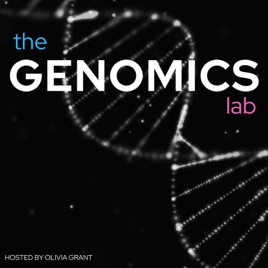
Advertise on podcast: The Genomics Lab
Rating
4.5from
This podcast has
34 episodes
Language
EnglishPublisher
Olivia GrantExplicit
No
Date created
2021/01/04
Latest episode
2022/04/13
Average duration
74 min.
Release period
25 days
Description
A podcast discussing current research in the field of Genomics
Unlock The Genomics Lab podcast Email contact info,
Listeners & Audience details
Email contact information
Direct podcast contact details

Listeners
Audience numbers & engagement insights

Audience details
Podcast Insights

Podcast episodes
Check latest episodes from The Genomics Lab podcast
Transposons and epigenetic priming of enhancers within early human embryo development with Dr Christopher Todd
2022/04/13
In today's episode I spoke again to Dr Christopher Todd from the Babraham institute. Chris is a postdoctoral researcher in Wolf Reiks lab who talked to me about transposable elements and epigenetic priming of enhancers with human embryonic development. Chris gave a great talk at GREECS 2022 where he discussed his research and I absolutely loved his talk, so immediately messaged him to join me on the podcast!
If like me, you feel unclear on what exactly are transposable elements, the details of their function & classification and want to learn more about enhancer priming, stay tuned to learn lots! Even if you do know these things, I guarantee you will still learn so much from Chris! Hope you all enjoy!
Chris' twitter: https://twitter.com/C_D_Todd
Reik lab twitter: https://twitter.com/ReikLab
Chris profile on Babraham website: https://www.babraham.ac.uk/people/member/746
Google scholar: https://scholar.google.com/citations?user=WPqJa6QAAAAJ&hl=en
Neuroscience meets epigenetics - Doctor Ben Rein
2022/02/18
TGL made it to 2022! On todays episode, I spoke to Dr Benjamin Rein, a neuroscientist all the way from Stanford. We speak all about Bens experience of science communication on social media, Ben uses Tik Tok & instagram to make awesome short videos on scientific papers and topics and has gained a following of +600,000 on tik tok! He also talks all about his passion for neuroscience, his PhD research and then we talked a lot about stuff we dont know a lot about!
Hope you enjoy this conversation & be sure to check Ben out on social media using the links below!
Bens tik tok - https://www.tiktok.com/@dr.brein?lang=en
Bens instagram - https://www.instagram.com/doctor.brein/?hl=en
Bens website - https://www.benrein.com
Spatial transcriptomics with Dr Patrick CN Martin
2021/12/08
In today's episode I spoke again to Dr Patrick CN Martin from the Biotech research and innovation centre at the University of Copenhagen, about spatial transcriptomics. Patrick is a post doctoral researcher who has been working on ST and more specifically, this pre print which we also took a deep dive into, on todays episode! Patricks new tool, named Vesalius (stay tuned to find out why) is able to decipher tissue anatomy from ST data by converting transcriptomic information into a color code for image segmentation.
The tool is able to successfully detect tissue architecture in mouse embryo and brain from high resolution ST data by incorporating image processing algorithms. Vesalius is a tool to perform high-resolution in silico anatomization and molecular characterization from ST data.
If like me, you feel unclear on what exactly is ST and how it works, stay tuned to learn lots! Even if you do know what ST is, don't worry! once Patrick taught me all about ST, we took a deep dive into the pre print, and discussed so many interesting topics.
Patricks twitter: https://twitter.com/pcnmartin
The pre print: https://www.biorxiv.org/content/10.1101/2021.08.13.456235v2
GREECS registration : https://whova.com/portal/registration/early_202201/
Epigenetics & fertility with Alka Gupta
2021/11/17
This week I spoke to Alka Gupta. Alka has just finished up her PhD and begun her postdoctoral position at UCSC in the Sharma Lab where she is now working on epigenetic inheritance. Today we spoke about her PhD research in which she was looking at the role of microRNAs in male infertility. We learnt about Sertoli cells, spermatogenesis and shrinking testis! Tune in to find out more!
Contact Alka here: https://twitter.com/alka_gupta__
GREECS registration link: https://whova.com/portal/registration/early_202201/
Biomarkers in genomics with Dr Paul Okunieff
2021/10/27
Today I speak to Dr Paul Okunieff , founder and consultant of Diacarta. DiaCarta is a leading translational genomics and personalized diagnostics company based in California. DiaCarta provides highly sensitive and advanced technologies aiming to change the landscape of precision medicine and molecular diagnostics by impacting healthcare treatment plans and the well-being of individuals around the world. Today me and Paul chat about the use of biomarkers in genomics, we touch on his recent coauthored papers in nature scientific reports here. We also discuss some ethical issues behind biomarkers and how events like 9/11 led Paul to pursue his career in this field.
Please visit Diacartas website here to find out more about them and connect with them on LinkedIn here.
The dark matter of the genome with Sudarshan Pinglay
2021/10/06
On todays episode, I speak to Sudarshan Pinglay, a PhD student from NYU medical center. Sudarshan is involved in the dark matter project- we talk about the dark matter of the genome, where introns, repetitive and regulatory elements reside. Sudarshan works specifically on the HOXA locus. The Hox family of genes pattern the head to tail axis in the developing embryo. In mammals, there are are four separate clusters (HoxA,B,C and D). Both space and time of Hox gene expression is colinear to their sequence in the genome. Loss of this leads to serious defects.
Sudarshan talks about his wet lab and dry lab work, where he has been using the HoxA cluster as a model to understand how the expression of Hox genes is regulated in order to pattern the developing nervous system. He tells us about his work aiming to build the HoxA cluster from the ground up so that he could manipulate the various players that have been implicated in Hox gene regulation and understand the pattern of Hox gene expression and embryonic development.
This is the pre print we discussed in todays episode, and more on the dark matter genome project can be found here.
Sudarshan can be found on twitter here!
The immune system: B cells and Epigenetics with Dr Hamish King
2021/09/22
In todays episode, I speak to Dr Hamish King, a Sir Henry Wellcome Fellow affiliated with the Blizard Institute at Queen Mary University of London. Hamish is interested in how errors in gene regulation lead to changes in the behaviour and function of B cells, an important cell type in our immune system that makes antibodies to fight and remember infections. Hamish talks about how he uses wet lab and bioinformatic techniques to answer these questions. Dr King is also due to become a laboratory head at WEHI in early 2022, where his lab will focus on answering a range of questions including:
How immune-specific chromatin-based mechanisms regulate gene expression
Whether autoimmune-associated genetic risk loci disrupt regulatory function of enhancers
If disease-specific epigenomic networks exist in autoimmunity
We talk also in the episode, about Hamish's recent paper which is accessible here, you can also find Hamish on twitter here where he is happy to be contacted further about his research and upcoming vacancies in his brand new lab.
Epigenetic biomarkers of exposure to tobacco smoke : A biosocial approach with Alexandria Andrayas
2021/09/08
Welcome to Episode 29 of The Genomics Lab! On today's episode we talk to Alexandria Andrayas who is a PhD candidate in the Soc-B Centre for doctoral training which is a new and unique programme in biosocial research. The programme is funded by the Economic and Social Research Council and the Biotechnology & Biological Sciences Research Council. It combines the strengths of the University of Essex, Manchester and UCL. The impact of smoking on health can be mediated through several biological pathways and it is well documented that smoking can be linked to large differences in DNA methylation as Alex discusses today. We also discuss the need and importance of giving consideration to the role that society may play in studies such as these. Stay tuned to find out more about epigenetics, DNA methylation and biosocial research.
Contact alex here: https://www.iser.essex.ac.uk/people/aandra
My preprint: https://www.biorxiv.org/content/10.1101/2021.09.02.458717v1
Dissecting the binding mechanisms of Transcription Factors to DNA with Dr Patrick CN Martin
2021/08/25
Welcome to Episode 28 of The Genomics Lab! On today's episode we talk to Dr.Patrick CN Martin who is a postdoctoral researcher at the University of Copenhagen. He completed his PhD in Dr Radu Zabets lab in 2020 where he investigated the binding mechanisms of transcription factors to DNA. His research involved development of an R package, ChIPAnalyser. A user-friendly, versatile and powerful R/Bioconductor package predicting and modelling the binding of TFs to DNA. ChIPanalyser performs similarly to state-of-the-art tools, but is an explainable model and provides biological insights into binding mechanisms of transcription factors to DNA. His research focused on investigating the binding mechanisms of three TFs that are known architectural proteins CTCF, BEAF-32 and su(Hw) in three Drosophila cell lines (BG3, Kc167 and S2). Aside from his research, Patrick enjoys coding, astrophysics and is now working in the exciting field of spatial transcriptomics! We also discuss the use of clinical data in genomics research, learning to code and bioinformatics. Hope you all enjoy! (See below for links)
Patrick's twitter: https://twitter.com/pcnmartin
Patrick's paper: https://www.sciencedirect.com/science/article/pii/S2001037020304736?via%3Dihub
ChIPAnalyser Bioconductor package: https://www.bioconductor.org/packages/release/bioc/html/ChIPanalyser.html
Remote control of gene expression: enhancers and the 4D genome with Professor Wendy Bickmore
2021/08/11
This week we are honoured to host Professor Wendy Bickmore, the Director of the MRC Human Genetics unit at the University of Edinburgh. Wendys research laboratory focuses on trying to better understand the 3D organisation of the genome, and how this controls how the genome functions during normal development. They are further interested in how this may be perturbed into disease. Wendy talks to us about some of her recent work which has been extremely important for better understanding enhancer function and also, some of the challenges and questions which remain to be answered in the field. She also provides some great insight into the experiments and methods ongoing in her lab now.
Find Wendy on twitter here : https://twitter.com/wendy_bickmore
Find out more about Wendys laboratory here: https://www.ed.ac.uk/mrc-human-genetics-unit/research/bickmore-group
Rattlesnakes and Population Genomics with Kat Ivey
2021/07/28
Welcome back! Today we are talking to Kathleen Ivey, a PhD student from the University of Texas at Arlington in the Castoe Lab. Kat talks to us all about her journey to her PhD, with a background in vet tech & herpetology. Kat now focuses on population genomics, with a particular interest in Rattlesnakes. She tells us all about being out in the field collecting the species right through to the laboratory investigation of gene expression! Find links to Kats socials below!
Kats twitter: https://twitter.com/KatIvey2
Kats publications : https://scholar.google.com/citations?user=wVZuQykAAAAJ&hl=en
Kats instagram: https://www.instagram.com/blondetravelingcircus/?hl=en
Making connections between epigenetics and evolution with Dr Peter Sarkies
2021/07/14
Welcome back for another episode! This week we chat to Dr Peter Sarkies from Imperial College London / MRC LMS! Peter is a senior lecturer running his own laboratory which aims to make connections between epigenetic gene regulation and evolution. Peter talks to us all about his research involving investigation of a wide range of epigenetic pathways including small RNA's such as Piwi interacting RNAs (piRNAs), DNA methylation and histone modification. Talking about RNAs is a first for us on the podcast, so we really enjoyed listening to everything Peter had to say!
Publication relevant to todays discussion: https://www.nature.com/articles/s41559-020-01293-z?proof=t
Blog post relevant to todays discussion: https://lms.mrc.ac.uk/epigenetics-evolution-in-the-fast-lane/
Lab website: https://psarkies.wixsite.com/epievo
Contact Peter on twitter here: https://twitter.com/PSarkies
Podcast reviews
Read The Genomics Lab podcast reviews
jmh7598 2021/08/05
Amazing podcast no matter experience
Super helpful podcast for anyone interested in genomics of any kind! Every concept is introduced, explained, and expanded upon with ease and fun in ev...
Podcast sponsorship advertising
Start advertising on The Genomics Lab relevant audience podcasts
You may also like to advertise on these Podcasts

4.7138192
The Dragon Reread
Jeff Lake, Micah Sparkman, and Alice Sullivan
4.83690
Mixed Up
Nicole Ocran and Emma Slade Edmondson

4.8106229
NBA History Conversations: Basketball Record
Adam Ryan
4.7128199
Stacks
Luke Martin
5160108
I Cry In Corners
Chari Orozco

4.8122113
minor details
Nicholas Baker & James Connors
520490
the Selfish Mom Podcast
Ali Kay

54269
Cinepals
Jaby Koay, Achara Kirk
4.810169
Betamax Babylon
11-29 Media
4.8175122
Chris Riback's Conversations
Chris Riback