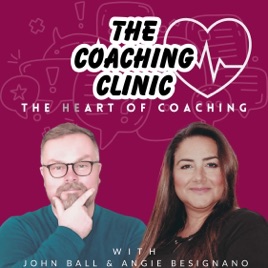
Advertise on podcast: Coaching Clinic: scale your business, acquire high ticket clients & master coaching skills
This podcast has
102 episodes
Language
EnglishPublisher
John Ball & Angela BesignanoExplicit
No
Date created
2021/02/22
Latest episode
2026/06/10
Average duration
22 min.
Release period
8 days
Description
Coaching Clinic is the go-to podcast for new and experienced professional coaches who want to grow a thriving, sustainable business and get better results with clients. Hosted by veteran coaches John Ball and Angela Besignano, this weekly show delivers actionable coaching strategies, business-building insights, and real-world tools to help you attract clients, master your craft, and scale with confidence. From powerful client conversations to group coaching design, sales, mindset, and marketing—this is your backstage pass to what really works in coaching today.
Unlock Coaching Clinic: scale your business, acquire high ticket clients & master coaching skills podcast Email contact info,
Listeners & Audience details
Email contact information
Direct podcast contact details

Listeners
Audience numbers & engagement insights

Audience details
Podcast Insights

Social media
Check Coaching Clinic: scale your business, acquire high ticket clients & master coaching skills social media presence

Podcast episodes
Check latest episodes from Coaching Clinic: scale your business, acquire high ticket clients & master coaching skills podcast
Say What You Mean: The Communication Problem Showing Up in Coaching Sessions
2026/06/10
There is a pattern showing up in coaching sessions that has nothing to do with the coaching itself. Clients are vaguer, harder to pin down, quicker to deflect. Getting a direct answer out of people is harder than it used to be, and the effects are landing in the room whether coaches are ready for them or not.
In this episode of The Coaching Clinic, John Ball and Angie unpack why direct communication is eroding, what is driving it, and why coaches, of all people, cannot afford to let it slide in their own practice.
The conversation gets personal. John connects the topic to his own experience of staying quiet about his identity for fear of making others uncomfortable, and the broader principle it points to: keeping yourself small to protect other people's feelings is not kindness. It is a slow tax on your effectiveness.
What you will take away from this episode:
Why avoidance and indirect communication are showing up more frequently inside coaching sessionsThe difference between being direct and being abrasive, and why conflating them weakens coachesHow to frame challenging questions so clients feel safe enough to go deeperWhen to push and when to read the room and ease offWhy social media culture may be partly responsible for the erosion of honest conversationHow a coach's own willingness to say the uncomfortable thing directly shapes what clients are willing to bring to sessionsJohn's personal reflection on staying quiet to protect others' comfort, and what it cost him
CHAPTERS:
00:00 The Challenge of Direct Communication
02:53 The Impact of Technology on Communication
05:33 Navigating Vulnerability in Coaching
08:28 The Fear of Being Direct
11:25 Authenticity in Coaching Conversations
14:24 Outro
FAQ SECTIONFrequently Asked Questions
Why are coaching clients becoming more avoidant and indirect in their communication?
John Ball and Angie discuss on The Coaching Clinic that avoidance in coaching sessions reflects a broader cultural shift rather than a coaching-specific problem. They identify increased reliance on text-based communication, the erosion of direct conversation through technology, and the chilling effect of social media pile-ons as contributing factors. Clients who have been burned by direct expression or who have absorbed cultural norms around indirect communication bring those patterns into the session. The result is deflection, resistance when challenged, and a reluctance to say what is actually on their mind.
What is the difference between being direct and being abrasive as a coach?
Angie addresses this distinction on The Coaching Clinic, noting that many people equate directness with aggression because they have experienced directness delivered badly. Being abrasive typically involves accusatory framing, false sweetness wrapped around a criticism, or a bluntness that disregards the other person's state. Being direct means saying what is true clearly and without evasion, while still holding the relationship. John Ball adds that trying to soften every uncomfortable truth does not protect the client; it weakens the coach's position and reduces the quality of the work.
How should coaches frame difficult or sensitive questions to keep clients engaged?
John Ball shares a specific approach on The Coaching Clinic: when a client mentions something emotionally charged in passing, flag it without forcing it. His framing is to name what the client said, acknowledge it may or may not be comfortable to explore, and ask directly whether they want to go there. This gives the client agency while keeping the topic alive. Angie adds that coaches should set expectations at the start of the relationship that sessions may go to uncomfortable places, while acknowledging that clients cannot always anticipate what that will feel like until it happens.
How does a coach know when to push a client harder and when to back off?
Angie's position on The Coaching Clinic is that coaches need to actively monitor the client's discomfort level rather than pressing consistently regardless of response. She suggests treating discomfort as a dial rather than a binary: pushing a client to an eight out of ten without recognising it and adjusting will damage trust and rapport. The skill is in reading the signals that a client is approaching their limit and navigating differently, rather than stopping entirely. John Ball echoes this, noting that clients who have asked to be challenged still need to retain the right to indicate when something is too much for that session.
Why does staying silent to avoid making others uncomfortable weaken a coach's effectiveness?
John Ball reflects on this directly in The Coaching Clinic, connecting it to his own experience of not mentioning his identity or his husband in professional contexts to avoid making others uncomfortable. His conclusion is that self-censorship in any form keeps you small and reduces your authenticity. Applied to coaching, a coach who avoids saying the uncomfortable thing, who softens every challenge, who withholds a direct observation to protect the relationship, is coaching with one hand tied behind their back. Authentic, direct communication is not a style preference; it is a professional standard.
Want to contact the show? You can leave us a voicemail. It's free to do, and we might feature you on our next episode. All you need to do is go to https://speakpipe.com/thecoachingclinicpodcast and leave us a message. You can also find our clips and full episodes on the exclusive Coaching Clinic YouTube channel: https://www.youtube.com/@coachingclinicpodcast
You can send us a video or voice message on LinkedIn:
John's LinkedIn Profile or go to PresentInfluence.com for coaching enquiries with John
Angie's LinkedIn Profile or visit AngieSpeaks.com
2023 Present Influence Productions Coaching Clinic: scale your business, acquire high ticket clients & master coaching skills 98
When You Need More Than a Coach: Hiring a Consultant for Your Coaching Business Rationale: Practical, searchable, clear.
2026/06/03
There's a pattern worth naming. Coaches who are struggling with their business almost always assume the problem is in the coaching. They need better skills, a different certification, and more training. So they hire another coach.
The business keeps struggling.
In this episode of The Coaching Clinic, John and Angie dig into why the problems most coaches and speakers face are business problems, not delivery problems, and why the people who are hardest to help are often the ones who can't see that from where they're standing.
John shares his own experience hiring consultants and ongoing mentors to address specific business outcomes, and why he sees a clear distinction between coaching, mentoring and consulting as different tools for different purposes.
What you'll take away from this episode:
Why coaches default to improving their craft when the real problem is in the business structureHow being "in the game" makes it nearly impossible to see where you're going wrongWhat to look for in a business consultant, and how to de-risk the investmentWhy AI flattery is not a substitute for someone who actually knows what they're talking aboutThe difference between coaching, mentoring and consulting, and when each one is the right fitWhy even experienced practitioners reach a point where external perspective becomes essentialWhat track record and outcome-specific guarantees should look like before you hire anyone
Whether you're just starting out, years into your coaching practice, or wondering why growth has plateaued despite strong client work, this episode is worth your time.
Chapters:
0:00 - Introduction to Business Coaching
0:16 - John's Experience with Consultants
0:49 - Angie's Perspective on Coaching
4:00 - Challenges in Transitioning Industries
7:50 - The Importance of Mentors and Guides
11:15 - Evaluating Expertise and Track Records
13:33 - Closing Thoughts
FAQ SECTIONFrequently Asked Questions
When should a coach hire a business consultant rather than another coach?
John Ball and Angie discuss in this episode of The Coaching Clinic that coaches should consider a business consultant when their growth has stalled despite strong delivery and client outcomes. The distinction they make is that coaching addresses mindset, behaviour and personal development, while consulting provides specific direction based on real-world experience with the problem you're facing. Ball argues that most coaching business problems are business problems, not craft problems, and treating them as the latter wastes time. The right moment to bring in a consultant is before the alarms are sounding, not after resources have been exhausted.
Why do coaches and speakers focus on improving their delivery skills instead of fixing their business?
According to John Ball on The Coaching Clinic, coaches and speakers default to improving their craft because that is the area they understand best and have the most control over. The coaching part of a coaching business feels familiar; the business mechanics do not. This creates a bias toward solutions like speaker coaching, charisma training or further certification, even when the actual problem is client acquisition, positioning or conversion. Ball argues that if you cannot clearly identify the problem from inside the business, you need external eyes, not more delivery practice.
What should coaches look for when vetting a business consultant?
John Ball states on The Coaching Clinic that a business consultant should be vetted on two criteria: a demonstrable track record with the specific outcome you need, and some form of guarantee or outcome commitment attached to their work. He distinguishes this from coaching, where the work is exploratory, and the answers are drawn out from the client. A consultant should be able to say what result they can help you achieve. Ball warns against consultants who rely primarily on AI-generated insight without real-world experience to back it up.
How does having an outside perspective help coaches grow their business?
John Ball and Angie use the football pitch analogy in this episode: when you are on the playing field, you cannot see the whole game. An external consultant, mentor or advisor can see patterns, blind spots and opportunities that are invisible to the person running the business day to day. Angie reinforces this by reflecting on a long-term client who spent 40 years successfully running a business and still struggled when entering a new sector, because the business model was different, even when the knowledge base was familiar. External perspective is valuable at every stage, not just during a crisis.
Is hiring a business consultant worthwhile even when a coaching business is going well?
John Ball's position on The Coaching Clinic is that consulting is most valuable before things break down, not after. He argues that the question should not be "am I struggling enough to justify this?" but "what am I not seeing that someone with relevant experience could show me?" Angie echoes this, noting that even coaches with a decade of practice are master coaches, not necessarily master business owners. Both hosts recommend treating external consultation as a proactive investment in clarity rather than a reactive rescue operation.
Want to contact the show? You can leave us a voicemail. It's free to do, and we might feature you on our next episode. All you need to do is go to https://speakpipe.com/thecoachingclinicpodcast and leave us a message. You can also find our clips and full episodes on the exclusive Coaching Clinic YouTube channel: https://www.youtube.com/@coachingclinicpodcast
You can send us a video or voice message on LinkedIn:
John's LinkedIn Profile or go to PresentInfluence.com for coaching enquiries with John
Angie's LinkedIn Profile or visit AngieSpeaks.com
2023 Present Influence Productions Coaching Clinic: scale your business, acquire high ticket clients & master coaching skills 97
Knowing When It's Time To Quit: When You're Consistently Not Getting Results
2026/05/27
When the business fog starts rolling in: Reconnecting with your whyEver feel like you're throwing a lot of effort into your business—social media posts, outreach, endless webinars—and yet, the results are just not adding up? If your calendar is more of a wasteland than a showcase of success, you're not alone. In this episode, we explore why your efforts might be missing the mark, the importance of understanding your true purpose, and how, sometimes, the best move is to pause rather than push.
In this episode:The common pitfalls of misaligned efforts and vanity metricsWhy visibility isn’t the only key to business growthThe significance of foundational business elements over performance hacksHow to reconnect with your original purpose and passionRecognising when it's time to quit or pivot, without guiltPractical ways to measure true progress beyond the obviousThe power of external coaching and honest feedback in business clarityPersonal stories of perseverance, setbacks, and the seasonality of successThe importance of patience and purpose in the slow burn of business growth
FAQs:Q: Why isn't my business growing despite my efforts? A: Often, the results lag behind the efforts due to misaligned strategies or focusing on vanity metrics rather than genuine progress.
Q: How can I reconnect with my original purpose? A: Reflect on your initial motivations and align your current strategies with those core values to reignite your passion.
Q: What are vanity metrics, and why should I avoid them? A: Vanity metrics are superficial indicators like social media likes that don't necessarily translate to business success. Focus on meaningful indicators that reflect true progress.
Q: When should I consider quitting or pivoting my business strategy? A: If your efforts consistently yield no results, it might be time to reassess your approach or consider a strategic pivot without guilt.
Q: How important is external feedback in business growth? A: External feedback and mentorship can provide valuable insights and reveal hidden disconnects in your strategy.
Q: What role does positioning play in business success? A: Positioning and relevance are crucial as they impact how your audience perceives your value and can significantly influence your success.
Q: How can I measure true progress in my business? A: Track meaningful, leading indicators that align with your business goals rather than just engagement metrics.
Q: Why is patience important in business growth? A: Understanding the delayed effect of efforts and giving your strategies enough time to yield results is essential for sustainable growth.
Q: What should I do if I feel overwhelmed by slow progress? A: Reassess your commitment, focus on actionable strategies, and consider seeking external perspectives to navigate challenges.
Timestamps:00:00 - The invisible struggle: Why effort doesn't always equal results
00:19 - Overcoming the ceiling: When your achievements feel out of reach
00:47 - The human side of setbacks: My story of doubt and resilience
01:16 - The role of positioning in long-term success
01:54 - Why performance on stage isn’t the root issue
02:19 - Understanding the results lag and patience as a virtue
02:43 - The importance of alignment and purpose in business pursuits
03:11 - How life’s chaos impacts your visibility and progress
03:20 - Debunking motivation myths: The real drivers of growth
03:43 - The truth about storytelling vs. foundational business elements
04:07 - Moving beyond the energy of success to practical mechanics
04:31 - The delayed effect of efforts and why persistence pays off
05:20 - Personal example: Why I keep podcasting despite slow growth
06:17 - The value of sticking with slow-burn projects and community building
07:05 - Personal insights on why I would miss my show’s network
07:28 - Re-evaluating why you continue and making conscious decisions
08:07 - When podcast efforts do produce results, even indirectly
08:36 - Why generic advice isn’t one-size-fits-all in business growth
09:03 - Lessons from experimenting with live streaming
09:30 - The importance of clarity and messaging before ramping higher
09:49 - Why online tactics can backfire if foundational steps are skipped
10:10 - Jumping into high-level activity without solid foundations
10:37 - The pitfalls of mimicking success without adaptation
11:01 - When social media outreach feels sleazy and counterproductive
11:57 - The futility of vanity metrics and passive social media observation
12:20 - The importance of tracking meaningful, leading indicators
12:40 - How passive behaviour on platforms like LinkedIn skews your perception
13:09 - Questioning whether the problem is on your end or systemic
13:33 - The difference between visibility and meaningful results
14:07 - Why downloads aren’t the only success metric
14:33 - Recognising that online inaction isn’t always a reflection of your efforts
14:59 - The importance of honest self-assessment and patience in progress
15:07 - Reconnecting with your why to rekindle your motivation
15:34 - The value of genuine purpose versus chasing quick wins
16:26 - Impact, identity, and meaningful contribution as core motivators
17:08 - Why most of us in coaching and speaking care deeply about purpose
17:26 - Your own unique purpose can redefine long-term success
17:44 - When practical life realities call for a pause, not a defeat
18:39 - The story of seasons: Hustle, pause, and come back stronger
19:04 - Recognising that setbacks can be restart signals, not end points
19:54 - Resources matter, but it’s what you do with them that counts
20:19 - The privilege of understanding your unique position and circumstances
20:48 - Knowing when to walk away and accept honest limitations
21:11 - If the moment to quit feels right, do it—without shame
21:45 - The brevity of the gap between effort and results than you imagine
22:05 - Practical advice: Adjust what is adjustable, rest assured your efforts matter
22:52 - The danger of hoping as a strategy—actions must be aligned with results
23:08 - The power of external perspectives and coaching
23:54 - Why an outside view can reveal hidden disconnects
24:07 - Final encouragement: Let’s navigate the fog, with honesty and purpose
Want to contact the show? You can leave us a voicemail. It's free to do, and we might feature you on our next episode. All you need to do is go to https://speakpipe.com/thecoachingclinicpodcast and leave us a message. You can also find our clips and full episodes on the exclusive Coaching Clinic YouTube channel: https://www.youtube.com/@coachingclinicpodcast
You can send us a video or voice message on LinkedIn:
John's LinkedIn Profile or go to PresentInfluence.com for coaching enquiries with John
Angie's LinkedIn Profile or visit AngieSpeaks.com
2023 Present Influence Productions Coaching Clinic: scale your business, acquire high ticket clients & master coaching skills 96
AI in Coaching: Tool, Thought Partner or Threat?
2026/05/12
John Ball and Angie open the clinic on a question every coach is quietly asking: how does AI fit into what we do, and does it make us better or just busier?
Neither of them is a convert. Neither is a sceptic. What they are is honest about where AI has actually changed how they work, and where it hasn't touched the thing that matters most.
In this episode:
Why Angie initially dismissed AI for coaching, and what changed her mindThe note-taking problem: how Zoom AI transcripts freed up session presence without replacing judgementWhy reviewing session notes in bulk with AI surfaces patterns that even experienced coaches miss over long engagementsJohn's reasoning for giving clients transcripts over recordings: not stepping back into the emotional state of the sessionHow to tell when a client is outsourcing their thinking to AI rather than doing the workWhy John's experiment with a "really sarcastic" ChatGPT persona did not go well (and why he's now using Claude)The supplement vs replacement distinction: why human coaching still produces the breakthroughs that AI cannotAI as a thought partner and objectivity tool, not a workhorse
The conversation lands somewhere useful: AI is most valuable for coaches when it handles the administrative and analytical weight so the coach can stay fully present for the work only they can do.
CHAPTERS
00:00 AI Buzz Kickoff
01:03 Skeptic to Curious
02:27 Fears and Pushback
04:36 Easy Not Lazy
06:14 Zoom Notes and Transcripts
08:03 Spotting AI Written Work
10:04 Theme Mining Past Notes
13:17 Tools for Content Creation
15:01 Why Coaches Matter
18:15 Humanity Over Perfection
19:17 Wrap Up and Outro
FAQ SectionHow are professional coaches using AI to improve their practice?
John Ball and Angie, co-hosts of The Coaching Clinic, use AI primarily for note-taking, session transcription and retrospective pattern analysis. Angie uploads client session notes into AI tools to identify recurring themes, missed focal points and forgotten frameworks across long coaching engagements. John uses AI-generated transcripts rather than recordings to help clients review sessions, avoiding the risk of clients re-entering the emotional state of the original conversation. Both hosts treat AI as a supplement to their coaching practice rather than a replacement for human judgement.
Can AI replace human coaches?
John Ball and Angie argue that AI cannot replace human coaches because the most impactful moments in coaching arise from real-time human interaction, not from AI analysis. AI lacks the empathy, lived experience and character that constitute a coach's credibility and effectiveness. While AI can surface patterns in notes or produce analytical summaries, it cannot replicate the relational dynamic that produces genuine client breakthroughs. The hosts acknowledge that some clients may use AI for self-guided work, but maintain that the transformation a skilled human coach produces remains distinctly irreplaceable.
How can coaches use AI for session notes without losing objectivity?
Angie recommends uploading accumulated session notes into an AI tool and prompting it to identify themes, focal points, growth opportunities and forgotten tools or frameworks. This approach is particularly useful for long-term coaching relationships where a coach may become too familiar with a client to maintain full objectivity. The AI does not replace the coach's awareness but provides an additional analytical layer, especially useful when reviewing 10 or more sessions where relevant details can otherwise be missed.
What are the risks of over-relying on AI in a coaching business?
John Ball cautions that AI writing is increasingly recognisable and that content produced entirely by AI tends to be "a little too perfect" and therefore not convincingly human. Both hosts raise the risk of clients outsourcing their thinking to AI rather than doing their own developmental work, and note that this is now detectable by coaches familiar with how AI outputs read. The broader risk is substitution: using AI to do the thinking rather than to support and accelerate the coach's own reasoning.
What is the difference between AI as a supplement and AI as a replacement in coaching?
John Ball and Angie draw a clear distinction between using AI to supplement coaching work (handling notes, surfacing patterns, drafting communications) and using it to replace the coach's core function. They agree that AI performs well as an unpaid analytical assistant or thought partner but cannot replicate the human credibility, experience and relational presence that define effective coaching. The supplement framing treats AI as a productivity and objectivity tool; the replacement framing, which both hosts reject, assumes AI can deliver the transformation that human coaching produces.
Want to contact the show? You can leave us a voicemail. It's free to do, and we might feature you on our next episode. All you need to do is go to https://speakpipe.com/thecoachingclinicpodcast and leave us a message. You can also find our clips and full episodes on the exclusive Coaching Clinic YouTube channel: https://www.youtube.com/@coachingclinicpodcast
You can send us a video or voice message on LinkedIn:
John's LinkedIn Profile or go to PresentInfluence.com for coaching enquiries with John
Angie's LinkedIn Profile or visit AngieSpeaks.com
2023 Present Influence Productions Coaching Clinic: scale your business, acquire high ticket clients & master coaching skills 95
When Clients Want Answers: How To Handle Requests For Solutions
2026/05/06
SUMMARY
In this episode, John explores how coaches can handle client questions without losing trust or creating dependency. It offers practical strategies for maintaining authority while empowering clients to make decisions.
key topics
Handling client questions without giving direct answersBalancing authority and empowerment in coachingReframing client expectations for decision-makingDifferentiating coaching from consultingStrategies for guiding clients to trust their own decisions
TAKEAWAYS
Avoid giving direct answers to maintain client independence.
Use acknowledgement, reframing, and guiding questions.Clarify your role: coach vs. consultant.Shift focus from finding the right answer to making a trusted decision.Share perspectives without landing on a solution.
Sound Bites
"Clients want certainty, but coaching is about trust.""Clarify your role: coach, not consultant.""Share perspectives, never land on a solution."
Chapters
00:00 Navigating Client Expectations in Coaching
02:31 The Balance Between Coaching and Consulting
04:14 Effective Strategies for Client Engagement
05:45 Contact us
Want to contact the show? You can leave us a voicemail. It's free to do, and we might feature you on our next episode. All you need to do is go to https://speakpipe.com/thecoachingclinicpodcast and leave us a message. You can also find our clips and full episodes on the exclusive Coaching Clinic YouTube channel: https://www.youtube.com/@coachingclinicpodcast
You can send us a video or voice message on LinkedIn:
John's LinkedIn Profile or go to PresentInfluence.com for coaching enquiries with John
Angie's LinkedIn Profile or visit AngieSpeaks.com
2023 Present Influence Productions Coaching Clinic: scale your business, acquire high ticket clients & master coaching skills 94
How Do You Know If Your Coaching Is Working? (Simple Metrics That Actually Help)
2026/04/29
Show NotesHow do you actually know if your coaching is working?
In this episode of The Coaching Clinic, Angie and John unpack one of the most uncomfortable—and most important—questions for coaches: are you effective, or are you just being liked?
They challenge the common reliance on client satisfaction, renewals, and “good sessions,” and explore why those signals can be misleading. Early-stage coaches often ride the highs and lows of recent sessions, but without clear metrics, improvement becomes guesswork.
The conversation moves beyond theory into practical application—how to introduce simple, usable feedback systems without damaging trust or turning sessions into surveys. They explore the role of structured feedback (like a 0–10 rating), better questioning, and the importance of creating space for honest input.
The core message is clear: if you’re not measuring your coaching, you’re relying on assumptions—and that has consequences for your growth and your clients’ results.
This episode is a direct, honest look at how to move from “I think I’m doing a good job” to actually knowing.
Key TopicsWhy client satisfaction isn’t the same as coaching effectivenessThe danger of recency bias in evaluating your coachingWhy renewals and retention are incomplete metricsHow to introduce simple feedback systems into your coachingUsing a 0–10 rating scale effectivelyAsking better questions to get honest client feedbackThe balance between trust, challenge, and evaluationWhy avoiding feedback limits your growth
Key TakeawayIf you’re not actively measuring your coaching, you’re guessing—and guessing limits both your development and your clients’ outcomes.
CHAPTERS
00:00 - Introduction and Topic Overview
00:41 - Measuring Coaching Effectiveness
03:18 - Personal Experiences and Insights
06:34 - The Role of Metrics in Coaching
12:11 - Feedback and Continuous Improvement
21:19 - Final thoughts on coaching and metrics.
FAQsHow do you know if your coaching is effective?You know your coaching is effective when you move beyond gut feel and start measuring client outcomes and experience. This includes structured feedback (like session ratings), evidence of progress, and whether the client is achieving meaningful results—not just enjoying the conversation.
What are the best metrics for measuring coaching effectiveness?There isn’t a single perfect metric, but useful ones include:
Session ratings (e.g. 0–10 scale)Client progress toward goalsQuality of client insights and actionsRetention or re-engagement (with context) The key is combining quantitative feedback with qualitative insight.
Is client satisfaction a reliable way to measure coaching success?Not on its own. Clients can enjoy sessions and still not make progress. Satisfaction reflects experience, not necessarily effectiveness. Strong coaching should challenge clients, which doesn’t always feel comfortable in the moment.
Should coaches ask for feedback after every session?It depends on your style and structure. Some coaches use quick ratings after each session, while others gather feedback periodically. The important thing is consistency and making it easy for clients to respond honestly.
What is a simple way to measure coaching sessions?A practical method is using a 0–10 rating at the end of a session, followed by one or two focused questions like:
What made it that score?What would have made it higher? This keeps feedback simple but actionable.
Why do coaches avoid asking for honest feedback?Because it’s uncomfortable. Honest feedback can challenge your confidence and expose blind spots. But avoiding it limits growth and can lead to losing clients without understanding why.
How can you ask for feedback without damaging the coaching relationship?Frame feedback as part of the process, not a critique. Make it clear that:
It helps you serve them betterThere are no negative consequencesYou’re looking for improvement, not validation Psychological safety is key.
Are client renewals a good measure of coaching success?They’re useful but incomplete. A client staying on doesn’t always mean they’re getting results—it may reflect comfort, habit, or relationship. Renewals should be considered alongside progress and impact.
What is the biggest mistake coaches make when evaluating their performance?Relying on intuition or recent sessions (recency bias). Many coaches judge their ability based on how the last session felt, rather than consistent patterns or structured feedback.
Can coaching be measured if it’s subjective?Yes—but not perfectly. Coaching is subjective, but that doesn’t mean it’s unmeasurable. The goal isn’t precision, it’s clarity. Even simple metrics create better awareness than guesswork.
Why is measuring coaching important for business growth?Without measurement, you can’t improve or identify issues early. This leads to:
Stagnation in your coaching skillsLost clients without clear reasonsReduced referrals and growth Measurement turns coaching into a developable skill, not just a perceived one.
What’s the risk of not measuring your coaching?You rely on assumptions instead of evidence. Over time, this can lead to declining results, client drop-off, and limited professional growth—often without realising why.
Want to contact the show? You can leave us a voicemail. It's free to do, and we might feature you on our next episode. All you need to do is go to https://speakpipe.com/thecoachingclinicpodcast and leave us a message. You can also find our clips and full episodes on the exclusive Coaching Clinic YouTube channel: https://www.youtube.com/@coachingclinicpodcast
You can send us a video or voice message on LinkedIn:
John's LinkedIn Profile or go to PresentInfluence.com for coaching enquiries with John
Angie's LinkedIn Profile or visit AngieSpeaks.com
2023 Present Influence Productions Coaching Clinic: scale your business, acquire high ticket clients & master coaching skills 93
Optimise Coaching Sessions: Balancing Support and Challenge
2026/04/22
SUMMARY
Are you challenging your clients enough?
Let's talk about Keeping Coaching Impactful
Angie and John discuss the client journey in coaching and the risk of sessions becoming comfortable, friendly chats rather than driving transformation. They emphasise that coaching should produce progress, expansion, and results, not “a $500 cup of coffee,” and that clients’ outcomes are the best advertisement and referral source for a coach.
They explore how effective challenge varies by client—some need gentle coaxing while others want direct feedback—while maintaining balance so clients aren’t discouraged or pushed just for the sake of it. They highlight the importance of setting standards, asking permission to go deeper, checking in with clients about what would make sessions more impactful, and staying nimble during calls to avoid avoidance and surface-level conversation. They note empathy has a place during life events, but coaching is not therapy or mere emotional comfort.
CHAPTERS
00:00 Coaching Chat Trap
01:31 500 Dollar Coffee
02:45 Friends vs Coach Role
04:12 Tailoring Challenge Style
06:09 Spectrum of Feedback
10:49 Permission to Go Deeper
18:14 Results Drive Referrals
19:43 Coach Energy and Prep
22:02 Hugs Therapy and Boundaries
26:30 Final Takeaways
Want to contact the show? You can leave us a voicemail. It's free to do, and we might feature you on our next episode. All you need to do is go to https://speakpipe.com/thecoachingclinicpodcast and leave us a message. You can also find our clips and full episodes on the exclusive Coaching Clinic YouTube channel: https://www.youtube.com/@coachingclinicpodcast
You can send us a video or voice message on LinkedIn:
John's LinkedIn Profile or go to PresentInfluence.com for coaching enquiries with John
Angie's LinkedIn Profile or visit AngieSpeaks.com
2023 Present Influence Productions Coaching Clinic: scale your business, acquire high ticket clients & master coaching skills 92
How to Use Client Feedback for Effective Coaching Check-Ins
2026/04/15
Empowering Coaching Clients With Check-Ins and Simple Metrics
Angie discusses how coaches can keep delivering value by sharing experience and, importantly, making clients an active part of the coaching equation. She recommends using simple metrics and regular check-ins—such as quick 0–10 ratings after sessions or structured touchpoints at one-third, two-thirds, and the end of an engagement—to avoid discovering issues at the “11th hour.”
Angie suggests asking strategic, rotating questions (e.g., how challenged or empowered the client felt, key takeaways, or preferences for cheerleading vs. tougher probing) and giving clients time to reflect before discussing in the next session. The goal is to ensure clients feel heard, improve coaching effectiveness, clarify what’s working, and end engagements without surprises, while also exploring future focus areas without being salesy.
00:00 Why Experience Matters
00:42 Make Clients Part
02:00 Metrics and Check Ins
03:43 Better Feedback Questions
05:58 Avoid the End But
08:02 Authority Plus Partnership
09:17 Wrap Up and Next Steps
10:23 Send Your Questions
Want to contact the show? You can leave us a voicemail. It's free to do, and we might feature you on our next episode. All you need to do is go to https://speakpipe.com/thecoachingclinicpodcast and leave us a message. You can also find our clips and full episodes on the exclusive Coaching Clinic YouTube channel: https://www.youtube.com/@coachingclinicpodcast
You can send us a video or voice message on LinkedIn:
John's LinkedIn Profile or go to PresentInfluence.com for coaching enquiries with John
Angie's LinkedIn Profile or visit AngieSpeaks.com
2023 Present Influence Productions Coaching Clinic: scale your business, acquire high ticket clients & master coaching skills 91
The 7 Key Strategies to Fully Book Your Coaching Practice
2026/04/01
How to Identify and Attract Your Ideal Clients in 2026
SUMMARY
In this episode, John & Angie discuss essential strategies for coaches and entrepreneurs to attract clients, build sustainable businesses, and avoid common pitfalls. They share personal experiences, practical tips, and insights on targeting the right audience, leveraging marketing channels, and maintaining focus.
Keywords:
coaching business, client attraction, marketing strategies, target audience, business growth, referrals, webinars, social media, niching, strategic focus
key topics:
Target audience identification and niching
Effective marketing channels and strategies
Building a referral-based business and reputation
The importance of strategic focus and avoiding distractions
Using webinars and content marketing to attract clients
Chapters
00:00 Introduction: The Evolution of Client Attraction Strategies
01:31 Reflecting on Past Mistakes in Business Marketing
02:57 The Importance of Knowing Your Target Audience
04:26 Deciding Who You Want to Work With and Who to Avoid
05:44 Building a Clear Client Profile and Filtering Clients
06:37 The Role of Research and Industry Knowledge
08:11 Effective Communication and Outreach Strategies
10:15 Focusing on B2B vs B2C Strategies
11:54 Creating Offers That Resonate with Your Target Market
14:07 Using Content and Industry Insights to Position Yourself
16:05 The Value of Specialisation and Niche Focus
18:03 Building Visibility Through Media and Speaking Opportunities
20:00 The Power of Referrals and Networking
22:04 Being Strategic and Focused in Your Marketing Efforts
24:09 The Shift from Free to Paid Offerings for Serious Clients
26:15 The Importance of Consistent Effort and Strategic Action
27:58 outro.mp3
Want to contact the show? You can leave us a voicemail. It's free to do, and we might feature you on our next episode. All you need to do is go to https://speakpipe.com/thecoachingclinicpodcast and leave us a message. You can also find our clips and full episodes on the exclusive Coaching Clinic YouTube channel: https://www.youtube.com/@coachingclinicpodcast
You can send us a video or voice message on LinkedIn:
John's LinkedIn Profile or go to PresentInfluence.com for coaching enquiries with John
Angie's LinkedIn Profile or visit AngieSpeaks.com
2023 Present Influence Productions Coaching Clinic: scale your business, acquire high ticket clients & master coaching skills 90
Energy in Coaching: Balancing Empathy and Professionalism
2026/03/25
Coach Energy and Consistency: Handling “That Client,” Emotions, and Authority in Sessions
SUMMARY
John and Angie discuss how coaches manage their energy and consistency across sessions, including whether they show up the same with every client and how reactions to “that client” can signal a coach’s own challenge in navigating difficulty. They explore adapting energy to different clients while still leading the session, and identify a risk point when a coach’s view of a client’s potential becomes clouded by triggers or poor rapport. They cover handling clients who overtalk, ask constant questions, assert disruptive authority, or arrive with strong emotions, using tactics such as slowing down, labelling emotions, asking what the client needs most, and pivoting if the client won’t discuss what’s wrong. They emphasise empathy without being pulled into clients’ emotions, holding space, rescheduling when needed, and building both process and intuition skills.
CHAPTERS
00:00 Coach Energy Consistency
00:59 Show Intro 01:15 Dreading That Client
01:58 Roster Energy Management
03:41 Why It Feels Hard
06:52 Adapt Without Losing Authority
09:37 Handling Power Challenges
13:00 When Clients Won't Share
14:32 Reschedule or Refocus
18:42 Empathy Without Absorbing
23:06 Warmth and Competence
27:23 Process vs Intuition Balance
27:48 Wrap Up and Listener Call
Want to contact the show? You can leave us a voicemail. It's free to do, and we might feature you on our next episode. All you need to do is go to https://speakpipe.com/thecoachingclinicpodcast and leave us a message. You can also find our clips and full episodes on the exclusive Coaching Clinic YouTube channel: https://www.youtube.com/@coachingclinicpodcast
You can send us a video or voice message on LinkedIn:
John's LinkedIn Profile or go to PresentInfluence.com for coaching enquiries with John
Angie's LinkedIn Profile or visit AngieSpeaks.com
2023 Present Influence Productions Coaching Clinic: scale your business, acquire high ticket clients & master coaching skills 89
Coaching Visibility: Boost Your Brand Recognition
2026/03/18
How Coaches Can Become More Known: Strategic Podcast Guesting, Speaking, and Content
SUMMARY
John opens the Coaching Clinic without Angie, who is busy applying the show’s advice with new clients, and shares key ways coaches can become more known to generate lead flow. He outlines the main pillars: developing clear IP by knowing exactly who you help, then using authority builders like a book, a podcast or a YouTube channel, speaking engagements (often starting locally and for free), and a focused social media channel rather than trying to be everywhere. He emphasises podcast guesting as a low-cost, accessible, and powerful approach when done strategically, noting most pitches are generic, poorly researched, and “spray and pray.” He recommends personalisation, demonstrating familiarity with the show, and proposing valuable conversation topics, and offers the first three free classes of his Strategic Podcast Guesting mini course via show notes or presentinfluence.com or direct from this link: https://app.hiro.fm/channel/podcastguest
CHAPTERS
00:00 Why Being Known Matters
00:40 Three Pillars Overview
00:57 Books Podcasts Speaking
01:31 Podcast Guesting Advantage
03:20 Social Media Focus
03:41 Do You Need Fame
04:47 Why Pitching Fails
05:54 Strategy Over Spray
07:29 Personalised Pitch Tactics
09:16 Free Guesting Mini Course
10:45 Wrap Up And Next Steps
Want to contact the show? You can leave us a voicemail. It's free to do, and we might feature you on our next episode. All you need to do is go to https://speakpipe.com/thecoachingclinicpodcast and leave us a message. You can also find our clips and full episodes on the exclusive Coaching Clinic YouTube channel: https://www.youtube.com/@coachingclinicpodcast
You can send us a video or voice message on LinkedIn:
John's LinkedIn Profile or go to PresentInfluence.com for coaching enquiries with John
Angie's LinkedIn Profile or visit AngieSpeaks.com
2023 Present Influence Productions Coaching Clinic: scale your business, acquire high ticket clients & master coaching skills 88
How to Manage Over-Talkative Clients in Coaching Sessions
2026/03/11
Keeping Coaching Sessions on Track: Handling Clients Who Talk Too Much.
SUMMARY
John & Angie discuss a common coaching challenge: clients or prospects who dominate calls, talk over the coach, and leave no space for productive coaching. They argue that effective coaches must stay in the “driver’s seat” or “pace car,” setting expectations up front that interruptions may occur to prevent unproductive rambling or to pause to address important nuances. They share tactics such as politely interrupting, redirecting, summarising what was said, asking clients to nutshell the point, and helping clients choose the most impactful focus for the session. They emphasise balancing empathy and respect with maintaining control, avoiding laziness or over-talking as a coach, and finishing on time to avoid creating expectations of overruns. When breakthroughs occur near the end, they suggest acknowledging them and carrying the topic into the next session with preparation tasks.
CHAPTERS
00:00 Coaching Call Problem
01:54 Control the Conversation
03:15 Be the Pace Car
05:55 Polite Interruptions
08:26 Preframe Expectations
11:05 Teach Clarity Fast
12:36 Summarise and Refocus
17:20 End on Time
21:25 Wrap Up and Next Time
Want to contact the show? You can leave us a voicemail. It's free to do, and we might feature you on our next episode. All you need to do is go to https://speakpipe.com/thecoachingclinicpodcast and leave us a message. You can also find our clips and full episodes on the exclusive Coaching Clinic YouTube channel: https://www.youtube.com/@coachingclinicpodcast
You can send us a video or voice message on LinkedIn:
John's LinkedIn Profile or go to PresentInfluence.com for coaching enquiries with John
Angie's LinkedIn Profile or visit AngieSpeaks.com
2023 Present Influence Productions Coaching Clinic: scale your business, acquire high ticket clients & master coaching skills 87
How to Start and Scale Your Coaching Business: Expert Tips from Angie and John
2026/03/04
The Business of Coaching: Vision, Strategy, and Avoiding Costly Mistakes
Angie and John discuss the dos and don’ts of building a coaching business, reflecting on how they started with little guidance and often spent money on marketing and setup that didn’t work. They emphasise creating a clear vision of what “success” looks like (lifestyle solopreneur vs. scaling with staff), understanding finances and time constraints, and following a general progression from one-to-one coaching to groups and then scaling. They warn against getting distracted by non-priorities, overspending without a strategy, and growing too quickly, sharing an example of a startup that scaled fast and had to lay off its team. They critique coaching “job” postings that are actually franchises or MLM-like models, urging due diligence, and stress the value of trustworthy mentorship plus expert advice on legal structure and tax efficiency.
CHAPTERS
00:00 Business of Coaching
01:36 Starting Without a Handbook
03:44 Roadmaps and Realities
06:50 Vision and Growth Stages
11:24 LinkedIn Coaching Schemes
13:46 Franchise vs MLM Warning
20:05 Scaling Too Fast Lessons
25:36 Spend With Strategy
27:01 Pay Coaches and Value People
30:24 Taxes, Mentors and Wrap Up
Want to contact the show? You can leave us a voicemail. It's free to do, and we might feature you on our next episode. All you need to do is go to https://speakpipe.com/thecoachingclinicpodcast and leave us a message. You can also find our clips and full episodes on the exclusive Coaching Clinic YouTube channel: https://www.youtube.com/@coachingclinicpodcast
You can send us a video or voice message on LinkedIn:
John's LinkedIn Profile or go to PresentInfluence.com for coaching enquiries with John
Angie's LinkedIn Profile or visit AngieSpeaks.com
2023 Present Influence Productions Coaching Clinic: scale your business, acquire high ticket clients & master coaching skills 86
The Power of Preparedness in Coaching Sessions
2026/02/25
Prepared Coaching: Notes, Energy, and Being Fully Present with Clients
SUMMARY:
Angie and John discuss why showing up unprepared to coaching sessions harms client outcomes and rapport, and why “work before the work” matters.
They emphasise protecting energy and presence by avoiding back-to-back sessions and building in at least 15 minutes between calls to reset, review prior notes, and track action steps. They argue that coaches who wing sessions without notes or tracking may be adequate but cannot be masterful, and that forgetting prior commitments is a “bad look” that can damage trust, renewals, reputation, and business.
They describe notes as a strategic tool that helps clients feel uniquely seen, supports continuity over months or years, and provides a story of the client’s progress when reviewed near the end of an engagement.
They also compare manual note-taking with AI note-taking, noting that AI can organise summaries and action steps, while coaches still capture standout moments and edit them before sharing.
Finally, they debate recording sessions, suggesting that recordings can help coach development and quality assurance, but may distract clients or pull them back into an old emotional state, while well-structured notes may deliver more value for client reflection and transformation.
CHAPTERS:
00:00 Prepared or Not
00:58 Willy Nilly Coaching
01:54 Energy and Spacing
04:18 Sweet Spot Scheduling
05:59 Notes and Mastery
09:35 Presence Feels Magical
10:32 Coffee Chat vs Results
13:52 Assembly Line Warning
14:57 Why Notes Matter
16:01 Rocks Pebbles Sand
16:57 AI Note Takers
19:21 Stay Present Coaching
19:58 Recordings For Clients
22:17 Transformation Over Replay
24:15 Final Session Story
25:57 Renewals And Progress
26:29 What Did You Say
28:09 Wrap Up And Next
Want to contact the show? You can leave us a voicemail. It's free to do, and we might feature you on our next episode. All you need to do is go to https://speakpipe.com/thecoachingclinicpodcast and leave us a message. You can also find our clips and full episodes on the exclusive Coaching Clinic YouTube channel: https://www.youtube.com/@coachingclinicpodcast
You can send us a video or voice message on LinkedIn:
John's LinkedIn Profile or go to PresentInfluence.com for coaching enquiries with John
Angie's LinkedIn Profile or visit AngieSpeaks.com
2023 Present Influence Productions Coaching Clinic: scale your business, acquire high ticket clients & master coaching skills 85
My coaching calendar is fully booked! What can I do?
2026/02/18
We know some problems are good problems to have, but they still need solutions. In this episode, Angie and John discuss the real challenges coaches face when reaching their capacity limits. They share insights on managing workload, setting boundaries, and scaling your coaching business sustainably while maintaining quality and personal well-being.
Key TopicsThe emotional and mental impact of reaching coaching capacityUnderstanding and defining your personal coaching limitHow solopreneurs can avoid burnout and manage their time effectivelyStrategies for handling client waitlists and managing client engagementShifting from one-on-one to group coaching to increase capacityBuilding a referral network and collaborative coaching partnershipsManaging the pipeline and avoiding cyclical business modelsSetting boundaries around weekends and personal timePreparing clients for wait times and maintaining high-value engagementPlanning for business scaling: when and how to expand your team or offerings
Timestamps00:00 - Introduction: Why capacity limits matter for coaches
02:11 - Recognising the emotional overwhelm of hitting capacity
04:00 - The importance of knowing your coaching capacity
05:28 - From one-hour sessions to managing your time effectively
06:48 - The necessity of preparation and session boundaries
07:56 - Handling weekend coaching and personal boundaries
09:26 - Protecting your weekends and personal time
10:14 - Managing client waiting lists and maintaining engagement
12:22 - Strategies for lead flow and pipeline management
14:15 - Transitioning to group coaching to scale capacity
16:33 - Creating waitlists and managing client expectations
17:48 - Planning for business growth and team expansion
20:08 - Delegating coaching to trusted partners
22:13 - Reflecting on future business scalability
Want to contact the show? You can leave us a voicemail. It's free to do, and we might feature you on our next episode. All you need to do is go to https://speakpipe.com/thecoachingclinicpodcast and leave us a message. You can also find our clips and full episodes on the exclusive Coaching Clinic YouTube channel: https://www.youtube.com/@coachingclinicpodcast
You can send us a video or voice message on LinkedIn:
John's LinkedIn Profile or go to PresentInfluence.com for coaching enquiries with John
Angie's LinkedIn Profile or visit AngieSpeaks.com
2023 Present Influence Productions Coaching Clinic: scale your business, acquire high ticket clients & master coaching skills 84
Podcast reviews
Read Coaching Clinic: scale your business, acquire high ticket clients & master coaching skills podcast reviews
Podcast sponsorship advertising
Start advertising on Coaching Clinic: scale your business, acquire high ticket clients & master coaching skills relevant audience podcasts
You may also like to advertise on these Podcasts

4.115956456
The Tucker Carlson Show
Tucker Carlson Network

4.828023450
Huberman Lab
Scicomm Media

4.240683
To Be The Man
Podcast Heat | Cumulus Podcast Network

4.41511292000
The Ben Shapiro Show
The Daily Wire
4.2155648
TENNIS.com Podcast
TENNIS.com Podcast/Tennis Channel Podcast Network
4.510846771
The Joe Budden Podcast
The Joe Budden Network
4.611626506
The Bulwark Podcast
The Bulwark
4.711480389
Matt and Shane's Secret Podcast
Matt McCusker & Shane Gillis

4.82510178
Smosh Reads Reddit Stories
Smosh

4.975169748
Small Town Murder
James Pietragallo, Jimmie Whisman