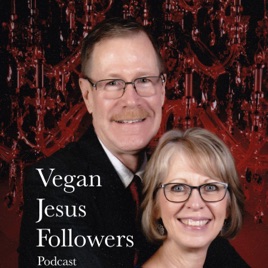
Advertise on podcast: Vegan Jesus Followers Podcast
Rating
5from
This podcast has
26 episodes
Language
EnglishPublisher
WhoFoo AdventuresExplicit
No
Date created
2021/07/13
Latest episode
2021/12/27
Average duration
10 min.
Release period
8 days
Description
Can you be a vegan and a Jesus follower at the same time? Join our conversations as we share with you from our own personal journey what it looks like to be a vegan and a Jesus follower.
Unlock Vegan Jesus Followers Podcast podcast Email contact info,
Listeners & Audience details
Email contact information
Direct podcast contact details

Listeners
Audience numbers & engagement insights

Audience details
Podcast Insights

Podcast episodes
Check latest episodes from Vegan Jesus Followers Podcast podcast
Episode 25 - Christmas Greeting & Blessing
2021/12/27
The last year or two have been especially difficult. Our world has radically changed. The political and social climate have become more sensitive and inflamed, even volatile. Let’s not forget Covid-19, the health effects and financial devastations from it, the relational isolation and other restrictions imposed on all of us as a result.
Yes, life has been downright discouraging, even depressing. That is why we want to share with you, our listeners, a special Christmas blessing. None of what has happened in our world is a surprise to our God. He knew beforehand what would happen and the eventual outcome is in His hands. This blessing comes from a song called “The Blessing” by Kari Jobe and Cody Carnes. There is a link below to a YouTube video of this song. Check it out. You will be blessed by it.
The Blessing
“The Lord bless you, and keep you, make His face shine upon you and be gracious to you. The Lord turn His face towards you and give you peace. Amen.”
“May His favor be upon you, and a thousand generations, and your family, and your children, and their children, and their children. May His presence go before you, and behind you, and beside you, all around you, and within you. He is with you. He is with you. In the morning, in the evening, in your coming, and your going, in your weeping, and rejoicing, He is for you. Amen.”
May God’s Shalom be with you and your family. Merry Christmas!
“The Blessing” by Kari Jobe and Cody Carnes
https://www.youtube.com/watch?v=Zp6aygmvzM4
Episode 24 - Carbophobia
2021/12/17
Do you have a fear of eating too many carbohydrates? Do you think carbohydrates make you gain weight? If you do, you have Carbophobia.
Where did this fear of carbs come from? In his book, “The Low-Carb Fraud”, T. Colin Campbell, PhD tells us. Back in 1972, Dr. Robert Atkins wrote a book called, “The Atkins Diet Revolution”. It wasn’t very popular, so several years later, in the 1980’s when there was a lot of talk about obesity, especially obesity in America, Dr. Atkins decided to re-market his book. In 1988 he revised and republished it with the title, “Dr. Atkins New Diet Revolution”. In this book, he proclaims that obesity is not caused by eating fat, it’s caused by eating too many carbs. He advocates severely restricting carbohydrate intake and getting most of your calories from fat and protein.
I’ve never had a fear of eating carbohydrates, but even as a child when I had a hamburger if I didn’t want to finish my hamburger my parents told me to eat the meat and leave the bun. Today it is common for people to eat high fat, high protein and restrict and even avoid carbohydrates altogether because they believe carbs will make you fat. Modern versions of what started as the Atkins diet are the South Beach Diet, the Paleo Diet and the Zone Diet.
For a person who has been eating a lot of processed carbs as well as a high fat, high protein diet, to severely restrict the amount of processed carbs that they’ve been eating can result in quick weight-loss. But what’s wrong with this approach?
1. Low carb diets are very unhealthy and have long-term health consequences.
2. Low carb diets lumps all carbohydrates into the same category, whether they are whole foods plant-based carbs or processed carbs. By doing so, it confuses people and leads them to believe that all carbs are the same and all are bad and should be avoided. That simply is not true.
3. Low-carb diets emphasizes fat and cholesterol and proclaims them as nutritional heroes that should be increased in a person’s diet. In reality, fat and cholesterol are the cause of many of our modern day health problems such as cardiovascular disease, arteriosclerosis, and non-alcoholic fatty liver disease to name a few.
4. A very restrictive diet of any kind, low-carb diet or otherwise is simply not sustainable. Whatever weight is lost from such a restrictive diet is ultimately gained back along with even more weight.
In contrast, a whole-foods, plant-based lifestyle isn’t restrictive. We don’t count, weigh or measure our food and we eat until we’re satisfied.
Dr. Michael Greger says low carb diets cripple people’s arteries. Wow! That’s enough of a reason right there to not eat a low-carb diet!
By definition, a low-carb diet emphasizes animal based foods, whereas a low fat diet emphasizes a plant-based diet. The healthiest way to fight obesity is to eat a whole foods plant-based diet that emphasizes whole foods that are high in nutrients, high in fiber, low in sodium, low in saturated fat, and very low in cholesterol, while at the same time steering clear of processed foods. Note the word “processed,” because these foods are low in nutrients, low in fiber, high in sodium, high in saturated fat and high in cholesterol.
We highly recommend the book, “The Low Carb Fraud” by T. Colin Campbell, PhD and Howard Jacobson, PhD which fully explains the danger of a low carb diet.
Episode 23 - The Relationship Between Aging and Health
2021/12/10
Aging and health. Such an interesting topic especially since we are in our 60’s and live in a 55+ community. It seems that people equate being old with being sick. Like once you are in your 50’s you start going downhill in your health, strength, etc. If you have a heart attack or cancer, it’s either because you are old or it’s in your family genetically.
The expectation that we’ve all probably believed is that children and young people are the healthiest, their parents are a little less healthy, and the elderly suffer from sickness and chronic disease and are most likely to be overweight or even obese. You’ve probably heard people blaming getting older for the weight they’ve put on and can’t get rid of or not being surprised when they’re diagnosed with a new medical condition or disease. Is this normal? Consensus seems to indicate that it is. If so, is it possible to reverse that trend and what is expected in the normal aging process?
In the book, “The Starch Solution” by John McDougall, MD and Mary McDougall, Dr. McDougall tells about how not only through personal experience in his own medical practice, but additionally through research in volumes written over 50 years that showed how patients with chronic, seemingly irreversible conditions, could be cured with one simple solution: a diet based on starch supplemented by vegetables and fruits. No pills or surgery needed. Over time, Dr. McDougall tested, documented, and systematized his plant – food, starch-based therapy into what is now the McDougall program.
Buzz and Carol have personally experienced how changing to a whole foods plant based diet has given us more energy and less sickness than we experienced when we ate the standard American diet. Carol has personally reversed the symptoms of Multiple Sclerosis and decreased the inflammation in her body to less than 1%. She has lost over 34 pounds and kept it off for over 13 years. Her body fat is around 23%. She walks every day and does strength training with free weights. We play with our grandchildren. Personally, from our experience aging does not mean you will automatically get sick or gain weight. Our lifestyle choices do make a difference at any age!
More about Dr. John McDougall and the McDougall Program at the following link:
https://www.drmcdougall.com
Episode 22 - Does God Always Answer Our Prayers?
2021/12/03
Do we expect God to always answer our prayers? Have we ever had prayers that God didn’t answer and wondered why? Yes! Let’s discuss some of our struggles and what we’ve learned.
In Matthew 7:7 we have the example of God giving good gifts to His children. If our children ask us for something we also give them good things. But if our child asks for candy or cake right before dinner we tell them “no, not before dinner.” What do we mean by God answering our prayer? Technically you can say that God answers all our prayers, sometimes with a “yes”, sometimes with a “no” and sometimes with “wait”. So when we talk about answered prayer, do we mean that God answers our prayer only when we receive an immediate answer and get exactly what we want? We shouldn’t.
Reasons we might not get exactly what we ask for when we pray:
1. Something separates us from God or we’re involved in doing evil. If so, God will hide His face from us and not hear our prayers. (Isaiah 59:1-2; 1 Peter 3:12)
2. Our motives are wrong. We need to examine our motives and make sure they aren’t purely selfish. (James 4:3)
3. Husbands- if we don’t treat our wives properly our prayers will be hindered. (1 Peter 3:7)
4. Disobedience to God’s commandments in His Word (1 John 3:21-22)
5. Asking God for something that contradicts His will (1 John 5:14)
6. We may need to humble ourselves and turn away from sin and seek God’s face. (2 Chronicles 7:13-14)
Another aspect of this is the whole timing of our prayers. Our timing doesn’t always match God’s timing. That’s true more often than we realize. Does living a life of dependency on God and having faith in Him and His provision really work if I can control my own life? If I don’t need God then I don’t need to rely on Him. Where’s the faith and dependence in that situation? There isn’t any! Maybe then the purpose of our prayers shouldn’t be to expect God to give us everything we want or to solve all our problems but for us to spend more time with Him and experience His presence in a deeper way than we could otherwise experience.
We learned in Transformation Prayer that when we pray for someone else, God may not answer that prayer because He will not go against that person’s will or choices if they are different than what we are praying for. Learning that was a light bulb moment for us. Maybe God doesn’t answer our prayers when, even if by our own ignorance, we are counteracting our prayers by our own choices. God can still supersede our choices with His love and mercy and He sometimes does. But He is under no obligation to rescue us when we make choices that are literally killing us. With knowledge comes responsibility. Sometimes we just don’t have the knowledge.
Scripture References
Matthew 7:7 “Ask, and it will be given to you; seek, and you will find; knock, and it will be opened to you. For everyone who asks receives, and he who seeks finds, and to him who knocks it will be opened. Or what man is there among you who, when his sons asks for a loaf, will give him a stone? Or if he asks for a fish, he will not give him a snake, will he? If you then, being evil, know how to give good gifts to your children, how much more will your Father who is in heaven give what is good to those who ask Him!”
Isaiah 59:1-2 “Behold, the Lord’s hand is not so short that it cannot save; nor is His ear so dull that it cannot hear. But your iniquities have made a separation between you and your God, and your sins have hidden His face from you so that He does not hear.”
James 4:3 “You ask and do not receive, because you ask with wrong motives, so that you may spend it on your pleasures.”
1 Peter 3:7 “You husbands in the same way, live with your wives in an understanding way, as with someone weaker, since she is a woman; and show her honor as a fellow heir of the grace of life, so that your prayers will not be hindered.”
1 Peter 3:12 “For the eyes of the Lord are upon
Episode 21 - God’s Sovereignty
2021/11/26
As Jesus Followers we believe that God is sovereign. But what does that mean? Christianity.com says sovereignty means being the ultimate source of all power, authority, and everything that exists. Only God can make those claims. We agree. But how does that effect our everyday life? Does God cause things to happen or does God allow things to happen? Both. Ok, so are we just puppets on a string whose every decision and action is overwhelmingly determined by God that we can in no way resist? Or do we have freedom of choice to make our own decisions and thus bear the consequences of our own choices and actions?
In Exodus chapter 7 God starts the process of delivering the people of Israel out from the land of Egypt. When we get to the end of the 2nd plague, in Exodus 8:15 it says, “But when Pharaoh saw that there was relief, he hardened his heart and did not listen to them, as the Lord had said.” During the 4th plague, when the Lord removed the swarms of insects, we see in Exodus 8:32 that Pharaoh hardened his heart this time also, and he did not let the people go.
We get to the 7th plague and in Exodus 9:27 it says, “Then Pharoah sent for Moses and Aaron, and he said to them, ‘I have sinned this time; the Lord is the righteous one, and I and my people are the wicked ones.’” It seems that if Pharoah and his servants sinned, the responsibility of their actions is on them. Again in verse 34, “But when Pharoah saw that the rain and the hail and the thunder had ceased, he sinned again and hardened his heart, he and his servants.”
At that point, in Exodus 10:1-3 it says, “Then the Lord said to Moses, ‘Go to Pharoah, for I have hardened his heart and the heart of his servants, that I may perform these signs of Mine among them, and that you may tell in the hearing of your son, and of your grandson, how I made a mockery of the Egyptians, and how I performed My signs among them; that you may know that I am the Lord.’ And Moses and Aaron went to Pharoah and said to him, ‘Thus says the Lord, the God of the Hebrews, ‘How long will you refuse to humble yourself before Me? Let My people go that they may serve Me.’”
We need to be careful not to do as Pharaoh did by refusing to humble ourselves before the God of heaven. Do we know that the Lord is God? Are we willing to humble ourselves before Him? Is Jesus your Savior and is He Lord of your life?
Are there times we want to make a choice to do something we really want and so embrace our freedom of choice, because we want to do what we want to do? When something happens to us that we don’t want to take responsibility for, do we claim God’s sovereignty in order to take away blame from ourselves? Let’s give an example. How often do we hear when people pass away that it was God’s time for the person to go and be with Jesus? We hear it a lot. That statement effectively removes any blame for their passing away on their personal choices which may have been extremely unwise, unhealthy or addictive. But it makes us feel better to say it was God’s time for them.
God is merciful. He can do anything He wants to. He can save us from the negative consequences of our actions even when we don’t make good choices because He is God and has a purpose and plan for our lives that goes beyond us.
https://www.christianity.com/theology/what-does-the-phrase-god-is-sovereign-really-mean-11555729.html
Episode 20 - Study on Nutrition and Covid-19 Infections
2021/11/19
We need to start by saying that we are not medical doctors and we are not making any recommendations for treatment of Covid-19. If you are experiencing any Covid-19 symptoms or suspect you might have Covid, then please get tested and follow the treatment plan prescribed by a doctor you trust.
A control study was done over a 3 month period in 2020 on nutrition and Covid-19 infections. The study was done at Columbia University involving nearly 3,000 front-line medical workers in six countries and was published by the prestigious British Medical Journal. Results of the study discovered that eating a plant-based diet involved a 73% lower risk of getting moderate to severe Covid-19 infections than the standard population. Those who eat pescatarian diets, which is basically a plant-based diet with the addition of fish, had a 59% lower risk of moderate to severe Covid-19 than the standard population, still 14% worse than those eating a plant-based diet. And finally, those who eat a keto diet which is a high fat, high protein, low carb diet have a 48% higher risk of moderate to severe Covid-19 infection than the standard population.
Our symptoms were mild. This doesn’t mean getting Covid-19 was fun. We still experienced a fever, headache, achy feeling and loss of energy, where you feel like a wet noodle. It also impacted our sense of smell and taste. But we didn’t experience the feeling like an elephant was sitting on your chest and extreme difficulty breathing. Buzz was symptom free within two weeks and Carol had a bit of congestion and a cough for three weeks, but then she has Multiple Sclerosis which is an auto-immune disease that causes her body to take longer to recover any time she even gets a cold or the flu. We believe our Covid-19 symptoms were much milder because we eat a whole-foods, plant-based diet. We can’t prove that. It has just been our experience. This study also confirms what we have experienced after getting Covid-19.
Episode 19 - Why We Eliminated Oils from Our Diet
2021/11/09
As we continued our journey of eating Whole Foods plant-based, we continued to read and to learn more about not only what to eat but how to prepare our meals. We learned that the more you process your food when you prepare it, the more you reduce the nutrients contained in the foods as well as removing the fiber contained in the foods. In the case of oil, you are extracting all of the fiber, carbohydrates and protein and what you end up with is 100% fat. That means it is very calorie dense and can easily contribute to weight gain. When we learned that we decided that adding oils to our food probably wasn’t a good idea. But what really pushed us to finally and totally give up added oils in our diet was when we discovered the book by doctor Caldwell Esselstyn, M.D., “Prevent and Reverse Heart Disease, The Revolutionary, Scientifically Proven, Nutrition-Based Cure”.
In this episode we share some of what we learned from Dr. Esselstyn’s book. We highly recommend the book for anyone who wants to prevent or reverse heart disease. His medical knowledge combined with his years of experience working with cardiac patients has been proven scientifically in the lives of his patients as he has worked with them over the years.
Episode 18 - Buzz’s Personal Journey of Recovery
2021/11/02
Starting the journey of recovery is difficult. It’s lonely, it’s scary and I didn’t feel like doing it. I felt shame. I felt like noone else had experienced what I had experienced. Noone else could understand me. Noone else knew what I was going through. Even when I started going to counseling with Carol, I felt like it was all my fault that we were doing this, so there was blame on me. Guilt, blame and shame. But then, in our second counseling session, Carol shared how she had put one of her dreams on hold because of me, so I could follow my dream of going back to school and changing careers so I could go into ministry. She had done a lot and given up a lot for me. When I started attending recovery meetings, I found out that while each person’s circumstances are different, everyone in recovery had hurts, hangups and habits and a lot of pain that they were trying to deal with. Ultimately we’re all broken people. I changed my opinion about “those addicts” in recovery to “us people” who are all broken and realized that all people should be in recovery because everyone has pain and can benefit from walking through the recovery process.
For me, the guys in recovery with me were my support system. They knew the worst about me and loved me anyway. They didn’t judge me or try to fix me, but listened to me as I shared my story, my emotions and my pain. And I didn’t judge them or try to fix them but listened to them. We were able to pour out our hearts in a safe environment of anonymity and confidentiality. I looked forward to going to recovery meetings. It was there that I could be honest with the people in my support system about the struggles I was going through, the emotions I was dealing with, and the pain I was feeling. In addition to my sponsor’s support and the support of my recovery small group, my wife stood by me and supported me on my journey of recovery. And while my recovery was my responsibility and didn’t depend on her, without her support my journey would have been much more difficult.
Several years later, while I was still in recovery, my wife was diagnosed with Multiple Sclerosis. Just as she had supported me in my recovery journey, I wanted to support her in her journey pursuing health. When she changed to a whole-foods plant based way of eating, initially I didn’t have a reason to change with her and didn’t really want to, but I wanted to support her. I thought that if making this change would help her it would also be good for me. So I made the commitment to go on this journey with her. All this to say two things: 1) Ultimately our recovery journey is our own responsibility but that 2) Our support of each other is crucial, and especially support from our spouse is a huge help in our recovery and our health, whether we’re talking about the 12-step recovery process or trying to live a healthier lifestyle, specifically in what we eat or not eat. I would encourage anyone who is listening and may not be in recovery but their spouse or their friend is in recovery or struggling right now, please support them and don’t try to sabotage the recovery or health journey they are on. Support them. We’re better together.
Episode 17 - Living With Pain
2021/10/26
We want to start by saying that in this episode about pain we aren’t talking about people with chronic pain caused by a severe accident, injury or disease. We don’t want to minimize pain that is caused by those reasons.
Americans want to avoid pain at all costs. About half of those who take over-the-counter pain pills admit to exceeding the recommended dosage. According to a 2017 National Survey on Drug Use and Health, it was estimated that 2 million Americans misused prescribed pain medication. We engage in many different types of addictive behavior to self-medicate and provide us with an escape, distraction from, or numbing to our pain. Addiction involves a compulsive behavior that leads to negative consequences. Individuals struggling to cope with painful emotions such as depression, boredom, stress, loneliness, fear or anxiety seek to provide immediate relief by engaging in their addictive behavior. The addict chooses immediate avoidance of pain rather than long-term self-care.
Buzz experienced a lot of hurt during the ministry years of his life and most of it came from the people who were supposedly the most mature, godly people. He chose to self-medicate with a porn addiction. It brought him to a crisis which forced him to address his addiction in order to save his marriage. Starting the recovery process was extremely hard and took years of working through the pain and addressing not only the addictive behavior but his underlying belief system.
Pain can be caused by a variety of reasons:
Pain can be caused by the consequences of our own choices.
Pain can be caused by an accident or act of nature that was totally out of our control.
Pain can be caused by an injustice committed against us. This is another case where our pain isn’t caused by us and isn’t our fault.
Carol has been around a lot of pain in her life that came from other family members as well as growing up in Africa and her family moving back and forth from Africa to the U.S. and leaving friends. Later she experienced a lot of pain and was diagnosed with Multiple Sclerosis. As she chose to address that pain through forgiveness and replacing the lies she was believing about herself with God’s truth, she experienced not only God’s peace emotionally but also physically within her body as the inflammation started to decrease.
Whenever we experience pain in our life, physically, emotionally, or spiritually, instead of just trying to avoid, deny, suppress or escape our pain we probably need to address it. Our pain is there for a reason. Sometimes pain can be good. It’s trying to get our attention and let us know something is wrong. Let’s be attentive to our pain and try to figure out why it’s there instead of trying at all cost to avoid our pain. We experience the most growth when we face our biggest difficulties, including our pain.
References:
https://www.webmd.com/pain-management/news/20030130/when-relieving-pain-raises-risk
https://www.drugabuse.gov/publications/research-reports/misuse-prescription-drugs/what-scope-prescription-drug-misuse
http://serenityonlinetherapy.com/addiction.htm
Episode 16 - Our Prophetic Words
2021/10/19
About four years ago, on a Sunday morning, our pastor offered to give anyone in the congregation who requested one, a prophetic word that God had uniquely given him for that person.
Buzz’s word was “cease”. He looked up the word “cease” in his exhaustive concordance, and one verse stood out and that was Psalm 46:10: “Cease striving and know that I am God; I will be exalted among the nations, I will be exalted in the earth.” The word “cease” here is the Hebrew raphah, and the primary root meaning is to sink, relax, abandon, become helpless. The King James, NIV & NLT Versions say, “Be still, and know that I am God”
Buzz grew up learning a life of performance-based-acceptance. When you live a life of performance in order to feel and receive love, your current achievement is never enough. Even if you perform well one day, there is always the expectation placed on you by yourself and others of your next performance assignment. It’s like running on a hamster wheel. It never ends and never gets you anywhere. Except if you stop or fail or fall short you feel like a failure. So the word “cease” is a powerful one for me. All my life I had been striving. This verse speaks to me that I needed to stop all my performance-based efforts and striving in an attempt to earn approval and love. I needed to “cease”. And you know what? It feels really good to cease striving. Don’t forget the next six words in the verse- “and know that I am God”. In all my performing I can act like I am God. One way I try to be God is to try to control my life and everyone’s around me instead of letting God be in control, because He already is in control. I’m not.
Carol’s word was “life”. Life is living matter and, as such, matter that shows certain attributes that include responsiveness, growth, metabolism, energy transformation, and reproduction. Although a noun, as with other defined entities, the word life might be better cast as a verb to reflect its essential status as a process. There are two types of life: Physical (living) and Eternal Life (salvation). Let’s talk about physical life. In her journey to find health, I learned that some foods have life and others have more death. In Dr. Fuhrman’s books “Eat to Live” and “Nutritarian Handbook & Andi Food Scoring Guide”, he give scores which he calls the Andi Food Score, to the nutrient values of food based on the levels of life it contains. For instance, kale has the highest Andi score of 1,000 where as air popped popcorn has an Andi score of 14.
In the book “Reference Guide for Essential Oils” by Connie and Alan Higley, they share that everything has an electrical frequency. Bruce Taino of Taino Technology in Cheney, Washington, developed new equipment to measure the bio frequency of humans and foods. He and D. Gary Young used this bio frequency to determine the relationship between frequency and disease. Another very interesting result of these studies was the influence that thoughts have on our frequency as well. Negative thoughts lowered the measured frequency and positive thoughts raised the measured frequency. It was also found that prayer and meditation increased the measured frequency levels. Not only is there life or death in the food we eat but also in the words we speak. In the book “The body keeps the score”, by Bessel Van Der Kolk M.D. shares how recent scientific advances show how trauma literally reshapes both body and brain, compromising sufferers’ capacities for pleasure, engagement, self-control, and trust. Trauma can happen through the words we speak to one another.
Our belief system is important. We believe in God and His FREE gift of salvation and eternal life. Carol has suffered for many years with depression and suicidal thoughts. God want’s her to choose life so she can live and do great things for Him. When suicidal thoughts come to her, she has learned to stop and say, “Carol that is a lie from the enem
Episode 15 - Food As An Addiction
2021/10/12
When we started the transition from a western carnivorous diet to a WFPB diet, we struggled with giving up certain processed foods like chips, cookies, chocolate, and crackers. Why couldn’t we just stop with just eating one cookie or a few chips? Why did we want to eat the whole bag? We bought a book entitled, Salt Sugar Fat: How the Food Giants Hooked Us, by Michael Moss and learned from it that our addiction to processed foods was not all our fault. The food industry has a big part in this processed food addiction.
An addiction is an inability to stop using a substance or engaging in a behavior even though it is causing psychological or physical harm. The term addiction does not only refer to dependence on substances such as heroin or cocaine. Some addictions also involve an inability to stop partaking in activities such a gambling, eating, or working. Addiction to food is included in this definition.
The food industry has invented foods and flavors in an attempt to sell more of their products and get us hooked on them in order to increase sales. To help with this they have turned to the Monell Chemical Senses Center in Philadelphia to study the science of why we are so attracted to sugar. The Monell Center tested 356 children, ages 5-10 to determine their bliss point for sugar. The bliss point is the precise amount of sweetness, that makes food most enjoyable. The bliss point is a powerful phenomenon and dictates what we eat and drink more than we realize.
There are five primary tastes: sweet, salty, bitter, sour, and umami. Fat isn’t one of these. And yet, fat has remarkable powers that the processed food industry relies heavily upon. It can transform a food from dry and listless into a silky smooth, texture-rich, savory delight. It improves tenderness, color and mouth-feel. In addition, it increases the shelf-life of a multitude of products from days to months. And it increases profit margins on cheaper cuts of meat because there is less meat and more fat. Scientist Adam Drewnowski determined that unlike sugar, fat has no bliss point. The more fat there was, the better. The highest levels of fat that were tested, in this case heavy cream, tasted even better with added sugar. He learned that adding both fat and sugar increased the allure of food that neither sugar nor fat alone could reach.
Studies have shown that babies love sugar the instant they’re born, but not salt. The scientists at Monell have been studying our desire for salt and they believe that salt is being pressed upon American kids. It turns out that the manufacturers of processed foods have been creating a desire for salt where none existed before. Why does the food industry do this? One reason is that the salty taste drives people to keep eating until the bag is empty. In addition, salt improves the taste. Cornflakes taste metallic without salt. Crackers without salt are bitter and soggy and stick to the roof of your mouth. Ham is rubbery. In baking bread, salt keeps the fast-spinning machinery from gumming up. Even more important is the problem of what the industry calls, “warmed-over-flavor” WOF (like a dog’s bark) for short. When the fats in meat oxidize, the meat tastes like cardboard. Some in the industry compare this to damp dog hair when it is reheated and added to soups or boxed meals. It’s the WOF that the industry is desperate to avoid, which is where salt comes in. Salt is one of the most effective counteractive measures against WOF from the meat’s deterioration.
Food addiction is heavily influenced by the food industry as products are chemically and scientifically engineered to create craving and a never ending desire for more. That’s what you can expect when you eat processed foods. To us, this plays a major role in modern day food addiction.
Episode 14 - What We Believe About Food Effects What We Eat
2021/10/04
How does what we believe effect what we eat? One belief is to choose foods to eat that are healthy. There are differences in what foods are viewed as healthy. For us, we eat a whole foods plant-based diet because we believe it is the healthiest diet on the planet. Eating whole foods (the less processed the better), including lots of greens, vegetables, fruits, legumes, grains, nuts and seeds, no animals products and no oils. We believe that animal foods are the biggest contributor to human disease. We believe that food is fuel for the body so we eat food that is consistent with that belief. Another view of eating foods that are considered healthy is eating animals in order to get enough of certain nutrients, such as protein, calcium and iron. Some believe these nutrients can only be found in sufficient quantity if consumed in animal foods. They don’t understand that we can get all the nutrients we need from a plant-based diet.
Vegans don’t eat any animals foods and also abstain from the use of animal products. A vegan’s behavior is clearly based on his belief system. For vegans the compassion for animals is the key aspect, not health. A vegan diet could consist of Oreo’s, potato chips and soda, which is vegan but not healthy.
Many people eat as a way of connecting with others. It’s the belief that food is necessary in order to connect with each other. If we don’t eat what they eat then we won’t be able to connect with them.
Comfort food is food that makes us happy or feel better. It can be nostalgic or of sentimental value, like grandma’s homemade apple pie. Or it can be food we eat to celebrate, or when we are sad, depressed, lonely or have experienced a breakup. We don’t eat it because we are trying to eat healthy or fuel the body. We eat it for emotional reasons. It’s usually unhealthy.
What we believe greatly influences what we eat. What do you believe about food and how is your belief effecting the way you eat?
Podcast reviews
Read Vegan Jesus Followers Podcast podcast reviews
Podcast sponsorship advertising
Start advertising on Vegan Jesus Followers Podcast relevant audience podcasts
You may also like to advertise on these Podcasts
4.8981534
Crime World
Crime World

4.81081688
No Vacancy Live!
No Vacancy Live
4.63031509
Survivor Fans Podcast
[email protected]
4.8190543
Back to Basics
Brian Brodersen
4.81971528
Love of the Star: A Dallas Cowboys Podcast
Audacy
4.91650546
Church of Lazlo Podcasts
Audacy

4.8203600
The Sports Daily with Reality Steve
Reality Steve
4.71801253
Chelsea FanCast
FootballFanCast.com
4.71481000
Next Level University
Kevin Palmieri and Alan Lazaros
4.9750411
Sh**ged Married Annoyed
Chris & Rosie Ramsey