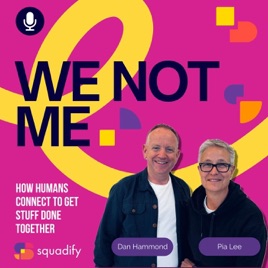
Advertise on podcast: We Not Me
Rating
5from
This podcast has
136 episodes
Language
EnglishPublisher
Dan Hammond & Pia LeeExplicit
No
Date created
2021/08/13
Latest episode
2026/02/06
Average duration
41 min.
Release period
18 days
Description
Exploring how humans connect and get stuff done together, with Dan Hammond and Pia Lee from Squadify. We need groups of humans to help navigate the world of opportunities and challenges, but we don't always work together effectively. This podcast tackles questions such as "What makes a rockstar team?" "How can we work from anywhere?" "What part does connection play in today's world?" You'll also hear the thoughts and views of those who are running and leading teams across the world.
Unlock We Not Me podcast Email contact info,
Listeners & Audience details
Email contact information
Direct podcast contact details

Listeners
Audience numbers & engagement insights

Audience details
Podcast Insights

Podcast episodes
Check latest episodes from We Not Me podcast
Three hidden patterns that could be holding your team back
2026/02/06
Teams often struggle with hidden dysfunctions that disguise themselves as positive behaviours, like pretending everything’s fine when it isn't, making decisions in corridors rather than as a team, and heaping blame on a single person rather than addressing systemic issues.
These patterns are particularly insidious because they hide under seemingly good intentions, making them difficult to spot and address.
Noj Hinkins is a team coach and leadership development consultant. He’s been working with senior teams for the past 15-20 years, typically at director level and above, doing one-on-one coaching, team building, and leadership development work. He specialises in identifying dysfunctions that can hold teams back.
Three reasons to listen
Recognise when toxic positivity is preventing your team from addressing real problems and creating a disconnect between team membersIdentify and eliminate covert processes that override team decisionsSpot scapegoating patterns where teams blame one person for systemic issuesEpisode highlights
[00:12:50] Team patterns in 2026[00:14:19] Toxic positivity[00:24:23] Covert process[00:30:33] Scapegoating[00:41:39] What to do first if you spot these patterns[00:43:34] Noj's media recommendation[00:44:53] Takeaways from Dan and PiaLinks
Covert Processes at Work, by Robert MarshakSo Far So Good, by the Blue Moon – Noj’s media recommendationTrack and improve your team performance with SquadifyLeave us a voice note
Balancing artificial and human intelligence
2026/01/23
In a working world where the conversation is increasingly dominated by AI, we need to consciously prioritise human connection and old-school practices, like face-to-face conversations, physical books, and time for deep thinking, to avoid becoming trapped in a cycle of constant acceleration that ultimately undermines our wellbeing and what makes us fundamentally human.
Jon Whittle is the former CEO of CSIRO's Data61, Australia's national AI research and development centre. He led a team of around 500 scientists, engineers and support staff across Australia. Jon’s working is transitioning to helping organisations understand and adopt AI in an effective, human-centred way, particularly with boards and leadership teams.
Three reasons to listen
To reframe AI adoption around human needs rather than pure efficiencyTo discover the risks of outsourcing human connection to AIAo learn how to adopt old-school practices that preserve your humanityEpisode highlights
[00:10:24] Leading hundreds of scientists and engineers[00:13:14] What it means to be human in an AI world[00:23:25] The danger of sharing problems with AI rather than other humans[00:31:33] What Jon has learned from classical Indian dance[00:36:18] AI for Business[00:39:55] Jon's media recommendation[00:42:06] Takeaways from Pia and DanLinks
Connect with Jon via LinkedInAI for Business – Jon’s bookCSIRO presents: Everyday AI – Jon’s podcastTurning Down the Noise – Jon’s media recommendationTrack and improve your team performance with SquadifyLeave us a voice note
How do you lead a team through economic uncertainty?
2025/12/19
Leading through uncertainty means accepting complexity rather than fighting it. The most powerful tool for doing so is clarity.
While conventional wisdom suggests focusing on trust-building and communication skills, Squadify data shows that starting with clarity – specifically around shared goals, processes, and measures of success – is what actually transforms groups of individuals into cohesive teams and drives performance.
Three reasons to listen
Learn to befriend uncertainty and focus on what you can influenceDiscover how to build team cohesion through clarity rather than trust exercisesUnderstand how teams work together as the key performance driverEpisode highlights
[00:02:31] Jamie's question[00:03:36] Befriending uncertainty[00:05:38] Are you a team, or a TINO?[00:08:51] The sixth dysfunction in teams[00:11:12] The trigger question for high performance[00:13:42] Doubling down on humanity[00:16:41] Coming up in 2026Links
Track and improve your team performance with SquadifyLeave us a voice note
Can you have a leaderless team?
2025/12/05
Autonomy in teams requires clarity, not chaos. Successful autonomous teams need defined authority over coordination, transparent processes, and intentional facilitation to empower people whilst maintaining alignment and effectiveness.
Jon Barnes is a facilitator, coach, and co-founder of Pala, and he focuses on helping teams and organisations become more autonomous. His approach spans a spectrum from making hierarchies feel less hierarchical, to helping teams operate fundamentally without line management.
Three reasons to listen
Create clarity in team structures by defining authority and decision-making processes upfrontBuild psychological safety and engagement through effective facilitation techniquesBalance empowerment with appropriate holding by learning when to let go and when to provide directionEpisode highlights
[00:12:22] the two types of waste in teams[00:18:10] What does leadership look like away from hierarchy?[00:21:44] Self-management in highly-pressurised teams[00:25:37] The myth of self-governance[00:27:12] Unhelpful self-management patterns[00:32:47] Jon's biggest two levers[00:35:32] Jon's media recommendation[00:36:59] Dan's media recommendation[00:41:12] Takeaways from Pia and DanLinks
Connect with Jon via LinkedInHumankind, by Rutger BregmanLonesome Dove, by Larry McMurtry – Jon’s media recommendationThe Ministry of Time, by Kaliane Bradley – Dan’s media recommendationFrom the Core, by John Wineland – Pia’s media recommendationTrack and improve your team performance with SquadifyLeave us a voice note
Is it OK to have a big team? (Q&A with Dan & Pia)
2025/11/21
There's a scientific basis for understanding optimal team size, including research on connection complexity, social loafing, and performance data that challenges common assumptions about how many people should work together effectively.
In this Q&A episode, Dan and Pia dive into the science and the data, to discover the optimum team size.
Episode highlights
[00:01:27] Is it OK to have a big team?[00:04:15] The Ringelmann effect[00:07:22] What's the optimum team size?[00:08:18] When is a team a group?[00:10:20] What the Squadify data showsLinks
Ringelmann effectTrack and improve your team performance with SquadifyLeave us a voice note
Humans in the age of AI
2025/11/07
While AI will dramatically reshape work and careers – potentially displacing entry-level jobs and creating “companies of one” – the true competitive advantage will lie in taking a human-centric approach to AI adoption, where diverse teams maintain creativity, critical thinking and genuine human connection rather than simply automating away people to maximise shareholder returns.
Larry Chao is the founding Chief Strategy and Operations Officer at trustme.ai, a startup building tools for AI governance. He’s also involved with nonprofits like Berkeley Skydeck and the Ethical AI Governance Group, where he helps empower the next generation of innovators to develop AI responsibly.
Sunaina Lobo has been a Chief Human Resources Officer three times over, and is now a strategic advisor to trustme.aiand co-founder of Momentum Global HR, where she does strategic HR consulting with an AI lens.
Three reasons to listen
Understand the trajectory and implications of AI evolution, and what this means for teams and workflowsNavigate the human impact of AI adoption in your organisationMove beyond AI as a differentiator to focus on human connection and diverse thought as the true sources of organisational strengthEpisode highlights
[00:12:47] The evolution of AI[00:16:55] AI and teams[00:17:37] Facts emerging from our continued use of AI[00:29:01] The case for responsible AI[00:32:15] The case against the "company of one"[00:41:50] Driving shareholder value while being human-centred[00:43:43] Suni's media recommendation[00:44:05] Larry's media recommendation[00:45:12] Takeaways from Pia and DanLinks
Connect with Larry via LinkedInConnect with Sunaina via LinkedInTrustMe.aiSuni’s podcast recommendations:Pioneers of AIThe AII Daily BriefKPop Demon Hunters – Larry’s recommendationHumankind, by Rutger BregmanTrack and improve your team performance with SquadifyLeave us a voice note
The three things holding back teams today
2025/10/23
Successful team performance requires slowing down to achieve alignment before rushing into action. Spending more time upfront ensuring everyone truly understands the problem statement, decision-making roles, and priorities will save significant time, energy, and relationship breakdowns later.
Without this foundational alignment, teams waste enormous amounts of time in ineffective meetings, experience constant breakdowns in execution, and carry baggage from unresolved issues that poisons future decisions. The key is to move with discipline and sophistication rather than mere speed, investing in both the technical frameworks and the relational intelligence needed to bring out the best thinking from diverse perspectives.
Susan Asiyanbi is the founder and CEO of the Olori Network, an executive leadership practice that works with CEOs, executive teams, and boards, specialising in studying what the strongest executive teams and boards do differently.
Three reasons to listen
Identify the hidden costs of misalignment in your team, from wasted meeting time to breakdowns in relationships that drain energy both at work and at homeApply a disciplined approach to decision-making that balances speed with rigour through five key strandsReclaim control of your calendar by conducting a time audit that reveals the gap between what you say matters and where you actually spend your energyEpisode highlights
[00:09:18] Alignment, themes, and relationships[00:11:06] How to get alignment[00:12:32] What happens when alignment isn't found[00:15:48] Asking the right questions[00:17:32] Decision-making is compromised[00:18:40] The five key components of a decision-making framework[00:26:17] How to move more slowly[00:28:41] How will AI affect decision-making?[00:31:44] What are you prioritising for?[00:37:23] What to try this[00:39:57] Susan's media recommendation[00:40:43] Takeaways from Pia and DanLinks
Connect with Susan via LinkedInTeam #1, by Patrick LencioniAI-Generated “Workslop” Is Destroying ProductivityHow to turn a group of strangers into a team – Susan’s media recommendationTrack and improve your team performance with SquadifyLeave us a voice note
The business case for social mobility
2025/09/18
Rather than trying to "fix" people or show them rungs on a ladder, social mobility comes from recognising individuals, giving them psychological safety, and allowing them to fulfil their own potential.
Diverse workplaces thrive not because of tokenistic inclusion efforts, but because different voices at the table lead to better outcomes and more successful organisations.
Dan and Pia are joined by Arad Reisberg, Associate Pro Vice-Chancellor at Brunel University of London, campaigner for social justice and social mobility, and co-founder of the Social Mobility Leaders Forum.
Three reasons to listen
Reframe your understanding of social mobility as social justice, focusing on creating opportunities for people to fulfil their potential rather than just climbing career laddersCreate an environment where people feel comfortable being their authentic selves by asking powerful questions and actively listeningBuild more diverse, successful teams by recognising that different voices at the table lead to better outcomes, challenging conventional thinking about "hiring for fit"Episode highlights
[00:09:32] What is social mobility?[00:15:24] How social mobility helps business[00:18:59] How to implement social mobility in your organisation[00:26:31] Arad's media recommendation[00:29:43] Takeaways from Dan and PiaLinks
Connect with Arad via LinkedInArad’s media recommendations: the Inward trilogy by Yung Pueblo:InwardClarity & ConnectionThe Way ForwardTrack and improve your team performance with SquadifyLeave us a voice note
Empowering the next generation of leaders in hospitality
2025/09/04
Restaurant franchises can be powerful environments for leadership development, especially for young people. When managed with intentionality, these seemingly entry-level jobs can provide significant opportunities for personal growth, skill development, and career advancement.
Melissa Nuttall, along with her partner, is the franchisee of a quick service restaurant in New Zealand. In this conversation with Pia and Dan, she lays out how good customer service and continuous training create positive work cycles that benefit both employees and customers.
Three reasons to listen
Achieve broader business goals while reducing cognitive load on staffDevelop young team members into capable leaders through progressive responsibilityCreate safe spaces for growth regardless of employees’ long-term career plansEpisode highlights
[00:08:38] Helping the next generation of leaders[00:14:21] Turning a culture around[00:18:23] Creating a stable launchpad for new careers[00:24:38] Leading with kindness and humility[00:27:58] Be mindful of your leadership shadow[00:29:20] Mel's media recommendation[00:30:11] Takeaways from Pia and DanLinks
Connect with Melissa via LinkedInTrack and improve your team performance with SquadifyLeave us a voice note
You don’t have a trust problem – you have a clarity problem
2025/08/21
While many teams focus on building trust to improve performance, it's actually clarity that needs to be addressed first.
Research shows that teams need clear roles, goals and processes before they can effectively build trust and collaborate. This represents a significant shift from traditional thinking about team development, and the data shows that improving clarity drives up trust results, whilst working directly on trust doesn't impact clarity scores.
In this episode, Squadify’s Chief Data Officer, Juliet Owen re-joins Dan and Pia to discuss the role clarity plays in driving team performance.
This episode will help you
Build team trust by first establishing clarity around roles, goals and processes rather than focusing directly on trust-building exercisesCreate effective one-page team documents that capture why the team exists, their collective goals, and non-negotiable behavioursDrive better team performance by shifting from individual KPIs to collective team goals that encourage collaboration rather than competitionEpisode highlights
[00:09:34] How teams are coping with change today[00:15:30] What we mean by trust[00:20:03] The trust gap[00:26:29] Case studies on building trust[00:33:12] What can you do?[00:34:59] Pia and Juliet's media recommendations[00:37:24] Takeaways from Pia and DanLinks
The Five Dysfunctions of a Team: A Leadership Fable, by Patrick LencioniYou Can’t Ask That – Pia’s mdia recommendationThe Ministry of Time, by Kaliane BradleyConnect with Juliet via LinkedInTrack and improve your team performance with SquadifyLeave us a voice note
How do we make AI more inclusive?
2025/08/07
Humans are crucial to AI adoption. While AI technology continues to advance, its effective implementation in business depends on people working with it rather than being replaced by it.
Inclusive AI means finding the right balance between technological advancement and human insight, rather than seeing AI as a simple push-button solution to complex knowledge work.
Susi O’Neill is a consultant, author, and speaker on frontier technology. She helps organisations implement AI effectively, analyses AI trends, and distills insights in her newsletter.
Three reasons to listen
To move past the hype and see how humans will continue to be essential in an AI-enhanced workplaceTo start implementing an effective approach to AI adoption in your organisationTo develop a more balanced perspective on technological change than the one propagated by Silicon ValleyEpisode highlights
[00:05:19] The nebulous nature of AI[00:11:17] Change is the constant[00:16:06] The falacy of the competetive advantage[00:18:16] Inclusive AI[00:26:18] How do we use AI responsibly?[00:29:05] Squadify's AI governance[00:33:06] Take your first step into AI[00:37:41] Suzi's media recommendations[00:40:32] Takeaways from Dan and PiaLinks
Track and improve your team performance with SquadifyLeave us a voice noteConnect with Suzi via LinkedInRethinking the Hype Cycle – Suzi’s newsletterWomen Leaders in Tech Outpace Men Counterparts in Generative AI AdoptionChannel 4 Corporate AI PrinciplesSupremacy, by Parmy OlsonThreads (1984)Offal
Being respected beats being liked
2025/07/24
Leaders who are respected are 12x more likely to be seen as effective than those who are simply liked. This is because respect is tied to competence, fairness, and consistency.
Respect in leadership isn't about titles or status, but about treating team members as capable adults rather than children. This helps avoid learned helplessness among teams, and creates environments where people feel safe to take risks, speak up, and even fail without fear of punishment.
Robyn Djelassi is a Chief People Officer, non-executive director, and coach. She runs her own HR consultancy working with organisations across Australia, with a focus on helping organisations achieve business results through their people.
Her approach to HR is a little different from the warm-and-fuzzy cliché that has permeated the industry, but is done with heart.
Robyn’s ADULTS leadership framework
A: Accountability over approval. Don’t lead to be liked; lead to be trusted.D: Debrief, don’t rescue. When mistakes happen, resist fixing them for your team.U: Uncomfortable is useful. Don’t smooth the edges; people grow through the stretch.L: Let go of control. Ask “Have I made it clear what success looks like?”T: Trust before proof. Trust people before they’ve earned it.S: Say less, ask more. Use questions to help people think for themselves.Episode highlights
[00:09:03] What new leaders think leadership is[00:10:37] The "cool mum" approach to leadership[00:14:12] What we mean when we talk about respect[00:15:39] We're getting psychological safety wrong[00:20:07] Findings from Google's Project Aristotle[00:23:43] How to garner respect as a new leader[00:24:39] Robyn's ADULTS framework[00:30:32] Robyn's media recommendation[00:31:57] Takeaways from Pia and DanLinks
Connect with Robyn via LinkedInWe Used to be Journos – Robyn’s podcast recommendationTrack and improve your team performance with SquadifyLeave us a voice note
“Best Places to Work” and other half truths
2025/07/10
Too many "best places to work" lists focus on performative, low-cost perks like free breakfasts and dog-friendly offices. But they ignore fundamental issues like fair pay, reasonable working hours, and meaningful parental leave.
Companies often use marketing language to make minimal benefits sound impressive, like claiming "enhanced parental leave" when they're barely exceeding the statutory minimum. This creates a disconnect between how organisations present themselves and the actual employee experience.
Amy Wilson is a commercial consultant advisor, with a background in marketing, who helps companies grow and founders focus on what matters. She mentors young and underrepresented founders, and she joins Dan and Pia to discuss her LinkedIn post critiquing The Times’ Best “Places to Work" list.
Three reasons to listen
To be mindful of performative workplace benefits that don't actually improve employee experienceTo identify misleading claims about "enhanced" benefits that barely exceed statutory minimumsTo understand how organisational silos and conflicting KPIs lead to workplace policies that prioritise appearance over substanceEpisode highlights
[00:06:48] What constitutes a good place to work?[00:10:55] Amy's response to the New York Times Best Business to Work article[00:17:09] Allies in name only[00:22:14] Why aren't companies doing the right thing?[00:25:27] Are things getting worse?[00:26:39] What can we do about it?[00:33:20] Amy's media recommendation[00:36:08] Takeaways from Dan and PiaLinks
Connect with Amy via LinkedInAmy’s response to the Sunday Times Besst Places to Work articleHalt and Catch Fire – Amy’s TV recommendationBuilding a thriving culture from the outside in – Episode 58, with Tom Wedge and Marcus SwalwellTrack and improve your team performance with SquadifyLeave us a voice note
Your practical guide to conversations that drive change
2025/06/26
Effective change management hinges on the quality of our conversations. Asking questions can be an exertion of power, so motivational interviewing seeks to bring clarity and ensure information is shared in a way that respects the recipient's readiness to receive it.
Jeffrey Wetherhold is a change management professional who helps organisations and teams navigate difficult changes. He specialises in motivational interviewing and uses this approach to help teams have more effective conversations during periods of change.
Three reasons to listen
To learn how to structure change-focused conversationsTo help you make more effective affirmations instead of offering general praiseTo learn how to share information more effectively, to ensure others are ready to receive and engage with itEpisode highlights
[00:07:17] Motivational interviewing[00:10:28] Making specific affirmations[00:12:48] Ask, offer, ask[00:15:26] When to ask questions[00:19:23] How to become a better listener[00:21:19] Fitting motivational interviewing into existing skillsets[00:22:46] Busynesss overriding business[00:28:22] Guiding, influencing, or leading conversations[00:31:28] Reflect more, ask less[00:32:58] Dan's media recommendations[00:35:11] Takeaways from Pia and DanLinks
Connect with Jeff via LinkedInTeam of Teams: New Rules of Engagement for a Complex World, by David Silverman, Stanley McChrystal, Tantum Collins, & Chris FussellMoral Ambition: Stop Wasting Your Talent and Start Making a Difference, by Rutger BregmanTrack and improve your team performance with SquadifyLeave us a voice note
The surprising science of hybrid working
2025/06/12
The “traditional” understanding of hybrid working is being challenged as organisations try to implement more structured approaches, creating friction with employees who developed their own interpretations of what hybrid working means during the pandemic.
Matthew Davis is an associate professor at the University of Leeds. He specialises in organisational and business psychology, with extensive research experience in workplace environments. He researches and consults on hybrid work patterns, and studies how companies are adapting their workspaces and practices.
Three reasons to listen
To understand different generational perspectives on hybrid work, from senior leaders pushing for office returns to younger workers concerned about isolation and development opportunitiesTo navigate the evolving definition of hybrid work and how it varies across organisationsTo better grasp how employee choice and control over both where and when to work has become central to how workers define hybrid arrangementsEpisode highlights
[00:11:54] What is"hybrid working"?[00:17:14] Is hybrid always a positive?[00:23:39] What do workers want?[00:24:31] Hybrid's benefits for inclusion[00:27:28] What hybrid is missing[00:30:57] Caveats on returning to the office[00:37:23] Matthew's guiding principle[00:40:50] Matthew's media recommendation[00:42:10] Takeaways from Dan and PiaLinks
Connect with Matthew via LinkedInThe Prophet and the Idiot, by Jonas JonassonTrack and improve your team performance with SquadifyLeave us a voice note
Podcast reviews
Read We Not Me podcast reviews
The Courage of a Leader 2025/05/05
Practical takeaways to foster real teamwork
This podcast is a powerful reminder that true success comes from collaboration, not just individual effort. With insightful conversations and practica...
dpiro42 2022/12/16
Love the hosts!
Whatever Dan and Pia want to talk about, I want to listen to. I love the subject and mission behind the podcast, but but more than all that, I find t...
Socially Curious 2022/02/17
Great topics, fascinating guests and important discussions
We Not Me is an excellent podcast that anyone working in a team can benefit from. The insights presented by the guests and the conversational approach...
Podcast sponsorship advertising
Start advertising on We Not Me relevant audience podcasts
You may also like to advertise on these Podcasts

4.892500
Arnie States Show (A.S.S.)
The Arnie States Show. A.S.S.

4.446580
BJSM Podcast
BMJ Group
517371
New Dad Gaming
Trevor Alexander & Jeff Smalley

4.8241305
The Adam Sank Show
Adam Sank

51679
Leave A Message with Ally & G
Audio Always
55175
PASTOR ADAM'S PODCAST
Adam Briel
4.332000
Weltwoche Daily
Weltwoche

4.733182
The Waterstones Podcast
Waterstones
4.443167
What The Trans!?
The What The Trans Group
510200
People Soup
People Soup