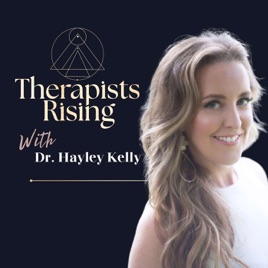
Welcome to the Therapists Rising Podcast, where we share real, raw, and behind-the-scenes stories and lessons from Therapists who are thinking outside the traditional clinical box and choosing to do things differently in their careers. I’m your host, Dr. Hayley Kelly, and I myself have made the journey from a very experienced, but burnt out and unhappy, Clinical Therapist - to a successful entrepreneur who runs a business she loves, is thriving financially, and working and living life on her own terms. Join me, and be inspired, as I speak with other Therapists who too are broadening their horizons, and experiencing more abundance, joy, and fulfilment than ever before. Together we will laugh, soak up priceless wisdom and take actionable steps, to help you transition from clinical practice to non-clinical offerings, and diversify and amplify your income - all while honouring your wellbeing and having a work-life balance. If you’re ready to be inspired and take action on your dreams, then you’re in the right place, friend. This is the Therapists Rising Podcast.
Advertise on Therapists Rising Podcast
Advertise on Therapists Rising Podcast to promote your brand to thousands of podcast listeners
Check latest episodes from Therapists Rising Podcast podcast
From 7 Enrolments to Six Figures: How a Vestibular Physio Built an Online Program from Scratch
2026/03/05
Picture a physio who launched her first online program with seven people enrolled. Six of whom she already knew personally. A sales page with no checkout connected. A program she hadn't finished recording yet.
That was Vicky Stewart's launch one.
Her most recent launch just crossed six figures.
Today's guest, Dr. Vicky Stewart, is a vestibular physiotherapist who spent years watching patients with chronic dizziness fall through the cracks of traditional healthcare. She built The Shift, a 10-week online group program, to reach the people her clinical hours never could. She didn't have a following, a marketing budget, or a polished funnel when she started. She had a clear problem, a willingness to start messy, and the psychological capacity to treat early results as data rather than verdicts.
This conversation is about what it actually looks like to build something over time, across seven launches, when the numbers are small at first and the fear is loud throughout.
HERE ARE THE 3 KEY TAKEAWAYS:
1️⃣ Your First Launch Is Not a Verdict, It's a Data Point — Seven people enrolled, six of whom Vicky already knew. Most people would have interpreted that as proof the idea didn't work. Vicky interpreted it as proof of concept. If one person paid, others will too. That reframe, from verdict to data, is one of the most reliable predictors of whether a therapist keeps going or quietly shelves the whole thing.
2️⃣ You Don't Need a Large Following to Fill a Program — Vicky built her early launches almost entirely through existing professional relationships, referrer networks, and speaking opportunities, including a keynote in Dubai, before she had any meaningful social media presence. The skills therapists already use to build referral networks in private practice transfer directly. You probably already have more reach than you think.
3️⃣ Messy and Started Beats Perfect and Waiting, Every Single Time — Vicky launched her beta without a checkout page connected to her sales page. She was already in open cart week when she found out. She sorted it in real time, ran the program anyway, and built everything else from there. Seven launches later, she has a waitlist, a team member supporting her community, and her first six-figure result. None of that happens if she waits until she feels ready.
YOU'LL ALSO HEAR:
How Vicky's pricing evolved from $330 for her beta to $1,697 per enrolment, and what had to shift internally to make each price increase feel possibleWhy researching competitors actually made things harder, not easier, and what she decided to do insteadWhat it looked like practically to build this while working four days a week with three kids at homeThe moment her husband took a redundancy and what that did to her approach going into her most recent launchWhy she decided early on she was never going to dance on Instagram, and how she filled her program anywayThe listener question that stopped me in my tracks: "If you'd waited until you felt completely ready, where would you be today?"What Vicky says is the one breadcrumb she'd leave anyone who is still sitting on their ideaRESOURCES:
Connect with Vicky Stewart:
Website: dizzyresolve.comInstagram: @dizzyresolveYouTube: @dizzyresolveTherapists Rising Programs:
Caseload to Course Bootcamp: therapistsrising.com/bootcampThe Incubator: therapistsrising.com/incubatorInstagram: @dr.hayleykellySUBSCRIBE & REVIEW: If you enjoyed this episode, please subscribe and leave a review on Apple Podcasts. Your reviews help other therapists find conversations that give them permission to start before they're ready.
From Perinatal Psych to Florist: When Your "Side Idea" Becomes the One That Works with Carla Anderson
2026/02/19
Picture a psychologist with 25 years in perinatal mental health — burned out from holding space for loss and trauma for decades.
She needed something that was just hers. No clinical notes, no disclosure risk, no empathy fatigue. She chose floristry.
And then her perinatal colleagues found out. And asked her to bring it to conferences. Then to teach it online. Now she has a waiting list of clinicians who want in.
Today's guest, Carla Anderson, is a clinical psychologist who built two very different streams inside one business — perinatal mental health training for healthcare clinicians, and floristry-based therapeutic programs for clinician self-care. She didn't plan it. She followed her gut. And the market responded in ways she didn't see coming.
HERE ARE THE 3 KEY TAKEAWAYS:
1️⃣ Your Burnout Might Be Pointing You Somewhere — Carla needed something that shut her brain off after 25 years of perinatal loss and trauma work. Floristry did that. What started as self-preservation became the foundation of an entirely new program. Your burnout isn't a problem to solve. Sometimes it's a signpost.
2️⃣ The "Weird" Idea Is Often the One That Takes Off — Carla kept reverting to her safe perinatal niche because floristry felt too new, too hard to package. Then perinatal conferences kept asking her to run the floristry sessions. Fellow Incubator members asked when they could join. The market told her what it wanted — she just had to listen long enough to believe it.
3️⃣ You Don't Have to Explain Everything Upfront — People come to Carla's workshops thinking it's about flower arranging. By the end they're doing deep reflective work through metaphor. You don't need a ten-paragraph explanation. You just need to get people in the room. The experience does the convincing.
YOU'LL ALSO HEAR:
Why healthcare clinicians (GPs, midwives, doctors) are desperately under-resourced when it comes to psychological support skills — and how Carla fills that gapWhat therapeutic horticulture actually is and the science behind why nature-based practices workHow she structured her first beta launch (including the Valentine's Day flowers disaster that became an accidental metaphor)The internal flip-flopping between the safe niche and the exciting one — and how she finally stopped revertingWhat it looks like to let market feedback build your confidence instead of waiting for certainty firstWhy everything is figureoutable — including how to teach flower arranging onlineRESOURCES: Connect with Carla Anderson:
Website: www.carlaandersoncliniciantraining.comFacebook & Instagram: @carlaandersoncliniciantrainingLinkedIn: Carla AndersonTherapists Rising Programs:
Caseload to Course Bootcamp: https://therapistsrising.com/bootcampThe Incubator: therapistsrising.com/incubatorInstagram: @dr.hayleykellySUBSCRIBE & REVIEW: If this episode made you look at your "just for me" hobby differently, subscribe and leave a review on Apple Podcasts. Your reviews help other therapists find conversations that give them permission to build something unexpected.
You don't have to abandon what you're good at to build something new. You don't have to have it all figured out before you start. And you definitely don't have to ignore the thing that lights you up just because it doesn't fit the obvious mould.
What if the thing you thought was just for you is exactly what other clinicians need? What opens up when you stop treating your own joy as a liability?
Corporations Are Paying Psychologists to Teach Play - Here's Why It's Working
2026/02/11
Picture a corporate wellness landscape where companies are tired of boring PowerPoint workshops but also can't justify wine tastings when burnout is a WHS compliance issue.
There's a gap there. A big one.
And what if you could fill it?
Today's guest, Dr. Mitzi Liddle, is doing exactly that. She's teaching corporations about play and pleasure - yes, you read that right - as nervous system regulation tools. Not fluff. Not entertainment. Neuroscience-backed performance enhancement.
And teams are actually booking it.
HERE ARE THE 3 KEY TAKEAWAYS:
1️⃣ Play Isn't Childish—It's a Nervous System Tool – When Mitzi started noticing corporate teams responded better to movement, music, and laughter than traditional lecture-style workshops, she followed that thread. Play and pleasure aren't frivolous—they're pathways to regulate your nervous system out of chronic stress and burnout. They bring you into your window of tolerance where creativity, energy, and clear thinking actually live.
2️⃣ There's a Gap in Corporate Wellness (And You Can Fill It) – Organizations don't want boring PowerPoint workshops. But they also don't want wine tastings that waste time. They want something engaging AND evidence-based. Something that addresses real burnout while meeting psychological safety requirements. If you can position experiential work with neuroscience backing, you've found the sweet spot.
3️⃣ Diversification Doesn't Mean Starting Over – Mitzi's been a psychologist for 20+ years. She didn't abandon her expertise—she expanded it. Corporate playshops for teams. Group programs for individual women. Both use the same foundation (play, pleasure, nervous system regulation) but serve different audiences. You don't need a brand new skill set. You need strategic positioning.
YOU'LL ALSO HEAR:
Why "playshops" get better engagement than traditional burnout prevention workshopsHow to position play and pleasure so corporations take it seriously (and pay for it)The neuroscience behind why these "soft" concepts actually work as performance toolsWhat changes when you follow your energy instead of grinding through what you think you "should" doHow Mitzi created her beta program fast—and what supported that momentumWhy dabbling and experimenting is actually the path (not a failure to commit)The one piece of advice for therapists who want something different but feel stuckRESOURCES:
Connect with Dr. Mitzi Liddle:
Website: www.drmitziliddle.com.auInstagram: @drmitziliddleTherapists Rising Programs:
The Incubator: therapistsrising.com/incubatorThe Collective Mastermind: therapistsrising.com/collectiveInstagram: @dr.hayleykellySUBSCRIBE & REVIEW:
If this episode made you rethink what's possible for your practice, subscribe and review on Apple Podcasts. Your reviews help other therapists discover conversations that challenge the status quo and open up new possibilities.
You don't have to choose between engaging work and credible work. Between joy and professionalism. Between staying small and burning out.
What if the thing that lights YOU up is exactly what your ideal clients need? What opens up when you give yourself permission to follow that?
Stop Hunting for Ideas: The One Question That Actually Creates Clarity
2026/02/04
You've got the notebook. The voice memos. The Google Doc titled "possible program ideas" you haven't opened in weeks. You're not short on ideas. You're drowning in reasonable options.
And somehow that feels worse than having no ideas at all.
Because when you're stuck with multiple good directions and still can't get traction, it starts to feel like a you problem. Like you're overthinking it. Not ready. Not disciplined enough.
Here's what you need to hear: You're not failing at this. You're misoriented. You're trying to choose before you're positioned to see clearly. And the question you're asking yourself is keeping you stuck.
HERE ARE THE 3 KEY TAKEAWAYS:
1️⃣ This Isn't Confusion - It's Misorientation – Your brain is doing exactly what it was trained to do: analyse before acting. But when there are multiple good options, analysis mode creates paralysis. Your nervous system reads commitment without clarity as threat, so you stay stuck in research mode. This isn't a motivation problem. It's a starting-point problem.
2️⃣ You're Asking the Wrong Question – "What program should I create?" forces comparison, activates imposter syndrome, and assumes you need something novel. The better question: "What problem am I already solving repeatedly, whether I intend to or not?" This shifts you from ideation to pattern recognition, from theoretical planning to lived experience. Most therapists don't need a new idea - they need better visibility on work they're already doing.
3️⃣ Depth Creates Blind Spots – If people keep bringing you the same problem without you marketing for it, that's data. But experienced therapists dismiss what feels familiar, obvious, or "too simple." The more expertise you have, the more invisible your skill becomes to you. You're not underestimating the work - you're underestimating yourself.
YOU'LL ALSO HEAR:
Why therapists trained to assess before acting get stuck when building programsThe nervous system response that keeps you in "gathering information" modeHow to recognize when you're dismissing your most obvious starting pointWhy confusion is often a sign of depth, not failureThe one question that creates grounded momentum instead of endless scanningWhy orientation matters more than urgency when building sustainable practicesRESOURCES:
Therapists Rising Programs:
The Incubator: therapistsrising.com/incubatorInstagram: @dr.hayleykellySUBSCRIBE & REVIEW:
If this episode reduced the frantic energy you've been carrying, subscribe and review on Apple Podcasts. Your reviews help other therapists find conversations that actually shift how they're thinking.
Clarity doesn't come from choosing the best idea. It comes from standing in the right place to see what's actually there.
You're not behind. You're just facing the wrong direction. What shifts when you ask a better question?
Why Everything Just Changed for Therapists: Money, Burnout, and Technology Collide
2026/01/28
For 12 months, I've been warning you the traditional therapy model is breaking down. Some of you have been listening. But many have been waiting for clarity.
Here's what you need to hear: The last eight weeks changed everything.
November 2025: Australia restricted Better Access referrals. December 2025: Fifth consecutive year of US Medicare cuts. January 30, 2026: US telehealth flexibilities expire.
While those policy changes hit, something else shifted: 1 in 8 young people now use AI chatbots for mental health advice. Corporate wellness budgets hit $53 billion with contracts being signed NOW for 2026-2027.
This isn't slow erosion. This is all five forces reaching tipping points simultaneously. This is the convergence.
HERE ARE THE 3 KEY TAKEAWAYS:
1️⃣ Three Realities Converging Right Now – The math isn't working (Medicare cuts, Better Access restrictions, client affordability crisis). Your colleagues are planning exits (52% US therapists burned out, 29% considering leaving). Future clients expect something different (70% Gen Z prefers virtual, 1 in 8 young people use AI chatbots).
2️⃣ Every Disrupted Profession Made This Mistake – Accounting got automated. Physical therapy faced reimbursement cuts. Personal training went digital. Each time, practitioners said "our profession is different." They were wrong. Pattern: professions split into commodity/premium tiers, early movers capture premium positioning, late movers compete on price.
3️⃣ The Window to Move From Strength is Closing – Early adopters already generate diversified income. Early majority (you) see it's real but still research. Late majority arrives when landscape is occupied. Corporate contracts signing NOW. Course markets maturing NOW. Window open now—won't stay open.
YOU'LL ALSO HEAR:
Why research-mode therapists experience decision paralysis under cognitive loadThe Kodak lesson: Believing current preferences = permanent demand is fatalAccountants who automated vs. those stuck "selling time"PT practices that diversified early: 200-300% revenue growth vs. 3-6x valuations for traditionalWhy "AI can't replace us" is technically true but misses the pointTechnology adoption curve: Waiting for certainty means you're lateResearch Path vs. Action Path: Which are you choosing?RESOURCES:
Data Sources:
Medicare cuts: BellMedEx 2025Better Access: Australian Dept of HealthAI adoption: Brown University School of Public HealthTherapists Rising:
The Incubator: therapistsrising.com/incubatorInstagram: @dr.hayleykellySUBSCRIBE & REVIEW:
If this episode made you uncomfortable, subscribe and review on Apple Podcasts. Your reviews help therapists find honest conversations about what's happening in our profession.
Therapists thriving in five years won't be ones who waited for perfect clarity. They'll be ones who moved with 80% information while they had stability.
That window is open now. What will you do with it?
The REAL Truth About Passive Income for Therapists (It's Not What You Think) with Kayla Das
2026/01/22
Let's talk about passive income, and NO, this isn't another "make money while you sleep" pitch.
This conversation with Kayla Das is the most honest, transparent take on passive income for therapists I've heard in a LONG time. Kayla's a Canadian social worker, business coach, author of The Passive Practice, and someone who's actually DONE this work. She's built multiple passive income streams and she's willing to tell you the TRUTH about what it really takes.
Here it is: passive income isn't passive at the beginning. It's WORK. Consistent, upfront, sometimes-discouraging work. But once it's established? That's when you get your time back. That's when you can help more people without burning out in one-to-one sessions.
If you're tired of trading hours for dollars and wondering if there's another way—this episode is for YOU.
HERE ARE THE 3 KEY TAKEAWAYS FROM THIS EPISODE:
1️⃣ Passive Income Is NOT Passive at the Beginning – This is NOT a get-rich-quick scheme. It's a "slow and steady wins the race" strategy. You'll put in consistent work upfront—sometimes for MONTHS—before you see revenue. Kayla didn't make a dime from her blog for six months. But she kept going. And now? It works on autopilot (mostly). Once it's built, you never start from scratch again.
2️⃣ Earned Income vs. Passive Income Changes Everything – One-to-one therapy = earned income. You work X hours, you make X dollars. There's a ceiling. With passive income, you create something ONCE—a course, blog, digital product, podcast—and it generates revenue over and over. That's what creates time freedom. But you need an audience to share it with (email list, social media, organic traffic).
3️⃣ It's About Pivoting, Not Quitting – Kayla's digital templates made NOTHING the first 30 days. Zero dollars. But she didn't scrap them. She pivoted—changed the marketing images, rewrote descriptions, tested things. Then it worked. The issue isn't usually your product—it's how you're presenting it. Be willing to fail, learn, and adjust.
YOU'LL ALSO HEAR:
Why most therapists recreate their old employment environment in private practice (and how passive income changes that)Seven types of passive income streams for therapists: blogging, podcasting, online courses, hiring therapists, digital products, books, and affiliate marketingThe three passive income success indicators that help you choose the RIGHT stream for youWhy Kayla's blog made $0 for six months—and why she kept writing anywayThe real reason most therapists don't pursue passive income (it's the upfront "no money" period)Why you NEED an audience before you launchHow to know if you're ready to start building a passive income stream
RESOURCES MENTIONED IN THIS EPISODE:
Kayla Das:
Book: The Passive Practice: The Passive Income Roadmap for Maximizing Schedule Flexibility, Time Freedom, and Private Practice Profitability (available on Amazon)Passive Income Personality Quiz: Find out which passive income stream is the best fit for YOUR personality (6-8 quick questions!)Website: KaylaDas.comTherapists Rising:
The Incubator: therapistsrising.com/incubatorInstagram: @dr.hayleykelly
SUBSCRIBE & REVIEW:
If this episode gave you a new perspective on passive income—or if you're ready to stop trading hours for dollars and start building something that works for you—please take a moment to subscribe and leave a review on Apple Podcasts!
Your reviews help more therapists find these real, honest conversations about building the businesses they actually want (without the BS or the hype).
Thanks for being here. See you next week.
The Hidden Cost of Staying Stuck
2026/01/14
I've been noticing this pattern with the therapists I work with. Incredibly capable people with clear ideas for what they want to build - programs, offerings, shifts in their practice. They can describe it in detail. But when I ask what's stopping them, the answer is always some version of "I'm stuck."
In this episode, I'm not giving you productivity tips or telling you to just start. I'm naming the quiet problem that nobody talks about: the kind of stuck that doesn't look like stuck at all. Because this type of stuck comes with a cost that accumulates slowly, and most of us don't see it until we're years in.
If you've been sitting with an idea for months (or years), if you keep researching instead of building, if you're waiting for more certainty before you commit - this episode is for you.
HERE ARE THE 3 KEY TAKEAWAYS FROM THIS EPISODE:
1️⃣ Staying Stuck Is Not Neutral - It Has a Real Cost – We believe taking action equals risk and staying stuck equals safety. But staying stuck erodes self-trust, creates ongoing frustration, causes decision fatigue, and leaves you feeling behind without knowing why. You're still on a trajectory - you're just not choosing it consciously.
2️⃣ Research Mode Is False Movement – When your version of stuck looks like productivity (taking courses, reading case studies, studying how others did it), it's especially dangerous. It feels like you're making progress. You're not. At a certain point, researching stops being preparation and starts being avoidance. You already have enough information to start.
3️⃣ You're Already Choosing Your Hard – Moving forward is hard. Staying stuck is also hard. Nothing worth doing is usually easy. The question isn't how to make it easier - it's which version of hard you want to choose. The uncertain pain of starting, or the familiar pain of staying where you are?
YOU'LL ALSO HEAR:
The specific Tuesday afternoon I spent three hours researching my program instead of building it (and the resignation that followed)Why high-integrity professionals get stuck in this particular patternThe difference between familiar pain and uncertain pain (and why we keep choosing familiar)How to identify which type of stuck you're experiencing (they're not all the same problem)Why compassion doesn't mean pretending there's no problemThe real cost of decision fatigue when you circle the same choice for monthsHow "not choosing" is still a choice with consequencesWhy clarity rarely arrives before commitment
RESOURCES MENTIONED IN THIS EPISODE:
Therapists Rising:
The Incubator: therapistsrising.com/incubatorInstagram: @dr.hayleykelly
SUBSCRIBE & REVIEW:
If this episode helped you see the pattern you've been stuck in - or gave you permission to name what's really happening - please take a moment to subscribe and leave a review on Apple Podcasts!
Your reviews help more therapists find these conversations and build the businesses they actually want without staying stuck in research mode for months.
Thanks for being here. See you next week.
Before You Plan Anything in 2026, Answer This One Question
2026/01/08
Everyone's doing planning episodes right now. Goal-setting frameworks, vision boards, annual reviews - and those resources are great. But here's what I think most people are skipping: the single piece of clarity that actually makes planning work.
I just came back from two weeks completely offline (forced digital detox courtesy of terrible cruise internet). And while I was offline, one question kept surfacing. Not "what do I need to do differently" or "what are my goals" - but something deeper that completely shifted how I'm approaching 2026.
In this episode, I'm not giving you another planning framework. I'm giving you the clarity that makes planning obvious. Because without this foundation, you'll abandon your plan by February. With it, everything else falls into place.
If you've ever set goals that looked good on paper but didn't stick, or found yourself circling the same idea without committing, this episode is for you.
HERE ARE THE 3 KEY TAKEAWAYS FROM THIS EPISODE:
1️⃣ Planning Without Clarity Is Why Your Goals Keep Falling Apart – It's not a discipline problem or a commitment problem. When you plan based on what you think you should do (instead of what actually matters), the plans don't stick. Clarity isn't a nice-to-have. It's the foundation.
2️⃣ Three Questions That Surface What's Actually There – Before you plan anything, sit with these: What keeps resurfacing for me? What am I no longer willing to carry into 2026? What am I waiting for permission to do? One of these will hit harder than the others. That's your entry point.
3️⃣ Identity Drives Behaviour (Not Willpower) – We don't have commitment problems, we have identity problems. When you ask "Who do I need to become?" instead of "What do I need to do?", action becomes natural. Someone who "tries to build" versus someone who "is a builder" - same activity, completely different relationship to it.
YOU'LL ALSO HEAR:
Why 2025 was one of my hardest years in business (and the breakthrough that came from it)The identity question that changed everything while I was offlineHow Chris Williamson's annual review process inspired this frameworkWhy therapists are especially good at waiting for permission (and how to stop)The gap between who you are now and who you need to become (and why that's information, not judgment)How clarity makes planning and decision-making obviousReal examples of applying this to launching a beta, scaling your practice, and stepping back from clinical workRESOURCES MENTIONED IN THIS EPISODE:
Chris Williamson on Diary of a CEO – Annual review discussionTherapists Rising:
The Incubator: therapistsrising.com/incubatorInstagram: @dr.hayleykellySUBSCRIBE & REVIEW:
If this episode gave you the clarity you needed before diving into planning - or helped you see the identity shift that's been waiting - please take a moment to subscribe and leave a review on Apple Podcasts!
Your reviews help more therapists find these conversations and build the businesses they actually want.
Thanks for being here. See you next week.
How to Go Into the Holidays Without the Pressure to Catch Up
2025/12/17
If you've ever headed into a break thinking "I'll finally catch up on everything," only to feel guilty the entire time—this episode is for you. Dr. Hayley Kelly breaks down why the pressure to be productive over holidays backfires, and gives you a practical framework to actually rest (or maintain minimal momentum) without the guilt.
This is the final Therapists Rising episode before a two-week break, and it couldn't be more timely. For therapists in Australia staring down six weeks of school holidays—or anyone facing year-end break pressure—Hayley shares the exact decision-making tool that helps you choose between full rest or minimal maintenance, and actually feel good about your choice. No fluff, no "just be kind to yourself" advice. This is a teachable framework you can use immediately.
HERE ARE THE KEY INSIGHTS:
1️⃣ The Capacity Audit – Learn how to accurately assess what's actually available to you during a break (spoiler: it's about one-fifth of what you think). Hayley walks you through the exact questions to ask yourself about time, nervous system capacity, and competing demands—so you're working with reality, not fantasy.
2️⃣ The Inertia Calculation – The framework for deciding whether to maintain minimal momentum or take full rest. You'll learn the specific criteria for each path, why there's no universal right answer, and how to make the choice that fits YOUR reality right now.
3️⃣ Implementation Strategies – If you choose minimal maintenance: how to define your minimum, reality-check the time required (double your estimate!), match it to actual capacity, and set a ceiling so it doesn't creep into becoming your whole break. If you choose full rest: how to do a clean stop, set boundaries, and use the "That's for January-me" mantra.
4️⃣ The Guilt Release Protocol – The missing piece that makes either choice actually work. Learn how to acknowledge guilt when it shows up (it will), return to your decision, and practice releasing pressure throughout the break—not as a one-time event, but as an ongoing practice.
YOU'LL ALSO HEAR:
Why breaks don't expand capacity—they change itThe chronic underestimation problem therapists have with time and tasksWhy we overestimate available time and underestimate how long things take (recipe for self-loathing)The timeline reality check: actual vs. fantasy timelines for building a businessHow pressure sneaks in quietly and compounds over the breakWhy rest is not falling behind—it's what makes everything else possibleWhat January looks like when you actually rest versus dragging guilt forwardRESOURCES MENTIONED:
Therapists Rising:
The Incubator: therapistsrising.com/incubatorInstagram: @dr.hayleykellySUBSCRIBE & REVIEW:
If this episode gave you a framework to approach your break without pressure—or helped you give yourself permission to actually rest—please take a moment to subscribe and leave a review on Apple Podcasts! Your reviews help more therapists find these conversations.
See you in the new year. Rest well.
I Gave Up My Medical License to Say This Out Loud with Dr Julie Sladden
2025/12/10
If you've ever felt unsafe speaking up, shrunk your practice to avoid regulatory scrutiny, or wondered if the system designed to protect you is actually harming you—this conversation will validate everything you've been feeling but haven't said out loud.
I'm speaking with Dr. Julie Sladden, a medical doctor, writer, and advocate who walked away from clinical practice, handed in her medical license, and became one of Australia's most vocal advocates for practitioner wellbeing and regulatory reform. You might know her from The Spectator, The Daily Declaration, and as co-founder of Australians for Science and Freedom.
HERE ARE THE KEY INSIGHTS:
1️⃣ The Public Protection Paradox – By silencing and harming doctors, regulatory bodies effectively harm the public. When practitioners are too afraid to speak or are strategically planning their exit from clinical work, patients lose. Workforce wellbeing isn't separate from patient care—it's the foundation of it.
2️⃣ The Line in the Sand – Julie shares the moment she realized she couldn't stay silent. She had three choices: walk away quietly, continue practicing and hope she didn't get caught, or close her practice publicly and speak out. She chose the latter, despite the financial devastation (her family income halved overnight) and fear of regulatory retaliation.
3️⃣ The Culture of Fear – We dive into how practitioners are shrinking their practices, deregistering entirely, and self-censoring out of fear. Julie shares why she ultimately surrendered her medical license—she realized AHPRA would likely come after her, and she didn't have capacity to fight that battle while doing advocacy work.
4️⃣ Finding Your Tribe & Rebuilding Healthcare – Julie discusses the critical importance of community. After mandates were announced, she connected with 500 practitioners who were thinking the same way. She also shares her vision for a better system: grassroots health education, protecting social connections, and shifting from sick care to true preventative care.
RESOURCES:
* Australians for Science and Freedom: scienceandfreedom.org
* The Collective Waitlist: therapistsrising.com/collective
* Instagram: @dr.hayleykelly
A NOTE FROM HAYLEY:
This episode might be controversial. I knew that going in. But I believe we're at a point where the cost of silence is higher than the cost of speaking up. Practitioners are burnt out, shutting down, deregistering, and strategically planning their exits from clinical work. That's not a retention problem—that's a system problem.
You don't have to agree with every position Julie holds. I don't either. But this conversation isn't about ideology. It's about the system we're all practicing inside, the weight it places on us, and what it costs to work within structures that often feel opaque, punitive, and misaligned with actual care.
If even our most capable, thoughtful practitioners are planning their exit, something needs to change. And change starts with conversation.
Thank you for listening with curiosity, compassion, and courage.
SUBSCRIBE & REVIEW:
If this episode showed you what's possible when you give yourself permission to build differently—or inspired you to rethink what scaling could look like in your practice—please take a moment to subscribe and leave a review on Apple Podcasts!
Stop Planning Like a Therapist: How to Create a 2026 You’ll Actually Stick To
2025/11/26
If you’ve ever ended the year thinking, “Why didn’t I get to my program?” or “How am I still drowning in clients?”, this episode is basically a loving intervention. Therapists don’t miss their goals because they’re unmotivated — they miss them because the system trains them to prioritise everyone else first. So their dream project becomes the “neglected child” of the business. Loved, wanted… always getting scraps.
In this solo episode, I’m breaking down why traditional planning fails therapists and how to design a 2026 that actually supports your nervous system, your business, and your desire to drop clinical hours without imploding. This is therapist-safe planning — honest, grounded, and built around your real life.
⭐ HERE ARE THE KEY INSIGHTS:
1️⃣ Why You Didn’t Hit Your Goals
We unpack guilt, urgency culture, emotional labour, and why clinical work always wins. Plus the real reason your program keeps getting pushed to “next term… next year.”
2️⃣ The 2025 Reflection Ritual
A three-part reflection to understand what drained you, what supported you, what made money, and who you don’t want to be again next year.
3️⃣ The Big Dream Dump
We explore what you actually want — dropping a clinical day, launching your program, taking real holidays, visibility, writing, creative work — without guilt or “be realistic” energy.
4️⃣ Your 3–5 Pillars for 2026
Not tasks — pillars. Diversification, money stability, schedule redesign, visibility, leadership, capacity. We map what this looks like for Escape, Stabilize, Expand, and Visionary stage therapists.
5️⃣ Mapping Your Nervous System Rhythms
School terms. Cycles. PMDD. ADHD. Grief dates. Low-capacity seasons. You plan for the real you, not the fantasy version.
6️⃣ Putting It on the Calendar
The therapist-safe way: non-negotiables first, then pillars, then buffers, then launches. I walk through how someone in the Stabilize Stage could safely drop a clinical day by September — without collapse or chaos.
⭐ RESOURCES MENTIONED IN THIS EPISODE:
Therapists Rising:
• The Incubator: therapistsrising.com/incubator
• The Collective Waitlist: therapistsrising.com/collective
• Instagram: @dr.hayleykelly
⭐ SUBSCRIBE & REVIEW:
If this episode gave you permission to design a kinder 2026 — or helped you realise nothing was “wrong” with you this year except the way you were conditioned to plan — please subscribe and leave a review. It helps more therapists build businesses that don’t require self-abandonment or burnout badges.
Scaling With Soul - How Dr. Catherine Hart Built a Practice That Breaks All the Rules
2025/11/19
If you've ever thought "scaling means selling out" or "growing a team means burning out," Dr. Catherine Hart is about to prove you wrong. She's built a 35-person psychology practice across five sites with a salaried employment model that actually retains clinicians—and she did it by breaking every rule.
In this episode, I'm talking with Dr. Catherine Hart, clinical psychologist, director of Succoris Psychology Group, and 2024 APS Supervisor of the Year. Catherine didn't set out to become an innovator—she started as a psychologist who felt like an outsider, too questioning, too bold. When she experienced how exploitative the contractor model can be, she made a decision: I'm building something different.
You'll hear Catherine's journey from one consulting room in 2019 to building an entire ecosystem—five sites, a training academy, business partnerships, and online courses. We dive into the salaried employment model revolutionizing retention, how to scale without losing your values, building systems that support humans, and what real leadership requires when you stop playing small.
HERE ARE THE KEY INSIGHTS:
1️⃣ The Salaried Model Revolution – Catherine breaks down exactly what her salaried employment model looks like and why it changes everything for clinician wellbeing and retention. You'll hear the real numbers, the pushback she faced, and the ripple effect on practice culture.
2️⃣ Scaling With Integrity – The real story of going from one room to five sites—the failures, pivots, and moments where she almost lost her way. How she uses innovation (AI note-taking, structured systems) to support clinicians, and her philosophy on scaling with purpose versus scaling because you can.
3️⃣ Permission to Want More – Catherine talks about being the kid who always asked "why," feeling like an outsider, and giving herself permission to want more than one-to-one work. She's now building clinical care, training academy, business partnerships, and courses—stepping into leadership and building legacy work.
4️⃣ The Business Education Therapists Never Got – Catherine is transparent about investing in herself, seeking business education (including The Incubator), and surrounding herself with community. Grad school taught clinical skills—not how to build sustainable, ethical businesses.
YOU'LL ALSO HEAR:
Her catalyst: exploitative contractor models in AustraliaBuilding team systems: onboarding, supervision, psychological safetyThe Succoris Academy and Clinical Psych Registrar pathway (launching Jan 2026)Business partnerships helping therapists build, grow, or exit ethicallyLaunching DBT Launchpad and online course creationThe Dolly Parton philosophy: business as a vessel for social impactHonest talk about leadership struggles and advice to her 2019 self
RESOURCES MENTIONED IN THIS EPISODE:
Catherine Hart:
Succoris Psychology: https://succoris.com.au/Instagram: @succoris_psychologySuccoris Academy: https://succoris-academy.thinkific.com/Therapists Rising:
The Incubator: therapistsrising.com/incubatorThe Collective Waitlist: therapistsrising.com/collectiveInstagram: @dr.hayleykelly
SUBSCRIBE & REVIEW:
If this episode showed you what's possible when you give yourself permission to build differently—or inspired you to rethink what scaling could look like in your practice—please take a moment to subscribe and leave a review on Apple Podcasts!
The 4 Boundaries That Stop Business Burnout
2025/11/12
If your business feels like it's draining you instead of filling you up, you're probably recreating the same patterns from therapy practice that burned you out in the first place. The endless availability, saying yes to everyone, undercharging out of guilt, and the resentment that builds when you're trying to be generous but running on empty.
In this episode, I'm breaking down the 4 specific business boundaries that changed everything for my business: Energy, Systems & Containers, Money & Sustainability, and Visibility & Emotional Energy. These aren't clinical boundaries—these are business owner boundaries that protect your capacity, profitability, and sanity.
You'll hear real stories from my business (including the wake-up call that made me choose sustainability over people-pleasing), learn why "service over profit" is actually destroying your business, and discover why building systems is more important than relying on willpower. If you've ever felt resentful of clients you're trying to help or found yourself responding to DMs at midnight, this episode will show you exactly where your boundaries are leaking.
HERE ARE THE 4 KEY BOUNDARIES FROM THIS EPISODE:
1️⃣ Energy Over Everything – If something consistently costs you more energy than it gives back, it's a no. Learn why ignoring red-flag clients always ends badly, how to be ruthless about fit, and why protecting your energy is fiduciary responsibility (not selfishness).
2️⃣ Systems & Containers (Because Willpower Is B******t) – A boundary without a system is just a wish. I'll share my DM boundary story and show you how to build infrastructure that holds boundaries for you—so you're not white-knuckling your way through every client interaction.
3️⃣ Money & Sustainability (Profit Funds Service) – When service constantly comes at the expense of profit, you're not being generous—you're being extractive toward yourself. Hear my wake-up call story about removing overdelivery, why people got upset, and how I chose sustainability anyway. Martyrdom is not a business model.
4️⃣ Visibility & Emotional Energy – Not every conversation deserves your nervous system. Learn how to handle criticism, hate DMs, and projections without defending yourself or losing sleep. Your job isn't to manage other people's discomfort with your boundaries.
RESOURCES MENTIONED IN THIS EPISODE:
Join The Incubator Waitlist: therapistsrising.com/incubator
Subscribe to my Newsletter for weekly insights on therapist entrepreneurship
Follow me on Instagram: @dr.hayleykelly
MORE FROM ME
Follow me on Instagram: @dr.hayleykelly
Visit my website: therapistsrising.com
SUBSCRIBE & REVIEW
If this episode helped you see where you're recreating burnout in your business—or gave you permission to want profit and boundaries without guilt—please take a moment to subscribe and leave a review on Apple Podcasts! Your support helps us reach more therapist-entrepreneurs who need this message. 🎙 Thanks for tuning in to Therapists Rising! See you next week!
The 7 Lies Keeping Therapists Broke and Burned Out
2025/11/05
"You just need more self-care."
That's what I kept hearing when I was burnt out, seeing 30+ clients a week, barely breaking even. I tried bath bombs, meditation apps, yoga breaks. None of it worked.
Because the problem wasn't my self-care routine. It was the business model.
In this episode, I'm dismantling the 7 lies that keep therapists overworked, underpaid, and stuck in unsustainable practices. The toxic narratives about burnout, pricing, marketing, and what it takes to build a therapy practice that doesn't destroy you.
Here's what I cover:
Lie #1: "If you're burned out, you're just not cut out for this work" — Why burnout is a business design problem, not a character flawLie #2: "Good therapists don't talk about money" — How pricing shame keeps therapists broke and resentfulLie #3: "You need to work at the pointy end of the spectrum to be a good therapist" — Why helping people flourish is just as valuableLie #4: "You have to be beige and invisible" — Why your personality is your competitive advantageLie #5: "Marketing is sleazy and unethical" — Reframing ethical marketing as informed consentLie #6: "If you just keep pushing through, it'll get easier" — Why waiting isn't a strategyLie #7: "Wanting more means you don't care" — Dismantling the false binary between money and integrity
💡 3 Powerful Takeaways:
1. You cannot self-care your way out of a broken business model.
Burnout isn't proof you need more resilience—it's evidence the system wasn't designed for your wellbeing. Business redesign helps you survive your career.
2. Money talk isn't dirty. It's data.
Financial safety IS client safety. When you're stable, you show up grounded and present. Ethical pricing isn't greed—it's sustainability.
3. The model doesn't get easier. You have to make it different.
Different boundaries. Different pricing. Different client selection. Different revenue streams. The future requires you to build it.
💻 Resources & Links
🔗 Join the Incubator Waitlist: therapistsrising.com/incubator📱 Instagram: @dr.hayleykelly
⭐ Subscribe, Rate & Review
If this episode helped you see that your exhaustion isn't a personal failing—please subscribe, rate, and review Therapists Rising.
Your words help reach more therapists who need to hear: You're not failing. The model is broken. And you can build something different.
What Sobriety Taught Me About Doing Business Differently
2025/10/29
For 12 months, I’ve been sober, and until a recent doctor’s appointment, I’d completely forgotten.
No countdown. No recovery story. No before-and-after moment. Just life, without alcohol.
When my doctor asked, “None? Not even socially?” and looked at me like I’d just confessed a crime, something clicked. His disbelief wasn’t about alcohol — it was about the quiet pressure we all feel to play along. To do the thing that makes everyone else comfortable, even when it doesn’t feel good to us.
That moment made me realise: sobriety isn’t really about alcohol. It’s about truth. It’s about self-trust. It’s about noticing all the ways we abandon ourselves - in business, relationships, and life - just to belong.
If you’ve ever found yourself saying yes when you meant no, discounting your prices to avoid seeming greedy, or over-giving because you don’t want to disappoint, this episode will hit home.
This is a conversation about emotional and professional sobriety - and what happens when you stop performing belonging and start building it from integrity instead.
Here’s what I cover:
Why my doctor’s disbelief revealed how deeply social conditioning shapes our choicesThe invisible contracts of belonging: how family, therapy culture, and business all reward self-abandonmentThe moment I realised I was trading authenticity for acceptance — and how that changed everythingMy Uni Games story: performing belonging by being the “responsible one” in a binge-drinking cultureWhy people-pleasing isn’t kindness — it’s your nervous system trying to keep you safeWhat emotional sobriety looks like in business (through a real example from an Incubator student)The paradox of safety vs. control: why we keep performing even when it hurtsHow to stay with yourself when your truth disappoints othersWhat sobriety has taught me about leadership, capacity, and self-trust💡 3 Powerful Takeaways:
Belonging that costs you your self is counterfeit.
If you have to abandon yourself to belong — in a team, relationship, or system — it’s not safety. It’s survival.Your nervous system isn’t broken.
When you find yourself overgiving or performing, that’s not weakness. It’s your body trying to protect attachment. Healing starts with awareness, not shame.Sobriety is self-trust.
You don’t have to quit drinking to practice sobriety. You just have to stop leaving yourself when things get uncomfortable.💻 Resources & Links
🔗 Join the Incubator Waitlist: therapistsrising.com/incubator
📩 Subscribe to my Newsletter: for weekly reflections on therapist innovation, ethical marketing, and leading with integrity.📱 Follow me on Instagram: @dr.hayleykelly
for insights on business, boundaries, and belonging for therapists.⭐ Subscribe, Rate & Review
If this episode helped you see your patterns differently or reminded you that you don’t need to perform to belong, please take a moment to subscribe, rate, and review Therapists Rising.
Your words help this message reach more therapists who need to hear:
You’re not too sensitive. You’re not too much. You’re just done performing safety at the expense of yourself.
Thanks for listening — and for choosing truth over performance.
You don’t need to earn belonging. You just need to stop performing it.
Podcast reviews
Read Therapists Rising Podcast podcast reviews
4.4 out of 5
5 reviews
★★★★★
Kate Grisfeld 2023/09/27
Amazing podcast for therapists looking to grow
I recently came across Dr. Hayley at an online event for therapists about the future of mental health, and I was blown away by her intelligence and in...