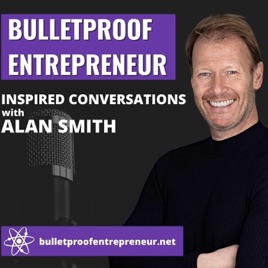
Advertise on podcast: Bulletproof Entrepreneur
This podcast has
97 episodes
Language
EnglishPublisher
Alan SmithExplicit
No
Date created
2022/06/16
Latest episode
2026/09/17
Average duration
72 min.
Release period
16 days
Description
A podcast for entrepreneurs – reverse engineering the formula for successful scale, sale and exit. Inspired conversations with world-class entrepreneurs and the specialists who support them.
Unlock Bulletproof Entrepreneur podcast Email contact info,
Listeners & Audience details
Email contact information
Direct podcast contact details

Listeners
Audience numbers & engagement insights

Audience details
Podcast Insights

Podcast episodes
Check latest episodes from Bulletproof Entrepreneur podcast
#95 Mark Rhodes: The Case for the Strategic Accountant Every SME Founder Wishes They Had
2026/09/17
Send us Fan Mail
Mark started his career at Ernst & Young writing transaction reports for corporates being sold, then walked away from big-business M&A to work with his dad in the family accountancy practice, the one his dad had spent 30 years turning into a growth-focused consulting firm for entrepreneurial SMEs. Years on, Mark has taken those big-firm disciplines pricing analysis, forward forecasting, Michael Porter's competitive strategy and applied them to a corner of the market where most accountancy firms rarely go beyond filing tax returns. In this conversation, he unpacks the "consulting accountant" model, the frameworks he brings to every founder, and why forward-facing beats historical every time.
In this episode:
Why Mark walked away from Ernst & Young's transaction services team to join his dad's accountancy practice, and the reverse psychology that seems to have workedThe "consulting accountant" phrase, borrowed from Rick Payne, and Mark's blunt take that most SME accountants are great historians but poor strategistsThe full-day (or half-day) in-person planning session that starts every client relationship, with personal objectives before business objectivesWhy he treats costs as resources: renaming the P&L, spotting the areas where founders are chronically under-investing training, marketing, peoplePeter Drucker's line that the purpose of a business is to create results outside yourself, and Michael Porter's two-part framework: create value, then capture valueWhy pricing is one of the biggest untapped levers in SME businesses, and Mark's simple rule for choosing clients if they can't get 10x the value back, don't work with themMichael Gerber's "the boss doesn't have a boss" problem, and why the accountability of a monthly meeting with an outsider often does more than any tool inside the businessOKRs (courtesy of Measure What Matters), cascading business plans, and the client who has every single person in the organisation present their own mini business plan at an annual dayRick Payne's shift from Key Performance Indicators to Key Predictive Indicators, and the "desert island" test for how few metrics you actually needThe Harkham property client (Mark's own brother-in-law and brother) that grew from six people to 30 by taking the process to heart, and the dental practice founder who stepped out of clinical work and eventually sold with far less stress than she expectedThe "Draw Toast" TED Talk exercise Mark uses to visualise how a business actually serves customers, and the moments of innovation that fall out of drawing rather than talkingHIPPO the Highest Paid Person's Opinion and why Mark's first question in a strategy session always goes to the person with the least equity and the least influence in the roomThe mini MBA programme Mark runs with Paul three topics (leadership, finance, competitive strategy), ten business owners a year, three hours a month, and a business simulation game that has founders running a fake company on eight decisions a monthWorking alongside other accountants rather than poaching them, and why Mark's firm trains 60 other accountancy firms in the same approachMark's definition of true wealth: having choices, and never playing with scared moneyA conversation about the forward-looking discipline that almost every SME accountant leaves on the table, and why the founders who get it done tend to end up with far more optionality than the ones who don't.
Book and resource recommendations: The Go-Giver by Bob Burg, What is Strategy by Michael Porter (Harvard Business Review), The Goal by Eliyahu Goldratt, Measure What Matters by John Doerr, and the Happiness Lab podcast.
This podcast is produced by Tribunista
Sponsored by Capital Partners
#94 Nigel Shanahan: The 20-Year Journey From IBM Salesman to a £50M Tech Exit
2026/08/06
Send us Fan Mail
Nigel Shanahan started his working life as a chartered accountancy trainee who "failed miserably", found his feet as an IBM salesman for 12 years, then left with a colleague and £250,000 of business angel funding to launch a text-messaging business at the start of the 2000s. It took another 20 years, one dilution to 5%, one buyback of his own company from the VCs, one moment of clarity at an M40 service station, and one 4:30am deal signing to build Rant and Rave into a business he sold to Upland Software in 2018 for what he'd told his team eight years earlier it would be worth: £50 million.
In this episode:
Loughborough University, a failed 18 months as a chartered accountancy trainee, and how a graduate management programme at IBM turned him into a salesman for 12 yearsThe Warwick University EU-funded programme (six Saturdays and Sundays in a row) that separated the entrepreneurs-in-waiting from those who'd stay in corporate lifeThe mentor, Harry, who ran that programme, and who Nigel credits with being one of the most important business relationships of his careerThe first business idea: SMS broadcast for corporates in the days when only people with "status" at IBM had a phone in their car, and the £250,000 angel investment that landed six weeks after the first pitchThe £100k+ IBM salary he walked away from, the £25,000 a year he paid himself for three years, and the young family who paid for it tooThe VC round that came next, the discipline it forced on him, and the phone call telling him his co-founder Ian had to go — and the "hardest business conversation" of Nigel's life the next morningBeing diluted to 5%, working 80-hour weeks, having remortgaged the house five times, and the moment at the M40 Welcome Break service station where Rant and Rave was bornThe wife, Desi, who told him it was "bloody brilliant" before anyone else didHarry's response when Nigel said he'd walk away and start over: "Don't be ridiculous. Do an MBO"The Vodafone relationship changing at exactly the right moment, the board panicking, and the MBO that ended with the VCs getting every pound of their money backThe sentiment engine that turned SMS broadcast into a two-way customer feedback business, and the ten further years of building that followedThe £50 million valuation Nigel told the team was possible eight years before it happened, and the 64 staff on the Enterprise Investment Share Scheme who came along for the rideThe wrong CEO hire that came from "meals and drinks" instead of a proper process, and the non-exec chairman Simon who asked the killer question over a curry: "what's the exit strategy?"Implementing the Entrepreneurial Operating System (EOS), the beauty pageant with investment banks, and picking GP BullhoundThe 2.5x ARR multiple SaaS deals used to go for, the £20M annual recurring revenue that got them to their target price, and the twin-track PE vs trade sale campaignWhy the senior team chose Upland Software over a leveraged private equity offer at the same valuation, and the 40-day due diligence that followedThe 4:30am signing after Nigel "threw his dolly out" and demanded the acquiring CEO come back from a golf trip, and "Disco Dave" — the M&A lawyer from Northern Ireland who arrived three weeks before the deal after the original partner left the firmLife after the exit: Mill Street co-working in Leamington Spa, the Make Good Grow philanthropic matchmaking platform, and Nigel's definition of true wealth — "happiness and contentment"A conversation about betting on a technology wave before anyone else can see it, why not all VCs are the same, and how a 20-year "overnight success" actually gets built.
This podcast is produced by Tribunista
Sponsored by Capital Partners
#93 From the vault: Scaling to a £100m ARR business and successfully exiting with Mark Mills
2026/07/24
Send us Fan Mail
Mark Mills started buying and selling at school — literally, with bags of broken biscuits from the biscuit factory where his aunt worked. Three decades and five businesses later, after a £20,000 debt from the failed pay phone venture that took years to clear, and a publishing business he sold for £1, he built Cardpoint into a £100M-a-year cash machine business turning over £2M a week. He now takes other founders through the 40-step process he ended up writing after selling his own company disastrously badly on the first attempt.
In this episode:
The broken-biscuits business at school that started it all, and why he thinks the best entrepreneurs are always capable salespeopleThe pay phones business in the early '90s that made money on hardware but nothing on calls, and the recession that wiped it outThe £20,000 debt he decided to pay off personally rather than take anyone down with himThe mobile phone moment: sitting around a table laughing at the idea that "someone would want one for his wife" — and the revolution they completely missedThe publishing business that got so broad it had no audience, and the £1 exit that followedThe 1999 trip to New York with his brother "because all the good ideas come from the States"The five business model rules it took him three failed ventures to figure out: recurring income, location-independent, scalable, necessary rather than fashion, and of its timeCardpoint: 36,000 free ATMs already in the market, and the counter-intuitive decision to put paid ones in more convenient locations — corner shops, petrol stations, tourist spotsThe maths behind £1.50 charges adding up to £100M in revenue, and why the business ended up needing a lot of accountantsWhy he ran Cardpoint with an exit in mind from day one, and how that discipline shaped every small day-to-day decisionThe disastrous first attempt to sell it — running buyer meetings while trying to do his day job — and the Christmas Day conversation with his wife that reset everythingThe six-month "I'm not for sale" period he used to prepare properly, and why saying no created more interest not lessThe 40-step exit process he now takes founders through, from tidying up leases and share structures to sharpening the sales pipelineThe four kinds of buyer he thinks about: PLCs, PE-backed roll-ups, private equity taking a hybrid stake, and pure trade sales — and the Minicam deal that used two of themWhy buyer due diligence matters as much as the other way round, and the founders who took less money because they preferred one buyer's team to another'sThe anticlimactic feeling after selling — the founder who ate beans on toast and cried the night the deal closed, and Mark's advice to do nothing for 12 months afterwardsMarking the occasion: daft cars, one burnt orange McLaren, and a pair of cufflinks Mark still wears years laterThe five "disinheritance events" his kids can recite, and why they occasionally try to talk each other into breaking the rulesHis definition of true wealth: not the money, but the choices — and why he'd rather be rich than famousA conversation about ruthlessly interrogating your own business model, the discipline of running every day as if the exit is coming, and why the moment after the wire transfer clears is often quieter than anyone expects.
Mark's Website: https://www.mark.co.uk
Book “Making Your Mark” - https://amzn.eu/d/04iC0CF7
This podcast is produced by Tribunista
Sponsored by Capital Partners
#92 Niraj Shah: How a Stroke at 30 Rewired His Definition of Wealth and Built Five Businesses
2026/07/09
Send us Fan Mail
Niraj was 30, healthy and getting ready for work when a stroke put him on the bathroom floor and eventually into the stroke unit at St Mary's Hospital in London.
Fifteen years on, he has built five businesses across property, meditation, sports tech and now M&A, all while carrying two convictions the health scare gave him: that a useful thought beats a true one, and that energy is a strategy in its own right. His latest venture, DKZ Equity, is out to fix what he sees as broken about how smaller entrepreneurs get sold.
In this episode:
The stroke at 30 that came with no family history, no warning and no explanation, and the "car crash" analogy his doctors used when they discharged himThe father he lost at 14 to a heart attack aged 47, and the two ambitions that shaped Niraj at 15: run his own business and see the worldWhy the plan he was already forming to leave employed life got accelerated the day he woke up in hospitalThe year he spent inside two tech startups just to learn how to build, and the mistake he was making that stopped anything getting off the groundThe pivot into real estate out of "desperation and frustration", the London Plan document nobody in property was reading, and the co-living niche that replaced his salaryWhy he built video viewings, electronic signatures and fibre-optic broadband into his lettings in 2012, and why he still finds property "incredibly boring"Riding the London wellness wave in 2014 and 2015, building a meditation and mental wellbeing movement, and the "moderately successful" exit that taught him more than a bigger one might haveThe sports tech partnership with Mac Lackey that nearly delivered a seven-figure exit on something that fundamentally didn't workThe three near-miss accountancy acquisitions that turned into the origin story of DKZ Equity in December 2024Why he thinks the sub-£50M M&A market is where things get "murky", and the incentive structures that push good advisers up-marketThe retainer-free M&A model he thinks founders should be wary of, the four-to-six percent fee range, and the tail provisions that have quietly wrecked good dealsThe 24-month tail clause that trapped one founder, cost them a £20M exit and forced them into another funding roundWhy he stacked his firm with two experienced partners from day one, and why he almost never takes equity when early-stage founders offer itEnergy as a strategy: the physical, mental and social edge that shows up in every meeting whether you notice it or notHis two-part definition of true wealth: winning the demographic lottery of a free-market Western economy, then having the bravery to define what you actually want rather than what social media tells you you shouldA conversation about treating your own health as infrastructure, building businesses in markets other people have written off, and the questions every founder should be asking before they sign an M&A engagement letter.
Niraj’s LinkedIn: https://www.linkedin.com/in/niraj5hah/
DKZ Equity Website: https://www.dkzequity.com
This podcast is produced by Tribunista
Sponsored by Capital Partners
#91 Sam Smith: From Northern Rock Crisis to London IPO and Super Scalers
2026/06/25
Send us Fan Mail
Sam Smith spent 24 years building FinCap from a single desk and a phone into a London-listed investment bank, becoming one of the few women to lead a public financial business in the UK. She bet on small caps when the big banks were running for the exit, kept hiring when her own team thought she was reckless, and walked away at her best year ever. Now she's putting everything she learned into Super Scalers, a community helping underrepresented founders scale past £50 million.
In this episode:
The summer sandwich round at age 17 that doubled takings in two weeks, and the family bakery moment Sam only recognised as entrepreneurial 20 years laterWhy she walked away from the Schroders and Morgan Stanley route on the day she qualified as an accountant, against the advice of literally everyone she knewBuilding a corporate finance division at 24 with nothing but a desk, a phone and three books on company lawThe MBO signed on 1 August 2007 — two weeks before Northern Rock collapsed across the road from her officeWhy she kept hiring aggressively through the financial crisis while her team begged her to stop, and the four months in 2009 when fees stopped completelyThe first redundancies she ever made, the coach she had to bring in, and the moment she still describes as one of the hardest of her careerThe 48-hour ultimatum to raise £2.5 million for the secondary buyout, the chairman who underwrote her on the spot, and the team that delivered the money in 24Why she gave everyone the same allocation, from receptionist to senior partner, and what that single decision did to the cultureThe IPO timed against Theresa May losing her cabinet, and the "last man standing" mindset that got the deal over the lineWhy she prefers loaning staff money to buy shares over handing out free options, and what skin in the game actually changesThe 10 days after stepping away that she calls the worst of her life, and why she still knew it was 110 percent the right callSuper Scalers, Rosaleen Blair, and the 144 women in the UK who have built businesses past £50 million in revenueA conversation about trusting your gut against every voice in the room, treating culture as the real point of difference, and ranking your own happiness out of ten every single day.
This podcast is produced by Tribunista
Sponsored by Capital Partners
#90 Martin Lightbody - The Scottish Baker Who Conquered America's Cake Aisle
2026/06/11
Send us Fan Mail
Martin Lightbody turned a fourth-generation Scottish bakery into the number one celebration-cake supplier to the UK supermarkets, scaling from 50 staff to 1,200 and £60 to 70 million in turnover. Then he sold up, took the whole idea to America, and won the Hershey licence for the entire country.
This is the full arc of a career built on one habit: seeing where the market was heading before anyone else, and betting big when the moment came.
In this episode:
Why his father refused to let him work in the family bakery as a boy, and the unpaid training across Europe's best bakeries that replaced itThe UK award he collected just as a new supermarket opened up the road and quietly started killing his tradeThe decision to sell every shop, take on millions in debt, and put the family home on the line before a single supermarket had said yesThe point of difference no rival could match, and why speed to market beat the big factories every timeThe licensing deals that built an empire, and the three that went spectacularly wrong (one involves rival football fans and a lot of ruined cakes)How he finally landed Disney after three years of knocking, then closed an entire American licence with a pallet and a half of cakeThe naked sauna standoff that got him the finance director he had chased for a year, who then stayed for 28 of themRepresenting Scotland at a sport he had never played, on an animal he had never sat onWhat he means when he calls himself a fan of plagiarismHis honest definition of true wealth, and the moment of relief he still remembersA conversation about pivoting before you are forced to, hiring people you think you cannot afford, and knowing exactly when to walk away.
Helpful Resources mentioned in the episode:
Sam Walton: Made In America
Bulletproof Entrepreneur #78 Sir Tom Hunter
This podcast is produced by Tribunista
Sponsored by Capital Partners
#89 The 20-Year Overnight Success: Failed Businesses, Crippling Debt, and Building GoProposal Into an Eight-Figure Exit
2026/05/28
Send us Fan Mail
James Ashford sold GoProposal to Sage for an eight-figure sum. People hear that and picture a clean line from idea to payday. It took him two decades, several businesses that died along the way, and one moment where he couldn't afford the fee to shut a company down.
He started as a wedding magician, walking straight up to the rowdiest table in the room on purpose. What he learned there became the thing every later business ran on. The failures came too: an agency he loved, gone over a single decision. A marriage under strain. A debt a friend had to cover for him.
Then a mentor asked him one blunt question, and the answer changed how he built everything after.
The part people don't see coming is what the exit actually did to him. The win arrived, and so did something he hadn't planned for. He talks about it more honestly here than most founders ever will, including the redefinition of "wealth" he landed on at the end, which is not the one he set out chasing.
If you're building something you hope to sell, or you already have and it feels stranger than you expected, this one's worth your time.
What Alan and James get into:
Why he targeted the worst table in the room, every timeThe agency that went under from one bad call, and what it cost him beyond moneyThe liquidation he couldn't pay for himselfA million-pound cheque pinned to a bedroom ceiling years before it meant anythingThe mentor question that rearranged his whole approachHow he picked who would buy his company long before they knew they wouldThe second Range Rover he ordered and sent straight backThe thing nobody warns you about on the other side of an exitThe definition of "true wealth" he arrived at, and how late it cameConnect with James
Website: https://jamesashford.comLinkedIn: https://www.linkedin.com/in/jamesashford/Instagram: https://www.instagram.com/thejamesashfordTikTok: https://www.tiktok.com/@fireproofjamesJames's book
Selling to ServeOther Book Recommendations:
Building a StoryBrand by Donald MillerThe E-Myth Revisited by Michael GerberThe Psychology of Money by Morgan HouselRich Dad, Poor Dad by Robert KiyosakiThe Richest Man in Babylon by George S. ClasonTony Robbins' Money: Master the Game
This podcast is produced by Tribunista
Sponsored by Capital Partners
#88 The Insider Who Now Teaches Founders to Beat Private Equity
2026/05/14
Send us Fan Mail
Nick Bradley has sat on the other side of the table for more than 50 acquisitions and 27 exits. He knows exactly how private equity firms assess a business, where founders give away their leverage, and why so many walk away from a life-changing deal with far less than they should have.
But this conversation is not really about deal mechanics. It is about the journey that got him there. From running a small gym in Adelaide to launching magazines in Sydney, to flying between London and New York every week for a job that was quietly costing him everything. It took a sudden loss, a stress injury he never saw coming, and an unexpected reunion to make him question the entire game he had spent a decade winning.
In this episode, Nick shares the framework he now uses to help founders build genuinely valuable businesses, the difference between the companies buyers fight over and the ones they pick apart, and the identity shift that has to happen before any exit is worth doing. He also opens up about the moment he put a resignation letter on the table, and how his definition of success looks nothing like it did ten years ago.
A candid conversation about ambition, reinvention, and what it actually means to build something worth selling.
This podcast is produced by Tribunista
Sponsored by Capital Partners
#87 He arrived in the UK with £500 and sold his company to one of word's biggest banks - Anton Padmasiri
2026/05/01
Send us Fan Mail
Anton arrived in the UK with £500 in his pocket. Years later, he founded WealthOS. He recently sold it to one of the world's largest banks.
In this episode, Alan sits down with the founder of WealthOS to talk through what the journey from arrival to acquisition actually looked like.
We hear about the door-knocking days in suburban Surrey, and the decision to leave a senior corporate role with two children in private school and a mortgage to cover. He shares the framework he used to pick a co-founder, and why the person who scored highest was not who anyone expected.
We get into the angel rounds, the strategic investment from Barclays, and the Liz Truss-era fundraising window that nearly ended the company.
There is the November when the bank account was down to four figures and payroll was three weeks away. The conversation he had with his wife about pulling the kids out of school. And the call from JP Morgan that came when an exit was not on his mind.
He also shares the principle his former chair gave him about how good businesses get acquired, and his answer to what wealth actually means after you have built and sold one.
Links:
Wealth OS: https://www.wealthos.cloud/
Anton's LinkedIn: https://www.linkedin.com/in/antonpadmasiri/
Books:
"Dreams From My Father" by Barack Obama - https://amzn.eu/d/074kFId1
"Range" by David Epstein - https://amzn.eu/d/0iBX3kyj
"Build" by Tony Fadell - https://amzn.eu/d/06ueeONi
Podcasts:
"Invest Like The Best" by Patrick O'Shaughnessy - https://pod.link/1154105909
This podcast is produced by Tribunista
Sponsored by Capital Partners
#86 Darya Simanovich — I Arrived in London with £300 and Built 15 Businesses. Here’s What Actually Worked.
2026/04/16
Send us Fan Mail
Darya Simanovich arrived in London 20 years ago with £300, no contacts, and barely any English. Today she runs two businesses, holds a full-time role supporting small business owners across London, mentors 400 founders a year, and has just published her first book.
In this episode, Daria breaks down what 15 businesses across completely different industries actually taught her about failure, timing, and the kind of resilience nobody calls resilience to your face. She also shares the frameworks she gives every founder she meets, including one with a 72-hour deadline that she says determines whether anything actually gets done.
If you have ever wondered whether the entrepreneurship path is for you, or you are already on it and wondering what separates the ones who make it, this is the conversation.
Darya's book: https://amzn.eu/d/0j0KvWsr
Links to other recommended resources:
The Artist's Way: A Spiritual Path to Higher Creativity
Atomic Habits
The 5 Types of Wealth: A Transformative Guide to Design Your Dream Life
The Psychology of Money: Timeless lessons on wealth, greed, and happiness
This podcast is produced by Tribunista
Sponsored by Capital Partners
#85 The Music Entrepreneur Who Sold Out To Stay In - Ian Grenfell of Quietus
2026/04/02
Send us Fan Mail
Ian has spent 45 years in the music industry, managing Simply Red, Simple Minds, The Pretenders, and Suede. He started at 17 with a boot full of vinyl and a two-litre Cortina, driving 1,200 miles a week as a sales rep.
He went on to oversee the biggest self-released album in history - Simply Red's Home, which outsold most Taylor Swift records and still holds the record today!
But Ian's story isn't just about music.
It's about what happens when a founder tries to exit a business built entirely on relationships, trust, and instinct. After a bruising experience selling 50% to Live Nation and rejecting a buyout offer before his plane left the runway at Heathrow, Ian found a route almost nobody in his world had heard of - and it changed everything.
This is a conversation about sliding doors moments, creative courage, knowing when enough is enough, and an exit strategy that let him cash out, stay involved, and reward every person who helped him build it.
This podcast is produced by Tribunista
Sponsored by Capital Partners
#84 He was told his business was worth nothing. Five years later he sold it for millions - on his own terms.
2026/03/19
Send us Fan Mail
Neil Osmond never set out to be an entrepreneur. He was a pharma executive with a steady job, a young family, and no savings when a friend showed him something on a computer that he couldn't stop thinking about.
What followed was a 15-year journey - mapping the London Olympics, pivoting into healthcare, nearly running a glorified lifestyle business, and eventually selling Earthware to a global medical communications group after more than ten first-stage offers.
In this episode, Neil walks through all of it: the brutal feedback that changed his direction, how he used Vivid Vision, EOS, and 8 Agencynomics benchmarks to transform the business, why knowing your number before you sell is non-negotiable - and what true wealth looks like when the chapter is finally closed.
Books mentioned:
Maverick – Ricardo Semler | Business Model Generation – Osterwalder & Pigneur | Agencynomics – Spencer Gallagher & Peter Hoole
Connect with Neil on LinkedIn: https://www.linkedin.com/in/neilmeosmond/
Subscribe to the Bulletproof Entrepreneur newsletter: https://alan-smith-bulletproofentrepreneur.kit.com/newsletter
Follow Alan on LinkedIn: https://www.linkedin.com/in/alancapital/
This podcast is produced by Tribunista
Sponsored by Capital Partners
#83 From Bomb Survivor to 32x EBITDA Exit - Andrew Scott’s Extraordinary Entrepreneurial Journey
2026/03/05
Send us Fan Mail
He survived a bomb at four years old. Lost everything in his thirties. Then built a group of companies employing nearly 100 people and sold his media business for 32 x EBITDA.
I sat down with Belfast-born entrepreneur Andrew Scott for one of the most honest conversations about failure, resilience, and reinvention you’ll hear anywhere.
Andrew shares the full story - from growing up during the Troubles, to arriving in London at 18 with nothing, to the moment he sat in a clapped-out BMW on a beach and thought it was all over. And what happened next.
Topics covered: surviving childhood trauma, the power of work ethic, building and losing businesses, the Purpose Plan Execute framework, creative deal-making, company culture, AI in business, and achieving a 32x EBITDA exit.
Links
🔗 Connect with Andrew: https://www.andrewscott.bio/
🔗 Subscribe to the Bulletproof Entrepreneur newsletter: https://alan-smith-bulletproofentrepreneur.kit.com/newsletter
🔗 Follow Alan on LinkedIn: CLICK HERE
This podcast is produced by Tribunista
Sponsored by Capital Partners
#82 He Ditched Cash, Bought Bitcoin, Then Listed His Company on the Stock Market: Entrepreneur, Scott Ellam of XCE.
2026/02/19
Send us Fan Mail
Scott Ellam started with a £13,000 basic salary, cold-called his way into closing a company acquisition at 22, and then built a thriving international executive search firm from his kitchen in 2014.
Then he did something almost no UK founder has done - he put Bitcoin on his business balance sheet, and then took the whole thing public - listing it on the stock market.
In this episode, Scott tells the full story:
Why he believes the £230 billion sitting in UK business bank accounts is quietly losing value every year, How he held his nerve watching Bitcoin drop from £60k to £16k while still buying daily, Why he believes the IPO structure he’s built solves one of recruitment’s oldest problems - attracting and retaining top billing talent.This isn’t really a Bitcoin episode. It’s an episode about what you do with the profits you’ve worked hard to build - and whether cash in the bank is actually as safe as it feels.
Whether you agree with the strategy or not, this conversation will challenge how you think about incentives, capital allocation, and long-term value creation.
What’s the “don’t get poor slowly strategy” for your business?
Links
https://uk.linkedin.com/in/scott-p-ellam-5a097449
https://www.spencer-riley.com/about-us/meet-the-team/scott-ellam
https://xce.io/
https://m.youtube.com/watch?v=YtFOxNbmD38
https://bitcoincollective.co/
https://www.amazon.co.uk/Principles-Bitcoin-Technology-Economics-Philosophy/dp/023122012X
This podcast is produced by Tribunista
Sponsored by Capital Partners
#81 Rachel Murphy - From £0 to Eight-Figure Exit in 1,042 Days
2026/02/05
Send us Fan Mail
Episode Overview
Rachel Murphy sold her company during lockdown. While building the national COVID-19 digital service. Without ever meeting the buyers in person.
This conversation is equal parts masterclass and madness - covering everything from selling timeshare at 13, to negotiating 50% equity in a struggling business, to achieving an eight-figure exit in under three years, to why every founder her acquirer bought has since left.
Rachel now runs The Grafter, helping entrepreneurs navigate exits with the playbook and emotional support that didn't exist when she needed it.
Guest Bio
Rachel Murphy is a multi-exited entrepreneur and founder of The Grafter, a business that helps entrepreneurs build, scale, and exit their companies. After building and selling her first company in her 20s, she spent 10-15 years as a high-level interim executive (CIO for Department of Education, leading NHS.UK digital transformation and launching the NHS app).
In 2015, she negotiated 50% equity in consultancy Difference and sold it for eight figures in 2020 - during lockdown, while simultaneously building the national COVID-19 digital solution.
She now leads a community of 200+ entrepreneurs and has helped facilitate 5 exits, 12 revenue doublings, and a £44M non-dilutive raise in just 38 months.
Key Takeaways
1. Build Your Exit Strategy Before You Need It
Rachel had a complete sell pack ready 18 months into the business. When unsolicited buyers called, she didn't scramble - she sent comprehensive documentation immediately, putting her in a position of strength.
Action: Start documenting your strategy, financials, and exit roadmap now - even if exit is years away.
2. Creative Deals Beat Starting From Scratch
Instead of building from zero, Rachel negotiated 50% equity in an existing struggling business by bringing her expertise, network, and turnaround strategy. One plus one equalled ten.
Action: Look for businesses adjacent to your skillset that need what you have. Equity partnerships can accelerate your journey.
3. Use Objective Frameworks for Emotional Decisions
Rachel used Wardley mapping to objectively assess three acquisition offers. The result: she chose the best fit for her team, not the highest bidder or her personal preference.
Action: Remove emotion from major decisions with frameworks. Work backwards from outcomes. Be brutally objective.
Links:
https://www.linkedin.com/in/rachthegrafter/?originalSubdomain=uk
The Grafter
The 5 Types of Wealth: The life-changing international bestseller, a guide to building a happier, healthier, wealthier life
This podcast is produced by Tribunista
Sponsored by Capital Partners
Podcast reviews
Read Bulletproof Entrepreneur podcast reviews
Podcast sponsorship advertising
Start advertising on Bulletproof Entrepreneur relevant audience podcasts
You may also like to advertise on these Podcasts

4.8583398
Didn't I Just Feed You
Stacie Billis and Meghan Splawn

4.4503509
Warfare
History Hit

4.8296431971
Fantasy Footballers - Fantasy Football Podcast
Fantasy Football

4.712822542
True Crime All The Time
Emash Digital

4.8159901996
Watch What Crappens
Ben Mandelker & Ronnie Karam

4.638551152
Modern Wisdom
Chris Williamson

4.66151303
True Crime with Kendall Rae
Mile Higher Media & Audioboom Studios

51088171
Middle Children
Jessie Jolles and Chris Burns

4.9264932000
Morning Wire
The Daily Wire

4.689251199
Get Sleepy: Sleep meditation and stories
Slumber Studios