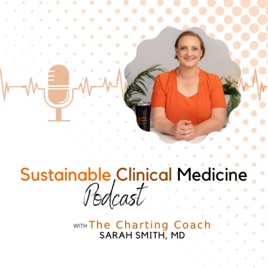
Advertise on podcast: Sustainable Clinical Medicine with The Charting Coach
Rating
4.9from
This podcast has
188 episodes
Language
EnglishPublisher
Dr. Sarah SmithExplicit
No
Date created
2023/01/12
Latest episode
2026/10/05
Average duration
39 min.
Release period
7 days
Description
On the Sustainable Clinical Medicine Podcast we are capturing the stories of physicians who have made clinical medicine sustainable in their own lives, including their before and after stories. I will also interview coaches who are helping Physicians create sustainable clinical medicine for themselves.
Unlock Sustainable Clinical Medicine with The Charting Coach podcast Email contact info,
Listeners & Audience details
Email contact information
Direct podcast contact details

Listeners
Audience numbers & engagement insights

Audience details
Podcast Insights

Podcast episodes
Check latest episodes from Sustainable Clinical Medicine with The Charting Coach podcast
The Research Is In! What 280 Doctors Proved About Physician Burnout | Episode 192
2026/10/05
Dr. Sarah Smith has always believed that getting home with the work of the day done was possible, and now there is published research to prove it. In this episode, she walks through the journal article that studied 280 Charting Champions members across a range of specialties and career stages, sharing exactly what the data found about hours spent charting outside clinical time, feelings of burnout and dread, and the number of patients doctors were still able to see. If you have ever wondered whether a coaching program can actually move the needle on physician administrative burden, or if you need something concrete to show your organization, this is the episode to send them.
Timestamped Highlights
[02:00]: Dr. Smith traces the origin of the Charting Champions program, not to a business plan, but to a very specific moment in her own clinical life when she realized she could not keep going the way she was going.
[09:00]: On a remote cabin with no internet, a pencil, and a pad of paper, Dr. Smith did something that would eventually reach hundreds of doctors worldwide, and the simplicity of how it started may surprise you.
[13:00]: Before the program even launched, Dr. Smith knew she would need to measure what it actually did, and the way she set that up created some unexpected challenges for her research team.
[16:00]: The study found something that most organizations will immediately ask about: does doing less charting after hours come at the cost of seeing fewer patients? The answer is significant.
[22:00]: The data on dread, burnout, and resignation ideation before and after Charting Champions are numbers worth knowing, especially if you are working inside a healthcare organization looking for interventions that actually hold up.
[28:00]: Dr. Smith closes with a direct message to doctors who want to bring this evidence to their employers, and where to find the full journal article and its reference list.
Three Key Takeaways
1. The study didn't just show improvement. It showed clinically significant improvement. Two hundred and eighty doctors completed both pre- and post-program surveys, and what they reported wasn't marginal. Charting outside clinical hours decreased significantly. Feelings of dread, burnout, and thoughts of resigning all dropped. And the proportion of doctors who frequently had their evenings and weekends free of paperwork nearly doubled, from 16 to 30 percent. The phrase "clinically significant" is precise here: this wasn't a feel-good survey, it was a longitudinal study that met the bar for meaningful change.
2. Productivity did not take a hit, and that matters for the organizational argument. One of the most common objections to any administrative burden intervention is that reducing paperwork time means reducing patient volume. This study directly addressed that, and found no significant difference in the number of patients seen per day before and after the program. For doctors trying to make the case to their hospital, clinic, or health system that coaching is worth supporting, this finding removes the most common counter-argument.
3. This program was built from one doctor's lived experience, then tested against evidence. The Charting Champions program did not begin as a curriculum or a product. It began as Dr. Sarah Smith spending two years working through every aspect of her own clinical day to solve a problem that was quietly making her miserable. What makes this research meaningful is that the intervention is grounded in something real, not top-down efficiency consulting, but a process developed by a doctor who had the same problem the participants had, and figured out a way through it.
Would you like to view a transcript of this episode? Click Here
Charting Champions is a premiere, lifetime access Physician only program that is helping Physicians get home with today's work done. All the proven tools, support and community you need to create time for your life outside of medicine.
Learn more at https://www.chartingcoach.ca
Enjoying this podcast? Please share it with someone who would benefit. Also, don’t forget to hit “follow” so you get all the new episodes as soon as they are released.
Come hang out with me on Facebook or Instagram. Follow me @thechartingcoach to get more practical tools to help you create sustainable clinical medicine in your life.
Questions? Comments? Want to share how this podcast has helped you? Shoot me an email at [email protected]. I would love to hear from you.
The Clinical Day Was Never Built With You in Mind | Episode 191
2026/09/28
This episode was originally published on Designing Healthcare That Cares, hosted by Dr. Laura Suttin. We are grateful to Dr. Suttin for the conversation and for permission to share it here.
Episode Summary
Nobody ever walked down the corridor and asked a doctor to see fewer patients today. Nobody ever offered to take half their inbox. The clinical day was not designed with the clinician in mind, and most doctors have spent their careers working inside that reality without ever stopping to question it.
In this episode, originally recorded for Designing Healthcare That Cares with Dr. Laura Suttin, Dr. Sarah Smith talks about what it actually looks like to start reclaiming your day from the inside, how to work with your team differently, what AI can and cannot do for your charting, and why noticing without judgment is always the first move.
What This Episode Covers
Why the clinical day was never designed with the doctor in mind, and what to do about it now
How to identify which inbox messages are not doctor work and get them off your plate permanently
What it looks like to work with your team at the highest level, and how to have that conversation without adding to their load
Why everything you say yes to in the room has a time consequence, and how to start navigating that
A practical and honest look at where AI scribing helps and where it quietly creates new problems
Why noticing without judgment is the foundation of every sustainable change in clinical medicine
How to batch staff questions, protect thinking time, and reduce the interruptions that drain executive function
Key Moment Worth Hearing
Dr. Smith describes discovering that the clinic nurse was spending over an hour a day booking ultrasound appointments, creating a bottleneck that delayed patient vitals and backed up the entire morning. One conversation redirected that work to the ultrasound clinic's own secretaries. The hour came back. That is the noticing piece in action.
Would you like to view a transcript of this episode? Click Here
Charting Champions is a premiere, lifetime access Physician only program that is helping Physicians get home with today's work done. All the proven tools, support and community you need to create time for your life outside of medicine.
Learn more at https://www.chartingcoach.ca
Enjoying this podcast? Please share it with someone who would benefit. Also, don’t forget to hit “follow” so you get all the new episodes as soon as they are released.
Come hang out with me on Facebook or Instagram. Follow me @thechartingcoach to get more practical tools to help you create sustainable clinical medicine in your life.
Questions? Comments? Want to share how this podcast has helped you? Shoot me an email at [email protected]. I would love to hear from you.
Stop Saying Yes to Homework Inside the Consultation | Episode 190
2026/09/21
This episode was originally published on Vital Signs: Thriving as a Woman in Medicine, hosted by Dr. Diane Shannon. We are grateful to Dr. Shannon for the conversation and for permission to share it here.
Episode Summary
Every time a doctor opens their mouth in a consultation, they are either shortening or lengthening their day. That is the lens Dr. Sarah Smith brings to clinical communication, and in this episode, originally recorded for Vital Signs: Thriving as a Woman in Medicine with Dr. Diane Shannon, she applies it to everything from how you greet a patient to how you handle the person who walks in with 17 problems. The conversation is practical, honest, and built around a single idea: you are the captain of the ship, and there are more choices available to you than you may have realized.
What This Episode Covers
Why the way you communicate inside the consultation is one of the biggest drivers of after-hours work
The real cost of not having efficient patient communication, including financial costs most doctors do not track
Why saying yes to everything in the room means saying yes to homework
How to handle the patient with 17 problems without abandoning good care
Practical strategies for reducing interruptions, batching staff questions, and protecting thinking time
Why noticing without judgment is the first and most important step toward change
How small, incremental pivots compound into a very different clinical day
Key Moment Worth Hearing
Dr. Smith describes what happens when a patient walks in and fills the silence while you are still mid-thought about their diabetes management. Her response to that moment, warm, direct, and completely unapologetic, is one of the most useful things in this episode.
Would you like to view a transcript of this episode? Click Here
Charting Champions is a premiere, lifetime access Physician only program that is helping Physicians get home with today's work done. All the proven tools, support and community you need to create time for your life outside of medicine.
Learn more at https://www.chartingcoach.ca
Enjoying this podcast? Please share it with someone who would benefit. Also, don’t forget to hit “follow” so you get all the new episodes as soon as they are released.
Come hang out with me on Facebook or Instagram. Follow me @thechartingcoach to get more practical tools to help you create sustainable clinical medicine in your life.
Questions? Comments? Want to share how this podcast has helped you? Shoot me an email at [email protected]. I would love to hear from you.
She Woke Up at 2AM to Chart. Here Is What She Did About It | Episode 189
2026/09/14
This episode was originally published on the Doctors Crossing Carpe Diem Podcast, hosted by Dr. Heather Fork. We are grateful to Dr. Fork for the conversation and for permission to share it here on the Sustainable Clinical Medicine Podcast.
Episode Summary
Dr. Sarah Smith spent the first 15 years of family medicine asking her mentors the same question: how do you do the paperwork part? The answer was always the same. Come in on Sundays. It was not until she was walking past the living room one evening, hearing her son talk about university, and realizing she was on her way to the computer again, that something shifted. In this episode, originally recorded for the Doctors Crossing Carpe Diem Podcast with Dr. Heather Fork, Dr. Smith talks about the moment everything changed, what she actually did differently, and what she now teaches doctors who are stuck in the same cycle she was.
What This Episode Covers
The moment Dr. Smith realized charting chaos was costing her more than just time
Why noticing your patterns without judgment is where change begins
How perfectionism and imposter syndrome slow charting down in ways most doctors never connect
Practical strategies for charting in real time and managing the clinical day more intentionally
How to reduce interruptions, set boundaries, and get notes done before the next patient
What good enough documentation actually looks like, and why it is more than enough
How AI is changing the charting landscape and where it still falls short
Key Moment Worth Hearing
Dr. Smith describes the preceptor she was unconsciously writing five-page notes for, years after training ended. When she realized who she was trying to please and what it was actually costing her, everything about her approach to documentation changed.
Would you like to view a transcript of this episode? Click Here
Charting Champions is a premiere, lifetime access Physician only program that is helping Physicians get home with today's work done. All the proven tools, support and community you need to create time for your life outside of medicine.
Learn more at https://www.chartingcoach.ca
Enjoying this podcast? Please share it with someone who would benefit. Also, don’t forget to hit “follow” so you get all the new episodes as soon as they are released.
Come hang out with me on Facebook or Instagram. Follow me @thechartingcoach to get more practical tools to help you create sustainable clinical medicine in your life.
Questions? Comments? Want to share how this podcast has helped you? Shoot me an email at [email protected]. I would love to hear from you.
Conflict Resolution for Doctors: Why Conflict Is a Vital Sign, Not a Disease | Episode 188
2026/09/07
Most doctors were never taught how to handle conflict. They were taught to avoid it, outlast it, or hand it to someone else. Dr. Lee Sharma is a gynecologist who completed a master's degree in conflict resolution in the middle of a busy clinical career and discovered something that changed everything: it was not medicine she did not like. It was the unresolved conflict happening around it. In this episode, she introduces a reframe that shifts the entire conversation, treating conflict not as a disease to eliminate but as a vital sign to investigate, and makes the case that learning to do that is one of the most direct paths to a sustainable clinical career.
Six Timestamped Highlights
[04:00]: Dr. Sharma describes the Monday morning meetings where nobody said anything, the same problems plagued the practice for years, and what she now understands about what was actually happening in that room.
[13:00]: She introduces the vital sign reframe for conflict, and explains why thinking of conflict as a disease is the very reason most doctors run from it rather than move toward it.
[20:00]: The doctor who is 45 minutes behind, the patient who is furious, and the specific words that can shift that encounter without abandoning your boundaries or your dignity.
[26:00]: How to navigate conflict with administration when goals feel completely opposed, and the one place to start that makes every difficult conversation easier to have.
[36:00]: The direct line Dr. Sharma draws between unresolved conflict and burnout, and why closing the charts does not mean you have gone home if you are still replaying a conversation at 8pm.
[41:00]: What doctors are and are not responsible for when the system is the problem, and why learning to make that distinction clearly is one of the most important things a doctor can do for their own sustainability.
Three Key Takeaways
1. Conflict is a vital sign, not a disease.
Dr. Sharma's central reframe is this: when a patient has a fever, you do not blame yourself or the patient. You use the fever to look harder. Conflict works the same way. It is a sign that something underneath needs attention, not evidence that someone is bad, wrong, or failing. When doctors stop treating conflict as something to be eliminated and start treating it as information to be investigated, the fear around it shifts. Curiosity replaces avoidance. And curiosity, she argues, is the single most effective tool for moving through a difficult encounter without losing the relationship on the other side.
2. Unresolved conflict does not stay at work.
Dr. Sharma is direct about the burnout connection. A doctor can close every chart and leave on time and still not have gone home if they are replaying a difficult patient interaction at the dinner table. Those thousand small cuts of the clinical day, the nurse who seemed unhappy with an order, the colleague who made a comment in the corridor, the patient who challenged a treatment plan, accumulate in the body and do not switch off just because the clinic is locked. Learning to engage with conflict constructively means fewer things get carried home. And fewer things carried home is one of the most underrated contributions to a sustainable clinical career.
3. With administration, start where you agree, not where you differ.
When conflict involves a power differential, most doctors walk in defending their position against someone defending theirs. Dr. Sharma calls this positional bargaining, and it almost never works. What she coaches instead is finding the single thing both parties can agree on and starting the conversation there. In a dispute about appointment numbers or supply budgets, that shared point is almost always quality of patient care. Starting from shared ground does not guarantee the outcome a doctor wants. But it preserves the relationship for the next conflict, which is always coming.
Guest Bio
Dr. Lee Sharma is a gynecologist, conflict resolution specialist, and co-founder of Lintel Health, based in Auburn, Alabama. After completing a master's degree in conflict resolution while practicing full-time OBGYN, she opened her own solo practice in 2001 and has spent over two decades consulting with hospital systems, residency programs, and clinical offices on conflict resolution in medicine. She is the creator of the SPARC system for addressing conflict in real time and co-hosts the podcast Scalpel and Sword. Find her at lintelhealth.com.
Would you like to view a transcript of this episode? Click Here
Charting Champions is a premiere, lifetime access Physician only program that is helping Physicians get home with today's work done. All the proven tools, support and community you need to create time for your life outside of medicine.
Learn more at https://www.chartingcoach.ca
Enjoying this podcast? Please share it with someone who would benefit. Also, don’t forget to hit “follow” so you get all the new episodes as soon as they are released.
Come hang out with me on Facebook or Instagram. Follow me @thechartingcoach to get more practical tools to help you create sustainable clinical medicine in your life.
Questions? Comments? Want to share how this podcast has helped you? Shoot me an email at [email protected]. I would love to hear from you.
Therapy for Doctors: Why You Do Not Have to Be in Crisis to Ask for Help | Episode 187
2026/08/31
Most burnout conversations focus on systems, strategies, and workflow. And those things matter. But what happens when the inbox is clear, the charting is done, and something still feels wrong? Dr. Annia Raja is a clinical psychologist whose practice is almost entirely dedicated to serving doctors in therapy, and she sees this pattern regularly. The practical strategies work, until they reveal something underneath that the strategies were never going to reach.
In this episode, she talks about the deeper psychological dynamics that underpin burnout in medicine, why the traits that made someone an excellent doctor often have roots that go much further back than medical school, and why therapy does not have to wait for a crisis.
Timestamped Highlights
[05:00]: Dr. Raja describes what happens when a doctor finally clears their inbox and gets their clinical day under control, and why for some of them the relief they expected does not arrive.
[09:00]: She introduces the tangled ball of yarn as a more honest metaphor than the onion for understanding how medicine, personality, childhood, and relationships interweave in burnout, and what it means for how recovery actually works.
[12:00]: Why rest is not a destination you arrive at, and what she keeps finding in therapy when doctors finally create time away and discover they do not know what to do with it.
[16:00]: The ruminative pattern she sees most often in female doctors, where it comes from, and why telling someone to simply stop replaying an interaction is never going to work.
[20:00]: The real reason most doctors wait until crisis to seek therapy, including the specific fears around credentialing and licensing boards, and what has changed in the US that most doctors do not know about.
[26:00]: The difference between symptom-focused therapy and depth-oriented therapy, and why she makes a specific case for the latter with high-achieving doctors who have already tried every other fix.
Three Key Takeaways
1. Practical strategies work until they reveal what they cannot fix.
Dr. Raja is not dismissive of workflow strategies, charting systems, or inbox management. She sees their value. What she also sees, regularly, is doctors who have implemented all of those things and still feel something is off. When the busyness clears, what is left? Who are you when you are not overwhelmed? For some doctors, that question is more confronting than the overwork ever was. The strategies address the surface. Therapy, she argues, addresses what is underneath it.
2. The traits that make doctors vulnerable to burnout usually started long before medical school.
Dr. Raja describes burnout not as something medicine creates from scratch but as something medicine builds on top of. Perfectionism, people-pleasing, hypervigilance, martyrdom tendencies, these patterns often have roots in family environments, childhood experiences, and personal histories that preceded medicine by decades. Medical training did not create them. It found them, rewarded them, and amplified them. Understanding that changes what recovery needs to look like.
3. You do not have to be in crisis to go to therapy.
Dr. Raja uses the gym as her analogy, and it is a good one. You do not go to the gym only when something is broken. You go to maintain, to build capacity, to stay ahead of what would otherwise accumulate. Mental and emotional care works the same way. She is direct about the credentialing fears that keep doctors from seeking help and equally direct about what has changed. Over 40 US state boards have now removed the intrusive mental health history questions from their applications. The barrier many doctors think is there may no longer exist.
Guest Bio
Dr. Annia Raja is a clinical psychologist based in California whose practice is dedicated almost entirely to serving doctors in therapy. She practices across multiple US states through PSYPACT and offers private pay sessions specifically to protect her clients' confidentiality and privacy. She will be speaking at the White Coat Investor Conference in February 2027. Find her at helmpsychologygroup.com and on Instagram at Helm Psychology.
Would you like to view a transcript of this episode? Click Here
Charting Champions is a premiere, lifetime access Physician only program that is helping Physicians get home with today's work done. All the proven tools, support and community you need to create time for your life outside of medicine.
Learn more at https://www.chartingcoach.ca
Enjoying this podcast? Please share it with someone who would benefit. Also, don’t forget to hit “follow” so you get all the new episodes as soon as they are released.
Come hang out with me on Facebook or Instagram. Follow me @thechartingcoach to get more practical tools to help you create sustainable clinical medicine in your life.
Questions? Comments? Want to share how this podcast has helped you? Shoot me an email at [email protected]. I would love to hear from you.
Curiosity in Medical Leadership: Why Asking Questions Outperforms Having Answers | Episode 186
2026/08/24
Most doctors are trained to have answers. The higher the stakes, the more certainty is rewarded. But when those same doctors step into leadership roles, that certainty becomes the very thing that gets in their way. Dr. Debra Clary has spent nearly two decades developing leaders inside healthcare organizations, and what her research keeps showing is that the leaders with the highest curiosity have the highest performing teams.
In this episode, she talks about what curiosity actually looks like in clinical environments, why resistance to change is biological rather than personal, and what happens when doctors who have spent careers being the expert in the room are suddenly asked to lead people who need to be heard.
Timestamped Highlights
[04:00]: Dr. Clary shares the research behind The Curiosity Curve, and why the data connecting leader curiosity to team performance surprised even the researchers who set out to find it.
[08:00]: She describes the single most powerful thing a leader can say to create a culture where people feel safe to speak up, and it is three words most high-achieving people rarely use.
[12:00]: The balance between certainty and curiosity in clinical medicine, and why the same trait that makes a doctor exceptional in an emergency can become an obstacle the moment they step into a leadership role.
[16:00]: Why resistance to change is not a character flaw but a biological response, and what leaders need to say before rolling out any new system or technology if they want it to actually work.
[20:00]: What AI can and cannot do, and why the differentiator that keeps doctors irreplaceable is not clinical knowledge but something more fundamental.
[25:00]: What happens when patients arrive armed with data from their own research, and how a doctor's relationship with curiosity determines everything about how that encounter goes.
Three Key Takeaways
1. Certainty narrows curiosity, and that is where dangerous things happen.
Dr. Clary's research found that leaders who created environments where questions were welcomed and the status quo could be challenged consistently outperformed those who did not. The same principle applies inside clinical environments. The doctor who is certain about how an encounter should go, how a system should work, or how a team should function stops asking questions, and the moment questions stop, so does learning. She is not arguing against clinical confidence. She is arguing that certainty and curiosity need to coexist, and that most leaders lean too heavily on one at the expense of the other.
2. Change resistance is biological, not personal, and leaders who understand that roll it out differently.
When something new arrives, the brain's first job is to assess threat. It is not interested in efficiency or innovation. It is interested in whether this is safe. Dr. Clary coaches leaders to work with that biology rather than against it, which means being transparent about the reason for a change, showing people how they fit into the future, and inviting them to help solve the implementation rather than handing them a directive. The organizations that skip that step, she says, pay for it in resistance, delay, and disengagement. The ones that do not skip it tend to move faster than they expected.
3. Leadership and culture are synonymous.
Dr. Clary's closing message is direct: so goes the top of the house, so goes the organization. A C-suite that does not model curiosity, collaboration, and psychological safety will not produce teams that offer those things either. For doctors moving into leadership roles, this reframe matters because it shifts the question from how do I get my team to perform differently to how do I need to show up differently first. The answer almost always involves asking more questions, saying I do not know more often, and being genuinely interested in what the person in front of you thinks. None of that is complicated. Most of it is just unfamiliar.
Guest Bio
Dr. Debra Clary is a leadership consultant, executive coach, and author based in the United States. With a doctorate in human behavior and organizational design and 18 years at Humana developing healthcare leaders, she works primarily with C-suite leaders and executive teams. She is the author of The Curiosity Curve, published in 2025. Find her at debraclary.com.
Would you like to view a transcript of this episode? Click Here
Charting Champions is a premiere, lifetime access Physician only program that is helping Physicians get home with today's work done. All the proven tools, support and community you need to create time for your life outside of medicine.
Learn more at https://www.chartingcoach.ca
Enjoying this podcast? Please share it with someone who would benefit. Also, don’t forget to hit “follow” so you get all the new episodes as soon as they are released.
Come hang out with me on Facebook or Instagram. Follow me @thechartingcoach to get more practical tools to help you create sustainable clinical medicine in your life.
Questions? Comments? Want to share how this podcast has helped you? Shoot me an email at [email protected]. I would love to hear from you.
How to Design a Clinical Day That Works: Intentional Systems With Dr. Bertina Hooks | Episode 185
2026/08/17
Dr. Bertina Hooks has been a hospitalist, a locums doctor, a private practice owner across three locations, a utilization management reviewer, a medical expert witness, and a physician coach. She built all of that intentionally, piece by piece, while raising a daughter and running a business with no roadmap. Then in December 2022, she was hospitalized with necrotizing fasciitis and woke up without her right leg below the knee.
In this episode, she talks about burnout recovery, career reinvention, and the non-clinical pathways most doctors do not know exist until they are desperate enough to start looking. Her message to every doctor who feels trapped is the same: you are not stuck, you are not broken, you just need clarity about what you are actually looking for.
Timestamped Highlights
[06:00]: Dr. Hooks describes how she set up her own outpatient practice from scratch, and the specific systems she built before she saw her first patient that kept charting inside clinic hours from day one.
[09:00]: She explains where she learned the delegation and workflow skills that most doctors never develop, and why hospitalist medicine was the unexpected training ground for running a sustainable practice.
[21:00]: The hybrid approach she used to start her private practice without financial risk, running hospitalist shifts alongside building her own panel, and why it allowed her to ramp up slowly and intentionally.
[22:00]: Dr. Hooks describes the health emergency that changed everything, and what it forced her to ask herself about medicine, identity, and what she actually wanted.
[25:00]: She maps out the three non-clinical career paths she coaches doctors through most often, including one that most physicians misunderstand entirely.
[33:00]: The values energy audit she uses with every coaching client, and why she believes alignment between values and career is the foundation of burnout recovery.
Three Key Takeaways
1. Sustainable practice requires intentional systems, not just goodwill.
Dr. Hooks did not stumble into an efficient clinical day. She designed it, deliberately, before she opened her doors. Pre-visit labs ordered a week in advance. Huddles with staff before morning and afternoon sessions. Templates for normal inbox results handled by the nurse, with anything flagged coming directly to her. Scribes from early on. Delegation structured around scope of practice. She knew what had made her exhausted as a resident and as a hospitalist, and she made different decisions. The lesson is not that her system is the right one. It is that she had one, and most doctors never build theirs.
2. Your medical degree is portable in more directions than you think.
Dr. Hooks has built income streams across clinical medicine, utilization management, medical expert work, and physician coaching. None of the non-clinical work required an additional degree. What it required was a willingness to see her existing skills differently, and a mindset shift around what counts as using her training. She coaches doctors who are considering a pivot and consistently finds the same thing: the barrier is almost never competence. It is imagination. The belief that there is only one way to be a doctor, and that stepping outside it means starting from scratch.
3. Burnout recovery starts with recognizing the signals before they become a crisis.
Dr. Hooks describes burnout as a spectrum, and the early signals are easy to miss or explain away. The clearest early sign she names: coming back from a break and not feeling the return of motivation that used to be automatic. She teaches a values energy audit as one of her foundational coaching tools, built on a simple question: when you look at where your energy is going, how much of it is actually aligned with what you care about? That audit, she says, is often the first time a doctor has been asked that question. And the answer is almost always the beginning of everything that needs to change.
Guest Bio
Dr. Bertina Hooks is a board-certified internal medicine physician, entrepreneur, and physician coach based in Texas. After building a multi-location private practice, navigating a serious health emergency that resulted in a below-knee amputation, and exploring careers across utilization management, medical expert work, and telemedicine, she founded Pinnacle Business Academy to help doctors navigate burnout recovery and career reinvention. Her memoir, From Fire to Freedom: A Memoir of Transformation, Renewal, and Resilience, launches September 23rd, 2026. Find her at pinnaclebusinessacademy.org and bertinamhooksmd.org.
Would you like to view a transcript of this episode? Click Here
Charting Champions is a premiere, lifetime access Physician only program that is helping Physicians get home with today's work done. All the proven tools, support and community you need to create time for your life outside of medicine.
Learn more at https://www.chartingcoach.ca
Enjoying this podcast? Please share it with someone who would benefit. Also, don’t forget to hit “follow” so you get all the new episodes as soon as they are released.
Come hang out with me on Facebook or Instagram. Follow me @thechartingcoach to get more practical tools to help you create sustainable clinical medicine in your life.
Questions? Comments? Want to share how this podcast has helped you? Shoot me an email at [email protected]. I would love to hear from you.
Why Better Patient Communication Takes Less Time, Not More With Dr. Chantal Lorio
2026/08/10
Most doctors believe they are good communicators. Most of them are right. But there is a difference between compassion, doing everything in your power to help someone, and empathy, letting them know for one moment that you genuinely understand what they are going through.
Dr. Chantal Lorio spent seven years as medical director of patient experience at Ochsner Health, has observed hundreds of clinical encounters firsthand, and has coached physicians on the specific connection between how they communicate with patients and how they feel at the end of the day.
In this episode, she makes a case that most doctors find counterintuitive: a five-second moment of empathy does not add time to a consultation. Done right, it actually shortens it.
Timestamped Highlights
[03:00]: Dr. Lorio describes the moment she first saw her own patient survey data and what she noticed that convinced her better communication was not about being nicer. It was about outcomes.
[11:00]: She introduces the concept of the bubble, the one thing a patient keeps repeating until someone acknowledges it, and explains exactly what it costs when a doctor tries to redirect past it instead.
[13:00]: A neighbor versus a doctor. Dr. Lorio uses a simple example to demonstrate the difference between compassion and empathy, and why patients can feel the difference even when both are present.
[20:00]: The retreat exercise that revealed to her how she was showing up at home versus at work, and why showing up in body is not the same as being present.
[27:00]: She describes pajama time, the data healthcare systems can now access showing which doctors are charting at 3AM, and what she believes organizations should do with that information rather than ignore it.
[33:00]: What Ochsner invested a million dollars in that had nothing to do with training or wellness programs, and why it saved doctors more time than almost anything else.
Three Key Takeaways
1. Empathy and compassion are not the same thing, and patients know the difference.
Dr. Lorio draws a distinction that most medical training never makes explicit. Compassion is wanting to help and acting on it. Empathy is stepping into someone's shoes for a moment and letting them know you did. Doctors are typically excellent at compassion. They ask the right questions, order the right tests, and do everything clinically necessary. But when a patient feels like the doctor did not quite get them, it is usually because the empathy moment was skipped. That moment, she argues, does not require extra time. It requires a single sentence, delivered once, at the right moment.
2. Acknowledging the bubble is faster than working around it.
Every consultation has one. A patient says something unrelated to the chief complaint, and keeps saying it, slightly louder and with more detail each time, until someone acknowledges it. Dr. Lorio calls it the bubble. The doctor who tries to redirect past it will spend more time on the visit than the doctor who pauses for five seconds and says you must be exhausted or things must be really tough right now. The acknowledgment puts it to rest. The patient feels heard. The conversation moves forward. What sounds like an extra step is actually a shortcut, and she has watched it play out in hundreds of observed encounters.
3. Sense of control is the most common thing doctors come to coaching for.
Dr. Lorio has worked with doctors across private practice and large health systems, and the theme that comes up most consistently is not workload or communication. It is a feeling of having no control over the clinic, the career, or life at home. She coaches around all three areas, helping doctors identify where they actually do have agency, exploring career possibilities beyond the current role even if they never act on them, and working on presence at home rather than just hours spent there. The shift from I am stuck to I have options, she says, is often the single most powerful thing coaching produces.
Guest Bio
Dr. Chantal Lorio is a podiatric surgeon, executive coach, and patient experience consultant based in New Orleans. After 16 years in private practice and 12 years as department chair at Ochsner Health, she served as medical director of patient experience for seven years before moving into independent coaching and consulting. She works with doctors and healthcare organizations on the connection between patient communication, physician wellbeing, and clinical outcomes, and is the author of I Get You, I Got You, available on Amazon. Explore her website here.
Would you like to view a transcript of this episode? Click Here
Charting Champions is a premiere, lifetime access Physician only program that is helping Physicians get home with today's work done. All the proven tools, support and community you need to create time for your life outside of medicine.
Learn more at https://www.chartingcoach.ca
Enjoying this podcast? Please share it with someone who would benefit. Also, don’t forget to hit “follow” so you get all the new episodes as soon as they are released.
Come hang out with me on Facebook or Instagram. Follow me @thechartingcoach to get more practical tools to help you create sustainable clinical medicine in your life.
Questions? Comments? Want to share how this podcast has helped you? Shoot me an email at [email protected]. I would love to hear from you.
Doctor Coaching From the Inside: What Happens When the System Invests in Its Own People | Episode 183
2026/08/03
The data couldn't be ignored, and it was so shocking it stopped her in her tracks.
When burnout data came back showing 53% of providers in her institution were burned out, Dr. Susan MacLellan-Tobert did not wait for someone else to fix it. She flew to Denver for a weekend coaching course, came back with a business plan, and helped build an internal coaching program that served over 300 staff members in two years, right in the middle of a pandemic.
In this episode, the retired pediatric cardiologist talks about what coaching actually does for doctors inside systems that are not changing anytime soon, why some doctors chose to leave after completing the program rather than stay, and what any clinician can take from coaching even if their organization never invests a single dollar in it.
Timestamped Highlights
[03:00]: Dr. MacLellan-Tobert describes what it felt like to watch medicine shift from team-based care where everyone contributed to a system of standardization and efficiency targets, and why that shift was the beginning of the end of her clinical career.
[12:00]: A burnout survey came back at 53%. She describes what happened next, including a weekend in Denver that changed the direction of her remaining years in medicine.
[16:00]: She explains what she had to fight to establish before the internal coaching program could even get started, and it was not funding or time. It was the perception of what coaching actually is.
[18:00]: Why some doctors who completed the coaching program chose to leave medicine rather than stay, and why she considers that a success rather than a failure of the program.
[22:00]: The difference between a coaching client who is paying for the program and one who receives it for free through their institution, and what that difference reveals about commitment and change.
[33:00]: A short list of the most common reasons doctors come to coaching, including one that surprises people who assume coaching is only for those in crisis.
Three Key Takeaways
1. Coaching does not fix the system. It changes what you can see inside it.
Dr. MacLellan-Tobert is clear about what coaching can and cannot do. It does not change the appointment template, the staffing ratios, or the corporate directives. What it does is shift the question a doctor is asking from why is this happening to me to what do I actually have agency over here. For some doctors that leads to a way of staying that feels more sustainable. For others it clarifies that the fit is no longer right. Both outcomes, she argues, are exactly what the program is supposed to produce.
2. Internal coaching programs work when they are protected, not bolted on.
When Dr. MacLellan-Tobert built the program at her institution, coaches were given 0.1 FTE each, and the institution accommodated scheduling so that providers could access coaching during the working day without it simply becoming another drain on their time. She has seen what happens when that structure is not in place, and the results are predictable: participation drops, commitment wavers, and the program becomes another initiative nobody has time for. The logistics matter as much as the intention.
3. You do not need to become a certified coach to use coaching skills.
Dr. MacLellan-Tobert now teaches with the Physician Coaching Institute, and one of the things she is most direct about is this: learning to listen fully, ask better questions, and be genuinely present with a colleague for 10 minutes is a coaching skill. It does not require a program, a credential, or a formal role. In a system where time and energy are in short supply, those skills are among the most valuable things a clinician can develop, both for the people they lead and for the patients sitting in front of them.
Guest Bio
Dr. Susan MacLellan-Tobert is a retired pediatric cardiologist, certified coach, and faculty member with the Physician Coaching Institute based in the United States. After nearly 30 years of clinical practice, she co-built an internal coaching program that served over 300 providers at her institution and now works as an independent coaching contractor with organizations and individuals across healthcare. She can be found at healingedgecoaching.com and on LinkedIn.
Would you like to view a transcript of this episode? Click Here
Charting Champions is a premiere, lifetime access Physician only program that is helping Physicians get home with today's work done. All the proven tools, support and community you need to create time for your life outside of medicine.
Learn more at https://www.chartingcoach.ca
Enjoying this podcast? Please share it with someone who would benefit. Also, don’t forget to hit “follow” so you get all the new episodes as soon as they are released.
Come hang out with me on Facebook or Instagram. Follow me @thechartingcoach to get more practical tools to help you create sustainable clinical medicine in your life.
Questions? Comments? Want to share how this podcast has helped you? Shoot me an email at [email protected]. I would love to hear from you.
What Medical Training Gets Wrong About Identity, Leadership, and Burnout With Dr. Nondumiso Makhunga-Stevenson
2026/07/27
Medical training produces a particular kind of identity. Responsible, accountable, self-sufficient, always proving competence. Those traits are useful in the clinic. They are quietly destructive everywhere else.
Dr. Nondumiso Makhunga-Stevenson is a doctor with 25 years of experience across clinical medicine, public health, nonprofit leadership, and pharma who now coaches doctors through career transitions and leadership challenges. In this episode, she introduces the African philosophy of Ubuntu as a lens for sustainable medical careers, and asks a question most doctors have never been given space to consider: what would it look like to measure your success not by what you personally can do, but by what your team can do together?
Timestamped Highlights
[06:00]: Dr. Makhunga-Stevenson describes the moment she told her sister she had made a mistake joining her dream job in pharma, and what her sister said that changed everything.
[12:00]: She unpacks the specific friction she experienced moving from mission-driven nonprofit work into a for-profit pharmaceutical company, and why it forced her to examine whether her values were actually incompatible with the sector or whether her thinking about the sector needed to change.
[20:00]: Three things medical training instils that serve doctors well in clinical roles and create significant problems everywhere else, including leadership and charting.
[22:00]: Dr. Makhunga-Stevenson makes an observation about charting that connects documentation avoidance directly to professional identity and the need to prove competence, and it reframes the charting problem in a way that is hard to unsee.
[30:00]: She introduces Ubuntu, the African relational philosophy, as a framework for medical leadership, and explains why the shift from what can I do to what can we do is not just a mindset change but an unlearning.
[35:00]: Her closing message on relational wholeness as the foundation of a sustainable medical career, and why connection with patients, colleagues, and yourself is not a soft extra but the core of what keeps doctors in medicine.
Three Key Takeaways
1. The traits that make great clinicians make difficult leaders.
Dr. Makhunga-Stevenson identifies three qualities that medical training reliably produces: putting work first, personal responsibility and accountability, and a constant drive to prove competence through external validation. In clinical roles, these traits are functional. In leadership, they become obstacles. The doctor who cannot delegate because they feel personally responsible for every outcome, or who measures their worth by how much work they personally complete rather than how much the team achieves, is living out their clinical training in an environment where it no longer serves them. Awareness of that pattern, she argues, is where change begins.
2. Charting avoidance is often about identity, not complexity.
This is one of the most precise observations in the episode. Dr. Makhunga-Stevenson draws a direct line between the need to prove competence, which is baked into medical training, and the way some doctors approach their notes. The chart becomes a place to demonstrate how thorough, how careful, how clinically excellent they are, not because the clinical or legal record requires it, but because somewhere along the way it became a proxy for proving themselves. She uses her own experience of a routine travel expense form to show how the same pattern plays out beyond clinical settings, and why coaching is often the only thing that makes the blind spot visible.
3. Ubuntu reframes what sustainable medical leadership actually looks like.
The philosophy of Ubuntu, often translated as I am because we are, sits at the heart of Dr. Makhunga-Stevenson's coaching practice. She applies it specifically to the transition from clinician to leader, arguing that a doctor who leads through a relational lens understands that their growth as a leader is inseparable from the growth of their team. The question shifts from what can I do to what can we do together, and that shift, she says, is not just a strategy. It is a form of relational wholeness that makes sustainable careers in medicine possible.
Guest Bio
Dr. Nondumiso Makhunga-Stevenson is a South African-trained doctor and ICF PCC-accredited coach who works with doctors navigating career transitions, leadership, and burnout through her practice Ubuntu Doctor Coaching at ubuntudoctorcoaching.com.
Would you like to view a transcript of this episode? Click Here
Charting Champions is a premiere, lifetime access Physician only program that is helping Physicians get home with today's work done. All the proven tools, support and community you need to create time for your life outside of medicine.
Learn more at https://www.chartingcoach.ca
Enjoying this podcast? Please share it with someone who would benefit. Also, don’t forget to hit “follow” so you get all the new episodes as soon as they are released.
Come hang out with me on Facebook or Instagram. Follow me @thechartingcoach to get more practical tools to help you create sustainable clinical medicine in your life.
Questions? Comments? Want to share how this podcast has helped you? Shoot me an email at [email protected]. I would love to hear from you.
You Were Trained to Hide Yourself. Here Is What That Is Costing You. Episode 181
2026/07/20
There is a version of professionalism in medicine that looks like competence from the outside and feels like self-erasure from the inside. Dr. Kathleen Muldoon is an anthropologist who teaches in a medical school, coaches doctors through burnout, and navigates the healthcare system daily as the mother of a medically complex child with 22 specialists on his care team.
In this episode, she brings all of those lenses to a conversation about psychological safety, curiosity, and what it actually costs doctors when they are trained to hide who they are. The question she keeps coming back to is one worth sitting with: what kind of clinical environment are you co-constructing, and what small things could you do differently starting today?
Highlights
[04:00]: Dr. Muldoon explains what burnout looks like from her vantage point, and why she sees it less as exhaustion and more as a detachment that builds quietly in environments where asking questions does not feel safe.
[08:00]: She describes what it is like to be a parent of a medically complex child navigating a care team of 22 specialists, and why staying curious in clinical encounters matters to her in a way that is deeply personal.
[14:00]: Dr. Muldoon defines psychological safety in clinical environments, and why the ability to ask a question or challenge a protocol without it being received as a threat is the foundation of both good learning and good medicine.
[19:00]: She introduces improv theater as a tool for practicing psychological safety in low-stakes environments, and explains why the techniques were originally developed for building empathy across difference, not for getting laughs.
[27:00]: The hidden cost of professionalism. Dr. Muldoon describes what happens when the cultural ceremonies of becoming a doctor teach students to erase themselves, and why that self-erasure may be one of the least examined drivers of burnout.
[36:00]: A five-second check-in practice she uses at the start of every workshop she runs, and why something that small can shift the entire dynamic of a clinical team.
Three Key Takeaways
1. Psychological safety is not about being comfortable. It is about being able to ask the question.
Dr. Muldoon is precise about what she means by psychological safety in clinical settings. It is not warmth, friendliness, or the absence of conflict. It is the specific experience of being able to ask a question, name a concern, or push back on a protocol without it being received as a challenge to someone's authority. In hierarchical environments like medicine, that experience is rarer than most people acknowledge. And without it, doctors stop asking, students stop questioning, and teams stop learning. The cost is not just cultural. It is clinical.
2. The hidden cost of professionalism is self-erasure.
Dr. Muldoon uses the language of anthropology to describe something doctors will recognize immediately. The white coat ceremony, the board exams, the residency rituals, all of the cultural markers that induct someone into the profession of medicine also teach a specific lesson: hide what you are feeling, perform competence, and leave the full version of yourself outside the clinic door. She argues that this inculcation of professionalism, however well-intentioned, is masking emotional suppression on a systemic scale. And that suppression, accumulated over years of training and practice, is one of the most underexamined contributors to burnout.
3. Change in a system that feels immovable starts with influence, not control.
Dr. Muldoon is clear that she is not asking anyone to burn the system down. What she offers instead is a reframe: trade control for influence. You may not be able to change the appointment schedule, the EMR, or the staffing model. But you can ask a better question in a difficult encounter, check in with your team before a shift, keep a parallel chart of moments that did not feel right, and model a different way of being in the room. Those small acts compound. And in her experience, they matter more than most people expect.
Guest Bio
Dr. Kathleen Muldoon is an anthropologist, medical educator, and coach based in Arizona. She is a professor at a medical school where she teaches anatomy and human development, and brings her training in applied improvisational theater into workshops designed to build psychological safety, team connection, and humane clinical environments. Dr. Muldoon coaches doctors and medical students navigating burnout and career transitions, and writes about humanity in medicine through her Substack publication and on KevinMD. She also draws on her experience as the mother of a medically complex child to bring a patient and caregiver perspective to her work with clinical teams.
Would you like to view a transcript of this episode? Click Here
Charting Champions is a premiere, lifetime access Physician only program that is helping Physicians get home with today's work done. All the proven tools, support and community you need to create time for your life outside of medicine.
Learn more at https://www.chartingcoach.ca
Enjoying this podcast? Please share it with someone who would benefit. Also, don’t forget to hit “follow” so you get all the new episodes as soon as they are released.
Come hang out with me on Facebook or Instagram. Follow me @thechartingcoach to get more practical tools to help you create sustainable clinical medicine in your life.
Questions? Comments? Want to share how this podcast has helped you? Shoot me an email at [email protected]. I would love to hear from you.
From Burnout to Thriving: What Women Doctors Need to Hear With Dr. Jeannie Lawrence Episode 180
2026/07/13
Most doctors experiencing burnout look completely fine from the outside. They are professional, put together, and still showing up. On the inside, they have been quietly disconnecting from their own emotions, dreams, and values for years, often without realizing it is happening.
Dr. Jeannie Lawrence is a board-certified psychiatrist who now coaches women doctors through burnout, and she has a name for what is driving it. In this episode, she talks about the misalignment at the core of burnout, why guilt about setting boundaries is not a problem to solve, and what emotional mastery actually looks like for a doctor who has spent years learning to switch their feelings off.
Highlights
[04:00]: Dr. Lawrence describes the community mental health center where she was seeing 25 psychiatric patients a day, five to seven minutes each, and the moment she realized she could keep up with that pace but no longer wanted to.
[10:00]: She was in the middle of an overbooked clinic day when she answered a call that changed everything. What happened next broke through what she calls the mirage that the work always has to come first.
[17:00]: She explains what she is doing now and why coaching lets her take a patient from stable to thriving in a way that clinical psychiatry, even at its best, never quite could.
[20:00]: Dr. Lawrence reframes burnout entirely. Not as an occupational hazard or a workload problem, but as a misalignment between who a doctor is and how they are living.
[27:00]: She describes two clients on opposite ends of the burnout spectrum and what it actually looked like for each of them to come out the other side.
[34:00]: She explains why waiting until the guilt goes away before setting a boundary is the wrong strategy, and what to do instead.
Three Key Takeaways
1. Burnout is a misalignment, not just a workload problem.
Dr. Lawrence does not see burnout as something that happens to doctors because they are too busy. She sees it as what happens when the distance between who a doctor is at their core and how they are actually practicing becomes too wide to ignore. It shows up as moral injury when the system asks them to practice in ways that conflict with their values. It shows up as disconnection when years of stuffing down emotion to stay professional have left them unsure what they even want anymore. And it shows up as depletion when they have been at the bottom of their own priority list for so long that the idea of mattering to themselves feels unfamiliar. The path out, she argues, starts with closing that gap.
2. The guilt of setting a boundary is not a sign something is wrong. It is a sign of your values.
Dr. Lawrence is direct about this. Most doctors know they need to say no more often. Knowing is not the problem. The problem is what to do with the flood of guilt that arrives the moment they try. Her answer is counterintuitive. Stop trying to get rid of the guilt, and stop waiting for it to disappear before you act. The guilt is there because you care about your patients and your team, and those are good things. When you understand what the guilt is actually telling you about yourself, it stops having the same grip. You can feel it and still choose differently.
3. Emotional mastery is not about expressing your emotions at work. It is about not being controlled by avoiding them.
Dr. Lawrence trained in psychiatry and cognitive behavioral therapy, and she is precise about what she means by emotional mastery. It is not crying in the clinic or processing feelings in the middle of a busy day. It is the ability to turn towards your emotional experience in a structured, self-compassionate way rather than pushing it further down. For doctors who have spent years conditioning themselves to disconnect from their inner world in order to function, this is often the piece that has been missing longest. And it is the piece, she says, that makes everything else possible.
Guest Bio
Dr. Jeannie Lawrence is a board-certified psychiatrist, burnout coach, and founder of The Sanctuary, a coaching program for women doctors. After 16 years in clinical psychiatry across community mental health, telehealth, and locums settings, she now works with women doctors navigating burnout, helping them move from depletion and stuckness to what she calls thriving and flourishing. She draws on her background in psychiatry and cognitive behavioral therapy to bring a clinical lens to coaching without medicalizing the process. She works with her clients longitudinally and can be found at jeannielawrencemd.com/sanctuary.
Would you like to view a transcript of this episode? Click Here
Charting Champions is a premiere, lifetime access Physician only program that is helping Physicians get home with today's work done. All the proven tools, support and community you need to create time for your life outside of medicine.
Learn more at https://www.chartingcoach.ca
Enjoying this podcast? Please share it with someone who would benefit. Also, don’t forget to hit “follow” so you get all the new episodes as soon as they are released.
Come hang out with me on Facebook or Instagram. Follow me @thechartingcoach to get more practical tools to help you create sustainable clinical medicine in your life.
Questions? Comments? Want to share how this podcast has helped you? Shoot me an email at [email protected]. I would love to hear from you.
How a GP Collapsed From Burnout and Found Her Way Back to Medicine Episode 179
2026/07/06
Dr. Jenny Brockis was the first one in and the last one out. She was dictating notes into her phone on the drive home. Her patients were asking the receptionist whether she had cancer because of how much weight she had lost. And she was still telling everyone she was fine. It took collapsing on the floor of an osteopath's rooms to stop her completely, and 12 months of recovery before she could see clearly what had actually happened.
In this episode, Dr. Brockis traces her journey from burnout in general practice to lifestyle medicine and health coaching, and asks a question that every driven doctor needs someone to ask them: what is actually realistic and sustainable here?
Highlights
[03:00]: Dr. Brockis describes the moment her burnout became impossible to ignore, and why the first thing she felt when she walked out of her practice for the last time was not relief but shame.
[08:00]: She set up her own general practice from scratch with no business training, no template, and no one to tell her that running it the way she imagined would cost her everything.
[13:00]: Her husband bought her a mobile phone so she could dictate notes in the car on the way home. She thought it was a solution. It was a warning sign she drove straight past.
[19:00]: A psychologist told her something about herself that she had never once considered in over two decades of clinical practice, and it reframed everything she thought she knew about why she burned out.
[28:00]: Dr. Sarah Smith asks her to coach her former self. What Dr. Brockis says she would have needed to hear is something most doctors never get told.
[43:00]: She closes with three things she wishes someone had given her permission to do much earlier, and the question she now asks every doctor she works with.
Three Key Takeaways
1. Burnout does not happen overnight, and it does not announce itself.
Dr. Brockis lost nearly 10 kilos. Her patients were whispering to her receptionist that she looked unwell. Her colleagues were watching and waiting. She was exhausted before she got out of bed in the morning. And she kept going, because she had built an identity around pushing through. By the time she collapsed, burnout had been building for months, possibly years. The warning signs were visible to everyone around her long before she could see them herself, which is why she now argues that reflection needs to be a scheduled practice, not something that happens by accident.
2. The sustainability skills that could prevent burnout are not taught in medical training.
Dr. Brockis set up her own general practice with no business training, no boundaries framework, and no one to ask what a sustainable clinical day actually looked like for her specifically. She is now working to get lifestyle medicine and behavioral change into medical school curricula, not because it is one more thing to teach, but because she believes it is the missing piece that keeps excellent doctors in medicine. The skills are learnable. They just need to be taught before the collapse, not after.
3. Connection was the thing that made recovery possible.
When Dr. Brockis finally stopped pushing, it was not just professional support that brought her back. It was colleagues from other practices reaching out. It was sitting in a friend's kitchen drinking tea. It was the basic human experience of being with people who were not asking anything of her. She had spent years filtering connection out of her day without realizing it, and rebuilding it was not a secondary part of her recovery. It was the foundation.
Guest Bio
Dr. Jenny Brockis is a UK-trained doctor, lifestyle medicine advocate, and health coach based in Perth, Western Australia. After burning out completely from running her own general practice and spending 12 months in recovery, she spent over 16 years as a health and wellbeing consultant before training in lifestyle medicine and adding her fellowship to her accreditation.
She now works with doctors and healthcare professionals who are burnt out, stuck, or navigating career transitions, and advocates for lifestyle medicine to be integrated into medical and allied health training. She is the author of Thriving Mind and writes a weekly blog at drjennybrockis.com.
Would you like to view a transcript of this episode? Click Here
Charting Champions is a premiere, lifetime access Physician only program that is helping Physicians get home with today's work done. All the proven tools, support and community you need to create time for your life outside of medicine.
Learn more at https://www.chartingcoach.ca
Enjoying this podcast? Please share it with someone who would benefit. Also, don’t forget to hit “follow” so you get all the new episodes as soon as they are released.
Come hang out with me on Facebook or Instagram. Follow me @thechartingcoach to get more practical tools to help you create sustainable clinical medicine in your life.
Questions? Comments? Want to share how this podcast has helped you? Shoot me an email at [email protected]. I would love to hear from you.
Doctor Burnout Prevention: Energy, Boundaries, and the PACE Method With Dr. Judy Wright Episode 178
2026/06/29
Dr. Judy Wright burned out more than once before she started paying attention to what was actually driving it. As a family doctor who spent years staying two hours after her last patient to finish charting, she knows firsthand what it costs to keep grinding without ever stopping to ask what you actually need.
In this episode, she talks about burnout prevention, energy management, and the quiet belief that saying yes is just part of being a good doctor and a good person. For high-achieving women in medicine who are still doing everything for everyone, her PACE method and her very honest account of learning to say no offer something more useful than another list of self-care tips.
Highlights
[02:00]: Her residency director told her she was slow because she cared too much about her penmanship. Dr. Wright explains what was actually going on, and why nobody gave her anything useful to work with.
[06:00]: She spent years leaving clinic two hours after her last patient before a single conversation with a colleague cracked something open for her.
[11:00]: The moment she came back from maternity leave, she walked into her clinic and asked for something she had never asked for before. What she asked for, and how she asked for it, is worth hearing in full.
[19:00]: Dr. Wright introduces the PACE method and makes a distinction between time and energy that reframes what sustainable clinical medicine actually requires.
[23:00]: She moved from clinical practice into leadership and immediately repeated every pattern she had spent years trying to break. She explains why, and what finally shifted.
[40:00]: A free stress assessment she has built specifically for doctors who think they are managing fine, because that is exactly where she was every time she burned out.
Three Key Takeaways
1. The problem is rarely time. It is almost always energy.
Most doctors who feel overwhelmed reach immediately for a time management solution. Dr. Wright argues that time is the wrong lens. Everyone has 24 hours. What varies is energy, and energy is renewable in a way that time is not. When she started working with groups of high-achieving women, she found that underneath the complaints about not having enough time was something else entirely: exhaustion, depletion, and a capacity that had been quietly shrinking for years. Protecting your energy, she argues, is not a luxury. It is the prerequisite for everything else.
2. Saying no is a skill that has to be practiced, not a decision you make once.
Dr. Wright is clear that she was not a people pleaser, but she still had work to do around saying no. For doctors who are socialized to help first and for women who are socialized to say yes, declining a request carries a weight of guilt that does not disappear just because you know it is the right call. She offers several practical ways to say no that do not require a single-word answer, and makes the case that every yes has a cost. The question is simply whether the cost is one you can afford.
3. Delegation only works when you know the people you are delegating to.
Dr. Wright is not interested in getting things off her plate for the sake of it. She watched leaders hand tasks to whoever was available and then spend more energy managing the fallout than the task would have taken. What she learned, both in clinical teams and at home with her own children, is that effective delegation starts with knowing people well enough to match the right task to the right person. That takes time upfront. It also, eventually, creates something that no amount of personal effort can build alone.
Guest Bio
Dr. Judy Wright is a board-certified family doctor, burnout prevention strategist, and performance coach based in the United States. She works primarily with high-achieving women leaders, helping them protect their energy, set meaningful boundaries, and continue performing at a high level without burning out in the process. Her PACE method, which stands for Pause, Awareness, Calibrate, Execute and Excel, gives doctors and leaders a practical framework for sustainable performance.Connect with Dr. Wright on Linkedin.
Would you like to view a transcript of this episode? Click Here
Charting Champions is a premiere, lifetime access Physician only program that is helping Physicians get home with today's work done. All the proven tools, support and community you need to create time for your life outside of medicine.
Learn more at https://www.chartingcoach.ca
Enjoying this podcast? Please share it with someone who would benefit. Also, don’t forget to hit “follow” so you get all the new episodes as soon as they are released.
Come hang out with me on Facebook or Instagram. Follow me @thechartingcoach to get more practical tools to help you create sustainable clinical medicine in your life.
Questions? Comments? Want to share how this podcast has helped you? Shoot me an email at [email protected]. I would love to hear from you.
Podcast reviews
Read Sustainable Clinical Medicine with The Charting Coach podcast reviews
LRunion829 2026/02/10
Excellent Podcast Host
Dr. Sarah Smith is an excellent podcast host. I recently joined as a guest and she was so warm and welcoming. She’s truly passionate about actionable ...
mamadoc1 2026/01/23
The best
Dr Sarah Smith is the best charting coach out there. Her insights are invaluable and have helped so many
Clinical Coach 2025/11/10
Practical, Insightful, and Inspiring
Dr. Sarah Smith has a warm, natural, and conversational style that makes her podcast a joy to listen to. She’s passionate about making medicine more s...
andreaaustinmd 2025/11/07
Awesome podcast!
Great podcast for doctors looking for a sustainable and fulfilling career! Thank you, Dr. Sarah!
MáireClar 2025/10/24
Great Resource
What a great resource tackling an ever growing problem in our current work environments as physicians- both thoughtful and practical.
ArchieRed 2025/09/26
Love the host and the topic
I so appreciate Sarah and her guests sharing ways for medicine to be joyful again!
SarahSaysHi 2025/01/09
Inspiring and thoughtful
If you are a physician or other healthcare professional, struggling to create a practice and a workflow that is meaningful and sustainable, this is th...
OKish712 2024/11/20
Masterful coach, excellent host
Sarah is an excellent podcast host. She combines traditional interview questions with coaching skills to get the most out of her guests. The result is...
DocMama7 2024/07/08
Love this podcast
Sarah is such a fabulous resource for all doctors—don’t miss this podcast!
FamilyDocAnnie 2024/05/27
A must-listen for all physicians!
Sarah shares such great practical advise for physicians looking to avoid (or get out of) burnout. Highly recommend!
Podcast sponsorship advertising
Start advertising on Sustainable Clinical Medicine with The Charting Coach relevant audience podcasts
You may also like to advertise on these Podcasts
4.7906254
Everything is Fine
Jennifer Romolini and Kim France

4.610766567
Serialously with Annie Elise
Annie Elise & Audioboom Studios
4.41171483
The Outlier Health Podcast
Matt Frazier, Matt Tullman, Isabelle Caputo, and Doug Hay

4.616081354
Giggly Squad
Hannah Berner & Paige DeSorbo

4.8219787
Imperfect Action
Steph Taylor
4.727420586
This Past Weekend w/ Theo Von
Theo Von

4.712993373
The Tim Dillon Show
The Tim Dillon Show

4.115929452
The Tucker Carlson Show
Tucker Carlson Network

4.827992447
Huberman Lab
Scicomm Media

4.240683
To Be The Man
Podcast Heat | Cumulus Podcast Network