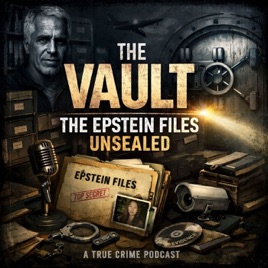
Advertise on podcast: The Vault: The Epstein Files
Rating
3.5from
This podcast has
1000 episodes
Language
EnglishPublisher
Bobby CapucciExplicit
Yes
Date created
2023/10/17
Latest episode
2026/10/06
Average duration
25 min.
Release period
1 days
Description
The Vault: The Epstein Files Unsealed is a deep-dive investigative podcast that pulls back the curtain on one of the most protected criminal networks in modern history. This series is built from the ground up on the actual paper trail—unsealed court records, depositions, exhibits, emails, and filings that were never meant to be read by the public. No pundit panels. No spin. Just the documents themselves, examined line by line, name by name, connection by connection—paired with precise, document-driven analysis that explains what the record truly shows. Each episode opens the vault on newly unsealed or long-buried Epstein files and walks listeners through what they actually reveal about power, money, influence, and the systems that failed survivors at every turn. Alongside the filings themselves, informed commentary breaks down the legal strategy, the institutional behavior, the contradictions, and the implications hiding between the lines. From judges’ orders and sealed exhibits to sworn testimony and back-channel communications, the show connects the dots the media often won’t—or can’t. Patterns emerge. Timelines collapse. Excuses fall apart. The Vault is a working archive in audio form, a living record of the Epstein case as told by the courts themselves—supplemented by rigorous analysis that provides context, challenges official narratives, and exposes where the record has been distorted, sanitized, or deliberately ignored. Every claim is grounded in filings. Every episode is anchored to the record. Listeners aren’t told what to think—they are shown what exists, what was said under oath, and what the commentary reveals about how those facts were buried, softened, or misrepresented. If you want to understand how Jeffrey Epstein was protected, who circled him, how institutions closed ranks, and why accountability keeps slipping through the cracks, The Vault: The Epstein Files Unsealed is where the record finally speaks for itself—and where the commentary ensures the documents do what no press release ever will.
Unlock The Vault: The Epstein Files podcast Email contact info,
Listeners & Audience details
Email contact information
Direct podcast contact details

Listeners
Audience numbers & engagement insights

Audience details
Podcast Insights

Podcast episodes
Check latest episodes from The Vault: The Epstein Files podcast
Ghislaine Maxwell’s 2002 Citizenship and the Federal Law Governing Denaturalization (Part 3) (10/5/26)
2026/10/06
Ghislaine Maxwell’s American citizenship could potentially be challenged under federal denaturalization law, not simply because she was later convicted of serious crimes, but because some of the conduct underlying those convictions occurred before she became a U.S. citizen in 2002. Under 8 U.S.C. §1451, citizenship can be revoked if it was illegally procured or obtained through concealment of a material fact or willful misrepresentation. Maxwell’s naturalization paperwork reportedly included negative answers to questions asking whether she had ever committed a crime for which she had not been arrested and whether she had procured anyone for prostitution. Her later federal conviction included conduct dating to 1997, years before she naturalized. That creates a concrete legal question: whether she knowingly concealed disqualifying conduct and whether truthful disclosure would have affected her eligibility for citizenship or triggered an investigation that would have exposed it.
The theory is strengthened by recent and historical denaturalization cases in which the Justice Department stripped or sought to strip citizenship from people whose serious pre-naturalization crimes were discovered or adjudicated years later. Courts have revoked citizenship where applicants concealed sexual abuse, child exploitation, fraud, and other serious misconduct that predated naturalization. Maxwell’s case would still require DOJ to prove materiality, willfulness, and legal ineligibility under the standards set by the Supreme Court, and denaturalization would not be automatic. But because she retained British and French citizenship, losing U.S. citizenship would not leave her stateless, and it could eventually expose her to removal proceedings after she completes her federal sentence. The core question is therefore not whether Maxwell deserves to lose citizenship, but whether she was legally entitled to receive it in the first place.
to contact me:
[email protected]
Ghislaine Maxwell’s 2002 Citizenship and the Federal Law Governing Denaturalization (Part 2) (10/5/26)
2026/10/06
Ghislaine Maxwell’s American citizenship could potentially be challenged under federal denaturalization law, not simply because she was later convicted of serious crimes, but because some of the conduct underlying those convictions occurred before she became a U.S. citizen in 2002. Under 8 U.S.C. §1451, citizenship can be revoked if it was illegally procured or obtained through concealment of a material fact or willful misrepresentation. Maxwell’s naturalization paperwork reportedly included negative answers to questions asking whether she had ever committed a crime for which she had not been arrested and whether she had procured anyone for prostitution. Her later federal conviction included conduct dating to 1997, years before she naturalized. That creates a concrete legal question: whether she knowingly concealed disqualifying conduct and whether truthful disclosure would have affected her eligibility for citizenship or triggered an investigation that would have exposed it.
The theory is strengthened by recent and historical denaturalization cases in which the Justice Department stripped or sought to strip citizenship from people whose serious pre-naturalization crimes were discovered or adjudicated years later. Courts have revoked citizenship where applicants concealed sexual abuse, child exploitation, fraud, and other serious misconduct that predated naturalization. Maxwell’s case would still require DOJ to prove materiality, willfulness, and legal ineligibility under the standards set by the Supreme Court, and denaturalization would not be automatic. But because she retained British and French citizenship, losing U.S. citizenship would not leave her stateless, and it could eventually expose her to removal proceedings after she completes her federal sentence. The core question is therefore not whether Maxwell deserves to lose citizenship, but whether she was legally entitled to receive it in the first place.
to contact me:
[email protected]
Ghislaine Maxwell’s 2002 Citizenship and the Federal Law Governing Denaturalization (Part 1) (10/5/26)
2026/10/06
Ghislaine Maxwell’s American citizenship could potentially be challenged under federal denaturalization law, not simply because she was later convicted of serious crimes, but because some of the conduct underlying those convictions occurred before she became a U.S. citizen in 2002. Under 8 U.S.C. §1451, citizenship can be revoked if it was illegally procured or obtained through concealment of a material fact or willful misrepresentation. Maxwell’s naturalization paperwork reportedly included negative answers to questions asking whether she had ever committed a crime for which she had not been arrested and whether she had procured anyone for prostitution. Her later federal conviction included conduct dating to 1997, years before she naturalized. That creates a concrete legal question: whether she knowingly concealed disqualifying conduct and whether truthful disclosure would have affected her eligibility for citizenship or triggered an investigation that would have exposed it.
The theory is strengthened by recent and historical denaturalization cases in which the Justice Department stripped or sought to strip citizenship from people whose serious pre-naturalization crimes were discovered or adjudicated years later. Courts have revoked citizenship where applicants concealed sexual abuse, child exploitation, fraud, and other serious misconduct that predated naturalization. Maxwell’s case would still require DOJ to prove materiality, willfulness, and legal ineligibility under the standards set by the Supreme Court, and denaturalization would not be automatic. But because she retained British and French citizenship, losing U.S. citizenship would not leave her stateless, and it could eventually expose her to removal proceedings after she completes her federal sentence. The core question is therefore not whether Maxwell deserves to lose citizenship, but whether she was legally entitled to receive it in the first place.
to contact me:
[email protected]
Mega Edition: When It Comes To Jeffrey Epstein, Who Investigates The Investigators? (10/6/26)
2026/10/06
The Jeffrey Epstein story has always been defined as much by failures of accountability as by the crimes themselves. In Florida, investigators developed extensive evidence that Epstein had sexually abused underage girls, yet the federal investigation ended with an extraordinary 2007 non-prosecution agreement that allowed him to avoid federal charges, protected unnamed potential co-conspirators and resulted in a comparatively lenient state plea and work-release arrangement. Victims were not properly informed before the agreement was finalized, setting off years of litigation over whether their rights had been violated. When Epstein was arrested again in 2019, prosecutors described conduct that raised obvious questions about how much of his network had ever been seriously investigated, but his death in federal custody weeks later ensured that the central defendant would never stand trial. Ghislaine Maxwell was eventually prosecuted and convicted, but the broader circle of people who allegedly facilitated, enabled, financed or ignored Epstein’s conduct largely avoided criminal accountability. The pattern repeatedly left survivors confronting the same question: why did authorities seem capable of documenting Epstein’s abuse without ever fully dismantling the system around him?
That accountability gap extended beyond prosecutors. Banks continued doing business with Epstein despite obvious reputational and compliance concerns, universities and elite institutions accepted his money or maintained relationships with him, powerful associates continued meeting with him after his conviction, and law-enforcement agencies repeatedly faced questions about what they knew and why more was not done. Civil lawsuits later exposed significant information about financial institutions, employees and associates that criminal investigations had never fully developed in public, while congressional oversight and document battles continued years after Epstein’s death. Even investigations into the original prosecution produced criticism without creating anything resembling a complete reckoning for how the case was handled. The result has been a decades-long pattern in which individual pieces of the Epstein story were investigated, litigated or exposed, but the entire structure was rarely confronted at once. Epstein himself was prosecuted twice, Maxwell was convicted, banks paid massive settlements, and institutions suffered reputational damage, yet the central accountability problem remained: the system repeatedly dealt with fragments of the operation while leaving the larger network, the enabling infrastructure and the decisions that protected it only partially examined.
to contact me:
[email protected]
Mega Edition: Jeffrey Epstein And The Art Of The Stash (10/6/26)
2026/10/06
Jeffrey Epstein built a deliberately complicated financial structure that allowed him to move enormous sums of money through trusts, corporations, limited-liability companies and accounts tied to the U.S. Virgin Islands, where he claimed residency and received substantial tax advantages. Court filings from the Virgin Islands alleged that Epstein regularly created new entities, shifted properties and money among them and used the structure to preserve and shield his assets while obscuring how money was being used. Two of the most important entities were Southern Trust Company and Southern Financial, both based in the Virgin Islands and controlled by Epstein; JPMorgan records described Southern Financial as his primary personal investment vehicle and showed that most of his assets were held through these entities. Southern Trust alone held hundreds of millions of dollars at various points, while Epstein’s broader network included corporations and trusts connected to his islands, aircraft, real estate and investments. Shortly before his death in 2019, Epstein also transferred virtually all of his property into the newly restated 1953 Trust, further placing his wealth behind another legal structure rather than holding it straightforwardly in his own name. The Virgin Islands later alleged that this complex arrangement was designed not merely for tax planning but to conceal assets, payments and aspects of Epstein’s criminal enterprise.
The money also moved rapidly across banks and international borders, making Epstein’s true financial picture extraordinarily difficult to follow from any single account. Records later showed relationships with JPMorgan, Deutsche Bank, Charles Schwab and other financial institutions, while suspicious-activity reporting disclosed accounts at additional banks including HSBC and Goldman Sachs. In 2019, as Deutsche Bank was pushing him out, tens of millions of dollars flowed through Southern Trust accounts, including approximately $27.7 million in attempted transfers connected to the purchase of a palace in Morocco, with money routed to an account in Switzerland. The larger pattern was one of constant movement: Epstein could hold investments through one Virgin Islands entity, maintain accounts at multiple financial institutions, shift money between corporate vehicles and trusts, and move funds internationally without his personal name necessarily appearing as the obvious holder of every asset. That did not make every offshore transaction illegal, but it created layers between Epstein and his wealth that complicated scrutiny by regulators, investigators and outsiders trying to determine where his money came from, where it went and what it financed. By the time he died, unraveling Epstein’s finances meant following hundreds of millions of dollars through a maze of entities, trusts, banks and jurisdictions rather than simply examining a conventional personal bank account.
to contact me:
[email protected]
Mega Edition: Jeffrey Epstein And The Fate Of His Palm Beach Mansion (10/6/26)
2026/10/06
Jeffrey Epstein’s Palm Beach mansion at 358 El Brillo Way, one of the most notorious properties associated with his abuse, was sold by his estate after his death and then completely demolished. Epstein had purchased the roughly 14,000-square-foot waterfront home in 1990, and it later became central to the original Palm Beach investigation after police searched the property in 2005. Following Epstein’s death in 2019, the estate sold the mansion in March 2021 for about $18.5 million to developer Todd Michael Glaser. Rather than renovate or preserve it, Glaser moved quickly to erase the structure altogether, saying the house carried an irreparable association with Epstein and what had happened there. Demolition began in April 2021, reducing the residence to an empty waterfront lot and eliminating one of the most recognizable physical symbols of the Epstein scandal.
The effort to sever the property from Epstein went even further. Glaser successfully had the address changed from 358 El Brillo Way to 360 El Brillo Way, part of an attempt to break the connection between the land and its infamous former owner. After demolishing the mansion, Glaser resold the vacant property in September 2021 for approximately $25.845 million to venture capitalist David Skok, producing a substantial profit in only a matter of months. The result was striking: a house that had been searched by police, described by survivors as a location of abuse and permanently identified with Epstein was physically wiped from the Palm Beach landscape. The land remained valuable waterfront real estate, but the building itself — and the address most closely associated with Epstein’s Palm Beach operation — disappeared.
to contact me:
[email protected]
Jeffrey Epstein And His Relationship To Seth Lloyd
2026/10/06
Seth Lloyd, an MIT professor and quantum computing specialist, came under fire for his relationship with Jeffrey Epstein after it emerged that he accepted both direct and indirect funding from Epstein—even after Epstein’s 2008 conviction for soliciting a minor. Lloyd met with Epstein multiple times, gave him personal tours of MIT’s facilities, and later admitted he had accepted two donations totaling roughly $225,000. Though Lloyd apologized publicly, critics argue that he knowingly legitimized a convicted sex offender by maintaining the connection and benefiting from Epstein’s money. MIT placed him on paid leave in 2020 after an internal report detailed these ties, highlighting yet again how Epstein sought credibility through academia, and how figures like Lloyd gave it to him.
to contact me:
[email protected]
Harvard And Their Patron Saint Of Donations, Jeffrey Epstein
2026/10/06
Jeffrey Epstein had extensive ties to the academic community. His reach spanned across the country when it came to donating to professors.
From the deserts of Arizona to the Pacific Coast and everywhere in between, proffesors and universities accepted his patronage.
None of these institutions had the relationship with Epstein that Harvard had however. Today we take a look at that relationship.
To contact me:
[email protected]
Source:
https://www.dailymail.co.uk/news/article-8279193/Jeffrey-Epstein-OFFICE-Harvard-damning-report-reveals.html
The House on Chew Avenue: Raymond Horsch And The Missing Women (Part 2) (10/5/26)
2026/10/06
The investigation surrounding 417 West Chew Avenue in Philadelphia began after Eugene Horsch was stopped in June 2026 with firearms, drugs, fraudulent federal credentials and a woman carrying identification in the name of missing woman Blair Tonzelli. That encounter led authorities back to the Horsch residence, where investigators uncovered an enormous digital archive created largely by Eugene’s late father, Raymond “R.C.” Horsch, a convicted felon with a decades-long history involving counterfeiting, drugs, false identities and violent-themed photography. Police say more than one million digital files have been recovered, including disturbing photographs and videos involving women who were missing or later found to have died. Among the women now central to the investigation are Amy McHale, Blair Tonzelli, Gabrielle Amarando, Maribel Fresses and Nicole Fusaro, along with two additional women whose identities have not been fully released. Investigators say imagery appears to show Amarando and Fresses alive and later apparently dead or gravely incapacitated, while recovered footage allegedly shows Raymond tightening a zip tie around the neck of a woman later identified by relatives as Fusaro until she became unconscious or appeared lifeless. McHale disappeared after spending the night at the Chew Avenue house in 2016, while Tonzelli had also stayed at the property before vanishing years later. The discovery of Tonzelli’s identity being used by another woman ultimately became one of the key developments that brought investigators back to the house.
Authorities are now attempting to determine where Raymond Horsch’s long-established world of staged violence ended and possible real violence began. Raymond spent years photographing vulnerable women, including women struggling with addiction, while creating scenes involving bondage, strangulation, apparent death and body disposal, making forensic authentication of the recovered material critical. Investigators have searched the house, plumbing, sewer lines, containers, storage devices and concealed areas while collecting chemicals, suspicious materials and other evidence for laboratory testing. Approximately 95 search warrants had reportedly been obtained by late September, and authorities planned an invasive forensic examination of the property beginning October 5, including removing floors, opening walls and sampling locations shown in Raymond’s photographs and videos for blood, DNA and other trace evidence. Only a portion of the digital archive had been reviewed by mid-September, meaning investigators could still identify additional women or uncover evidence that changes the scope of the inquiry. Raymond died in May 2025 and can never be questioned about what investigators are finding, leaving detectives to reconstruct the story through digital files, metadata, witnesses and whatever physical evidence remains inside the house. For the families who spent years without answers, the investigation has transformed long-dormant disappearances into one interconnected mystery centered on a single Philadelphia property and the disturbing archive left behind by the man who lived there.
to contact me:
[email protected]
The House on Chew Avenue: Raymond Horsch And The Missing Women (Part 1) (10/5/26)
2026/10/05
The investigation surrounding 417 West Chew Avenue in Philadelphia began after Eugene Horsch was stopped in June 2026 with firearms, drugs, fraudulent federal credentials and a woman carrying identification in the name of missing woman Blair Tonzelli. That encounter led authorities back to the Horsch residence, where investigators uncovered an enormous digital archive created largely by Eugene’s late father, Raymond “R.C.” Horsch, a convicted felon with a decades-long history involving counterfeiting, drugs, false identities and violent-themed photography. Police say more than one million digital files have been recovered, including disturbing photographs and videos involving women who were missing or later found to have died. Among the women now central to the investigation are Amy McHale, Blair Tonzelli, Gabrielle Amarando, Maribel Fresses and Nicole Fusaro, along with two additional women whose identities have not been fully released. Investigators say imagery appears to show Amarando and Fresses alive and later apparently dead or gravely incapacitated, while recovered footage allegedly shows Raymond tightening a zip tie around the neck of a woman later identified by relatives as Fusaro until she became unconscious or appeared lifeless. McHale disappeared after spending the night at the Chew Avenue house in 2016, while Tonzelli had also stayed at the property before vanishing years later. The discovery of Tonzelli’s identity being used by another woman ultimately became one of the key developments that brought investigators back to the house.
Authorities are now attempting to determine where Raymond Horsch’s long-established world of staged violence ended and possible real violence began. Raymond spent years photographing vulnerable women, including women struggling with addiction, while creating scenes involving bondage, strangulation, apparent death and body disposal, making forensic authentication of the recovered material critical. Investigators have searched the house, plumbing, sewer lines, containers, storage devices and concealed areas while collecting chemicals, suspicious materials and other evidence for laboratory testing. Approximately 95 search warrants had reportedly been obtained by late September, and authorities planned an invasive forensic examination of the property beginning October 5, including removing floors, opening walls and sampling locations shown in Raymond’s photographs and videos for blood, DNA and other trace evidence. Only a portion of the digital archive had been reviewed by mid-September, meaning investigators could still identify additional women or uncover evidence that changes the scope of the inquiry. Raymond died in May 2025 and can never be questioned about what investigators are finding, leaving detectives to reconstruct the story through digital files, metadata, witnesses and whatever physical evidence remains inside the house. For the families who spent years without answers, the investigation has transformed long-dormant disappearances into one interconnected mystery centered on a single Philadelphia property and the disturbing archive left behind by the man who lived there.
to contact me:
[email protected]
Jane Doe And Her Unredacted Memo Of Law In Opposition To Being Unmasked By Leon Black (Part 2) (10/5/26)
2026/10/05
In the case of Jane Doe v. Leon Black (Civil Action No.: 1:23-cv-06418-JGLC), Plaintiff Jane Doe has filed a memorandum opposing Defendant Leon Black's motion to compel her to publicly disclose her full name. Doe argues that revealing her identity would subject her to undue harassment and invasion of privacy, especially given the sensitive nature of the allegations, which include sexual assault. She emphasizes that proceeding under a pseudonym is essential to protect her from potential retaliation and to preserve her privacy.
Doe further contends that maintaining her anonymity does not prejudice the defendant, as Black is already aware of her true identity and can adequately prepare his defense. She asserts that courts often permit plaintiffs to proceed pseudonymously in cases involving sexual assault to encourage victims to come forward without fear of public exposure. Therefore, Doe requests that the court deny Black's motion and allow her to continue using a pseudonym throughout the proceedings.
to contact me:
[email protected]
source:
gov.uscourts.nysd.602764.127.0.pdf
Jane Doe And Her Unredacted Memo Of Law In Opposition To Being Unmasked By Leon Black (Part 1) (10/5/26)
2026/10/05
In the case of Jane Doe v. Leon Black (Civil Action No.: 1:23-cv-06418-JGLC), Plaintiff Jane Doe has filed a memorandum opposing Defendant Leon Black's motion to compel her to publicly disclose her full name. Doe argues that revealing her identity would subject her to undue harassment and invasion of privacy, especially given the sensitive nature of the allegations, which include sexual assault. She emphasizes that proceeding under a pseudonym is essential to protect her from potential retaliation and to preserve her privacy.
Doe further contends that maintaining her anonymity does not prejudice the defendant, as Black is already aware of her true identity and can adequately prepare his defense. She asserts that courts often permit plaintiffs to proceed pseudonymously in cases involving sexual assault to encourage victims to come forward without fear of public exposure. Therefore, Doe requests that the court deny Black's motion and allow her to continue using a pseudonym throughout the proceedings.
to contact me:
[email protected]
source:
gov.uscourts.nysd.602764.127.0.pdf
Katie Phang Goes Scorched Earth On Todd Blanche (10/5/26)
2026/10/05
Attorney Katie Phang accused Attorney General Todd Blanche and the Justice Department of making another last-minute attempt to delay her lawsuit seeking fuller disclosure of Jeffrey Epstein records. The dispute centered on an October 1 deadline imposed by U.S. District Judge Emmet Sullivan requiring Blanche to file a certified list identifying the contents of the government’s administrative record, with the full record due to Phang by October 15. Instead of meeting that deadline, the Justice Department sought additional time and simultaneously moved for judgment on the pleadings, arguing that compiling the administrative record would waste government resources because Phang’s case should be dismissed. Phang sharply rejected that position, accusing the government of mischaracterizing her lawsuit and contradicting its earlier arguments about the legal framework governing the case. She maintained that her claims were being pursued under the Administrative Procedure Act in connection with the Justice Department’s handling of its obligations under the Epstein Files Transparency Act, rather than simply suing directly under the disclosure statute itself.
The latest confrontation continued a pattern of deadline fights that had already drawn criticism from Judge Sullivan. In September, Sullivan rejected Blanche’s earlier request for a 60-day stay, ordered him to answer Phang’s complaint by September 24 and specifically required the administrative-record list by October 1 after concluding that the government had failed to justify previous missed deadlines. Phang’s attorneys argued that the Justice Department could not now avoid producing that record merely by filing another dispositive motion, noting that the court’s own rules generally required the administrative record to accompany such a filing. The significance of the record was substantial because it could reveal how the Justice Department decided what Epstein material to release, redact or withhold, potentially allowing Phang to challenge those decisions against the government’s own internal documentation. The October filing therefore represented another attempt by Blanche to stop or delay the case before that decision-making record was turned over, while Phang continued pressing Sullivan to enforce the deadlines he had already imposed.
to contact me:
[email protected]
source:
‘Todd, which one is it?’ Attorney confronts Todd Blanche for latest Epstein delay ruse - Raw Story
Prince Andrew Takes Police to Court Over Epstein Files Arrest (10/5/26)
2026/10/05
Andrew Mountbatten-Windsor launched a legal challenge against Thames Valley Police over the search warrants used during his February 2026 arrest in connection with the Jeffrey Epstein files. The former Duke of York, who was arrested at Marsh Farm on the Sandringham Estate on his 66th birthday and questioned for almost 12 hours on suspicion of misconduct in public office, asked the High Court to review whether police acted lawfully when they obtained warrants to search Marsh Farm and his former residence at Royal Lodge. Detectives spent several days searching the properties and seized documents and other material. The investigation stemmed from Epstein-related records that reportedly suggested Andrew may have provided Epstein with sensitive government information while serving as Britain’s special representative for trade between 2001 and 2011, including reports about overseas visits and a confidential briefing concerning investment opportunities in Afghanistan. Andrew had not been charged and remained under investigation.
Andrew’s legal team was specifically challenging the validity of the warrants rather than simply contesting the broader investigation, and a High Court judge had already granted permission for the judicial review to proceed. A private hearing was scheduled to determine whether documents connected to that challenge should be released. The investigation itself was also facing complications because, according to the report, the U.S. Justice Department had not provided British authorities with unredacted versions of relevant Epstein records, potentially leaving investigators dependent on a lengthy formal international request. Thames Valley Police had meanwhile widened its inquiry to include allegations of sexual misconduct and appealed for additional witnesses to come forward. The case therefore placed Andrew in the unusual position of simultaneously remaining the subject of an active Epstein-related police investigation while asking the courts to rule that some of the investigative measures used against him were unlawful.
to contact me:
[email protected]
source:
Exclusive: Andrew takes police to court over Epstein files arrest
Dr. Michael Freeman Challenges the Forensic Record in Jeffrey Epstein’s Death (10/5/26)
2026/10/05
A forensic-medicine professor who reviewed Jeffrey Epstein’s autopsy records was preparing to present findings that could challenge the official conclusion that Epstein died by suicide in his Manhattan jail cell in August 2019. Michael Freeman, editor-in-chief of the Journal of Forensic and Legal Medicine, examined autopsy materials obtained from Epstein’s brother, Mark Epstein, and conducted what he described as a biomechanical analysis of the ligature pattern. Freeman said the case contained unusual features for a suicide investigation, including the absence of photographs of Epstein’s body at the death scene and the fact that the ligature itself was not preserved or examined. He also reviewed images that he said showed injuries that were not accounted for by the medical examiner, though he had not yet publicly disclosed his ultimate conclusion.
Mark Epstein said Freeman’s work reinforced his long-standing belief that his brother’s death deserved a deeper investigation and argued that a more detailed scientific review at the time could have produced a different conclusion. Freeman was expected to present his findings at University College London in November 2026 and later publish the research alongside the autopsy files. He stressed that Epstein’s death could only be explained as either suicide or homicide and said his presentation would weigh the evidence supporting both possibilities. The development added another layer to the years of questions surrounding Epstein’s death, particularly because of the documented failures at the jail and the continuing disputes over the forensic evidence.
to contact me:
[email protected]
Podcast reviews
Read The Vault: The Epstein Files podcast reviews
Legalartist 2026/02/23
Horrible narration
Is this narrated by AI? It sounds like a robot reading it… I find it hard to listen to because it’s not a normal cadence?
Mothra Stewart 2026/02/06
Thank you
I appreciate you
mysterymach 2026/02/05
on second thought.....
I was all in on this pod, I really felt like it had a lot of info to give. But i was on my fourth episode when the host decided to go on an ego-filled...
Podcast sponsorship advertising
Start advertising on The Vault: The Epstein Files relevant audience podcasts
You may also like to advertise on these Podcasts

4.6687131106
Armchair Expert with Dax Shepard
Armchair Umbrella
4.9553872190
The MeidasTouch Podcast
MeidasTouch Network
4.639655
Only Murders in the Building Podcast
Straw Hut Media

4.7828513
The Home Service Expert Podcast
Tommy Mello: $200 Million Founder|Forbes, Inc., Entrepreneur Columnist

4.443361346
Something You Should Know
Mike Carruthers | OmniCast Media
4.7906254
Everything is Fine
Jennifer Romolini and Kim France

4.610766567
Serialously with Annie Elise
Annie Elise & Audioboom Studios
4.41171483
The Outlier Health Podcast
Matt Frazier, Matt Tullman, Isabelle Caputo, and Doug Hay

4.616078353
Giggly Squad
Hannah Berner & Paige DeSorbo
4.8219787
Imperfect Action
Steph Taylor