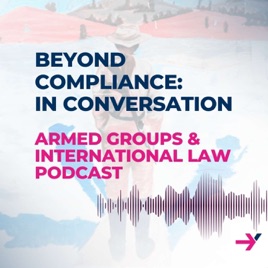
Advertise on podcast: Beyond Compliance: In Conversation
This podcast has
21 episodes
Language
EnglishPublisher
Beyond ComplianceExplicit
No
Date created
2024/09/10
Latest episode
2026/10/08
Average duration
56 min.
Release period
49 days
Description
What does everyday life during war and armed conflict look like? How do ordinary people engage with armed actors? And how can the law contribute to protecting civilians? Join Katharine Fortin and Florian Weigand in their discussions with leading academics, researchers, and practitioners working and conducting research in this area, shedding light on armed groups, civilian protection, and international law.
Unlock Beyond Compliance: In Conversation podcast Email contact info,
Listeners & Audience details
Email contact information
Direct podcast contact details

Listeners
Audience numbers & engagement insights

Audience details
Podcast Insights

Podcast episodes
Check latest episodes from Beyond Compliance: In Conversation podcast
S2 EP 9: War and the Environment
2026/10/08
How does armed conflict affect the environment, and how does environmental harm affect communities? What role do armed actors play in governing and damaging the environment? And how can law and peace processes better address environmental harm? In this episode of Beyond Compliance: In Conversation, Katharine and Florian speak with Anki Sjöberg, Co-Director at Fight for Humanity, and Laura Baron-Mendoza, Colombian lawyer and international legal scholar specialising in environmental justice and transitional justice.
Cited Documents:
Sjöberg, Anki, Michalko, Ján and Davies, Gemma, Gender norms and protection: navigating agency, risk and backlash , HPG Working Paper, London: ODI GLOBAL, July 2026.
Sjöberg, Anki and Balci, Mehmet, In Their Shoes: Health Care in Armed Conflict from the Perspective of a Non-State Armed Actor, Daedalus, the Journal of the American Academy of Arts & Sciences, Spring 2023, pp.123-124.
Baron-Mendoza, Laura, Beyond the battlefield: leveraging rebel law for environmental protection and human rights, Journal of Human Rights and the Environment, September 2026, pp.106-148.
Baron-Mendoza, Laura, The FARC-EP as environmental governance actors: shifting the ecological perspective on war, International Journal of Law in Context, November 2025, pp.177-199.
Guest Bios:
Anki Sjöberg is Co-Director at Fight for Humanity. Anki has over 20 years of experience from working in the non-profit sector on issues linked to conflict, security, armed groups, and gender. Her work has focused on research, methodology, and operational work at a senior level with and on non-state armed actors in a variety of contexts. She holds a PhD in International Relations focused on Political Science from the Graduate Institute of International and Development Studies in Geneva, Switzerland.
Laura Baron-Mendoza is a Colombian lawyer and international legal scholar specializing in international law, environmental justice, and transitional justice. She holds a PhD from McGill University and currently serves as Senior Environmental Justice & International Law Fellow at MADRE, as well as Associate Research Fellow at the Institute of Commonwealth Studies (ICwS), University of London. Her work bridges research, law, and practice, with experience advising the International Criminal Court, Colombia’s Special Jurisdiction for Peace (JEP), and peacebuilding institutions on environmental accountability in conflict and post-conflict settings.
The Beyond Compliance Consortium is a co-productive, socio-legal research partnership that traverses the fields of international law, conflict studies, humanitarian protection work and human rights policy, and brings together these communities of scholarship and practice with people with lived experience of conflict. It is funded by UK International Development. The second season is funded by UK International Development, while the first season was funded by the Dutch Research Council (NWO).
Katharine Fortin is an Associate Professor in human rights law and international humanitarian law at the Netherlands Institute of Human Rights, Utrecht University.
Florian Weigand is the Co-Director of the Centre on Armed Groups.
S2 EP 8: Children and Armed Conflict
2026/10/01
How are children affected by armed conflict? What kinds of harm do they face? And can the protection for children offered by international law translate into reality on the ground? Engaging with these questions, in this episode Katharine and Florian speak with Lway Mownt Noon, a Myanmar human rights activist and research consultant for the Beyond Compliance Consortium, and Cécile Aptel, Professor of Practice at the Fletcher School.
Cited Documents:
Lway Mownt, Noon, Holmes, Samantha, Rush, Chris and Weigand, Florian, Between Aftershocks & Airstrikes in Myanmar – Accounts of Compounding Harm + Need, Armed Groups and International Law, July 2025.
Aptel, Cécile, Unpunished Crimes: The Special Court for Sierra Leone and Children, in The Sierra Leone Special Court and its Legacy, 2014, CUP, pp. 340-360).
Aptel, Cécile, Atrocity Crimes, Children and International Criminal Courts: Killing Childhood, Routledge, 2023.
Guest Bios:
Lway Mownt Noon is an ethnic civil society activist, a researcher focusing on identity politics and geopolitics of Myanmar and works as a research consultant for the Beyond Compliance Consortium contracted by the University of York. Noon has worked on human rights for over 18 years, with a focus on women, children, and political prisoners. Noon was born under an armed conflict and is a victim of trafficking. She also has first-hand experience of being in IDP camps, refugee camps, and being held as a political prisoner. Noon holds a degree in International Relations and a Master's degree in Development Studies. Noon acts as a watchdog to the Myanmar military, ethnic armed organisations, and people's defence forces in Myanmar.
Professor Cécile Aptel is Professor of Practice at The Fletcher School, Visiting Professor at the College of Europe and Visiting Scientist at Harvard. An internationally recognized expert in child rights, international law and justice, she has held senior leadership positions at the UN, including UNIDIR and UNICEF, the IFRC and the Geneva Academy, and helped establish major international accountability mechanisms.
The Beyond Compliance Consortium is a co-productive, socio-legal research partnership that traverses the fields of international law, conflict studies, humanitarian protection work and human rights policy, and brings together these communities of scholarship and practice with people with lived experience of conflict. It is funded by UK International Development. The second season is funded by UK International Development, while the first season was funded by the Dutch Research Council (NWO).
Katharine Fortin is an Associate Professor in human rights law and international humanitarian law at the Netherlands Institute of Human Rights, Utrecht University.
Florian Weigand is the Co-Director of the Centre on Armed Groups.
S2 EP 7: Mental Harm
2026/09/14
How does war affect mental health? And is international law equipped to recognise and address these harms? In this episode, Katharine and Florian speak with Lyla Schwartz, Program & Psychology Director at Poma Global and Researcher at the University of Basel, and Samantha Holmes, Researcher at the Beyond Compliance Consortium at the University of York’s Centre for Applied Human Rights.
Cited Documents:
Holmes, Samantha, Incidental mental harm through a decolonial lens: A culturally and contextually sensitive implementation of the principle of proportionality, International Review of the Red Cross, Vol. 108, No. 932, 2026.
Lway Mownt, Noon, Holmes, Samantha, Rush, Chris and Weigand, Florian, Between Aftershocks & Airstrikes in Myanmar – Accounts of Compounding Harm + Need, Armed Groups and International Law, July 2025.
Holmes, Samantha, War is not skin deep – International Humanitarian Law and mental health, Armed Groups and International Law, October 2024.
Schwartz, Lyla, Hassanpoor, Zainab, Lane, Hannah and Klapheke, Elizabeth, Economic constraints and gendered rules: Understanding women’s perspectives of how government-imposed restrictions impact women’s mental health and social wellbeing across Afghanistan, SSM - Mental Health, Vol. 6, 2024.
Schwartz, Lyla, Nakonechna, Mariia, Campbell, Georgina, Brunner, Donja, Stadler, Christina, Schmid, Marc, Fegert, Jörg M. and Bürgin, David, Addressing the mental health needs and burdens of children fleeing war: a field update from ongoing mental health and psychosocial support efforts at the Ukrainian border, European Journal of Psychotraumatology, 13 (2), 2022.
Guest Bios:
Samantha Holmes is a Research Associate at the York Law School and the Centre for Applied Human Rights (CAHR) at the University of York. She is also a member of the Beyond Compliance Consortium’s research programme “Building Evidence on Promoting Restraint by Armed Actors”. Her international humanitarian and human rights law research is informed and underpinned by her extensive human rights work across Southeast Asia. Her ongoing research focuses on the impacts of war on mental wellbeing and how the law can prevent mental harm. Samantha holds an LLM in International Human Rights Law and Practice from the University of York, and an LLB from Queen Mary University of London.
Lyla Schwartz is a PhD Candidate at the University of Basel, Switzerland, focusing on the mental health of refugees. She is a psychotherapist and clinical researcher with over a decade of experience supporting individuals, families, and communities through trauma, stress, and life transitions. Lyla has extensive field work experience in India, Peru, South Africa, Greece and Afghanistan. Specifically she has spent four years in Kabul, where she founded the organization Peace of Mind, providing services traumatized children.
The Beyond Compliance Consortium is a co-productive, socio-legal research partnership that traverses the fields of international law, conflict studies, humanitarian protection work and human rights policy, and brings together these communities of scholarship and practice with people with lived experience of conflict. It is funded by UK International Development. The second season is funded by UK International Development, while the first season was funded by the Dutch Research Council (NWO).
Katharine Fortin is an Associate Professor in human rights law and international humanitarian law at the Netherlands Institute of Human Rights, Utrecht University.
Florian Weigand is the Co-Director of the Centre on Armed Groups.
S2 EP 6: Drones & the Future of War
2026/07/13
How are drones changing the way wars are fought? What kinds of harm do they cause for civilians? And is international law able to keep pace with these developments? Engaging with these questions, in this episode of Beyond Compliance: In Conversation, Katharine and Florian speak with Khrystyna Kozak, Researcher at the Center for Civilians in Conflict’s (CIVIC) Ukraine Country Office, and Rebecca Mignot-Mahdavi, Assistant Professor of Law at Sciences Po Law School.
Cited Documents:
Center for Civilians in Conflict (CIVIC), From Risk to Resilience: Civilian Protection Readiness in Ukraine, 2026.
Mignot-Mahdavi, Rebecca, Drones and International Law: A Techno-Legal Machinery, Cambridge University Press, 2023.
Mignot-Mahdavi, Rebecca, Surveillance on the Battlefield: Rituals of Sovereignty, Ars Interpretandi: Journal of Legal Hermeneutics, 2023, pp.26.
Mignot-Mahdavi, Rebecca, Drones Programs, the Individualization of War and the Ad Bellum Principle of Proportionality, in Necessity and Proportionality in International Peace and Security Law, Claus Kress & Robert Lawless eds., Oxford University Press, 2020, pp.131-168.
Guest Bios:
Khrystyna Kozak is a Researcher at the Center for Civilians in Conflict (CIVIC) Ukraine Country Office. She holds a Master of Global Affairs at the University of Notre Dame with a concentration in International Peace Studies and holds an L.L.M. in Human Rights. Khrystyna has over seven years of experience working with NRC, UNHCR, and WFP, Register of Damages for Ukraine specializing in protecting civilians and accountability in armed conflict.
Rebecca Mignot-Mahdavi is an Assistant Professor of International Law at Sciences Po Law School. Her current research is situated in the fields of international law, international legal theory and digital security law and governance. Her research includes reflections on technolegal modes of governance and their evolution/proliferation in a context where risk-anticipation strategies and technology are in play. She explores these technolegal phenomena beyond rigid disciplinary boundaries. Rebecca is a Principal Investigator for the project AI-NODES (on the normative and distributive effects of AI), as part of the PostGenAI@Paris cluster. She is an Editor for the Legal Theory section of the Leiden Journal of International Law, a co-founder of the ESIL Interest Group on International Law and Technology, and an Associate Researcher at the TMC Asser Institute, University of Amsterdam. Rebecca holds a PhD from the European University Institute and the École des Hautes Études en Sciences Sociales.
The Beyond Compliance Consortium is a co-productive, socio-legal research partnership that traverses the fields of international law, conflict studies, humanitarian protection work and human rights policy, and brings together these communities of scholarship and practice with people with lived experience of conflict. It is funded by UK International Development. The second season is funded by UK International Development, while the first season was funded by the Dutch Research Council (NWO).
Katharine Fortin is an Associate Professor in human rights law and international humanitarian law at the Netherlands Institute of Human Rights, Utrecht University.
Florian Weigand is the Co-Director of the Centre on Armed Groups.
S2 EP 5: Civilian Harm
2026/03/30
What is ‘civilian harm’, and how should it be understood in contemporary warfare? Why do definitions matter, and who gets to shape them? In this episode, Katharine and Florian speak with Lauren Gould from Utrecht University and Janina Dill from the University of Oxford about evolving approaches to defining and addressing harm to civilians.
Cited Documents:
Gould, L., Demmers, J., Bijl, E., & Azeem , S. Investigating Remote Warfare as the Radical Undoing of Life: The compounding civilian harm effects of US-led coalition bombings in Iraq. Antipode. 2025.
Gould, L., & Stel, N. (2021). Strategic ignorance and the legitimation of remote warfare: The Hawija bombardments. Security Dialogue ,53(1), 57 74.
Dill, J., Myers, E., Schubiger L., A Matter of Principle: How Local Consent Affects U.S. Support for Military Interventions. International Security 2026; 50 (3): 55–85.
Dill, J., Sagan, S., Creeds and Contestation: How US Nuclear and Legal Doctrine Influence Each Other, Security Studies, 34(5), 833–867.
Guest Bios:
Lauren Gould is Associate Professor in Conflict Studies and the principle investigator and project leader of the Realities of Algorithmic Warfare programme and Intimacies of Remote Warfare programme at Utrecht University. She also leads the project ‘Assembling the Western Way of War in Afghanistan and Beyond’ at the NIOD Institute for War, Holocaust and Genocide Studies. From a critical conflict and war studies perspective her trans- and interdisciplinary research programmes trace and conceptualize the changing character of the Western way of war and its impact on civilian harm and democratic accountability.
Janina Dill is the Dame Louise Richardson Chair in Global Security at the Blavatnik School of Government at the University of Oxford, a Professorial Fellow of Trinity College Oxford, and Co-Director of the Oxford Institute for Ethics, Law, and Armed Conflict (ELAC). Her research on law in war has been published in major journals of both International Law and Political Science. In 2021, she won a Philip Leverhulme Prize. She currently co-convenes studies on cumulative civilian harm in war, funded by the UKRI and the National Science Foundation, and on the concept of military objectives in IHL, in collaboration with the ICRC. She is a frequent public commentator on laws and ethics of war.
The Beyond Compliance Consortium is a co-productive, socio-legal research partnership that traverses the fields of international law, conflict studies, humanitarian protection work and human rights policy, and brings together these communities of scholarship and practice with people with lived experience of conflict. It is funded by UK International Development. The second season is funded by UK International Development, while the first season was funded by the Dutch Research Council (NWO).
Katharine Fortin is an Associate Professor in human rights law and international humanitarian law at the Netherlands Institute of Human Rights, Utrecht University.
Florian Weigand is the Co-Director of the Centre on Armed Groups.
S2 EP 4: Domicide & Reparations
2026/03/10
What does the loss of home during conflict mean for those affected? And how well does international law capture and address this experience? In this episode, Katharine and Florian talk to Luke Moffett, Chair of the Human Rights and International Humanitarian Law at Queen's University Belfast, and Ammar Azzouz, Research Fellow at the School of Geography and the Environment at the University of Oxford, about the weaponisation of architecture during armed conflict, and how the emotional and social meaning of home challenges existing legal approaches.
Cited Documents:
Moffett, Luke, Justice for Victims before the International Criminal Court, Routledge, 2014.
Moffett, Luke, Reparations and War, OUP, 2023.
Moffett, Luke, Algorithms of War: The Human Cost of AI in Conflict, Bristol University Press, 2026.
Azzouz, Ammar, Domicide: Architecture, War and the Destruction of Home in Syria, Bloomsbury, 2023.
Azzouz, Ammar, Re-imagining Syria: Destructive reconstruction and the exclusive rebuilding of cities, 2020, City, 24(5–6), 721–740.
Azzouz, Ammar, Return to Syria: what i found amid the ruins of Homs, Financial Times, 2025.
Guest Bios:
Professor Dr Luke Moffett is chair of Human Rights and International Humanitarian Law at Queen's University Belfast. His research focuses on victims' rights, reparations, civilian harm, and the increasing algorithmic turn in armed conflict. He has conducted fieldwork in over a dozen conflict/post-conflict societies and worked with different victim groups in advocating and litigating for redress. He is author of Justice for Victims before the International Criminal Court (Routledge 2014), Reparations and War (OUP 2023), and Algorithms of War (BUP 2026).
Ammar Azzouz is a British Academy Research Fellow at University of Oxford. His research focuses on destruction and reconstruction of cities, cultural heritage and art in exile. He is the author of Domicide: Architecture, War and the Destruction of Home in Syria, published by Bloomsbury in 2023. He has written for a wide range of platforms including the New York Times, Financial Times and the Guardian.
The Beyond Compliance Consortium is a co-productive, socio-legal research partnership that traverses the fields of international law, conflict studies, humanitarian protection work and human rights policy, and brings together these communities of scholarship and practice with people with lived experience of conflict. It is funded by UK International Development. The second season is funded by UK International Development, while the first season was funded by the Dutch Research Council (NWO).
Katharine Fortin is an Associate Professor in human rights law and international humanitarian law at the Netherlands Institute of Human Rights, Utrecht University.
Florian Weigand is the Co-Director of the Centre on Armed Groups.
S2 EP 3: Sanctions
2026/02/16
How do sanctions affect the dynamics of armed conflict? How do sanctions work? And do they succeed in addressing harm and need? Exploring such questions, Katharine and Florian speak with Delaney Simon from the International Crisis Group and Mohammad Kanfash from Utrecht University.
Cited Documents:
Kanfash, Mohammad, Sanctions as Barriers to the Work of Humanitarian Organizations in Syria in “Economic Sanctions from Havana to Baghdad: Legitimacy, Accountability, and Humanitarian Consequences,” edited by Joy Gordon. 2025
Kanfash, Mohammad, Interplay between sanctions, donor conditionality, and food insecurity in complex emergencies: the case of Syria. Disasters, 49. 2024
Kanfash, Mohammad, Starve or Surrender: Sanctions as a Siege Warfare Strategy in the Syrian Conflict. Syria Studies Journal, (15) 01. 2023
Simon, Delaney, It’s Not That Easy to Lift Sanctions on Syria, Foreign Policy, 2025.
Simon, Delaney, Rethinking UN Sanctions on Syria’s Interim Leaders, International Crisis Group, 2025.
Simon, Delaney, U.S. Sanctions Relief for Syria Is an Important Start, but Not Enough, Lawfare, 2025.
Guest Bios:
Mohammad Kanfash is a doctoral researcher at the Centre for Conflict Studies, Utrecht University, and a humanitarian practitioner with 17 years of experience in the Middle East and Europe. His work bridges academic inquiry and field practice, focusing on sanctions and their consequences for conflict-affected societies.
Delaney Simon is a senior analyst at the International Crisis Group, where she researches conflict prevention and economic statecraft. She is the author of the organization’s flagship report on the impact of economic sanctions on conflict dynamics. She has worked there since 2021. From 2015 to 2021, Delaney served the United Nations in Afghanistan, Lebanon and Yemen. In those countries, she advised senior United Nations officials on political stability, conflict mitigation and humanitarian planning. Earlier in her career, she was the special assistant to Afghanistan’s Ambassador to the United Nations in New York and a researcher on conflict policy in Colombia, the Democratic Republic of Congo and other countries.
The Beyond Compliance Consortium is a co-productive, socio-legal research partnership that traverses the fields of international law, conflict studies, humanitarian protection work and human rights policy, and brings together these communities of scholarship and practice with people with lived experience of conflict. It is funded by UK International Development. The second season is funded by UK International Development, while the first season was funded by the Dutch Research Council (NWO).
Katharine Fortin is an Associate Professor in human rights law and international humanitarian law at the Netherlands Institute of Human Rights, Utrecht University.
Florian Weigand is the Co-Director of the Centre on Armed Groups.
S2 EP 2: Famines & Starvation
2026/01/08
What drives today’s famines? What role does armed conflict play? And to what extent does international law address these challenges? Engaging with such questions, in this episode of Beyond Compliance: In Conversation, Katharine and Florian speak with Alex de Waal, executive director of the World Peace Foundation and Professor at the Fletcher School at Tufts University, and Yousuf Syed Khan, Investigations Manager at Legal Action Worldwide.
Cited Documents:
de Waal, Alex, The Real Politics of the Horn of Africa: Money, War and the Business of Power, Wiley, 2015.
de Waal, Alex, Mass Starvation: The History and Future of Famine, Wiley, 2018.
de Waal, Alex, New Pandemics, Old Politics: Two Hundred Years of War on Disease and its Alternatives, Polity, 2021.
Khan, Syed Yousuf, Reframing Medical Deprivation Within the Starvation War Crime Paradigm, Tufts University, Fletcher School of Global Affairs, World Peace Foundation, forthcoming January 2026.
Khan, Syed Yousuf, Gaza Arrest Warrants: Assessing Starvation as a Method of Warfare and Associated Starvation Crimes, Just Security, 2024.
Kather, Alexandra Lily and Khan, Syed Yousuf, The Nexus Between Starvation Crimes and Sexual Violence: Indicia of On-going Extermination in Tigray, Ethiopia, Opinio Juris, 2023.
Guest Bios:
Alex de Waal is executive director of the World Peace Foundation and Research Professor at the Fletcher School, Tufts University. He has worked on famine, conflict, and related issues since the 1980s as a researcher and practitioner. He served as a senior advisor to the African Union on Sudan and South Sudan in various capacities. He is the recipient of the Huxley Award of the Royal Anthropological Institute for 2024.
Yousuf Syed Khan is the Investigations Manager at Legal Action Worldwide (LAW) in Geneva, overseeing international criminal investigations across multiple conflict-affected regions in support of strategic litigation. He is also a nonresident senior fellow with the Atlantic Council’s Strategic Litigation Project, and an associate fellow at the International Centre for Counter-Terrorism – The Hague. Khan has over fifteen years of legal experience in complex conflict situations, with expertise on UN atrocity inquiries. Khan spent several years working in active conflict zones across Asia, Africa, and Europe.
The Beyond Compliance Consortium is a co-productive, socio-legal research partnership that traverses the fields of international law, conflict studies, humanitarian protection work and human rights policy, and brings together these communities of scholarship and practice with people with lived experience of conflict. It is funded by UK International Development. The second season is funded by UK International Development, while the first season was funded by the Dutch Research Council (NWO).
Katharine Fortin is an Associate Professor in human rights law and international humanitarian law at the Netherlands Institute of Human Rights, Utrecht University.
Florian Weigand is the Co-Director of the Centre on Armed Groups.
S2 EP 1: Civilian Protection & the Legacies of the War in Afghanistan
2025/11/19
How was civilian protection practiced and experienced during the international intervention and war in Afghanistan? And what are the legacies for international law today? In this episode, Katharine and Florian speak with Shaharzad Akbar, former Chairperson of the Afghanistan Independent Human Rights Commission, and Thomas Gregory, author of Weaponizing Civilian Protection: Counterinsurgency and Collateral Damage in Afghanistan. Together, they explore how Afghans experienced harm amid two decades of conflict, how the coalition’s approach to civilian protection evolved, and what this reveals about international law.
Cited Documents:
Akbar, Shaharzad, The Battle Against Gender Apartheid: Hope through Accountability, Verfassungsblog, 2025.
Akbar, Shaharzad, A Crisis of Justice for Afghan Victims of War, Just Security, 2022.
Gregory, Thomas, Weaponizing Civilian Protection: Counterinsurgency and Collateral Damage in Afghanistan (Oxford University Press, 2025).
Edkins, Jenny, Zehfuss, Maja, and Gregory, Thomas, Global Politics: A New Introduction (Routledge, 2025).
Guest Bios:
Shaharzad Akbar is the Executive Director of Rawadari, an organisation that monitors and reports on the human rights situation in Afghanistan. She previously served as Chair of the Afghanistan Independent Human Rights Commission. Akbar is currently an Honorary Fellow at Wolfson College, University of Oxford. She holds an MPhil from the University of Oxford. Shaharzad's writing has appeared in Just Security, Washington Post, Foreign Affairs, Justice Info and other international outlets.
Thomas Gregory is Senior Lecturer in Politics and International Relations at the University of Auckland, New Zealand. His research focuses on civilian casualties in contemporary conflict, with a particular emphasis on how civilian harm is legitimised. His most recent books are Weaponizing Civilian Protection: Counterinsurgency and Collateral Damage in Afghanistan (Oxford University Press, 2025) and Global Politics: A New Introduction (Routledge, 2025), which is co-edited with Jenny Edkins and Maja Zehfuss.
The Beyond Compliance Consortium is a co-productive, socio-legal research partnership that traverses the fields of international law, conflict studies, humanitarian protection work and human rights policy, and brings together these communities of scholarship and practice with people with lived experience of conflict. It is funded by UK International Development. The second season is funded by UK International Development, while the first season was funded by the Dutch Research Council (NWO).
Katharine Fortin is an Associate Professor in human rights law and international humanitarian law at the Netherlands Institute of Human Rights, Utrecht University.
Florian Weigand is the Co-Director of the Centre on Armed Groups.
S1 EP 12: Civilian Agency in the Digital Realm
2025/07/14
How are civilians in Ukraine exercising agency in the digital realm? And what are the consequences of their digital engagement, both politically and under international law? In this episode, Katharine and Florian bring together Oona Hathaway and Taras Fedirko (experts from law and political and economic anthropology) to shed light on this new dimension of agency during armed conflict.
Cited Documents:
Hathaway, Oona A. and Vera, Catherine and Pe'er, Inbar, Crowdsourced War (March 21, 2025). Available at SSRN: https://ssrn.com/abstract=5188908 or http://dx.doi.org/10.2139/ssrn.5188908
Hathaway, Oona A. and Donilon, Sarah and Squires, Carter, War Hazards Compensation for Civilians (March 28, 2025). Available at SSRN: https://ssrn.com/abstract=5197392 or http://dx.doi.org/10.2139/ssrn.5197392
Candea, Matei, Heywood, Paolo and Fedirko, Taras. Modalities of Free Speech, Annual Review of Anthropology, 2025. https://doi.org/10.1146/annurev-anthro-071423-115444
Candea, Matei, Fedirko, Taras, Heywood, Paolo and Wright, Fiona. Freedoms of Speech: Anthropological Perspectives on Language, Ethics, and Power, Toronto: University of Toronto Press, 2024. https://doi.org/10.3138/9781487552978
Guest Bios:
Oona A. Hathaway is the Gerard C. and Bernice Latrobe Smith Professor of International Law at Yale Law School, Professor of Political Science at the Yale University Department of Political Science, Faculty at the Jackson School of Global Affairs, and Director of the Yale Law School Center for Global Legal Challenges. She is president-elect of the American Society of International Law and a non-resident scholar at the Carnegie Endowment for International Peace. She has been a member of the Advisory Committee on International Law for the Legal Adviser at the US Department of State since 2005 and in 2014-2015 she served as Special Counsel to the General Counsel at the U.S. Department of Defense.
Taras Fedirko is a lecturer (assistant professor) at the School of Social and Political Sciences, University of Glasgow, and Senior Research Fellow at the Institute for Human Sciences in Vienna. He is a political and economic anthropologist studying how social movements organise to transform war economies; states; and capitalist labour and value regimes. He is currently leading a collective research project exploring crowdsourcing in Ukraine’s war economy.
The Beyond Compliance Consortium is a co-productive, socio-legal research partnership that traverses the fields of international law, conflict studies, humanitarian protection work and human rights policy, and brings together these communities of scholarship and practice with people with lived experience of conflict. It is funded by UK International Development. The second season is funded by UK International Development, while the first season was funded by the Dutch Research Council (NWO).
Katharine Fortin is an Associate Professor in human rights law and international humanitarian law at the Netherlands Institute of Human Rights, Utrecht University.
Florian Weigand is the Co-Director of the Centre on Armed Groups.
S1 EP11: Civilian Self-Protection and Land
2025/06/17
How does a community’s relationship with the land they live on feed into their experiences of harm? What solutions do they find to protect themselves? Katharine and Florian speak to Dr Piergiuseppe (Pier) Parisi and Dr Marwan Darweish about their research on the different ways in which civilian communities resist against armed actors in Colombia and Palestine.
Cited Documents:
Centre for Trust, Peace and Social Relations, Coventry University (UK), On Our Land (video), 2021.
Darweish, Marwan, Popular Resistance in Palestine, in Decolonizing the Study of Palestine, Indigenous Perspectives and Settler Colonialism after Elia Zureik, I.B.Tauris, 2023.
Parisi, Piergiuseppe, Beyond Compliance Symposium: Security beyond the physical – Addressing the Nasa indigenous people’s spiritual harm in armed conflict, Armed Groups and International Law Blog, 2024.
Safety and dignity: Enhancing unarmed civilian protection amongst Palestinian communities in the South Hebron Hills (Masafer Yatta), Civil Protection to stay on our land, Palestine (video), 2024.
Guest Bios:
Dr. Marwan Darweish, is Associate Professor in Peace Studies at the Center for Peace and security at Coventry University, UK. His research is multidisciplinary and focuses on nonviolent resistance, cultural resistance, unarmed civil protection, conflict transformation cultural heritage and gun crime violence among the Palestinians in Israel. He is former Director of the MA in Peace and Conflict Studies at Coventry university.
Dr. Piergiuseppe Parisi Piergiuseppe (Pier) Parisi is a lecturer in international human rights law at the Centre for Applied Human Rights and the York Law School (University of York, UK). Currently, his research focuses on several articulations of the rights of Indigenous peoples, including the right to Indigenous education, Indigenous justice mechanisms and their intersection with international humanitarian and human rights law, as well as Indigenous conceptions of security and protection in armed conflict. Pier was the Principal Investigator of the Ritualising Protection Project.
The Beyond Compliance Consortium is a co-productive, socio-legal research partnership that traverses the fields of international law, conflict studies, humanitarian protection work and human rights policy, and brings together these communities of scholarship and practice with people with lived experience of conflict. It is funded by UK International Development. The second season is funded by UK International Development, while the first season was funded by the Dutch Research Council (NWO).
Katharine Fortin is an Associate Professor in human rights law and international humanitarian law at the Netherlands Institute of Human Rights, Utrecht University.
Florian Weigand is the Co-Director of the Centre on Armed Groups.
S1 EP 10: Strengthening Civilian Protection
2025/05/26
How is civil society in South Sudan engaging with armed actors to protect civilians? And what can humanitarian actors do? In this episode of Beyond Compliance: In Conversation, Katharine and Florian talk to Rev Peter Tibi, Gemma Davies and Leigh Mayhew about how different types of actors can strengthen civilian protection.
Cited Documents:
Davies, Gemma, Gray, Felicity, Barbelet, Veronique, Keeping protection paramount amidst a ‘humanitarian reset’: the need for proactive protection action to reduce civilian harm, HPG policy brief, London: ODI Global, 2025.
Davies, Gemma, Mayhew, Leigh, with The Bridge Network, Community engagement with armed actors in South Sudan: reducing violence and protection risks, HPG case study. London: ODI, 2024.
Davies, Gemma, Barbelet, Veronique and Mayhew, Leigh, Reducing violence and strengthening protection of civilians: debuking assumptions, HPG policy brief, London: ODI Global, 2024.
Guest Bios:
Rev. Tibi has served as the Principal at Imatong Bible College in Juba, Sudan. He served as an administrator and Assistant Executive Secretary for Africa Inland Church-Sudan, and worked within AIC for 13 years. He moved on to the New Sudan Council of Churches, where he served as the Deputy Executive Secretary; then in the Sudan Council of Churches as Acting Executive Secretary and General Secretary. Rev. Tibi has served as the Executive Director of RECONCILE, International, since November of 2009.
Gemma Davies is a Senior Research Fellow for the Humanitarian Policy Group at ODI. She has extensive experience working with a range of international humanitarian and human rights organisations, as well as the Department for International Development, in several conflict and fragile affected states, predominantly in Sub-Saharan (East, Horn and Western) Africa. Gemma specialises in a range of issues including protection of civilians, forced displacement and humanitarian negotiations.
Leigh Mayhew is a Senior Research Officer within ODI’s Global Risks and Resilience programme, and a fellow at The Centre on Armed Groups. His research focuses on armed group dynamics, illicit economies and development, smuggling networks and the intersection with armed conflict, radicalisation, and the security dimensions of climate change. Currently, Leigh’s work is focused on how communities engage armed actors to advance community self-protection.
The Beyond Compliance Consortium is a co-productive, socio-legal research partnership that traverses the fields of international law, conflict studies, humanitarian protection work and human rights policy, and brings together these communities of scholarship and practice with people with lived experience of conflict. It is funded by UK International Development. The second season is funded by UK International Development, while the first season was funded by the Dutch Research Council (NWO).
Katharine Fortin is an Associate Professor in human rights law and international humanitarian law at the Netherlands Institute of Human Rights, Utrecht University.
Florian Weigand is the Co-Director of the Centre on Armed Groups.
S1 EP9: Gender & Civilian Agency
2025/04/03
How are women in India’s violence-affected Manipur State shaping not only conflict dynamics, but also trade and mobility? And how do ideas around gender influence, produce and challenge understandings of the principle of distinction under IHL? In this episode of Beyond Compliance: In Conversation, Katharine and Florian talk to Shalaka Thakur and Helen Kinsella about the synergies between their research.
Cited Documents:
Kinsella, Helen, Settler Empire and the United States: Francis Lieber on the Laws of War, American Political Science Review, 2023.
Kinsella, Helen & Mantilla, Giovanni, Contestation before Compliance: History, Politics, and Power in International Humanitarian Law, International Studies Quarterly, 2020.
Thakur, Shalaka & Mampilly, Zachariah, Rebel Taxation as Extortion or a Technology of Governance? Telling the Difference in India's Northeast, Comparative Political Studies, 2024.
Guest Bios:
Helen Kinsella is a Professor of Political Science and Law at the University of Minnesota, Twin Cities. She holds affiliate faculty positions in the Department of Gender, Women & Sexuality Studies, the Hubert H. Humphrey School of Public Affairs, the Human Rights Center at the Law School, and the Interdisciplinary Center for the Study of Global Change. As of June 2023, she is also a Visiting Scholar, at the Senator George J. Mitchell Institute for Global Peace, Security and Justice, Queens University, Belfast, Northern Ireland. She has a PhD in Political Science and an MA in Public Policy from the University of Minnesota, Twin Cities, and a BA in Political Science and Gender Studies from Bryn Mawr College.
Shalaka Thakur is a postdoctoral researcher at the Danish Institute for International Studies (DIIS) on the project 'Trade-based statecraft: the new spatial logic of the state' (TRADECRAFT), which explores the role of checkpoints and transit taxes in state-making. Her fieldwork focuses on the borderlands between India and Myanmar, analysing how checkpoints, civilians and authorities interact to shape order and the economy. She holds a PhD in International Relations / Political Science from the Graduate Institute, Geneva, and an MSc in Conflict Studies from the London School of Economics and Political Science.
The Beyond Compliance Consortium is a co-productive, socio-legal research partnership that traverses the fields of international law, conflict studies, humanitarian protection work and human rights policy, and brings together these communities of scholarship and practice with people with lived experience of conflict. It is funded by UK International Development. The second season is funded by UK International Development, while the first season was funded by the Dutch Research Council (NWO).
Katharine Fortin is an Associate Professor in human rights law and international humanitarian law at the Netherlands Institute of Human Rights, Utrecht University.
Florian Weigand is the Co-Director of the Centre on Armed Groups.
S1 EP8: Peacebuilding from Below
2025/02/06
What was the role of civil society in the Basque Country conflict transformation process? How did civil society succeed to even influence the process of ETA's disarmament? And could this happen elsewhere? Florian and Katharine talk to Dr. Véronique Dudouet and Urko Aiartza Azurtza to find out more about how the conflict moved towards peace, whether lessons could be replicated elsewhere and the role of international law in the process.
Cited Documents:
Dudouet, Véronique, From the Street to the Peace Table: Nonviolent Mobilization during Intrastate Peace Processes, United States Institute of Peace, 2021
Basque Permanent Social Forum, ETA's disarmament in the context of international DDR guidelines: Lessons learnt from an innovative Basque scenario, Berghof Foundation, Transition Series No. 12, 2017
Guest Bios:
Urko Aiartza Azurtza was deeply committed to promoting peace in the Basque Country through extensive involvement. Member of the Gipuzkoa Bar, he was involved in many human rights cases in Basque Country and he is currently CoPresident of the European Lawyers Association For Democracy and World Human Rights. He stood as Senator in Madrid from 2011 to 2015. In recent years, he has been actively providing advice on peace and mediation to public and private international institutions in Latin America, Africa, and Asia. He is senior advisor at EIP and a consultant at OCHA's Humanitarian Negotiation Unit as well as a fellow of the Centre on Armed Groups. Since 2019, he has taken on the role of director at the Olaso Dorrea Foundation and its “TM eLab”, a centre for generating innovative ideas in the Basque Country, his birthplace and current residence.
Dr. Véronique Dudouet is a Senior Advisor at the Berghof Foundation (Berlin, Germany), where she serves as focal point for inclusive peace processes, and conducts research, trainings and policy advice on conflict transformation, with a specific focus on non-state armed groups and social movements. In 2019, she was a Jennings Randolph Senior Fellow at USIP, Washington DC. She is the (co-)author of four books, including Civil Resistance and Conflict Transformation: Transitions from Armed to Nonviolent Struggle (Routledge 2014). She has a PhD in conflict resolution from Bradford University, UK (2005).
The Beyond Compliance Consortium is a co-productive, socio-legal research partnership that traverses the fields of international law, conflict studies, humanitarian protection work and human rights policy, and brings together these communities of scholarship and practice with people with lived experience of conflict. It is funded by UK International Development. The second season is funded by UK International Development, while the first season was funded by the Dutch Research Council (NWO).
Katharine Fortin is an Associate Professor in human rights law and international humanitarian law at the Netherlands Institute of Human Rights, Utrecht University.
Florian Weigand is the Co-Director of the Centre on Armed Groups.
S1 EP7: Victimhood & Everyday Peace
2024/11/29
What role did civilians play during the conflict and peace process in Northern Ireland? How does agency relate to victimhood and transitional justice? And how can people contribute to ‘everyday’ peace? In this episode, Katharine and Florian talk to Kieran McEvoy from Queen’s University Belfast and to Roger Mac Ginty from Durham University about Northern Ireland and their research on civilians navigating armed conflicts across the world.
Cited documents:
Mac Ginty, Roger, Everyday Peace: How so-called ordinary people can disrupt violent conflict, Oxford University Press 2021
McEvoy, Kieran, Mallinder, Louise & Bryson, Anna, Lawyers in Conflict and Transition, Cambridge Studies in Law and Society, 2022
McEvory, Kieran, Beyond Legalism: Towards a Thicker Understanding of Transitional Justice, Routledge, 2014
Guest bios:
Kieran McEvoy is the Senator George J. Mitchell Chair of Peace, Security and Justice and Professor of Law and Transitional Justice at the Senator George J Mitchell Institute for Global Peace, Security and Justice, Queen’s University Belfast. He is also currently a Leverhulme Major Research Fellow working on how armed groups address past harms. He has conducted research in over a dozen conflicted or transitional countries contexts on topics including among others politically motivated prisoners, ex-combatants, victims and amnesties.
Roger Mac Ginty is Professor at the School of Government and International Affairs, and the Durham Global Security Institute, Durham University. His 2021 book, Everyday Peace: How so-called ordinary people can disrupt violent conflict (Oxford University Press), won the 2020-2022 Ernst-Otto Czempiel Award for best book on peace. He edits the journal Peacebuilding and is co-founder of the Everyday Peace Indicators.
The Beyond Compliance Consortium is a co-productive, socio-legal research partnership that traverses the fields of international law, conflict studies, humanitarian protection work and human rights policy, and brings together these communities of scholarship and practice with people with lived experience of conflict. It is funded by UK International Development. The second season is funded by UK International Development, while the first season was funded by the Dutch Research Council (NWO).
Katharine Fortin is an Associate Professor in human rights law and international humanitarian law at the Netherlands Institute of Human Rights, Utrecht University.
Florian Weigand is the Co-Director of the Centre on Armed Groups.
Podcast reviews
Read Beyond Compliance: In Conversation podcast reviews
Podcast sponsorship advertising
Start advertising on Beyond Compliance: In Conversation relevant audience podcasts
You may also like to advertise on these Podcasts

4.8258931492
Relatable with Allie Beth Stuckey
Blaze Podcast Network
4.8224751793
The Andrew Klavan Show
The Daily Wire

4.716492000
Morning Mindset Christian Daily Devotional Bible study and prayer
Carey Green

4.810941764
Warchant Podcasts featuring Seminole Headlines
Warchant.com
4.82762857
Dopey: On the Dark Comedy of Drug Addiction
Dave & Chris
4.890611566
Fearless with Jason Whitlock
Blaze Podcast Network
4.959792000
Legal AF by MeidasTouch
MeidasTouch Network
4.725721047
The Dana Show with Dana Loesch – Politics & Culture Commentary
Dana Loesch – Conservative Political Commentary
4.723151959
Timeless Wisdom with Dennis Prager
Salem Podcast Network

4.816571994
Juicebox Podcast: Type 1 Diabetes
Scott Benner