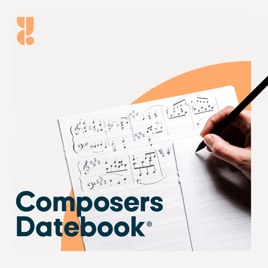
Advertise on podcast: Composers Datebook
Rating
4.7from
This podcast has
30 episodes
Language
EnglishPublisher
American Public MediaExplicit
No
Date created
2007/03/19
Latest episode
2026/10/17
Average duration
2 min.
Release period
2 days
Description
Composers Datebook™ is a daily two-minute program designed to inform, engage, and entertain listeners with timely information about composers of the past and present. Each program notes significant or intriguing musical events involving composers of the past and present, with appropriate and accessible music related to each.
Unlock Composers Datebook podcast Email contact info,
Listeners & Audience details
Email contact information
Direct podcast contact details

Listeners
Audience numbers & engagement insights

Audience details
Podcast Insights

Podcast episodes
Check latest episodes from Composers Datebook podcast
Boulez and Jarre
2026/10/17
Synopsis
Today’s date in 1946 marks an important moment in Parisian theatrical history with the debut performance of a legendary acting company created by husband-and-wife actors Jean-Louis Barrault and Madeleine Renaud. Their opening production was Shakespeare’s Hamlet in a French translation by André Gide, with incidental music by Swiss composer Arthur Honegger. To play Honegger’s score, Barrault hired two young musicians at the start of their careers.
The first, 21, was to play the eerie electronic sounds Honegger scored for the Ondes Martinot, evoking the elder Hamlet’s ghost. That young musician was a composition student named Pierre Boulez, who would remain associated with Barrault’s company for a decade before becoming a famous conductor and composer of avant-garde scores like Le Marteau Sans Maître.
The second musician Barrault hired was a 22-year-old percussionist, who brought Hamlet to a dramatic close with timpani crescendos evoking Fortinbras’ final line in the play, “Go, bid the soldiers shoot.” That young musician, Maurice Jarre, would also become a famous composer, taking quite a different career path than Boulez. He devoted himself to film scoring, composing several famous ones, such as Dr. Zhivago for British film director David Lean.
Music Played in Today's Program
Pierre Boulez (1925-2016): Le Marteau Sans Maître; Orchestre Du Domaine Musical; Pierre Boulez, conductor; PCA 101
Maurice Jarre (1924-2009): Lara’s Theme from Dr. Zhivago; Royal Philharmonic Orchestra; Maurice Jarre, conductor; Sony 42307
A domestic postscript from Richard Strauss
2026/10/16
Synopsis
Of all the works of Richard Strauss, the one that premiered in Dresden on today’s date in 1925 ranks amount the least-known.
For starters, it has an odd title, Parergon to the Symphonia Domestica. “Parergon” means “an ornamental accessory or embellishment,” and he meant his new work, written for piano left-hand and orchestra, as a follow-up to his Symphonia Domestica tone-poem of 1903, which depicted one day in the Strauss family household, complete with baby’s bath.
The baby in question was his son Franz, who by 1925 was a young man setting up his own household, and recently recovered from a near-fatal case of typhus contracted while on his honeymoon in Egypt. For Strauss, this Parergon was a private celebration of his son’s survival.
For Paul Wittgenstein, the wealthy one-handed concert pianist who commissioned the new work, this was one of several he had requested from leading composers of his day, all designed to showcase his talent. Wittgenstein’s contract with Strauss stipulated that Wittgenstein alone would have exclusive rights to the Parergon as long as he wished, and so it wasn’t until 1950 that any other pianist could perform it.
Music Played in Today's Program
Richard Strauss (1864-1949): Parergon to the Symphonia Domestica
Missa Salisburgensis
2026/10/15
Synopsis
The hills surrounding the Austrian town of Salzburg, according to Rogers and Hammerstein, are “alive with the sound of music.” Well, the same could have been said for the vast interior and multiple choir lofts of Salzburg Cathedral on today’s date in 1682. A lavish celebration of the 1100th anniversary of the Archbishopric of Salzburg culminated in a specially-composed mass setting, with performers placed above and all around the citizens assembled there for the occasion.
The music was composed by one of Salzburg’s most remarkable composers. No, not Mozart – he wouldn’t be born for another six decades or so. We’re talking about Heinrich Ignaz Franz von Biber, who lived from 1644 to 1704, and, while not a native son like Mozart, was similarly employed by one of the princely archbishops of Salzburg. Unlike Mozart, however, Biber was on much better terms with his employer.
Biber’s magnificent Missa Salisburgensis for 53 voices is now regarded as a masterpiece of the Baroque music — but was almost lost. Forgotten for two centuries, the manuscript score was rediscovered by a choir director in 1870 in the home of a Salzburg greengrocer, who planned to use the large sheets of music paper to wrap vegetables.
Music Played in Today's Program
Heinrich Ignaz Franz Biber (1644-1704): Missa Salisburgensis; Musica Antiqua Köln; Reinhard Goebel, conductor; DG Archive 457 611
Dvorak's Violin Concerto
2026/10/14
Synopsis
On today’s date in 1883, the premiere of Antonín Dvořák’s Violin Concerto was given in Prague by Czech violinist František Ondrícek with the National Theatre Orchestra, led by Czech conductor Moric Anger, an old friend of Dvořák’s and his onetime roommate.
The concerto was commissioned by distinguished violinist Joseph Joachim, an old friend and collaborator of German composer Johannes Brahms. Brahms had sent him two of Dvořák’s chamber works for strings. He expressed enthusiasm for these pieces and urged Dvořák to write a concerto for him.
So far, so good.
He had a finished score by December 1879, but Joachim had what we now would call “some issues” with the score, and, by the time he was finishing the last revisions, three years had elapsed with no talk of a premiere. He realized Joachim was unlikely ever to premiere the new concerto, so he offered it to Ondrícek, a young virtuoso who eagerly championed it in Prague and abroad.
Joachim finally did perform Dvořák’s concerto in Berlin in 1894, about 15 years after he had commissioned it.
Music Played in Today's Program
Antonin Dvořák (1841-1904): Violin Concerto
Zwilich celebrates
2026/10/12
Synopsis
As far as housewarming gifts go, a nice bottle of champagne is common, or maybe a bouquet of flowers. But if you’re a composer, and the occasion is the ceremonial opening performance at a new concert hall, you write a celebratory piece of music.
On today’s date in 1984, for the inaugural concert of the Indianapolis Symphony’s new home, the Circle Theater, American composer Ellen Taaffe Zwilich wrote an orchestral work titled, appropriately enough, Celebration.
“In writing this work, I was motivated by three complementary goals. First, I wanted to celebrate a joyous and historic occasion with all its inspiring symbolism of beginning and renewal. My second goal was to write a kind of ‘toccata’ or test piece for the new Circle Theater. Finally, I wanted to celebrate the orchestra itself, which is, after all, the centerpiece of the occasion. Thus, Celebration is like a mini-concerto for orchestra,” she said.
Zwilich’s housewarming gift was dedicated to the Indianapolis Symphony’s music director in 1984, conductor John Nelson. Despite its origins as an occasional piece for a particular event, Celebration has gone on to become one of her most popular and frequently performed orchestral works.
Music Played in Today's Program
Ellen Taaffe Zwilich (b. 1939): Celebration; Indianapolis Symphony; John Nelson, conductor; New World 336
Prokofiev's Sixth and Seventh
2026/10/11
Synopsis
By a coincidence, the last two symphonies of Soviet composer Sergei Prokofiev premiered on today’s date: his Symphony No. 6 premiered in Leningrad in 1947, and his final, Symphony No. 7, in Moscow, in 1952.
The Symphony No. 6 is tragic in tone, and Prokofiev confided that it was about the physical and emotional wounds suffered by his countrymen during World War II. It was premiered at the opening concert of the Leningrad Philharmonic’s 1947 season and was applauded warmly by both audiences and the official Soviet critics. But early in 1948, he somehow ran afoul of the Central Committee of the Communist Party, and his Symphony No. 6 was quickly withdrawn from further performances.
Prokofiev’s Symphony No. 7 was intended to be for children, a kind of symphonic Peter and the Wolf, written in a deliberately populist style and with a wary eye on the dictates of the Central Committee. It’s an airy, almost transparently melodic score. Originally, it had a wistful, somewhat melancholic ending, with the music trailing off into silence. During the final dress rehearsals, however, he wrote an alternative, perhaps more “politically correct” finale, decidedly chipper and upbeat in tone.
Music Played in Today's Program
Sergei Prokofiev (1891-1953): Symphony No. 6; National Symphony; Leonard Slatkin, conductor; RCA/BMG 68801; and Symphony No. 7; French National Orchestra; Mstislav Rostropovich, conductor; Erato 75322
The school of Monk
2026/10/10
Synopsis
American jazz composer and pianist Thelonious Sphere Monk was born on today’s date in 1917. Largely self-taught, he began playing piano at 6. At 17, he dropped out of New York’s esteemed Stuyvesant High School for gifted students to serve as organist for a touring evangelist. In his 20s, he became the house pianist at Minton’s, a Manhattan jazz nightclub.
His original compositions, marked by dissonances and angular twists of melody, became jazz standards. They also had great titles: ‘Round Midnight; Straight, No Chaser; Ruby, My Dear; and Well, You Needn’t.
He made the cover of Time magazine and is credited with being the second-most-recorded jazz composer after Duke Ellington.
Biographer Robin D.G. Kelly, who spent 14 years researching his life and music, said, “He was Janus-faced [looking backward and forward]. … Monk pulled as much from his roots, the old-style [stride] piano traditions he never left, as from the really futuristic musical territory he was the first to visit. He’s always going to be associated with the founding of Bebop, with Charlie Parker and Dizzy Gillespie. I don’t place him on the Bebop school, though — I place him in his own school.”
Music Played in Today's Program
Thelonious Monk (1917-1982): Ruby, My Dear; Thelonious Monk, piano; Columbia Legacy CK-63533
Vivaldi’s 'Juditha Triumphans'
2026/10/09
Synopsis
On today’s date in 2001, the release of a CD of Vivaldi’s oratorio Juditha Triumphans launched an ambitious project to record nearly 450 works of the famous Italian Baroque composer that exist as manuscript scores in the Biblioteca Nazionale in Turin, Italy.
It’s the largest collection of manuscript scores by any 18th-century composer in existence and includes many Vivaldi works unperformed since his lifetime.
Susan Orlando, the director of the recording project, explained how that came to be: “When Vivaldi died in Vienna in 1741, he had debts, so the authorities immediately sealed off his home. We have the inventory that they made. It included no musical manuscripts, but there was a big, empty chest. It seems Vivaldi’s brother had got hold of the music and sold it off.”
Back then, his scores ended up with various wealthy collectors, but in 1930 the scattered music was consolidated and bequeathed to the library in Turin.
The French label Naïve has released over 60 Vivaldi Edition CDs so far, including 17 of his operas. More than a dozen additional titles are planned for release by 2028, the year that will mark the 350th anniversary of Vivaldi’s birth.
Music Played in Today's Program
Antonio Vivaldi (1678-1741): Sinfonia from Juditha Triumphans; Academia Montis Regalis; Magdalena Kozena, mezzo soprano; Juditha Maria José Trullu, mezzo soprano; Holofernes Marina Comparato, mezzo soprano; Vagaus Anke Herrmann, soprano; Abra Tiziana Carraro, soprano; Alessandro De Marchi, conductor; Naïve Vivaldi Edition OP-30314
Ligeti's 'out there' Violin Concerto
2026/10/08
Synopsis
On today’s date in 1992, one of the strangest — and some would say most strikingly original — violin concertos of the late 20th century had its premiere performance in Cologne, Germany. It was written by Transylvanian-born Hungarian composer György Ligeti.
He became famous in the west when some of his music appeared in the 1968 Stanley Kubrick film 2001: A Space Odyssey. Kubrick used his music to evoke the eerie and empty vastness of outer space. And, in fact, Ligeti was fascinated by the sounds traditional orchestral instruments make when pressed to the extreme limits of their range — their own sonic “outer limits.” There’s some of that in his 1992 Violin Concerto, plus a dash of the traditionally melancholic Hungarian strain familiar from the music of his famous compatriot Béla Bartók. Finally, tossed in for good measure, is his puckish fondness for thumbing his nose at life, the universe and traditional concert hall decorum.
As if to counterbalance his melancholic strain, or perhaps just express it in a more surprising way, there’s a good deal of the clown in Ligeti, who includes a chorus of ocarinas in the score of his violin concerto.
Music Played in Today's Program
György Ligeti (1923-2006): Violin Concerto; Saschko Gavrilov, violin; Ensemble InterContemporain; Pierre Boulez, conductor; DG 439 808
Jake Heggie's opera 'Dead Man Walking'
2026/10/07
Synopsis
As the 20th century drew to its close, some who followed the development of opera were struck by the number of new American operas on American themes.
On today’s date in 2000, one of these new operas debuted in San Francisco. Dead Man Walking, an opera in two acts, was based on a 1993 book by Sister Helen Prejean, a book also made into a successful movie. The libretto for the operatic version of Sister Prejean’s book was crafted by Terrance McNally and set to music by American composer Jake Heggie.
Now, an opera based on eyewitness accounts of American prisoners on death row might seem an unlikely topic for an opera, but Sister Prejean didn’t think so.
“I love the way the opera captures essential human conflicts: love or hate, compassion or vengeance, redemption or condemnation,” she said. “… From the beginning, I told McNally and Heggie that I’d trust them to compose the opera if they wove into its center the quest for redemption. They got it. And I could tell by the stillness in the auditorium and the tumultuous applause at the end that the audience also really gets it.”
Music Played in Today's Program
Jake Heggie (b. 1961): Dead Man Walking; San Francisco Opera; Patrick Summers, conductor; Erato 86238
Music for the movies
2026/10/06
Synopsis
On today’s date in 1927, the landmark film The Jazz Singer received its premiere showing at the Warner Theater in New York. The Jazz Singer starred Al Jolson and is usually credited with being the first “talkie” — the first motion picture to successfully incorporate prerecorded music and spoken dialogue. Both the music and dialogue were recorded using the Vitaphone process, essentially a set of disc recordings synchronized for playback with the film’s projector.
The previous year, the New York Philharmonic had participated in the first Vitaphone projects, recording Wagner’s Tannhauser Overture as the first music video and performing the soundtrack for the otherwise silent drama Don Juan, starring John Barrymore.
Within a decade, Hollywood orchestras would be recording the classic film scores of European émigré composers like Erich Wolfgang Korngold and Max Steiner, and within two decades American composers like Aaron Copland and Bernard Herrmann would be writing their memorable film scores, as well.
But back in 1927, all of that was well in the future, and, as one of Jolson’s lines in The Jazz Singer so prophetically put it, “You ain’t heard nothin’ yet.”
Music Played in Today's Program
Felix Arndt (1889-1918): An Operatic Nightmare (Desecration Rag No. 2); Paragon Ragtime Orchestra; Rick Benjamin, conductor; Newport Classics 60039
Erich Wolfgang Korngold (1897-1957): The Prince and the Pauper film score; National Philharmonic; Charles Gerhardt, conductor; RCA/BMG 0185
Grove and Sullivan 'discover' Schubert
2026/10/05
Synopsis
On today’s date in 1867, two eminent British Victorians arrived in Vienna in search of Franz Schubert. Now, Schubert had been dead for 39 years, as the two Brits were quite aware. George Grove, 47, was England’s finest musicologist, and Arthur Sullivan, 25, one of the country’s most promising young composers.
Grove believed there might be forgotten manuscripts in the possession of the late composer’s relatives, so the pair met with Schubert’s nephew, Herr Doktor Schneider, who said he did have some pieces by Uncle Franz that no one had played for more than 40 years. If the two gentlemen had no objection to getting dusty, they were welcome to rummage the family’s storage closets.
The two visitors braved the dust and found orchestral parts for Schubert’s Rosamunde incidental music, tied up in a big bundle after the work’s premiere back in 1823 and untouched since then.
Grove and Sullivan spent the rest of the day carefully making a copy of their discovery. At 2 a.m., after finishing the task, their spirits must have been pretty high, since to celebrate the proper Victorian gentlemen began an impromptu game of leapfrog.
Music Played in Today's Program
Franz Schubert (1797-1828): Rosamunde Incidental Music; Chamber Music Orchestra of Europe; Claudio Abbado, conductor; DG 431 655
Copland's 'Appalachian Spring' Suite
2026/10/04
Synopsis
On today’s date in 1945, Artur Rodzinski conducted the New York Philharmonic in the premiere performance of an orchestral suite arranged from Aaron Copland’s ballet score Appalachian Spring.
For the ballet’s 1944 premiere at the Library of Congress, Copland called for a chamber orchestra of 13 players, but for most music lovers, it’s as a work for a larger symphony orchestra that Appalachian Spring is most often remembered.
He said he had conducted all of his own works but knew his Appalachian Spring best of all. He also had some specific advice for other conductors of his score.
“I have often admonished orchestras, professional and otherwise, not to get too sweet or too sentimental with it, and I have reminded performers that Appalachian Spring should be played cooler than Tchaikovsky and lighter than Stravinsky’s Rite of Spring. My own favorite place in the whole piece is toward the end where I have marked a misterioso. I would tell string players that we don't want to know where the up and down bows are. They must have a special sustained quality there, a kind of organ like sound, with each entry like an amen,” he said.
Music Played in Today's Program
Aaron Copland (1900-1990): Appalachian Spring Suite; New York Philharmonic; Leonard Bernstein, conductor; Sony Classical 63082
The Dream of Gerontius
2026/10/03
Synopsis
Despite a disastrous premiere in Birmingham on today’s date in 1900, Edward Elgar’s oratorio The Dream of Gerontius has become one of his best-loved and most-frequently performed works in the U.K., where, in 2015, Classic FM offered a guide to what it called the work’s “most epic choral stupendousness.”
Here’s Classic FM’s summary of its story: “The piece follows an ‘everyman’ character (the word ‘Gerontius’ comes from the Greek for ‘old man’) as he faces death, meets his guardian angel and goes before his God before being taken to Purgatory with the promise of everlasting glory.”
Well, all that Roman Catholic talk of Purgatory in the poem by Cardinal John Henry Newman that Elgar set to music did not sit well with the Church of England in the early decades of the 20th century. Many Anglican clerics flatly refused to let it be performed in their cathedrals.
But that controversy is long a thing of the past, and nowadays Gerontius is performed at cathedrals such as St. Paul’s in London and in concert venues such as the Royal Albert Hall, where in 1991 it was performed at the BBC Proms in the presence of the Prince of Wales, now known as King Charles III.
Music Played in Today's Program
Edward Elgar (1857-1934): The Dream of Gerontius; John Shirley-Quirk, baritone; London Symphony Chorus; King’s College Choir, Cambridge; London Symphony Orchestra; Benjamin Britten, conductor; London/Decca 448170
Steve Heitzeg's 'Nobel Symphony'
2026/10/02
Synopsis
In 2001, to commemorate the 100th anniversary of the Nobel Prize, Gustavus Adolphus College in St. Peter, Minnesota, commissioned American composer Steve Heitzeg to write a Nobel Symphony.
In 1866, the Swedish engineer and scientist Alfred Nobel had invented dynamite. His patent helped him amass a great fortune, but, troubled by the destructive power and potential misuse of his invention, Nobel arranged that his estate would award annual prizes to those who made significant contributions to world peace.
For his Nobel Symphony, Heitzeg chose to set quotes from a variety of Nobel laureates, including Archbishop Desmond Tutu, Elie Wiesel, Martin Luther King, Jr. and the Dalai Lama. Purely instrumental effects were also employed to convey something of their ideas and ideals. For example, in a section honoring a 1997 winner of the Nobel Prize, the International Campaign to Ban Landmines, he scored an eerie march for a percussion ensemble consisting of hollow artificial limbs.
The October 2, 2001 premiere of the Nobel Symphony came shortly after the tragic events of September 11th. Understandably, its message had a special resonance for the performers and audiences present at its first performance.
Music Played in Today's Program
Steve Heitzeg (b. 1959): Nobel Symphony; Gustavus Orchestra; Warren Friesen, conductor; Gustavus Adolphus 60171-10022
Podcast reviews
Read Composers Datebook podcast reviews
justaguitarguy 2026/05/04
Commercials ruined it
This is a great, entertaining, educational podcast. Sadly, the new long commercial message at the beginning of each episode has ruined it. I will list...
Pudelmom 2025/03/05
History is Interesting
The historical tidbits add interesting background.
Fill makes Games 2024/12/04
Gut
Gut, sehr gut.
HarrierLG 2024/09/29
Make it a longer show?
My only complaint of Composer's Datebook is that it is too short! Perhaps a five minute snippet instead of two? Include score illustrations on the w...
tara starlong 2024/08/02
Nice Musical Podcast
I like to listen to the Nutcracker
Booknerd336 2024/06/23
Bach is back/Editor is needed
The “Bach is back” episode misidentifies the featured music as a harpsichord concerto, when it is an orchestral/choral piece, probably a cantata.
danktighny 2024/02/07
Meditation
I stop what I’m doing to really listen to this. It is my 2 minute musical oasis wherever it lands in my day. Thank you.
pigslauterer 2023/12/04
Great listen everyday
I listen to it every day and it’s very interesting
EmmettHogan 2023/01/12
My Quotidian Reminder about Art
Hello! I’m a lawyer in Chicago, who’s recuperating from a head injury in 2018/19. Since then: I picked up this quick, refreshing podcast. I listen ...
WoodfordSki 2021/10/01
A Delight
It makes the day brighter.
Podcast sponsorship advertising
Start advertising on Composers Datebook relevant audience podcasts
You may also like to advertise on these Podcasts

4.443431352
Something You Should Know
Mike Carruthers | OmniCast Media
4.7906254
Everything is Fine
Jennifer Romolini and Kim France
4.610812570
Serialously with Annie Elise
Annie Elise & Audioboom Studios

4.41171483
The Outlier Health Podcast
Matt Frazier, Matt Tullman, Isabelle Caputo, and Doug Hay
4.616125357
Giggly Squad
Hannah Berner & Paige DeSorbo

4.8219787
Imperfect Action
Steph Taylor
4.727499587
This Past Weekend w/ Theo Von
Theo Von
4.713009375
The Tim Dillon Show
The Tim Dillon Show
4.115956456
The Tucker Carlson Show
Tucker Carlson Network
4.828036451
Huberman Lab
Scicomm Media