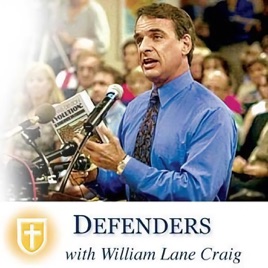
Advertise on podcast: Defenders Podcast
Rating
4.8from
This podcast has
916 episodes
Language
EnglishPublisher
William Lane CraigExplicit
No
Date created
2007/04/22
Latest episode
2026/10/14
Average duration
15 min.
Release period
7 days
Description
Defenders is Dr. William Lane Craig's Sunday school class on Christian doctrine and apologetics
Unlock Defenders Podcast podcast Email contact info,
Listeners & Audience details
Email contact information
Direct podcast contact details

Listeners
Audience numbers & engagement insights

Audience details
Podcast Insights

Podcast episodes
Check latest episodes from Defenders Podcast podcast
Doctrine of the Last Things Part 12: Parables of the Delay of the Parousia
2026/10/14
Did Jesus expect to return within his disciples’ lifetime? A pair of sayings in the Gospels can give that impression. But Dr. Craig points out that Jesus also told parable after parable anticipating a delay before his return: the faithful servant, the ten maidens, the talents, and the sheep and the goats. What do these stories reveal about how Jesus prepared his followers for the long wait ahead?
Doctrine of the Last Things (Part 11): Delay of the Parousia Continued
2026/10/07
Did Jesus predict he would return within the lifetime of his hearers? Dr. Craig takes a closer look at two of the most contested sayings in the Gospels, Mark 9:1 and Mark 13:30, and asks what "the kingdom of God come with power" and "all these things" may have referred to in their original contexts. The answer may not be the Second Coming at all.
Doctrine of the Last Things (Part 10): Delay of the Parousia
2026/09/30
Did Jesus predict he would return within the lifetime of his first hearers? Some of his sayings seem to say exactly that. Dr. Craig weighs two common answers to this "delay of the parousia" problem, explains why neither satisfies him, and offers his own solution, drawn from a surprising detail in Matthew's account of Jesus sending out the Twelve.
Doctrine of the Last Things (Part 9): The Time of the Second Coming
2026/09/23
Did Jesus expect to return within the lifetime of his first hearers? Dr. Craig takes up one of the most debated questions in the doctrine of the last things: the timing of the Second Coming. In the Olivet Discourse of Mark 13, Jesus predicts false messiahs, wars, earthquakes, famines, persecution, cosmic signs, and the preaching of the gospel to all nations before the end. Paul adds more in 2 Thessalonians 2, where the rebellion and the man of lawlessness must come first, and in Romans 11, where the full number of the Gentiles comes in before all Israel is saved. Taken together, these texts suggest Christ's return lies far in the future. Yet Jesus also says "this generation will not pass away before all these things take place" (Mark 13:30), and that some standing before him would not taste death before seeing the kingdom come with power (Mark 8:38–9:1), a saying Matthew 16:28 makes sharper still. Dr. Craig sets these two lines of evidence side by side and frames the puzzle he resolves in the next lesson.
Doctrine of the Last Things (Part 8): The Purpose of the Second Coming
2026/09/16
Why does Christ need to come back at all? Dr. William Lane Craig lays out four purposes Scripture assigns to the Second Coming: it completes the work of redemption begun at the cross, triggers the resurrection of the dead, brings about the judgment of all people, and gathers the elect into the Kingdom of God. Drawing on 1 Corinthians 15, John 5, Matthew 16 and 24, and Jude, Dr. Craig shows that the Second Coming is not a single event with one purpose but a multifaceted culmination of God's redemptive plan.
Doctrine of the Last Things (Part 7): The Nature of the Second Coming
2026/09/09
Having rejected both the Rapture view and the Preterist view in prior lessons, Dr. William Lane Craig lays out the classical Christian position: Christ's return will be a single, visible event. In this lecture he examines four characteristics of that return. It will be personal, a literal coming of Christ himself, not a symbolic or figurative event. It will be glorious, a public display of power in contrast to the humility of his first coming. It will be decisive, bringing human history to its close. And it will be sudden and unexpected, which is why Scripture calls believers to readiness rather than speculation about timing. Dr. Craig supports each point from Scripture, including 1 Thessalonians 4 and 5, Acts 1, Matthew 24, Mark 14, 1 Corinthians 15, and Revelation 1.
Doctrine of the Last Things (Part 6): The Preterist Interpretation Continued
2026/09/02
Dr. William Lane Craig continues his critique of the preterist view that Christ's "coming" as the Son of Man was fulfilled in the destruction of Jerusalem in AD 70. He argues, first, that the New Testament consistently describes this coming as visible and public: witnessed by everyone, not a secret event hidden from history. Second, he contends that Christ was already reigning as the risen and ascended King well before AD 70, so the Olivet Discourse can't be describing his enthronement in that year; it's better read as his future return as conquering King. Third, and most decisively, Paul ties Christ's coming to the bodily resurrection of the dead, which plainly did not happen in AD 70, a problem so sharp that even interpreters sympathetic to a preterist reading, as N.T. Wright's own remarks show, end up treating Paul's resurrection hope as a separate, still-future event. Dr. Craig explains why, despite its appeal, he can't accept Preterism as the solution to the New Testament's expectation of Christ's return.
Doctrine of the Last Things (Part 5): The Preterist Interpretation
2026/08/26
Continuing the series on the Second Coming, Dr. William Lane Craig examines the Preterist view, the position, defended by scholars including G. B. Caird, R. T. France, and N. T. Wright, that the coming of the Son of Man predicted in Jesus' Olivet Discourse already happened in AD 70 with the destruction of Jerusalem. On this reading, the Great Tribulation was the horror of the Roman siege of Jerusalem, and the apocalyptic imagery of Mark 13 (e.g., darkened sun, falling stars) is symbolic language paralleled in Isaiah 13, Ezekiel 32, and Peter's Pentecost sermon in Acts 2, not a literal description of the end. Dr. Craig walks through the Preterist case, including its appeal to Daniel 7 for the Son of Man's heavenly enthronement rather than an earthly return, and explains why Mark 13:30, "this generation will not pass away," is really what drives the view. He finds it initially attractive for solving that verse, but ultimately unpersuasive: like the Rapture view, Preterism ends up requiring an invisible coming of Christ before his final return.
Doctrine of the Last Things (Part 4): The Rapture Interpretation Concluded
2026/08/19
Does the New Testament actually teach a secret "rapture" before Jesus' final return — or is that idea being read into the text rather than out of it? In this episode, Dr. William Lane Craig wraps up his case against the Rapture view by turning to the passage its defenders lean on most: 2 Thessalonians 2, where Paul tells the Thessalonians not to be shaken by claims that "the day of the Lord" has already come.
Dr. Craig walks through Jesus' Olivet Discourse, Paul's letters to the Thessalonians and Corinthians, and a strange episode in 2 Timothy where two men taught that the resurrection had already happened — testing each passage to see whether it points to a two-stage return of Christ or a single, unmistakable Second Coming.
Doctrine of the Last Things (Part 3): The Rapture Interpretation Continued
2026/08/12
Dr. William Lane Craig continues his examination of the "secret rapture" view, tracing Paul's language about the Lord's coming through 1 and 2 Thessalonians, 1 Corinthians 15, and Jesus' own words in John 5 and Mark 13. He argues that the "coming of the Lord" in 1 Thessalonians 4 and the resurrection described in 1 Corinthians 15 are one and the same event as Christ's visible, glorious Second Coming and not a separate, secret snatching away of believers beforehand. Comparing the Greek vocabulary Paul uses (parousia, episynagoge) with Jesus' Olivet Discourse, Dr. Craig concludes that Scripture gives no basis for a pre-tribulation rapture distinct from Christ's final return.
Doctrine of the Last Things (Part 2): The Rapture Interpretation
2026/08/05
Continuing the study of the Second Coming, Dr. William Lane Craig examines the popular "rapture" view — the idea that Christ will secretly return to snatch believers away before a visible Second Coming and the Great Tribulation. Tracing the doctrine's origins to 19th-century dispensationalist John Darby and its spread through the Scofield Reference Bible, Dallas Theological Seminary, and pop-culture works like Left Behind, the lecture tests the rapture view against key biblical texts, including Jesus's Olivet Discourse and 1 Thessalonians 4, to ask whether Scripture actually supports a two-stage return of Christ.
Doctrine of the Last Things (Part 1): The Second Coming of Christ
2026/07/29
Dr. William Lane Craig opens the eschatology unit of Defenders 3 with a study of the Second Coming of Christ. He surveys Old Testament messianic prophecy (Isaiah 9:6-7, Isaiah 11:1-10, Daniel 7:13-14) as background, then turns to Jesus' Olivet Discourse in Mark 13, where Christ predicts wars, persecution, the "desolating sacrilege," and his own return "in clouds with great power and glory." Craig notes roughly 250 New Testament references to Christ's return and previews next week's look at Paul's parallel teaching.
Doctrine of the Church (Part 12): Assessment of Competing Views on the Lord’s Supper
2026/07/22
Dr. William Lane Craig evaluates competing views of the Lord's Supper — transubstantiation, consubstantiation, and the Reformed spiritual-presence view — before defending his own position that the Lord's Supper is a memorial ordinance rather than a sacrament. He argues transubstantiation lacks scriptural support, showing that Jesus' words of institution and the "bread of life" discourse in John 6 use the same kind of symbolic, Semitic imagery found elsewhere in Paul (the rock as Christ, Hagar and Sarah as the two covenants) and throughout John's Gospel (new birth, living water, spiritual food), where literalistic readings are consistently shown to be misunderstandings. He also contends that a literal eating of Christ's body confuses the nature of his physical, humanoid resurrection body. He extends similar objections to consubstantiation, adding that it improperly mixes Christ's human and divine natures in violation of Chalcedonian Christology. Turning to the Reformed view, he argues that Christ's spiritual presence in the Supper is real but no different from his presence in prayer, worship, or fellowship generally, concluding that the Supper is best understood as a memorial in which believers remember Christ's death, examine themselves, confess sin, and commune with him spiritually.
Doctrine of the Church (Part 11): Consubstantiation and Other Views
2026/07/15
Having examined the Catholic doctrine of transubstantiation in previous episodes, Dr. Craig now turns to three more views of the Lord's Supper. He explains the Lutheran doctrine of consubstantiation — where Christ's body and blood are present alongside the bread and wine, grounded in Luther's doctrine of the communication of attributes (communicatio idiomatum). He then contrasts this with Calvin's Reformed view of a spiritual presence and communion with Christ, and finally with Zwingli's view of the Supper as a memorial ordinance rather than a sacrament. Next time: an assessment of these four competing views.
Defenders: Doctrine of the Church (Part 10): The Lord’s Supper - Roman Catholic Interpretation
2026/07/08
Dr. William Lane Craig continues his examination of the Lord's Supper with a deep dive into the Roman Catholic doctrine of the Eucharist as a sacrifice. Beyond transubstantiation, Catholics hold that the Mass is a propitiatory offering to God for the sins of both the living and the dead. Dr. Craig traces this doctrine from Irenaeus's early view of the Eucharist as a thank offering, through its codification at the Council of Trent, to its further development at Vatican II — exploring what it means for Christ to be "re-presented" to God in each celebration of the Mass.
Podcast reviews
Read Defenders Podcast podcast reviews
WretchedMan93 2026/04/13
A review of the reviewers and WLC
The reviewers need to do more research if they are to continue with bringing up anything coming from this lecture. As for William Lane Craig, I contin...
Phil12741 2026/03/01
Old Episodes unavailable
The low rating is for the unavailability of any of the episodes preceding November 2018, not for the content of the podcast. It would be a 5 stars if ...
rm📟 2023/08/22
Forever grateful for Dr. Craig‘s class and thoughtful expressive teaching
I don’t think I have the words to express how grateful I am that through Dr. Craig, I have learned how to pray through Jesus and I now understand the ...
TX-Apostolic 2023/02/08
Painful
This series is so painful to listen to because I believe WLC is a very intelligent and articulate man. But, these arguments are chock full of presuppo...
Thorin son of Thrain 2021/11/24
The best theology and apologetics class
This is the best theology and apologetics class available today. Highly recommended
lindzel13 2021/11/08
Amazing teacher
This podcast has been so helpful for me. I’m at a reformed seminary studying counseling and a lot of this deep diving into the doctrines is new to me....
Jackson A. Stone 2021/03/06
Comprehensive and awesome
Really grateful for this series. Covers a very wide range of topics dealing with all aspects of the Christian world. Each topic is relevant and covere...
itsmedayton 2020/09/17
Excellent resource
Great, easy to access, balanced approach to a wide variety of Christian topics. The depth and breadth of the teaching is very impressive. This is a se...
AlpacaLips 2020/07/30
Please fix the duplicate episodes already.
A three star podcast with five-star content. Make it a 5-star podcast by fixing this simple problem. Please--it’s been messed up for literally years.
...
daddyyoyos 2020/03/21
Mark Diangelo
Mark is spot on with his review! Well said. 2 stars for the speaker, 4 stars for Marks review.
Podcast sponsorship advertising
Start advertising on Defenders Podcast relevant audience podcasts
You may also like to advertise on these Podcasts
4.922331833
The Ten Minute Bible Hour Podcast
Matt Whitman

4.662842000
The Dr. Laura Podcast
Dr. Laura Schlessinger & SiriusXM

4.723702000
Everything Everywhere Daily
Gary Arndt

4.813252012
The Jeff Cameron Show ~ Warchant.com
Jeff Cameron Show

4.8258931492
Relatable with Allie Beth Stuckey
Blaze Podcast Network
4.8224751793
The Andrew Klavan Show
The Daily Wire

4.716492000
Morning Mindset Christian Daily Devotional Bible study and prayer
Carey Green

4.810941764
Warchant Podcasts featuring Seminole Headlines
Warchant.com
4.82762857
Dopey: On the Dark Comedy of Drug Addiction
Dave & Chris
4.890611566
Fearless with Jason Whitlock
Blaze Podcast Network