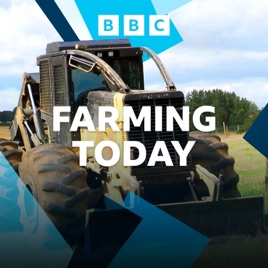
Advertise on podcast: Farming Today
Rating
4.5from
This podcast has
29 episodes
Language
EnglishPublisher
BBC Radio 4Explicit
No
Date created
2007/08/09
Latest episode
2026/10/14
Average duration
16 min.
Release period
2 days
Description
The latest news about food, farming and the countryside
Unlock Farming Today podcast Email contact info,
Listeners & Audience details
Email contact information
Direct podcast contact details

Listeners
Audience numbers & engagement insights

Audience details
Podcast Insights

Podcast episodes
Check latest episodes from Farming Today podcast
14/10/26 Homegrown
2026/10/14
Climate change is already reshaping the way farmers think. Wetter winters, hotter summers, and new pests and diseases are creating fresh challenges. At the same time, global instability, from conflict to trade disputes, has highlighted the fragility of food supplies.
As part of our special week exploring the next 75 years of farming, today we're asking: what should Britain be growing in the future?
We visit the John Innes Centre in Norfolk, one of the world's leading plant science institutes, where researchers are developing crops that could thrive in a very different climate.
We'll hear from Professor Tim Lang on how the UK can feed itself in an increasingly uncertain world, and from Scotland, where a warming climate may open the door to crops traditionally grown much further south, even as it brings new risks and pressures of its own.
Presented by Anna Hill and produced by Beatrice Fenton.
13/10/26 Tech
2026/10/13
As part of a special week marking the 75th anniversary of The Archers and exploring what the next 75 years could hold for farming, today we look at how technology and AI could transform the way food is produced.
At Place UK, one of the country's biggest soft-fruit growers, automation and robotic harvesting are already being trialled, to help cope with labour shortages and rising costs.
We hear from Sir James Dyson, a major investor in farm robotics and AI, and from farmers in Northern Ireland who are already putting those technologies to work, using artificial intelligence to monitor livestock and automate everyday jobs.
Presented by Anna Hill and produced by Beatrice Fenton.
12/10/26 Land Use
2026/10/12
As The Archers marks its 75th anniversary, Farming Today is looking ahead to the next 75 years of British farming.
All week we’ll be imagining how agriculture could change, from how land is used to what crops we grow, using what technology and how the identity of farming itself could shift.
Today we’re in Inkberrow in Worcestershire, the village which inspired Ambridge and asking: what will we be doing with the land we currently farm over the next 75 years?
We hear from Jeremy Clarkson on how he sees the future of Diddly Squat Farm, from The Archers’ farming and countryside advisor Sybil Ruscoe, and from Wales, where how land is used is increasingly under debate.
Presented by Charlotte Smith and produced by Beatrice Fenton.
10/10/2026: Harvest, Bird flu, Farm boundaries
2026/10/10
The official estimates for England's harvest 2026 are in, and the figures from the governnment show that its the smallest harvest of both barley and oats since 2012. Wheat saw a small increase with losses in the South and East offset by a better harvest further North, and oil seed rape had a better year with a 6 per cent increase in yield. We hear from farmers who suffered in the droughts.
This week we've been exploring farm boundaries - from hedges and stone walls to barbed wire. We hear from people restoring ancient boundaries, and learn about the history of barbed wire from the National Cowboy Museum in Oklahoma.
The first cases of highly pathogenic avian flu in kept poultry have arrived in the UK - and as migratory wild birds start to arrive to overwinter here, poultry farmers are being urged to improve biosecurity. The case was reported in a backyard flock on the Isle of Lewis in Scotland. Last winter free range flocks had to be kept inside to try to protect them from infection, and the UK Chief Vet says anyone farming poultry must now review and improve their biosecurity.
Presented by Charlotte Smith and produced by Sally Challoner.
09/10/26 Drought aftermath, Cornish hedges, SNP conference, AI and farming
2026/10/09
The official estimates for England's harvest 2026 are in, and they don't make happy reading. Provisional figures from the government show that it's the smallest harvest of both barley and oats since 2012. Wheat saw a small increase with losses in the south and east offset by a better harvest further north, and oilseed rape had a better year with a 6% increase in yield.
All week we're talking about boundaries, the fences and walls which define farms and fields. Traditional Cornish hedges are an earth bank sandwiched between two stone walls - not what you might expect from the word 'hedge'. Many of these hedges were lost to make fields bigger during the mid-twentieth century push for food production. Others have collapsed into disrepair, but there’s now a push to restore and appreciate Cornish hedges anew.
The Scottish National Party insists that its plan to introduce a price cap on some essential foods will go ahead; the initiative has been described as 'a potty gimmick' and criticised by retailers, farmers and food and drink manufacturers. The SNP holds its annual conference in Aberdeen next week. The minister for agriculture, marine and the islands Jim Fairlie says capping food prices won't impact farmers.
Artificial intelligence which is beginning to transform many aspects of our lives - so what's its potential for farmers? Producers are facing more challenges than ever, from drought and heatwaves to labour shortages and the spiralling price of fuel and fertiliser. We visited a robotic dairy on the Somerset/Devon border to ask if AI will bring the fourth agricultural revolution.
Presenter: Charlotte Smith
Producer: Rebecca Rooney
08/10/2926: Fly tipping, History of barbed wire, Energy from heat
2026/10/08
Half of farmers say they've had rubbish fly tipped on their land, and the majority of those asked say the problem is getting worse. These are the results of a survey of 512 farmers in England and Wales by the National Farmers Union - which is campaigning for more and stronger deterants to tackle the problem. The latest government figures show a 9 per cent year on year increase in fly tipping reported by local authorities in England between 2023/4 and 2024/5.
There’s an old saying that good fences make good neighbours and all this week on Farming Today we’re looking into a slightly leftfield subject, the boundaries farmers use between their own farms and others, and, within their own farm. Fencing - or hedging or walls - are crucial to farmers. Today - the fence that tamed the American ‘wild west’, still used by farmers across the world today - barbed wire.
A company from Shropshire has invented a new material which it claims could save chicken farmers thousands of pounds. Zero Charge Technologies wants to harness the waste heat generated in chicken sheds to produce free electricity. It says it can do this with a substance called Delta T- an alternative to solar panels - which can also be fitted on roofs, and will generate power from waste heat day and night.
Presented by Charlotte Smith and produced by Sally Challoner.
07/10/26 Sugar beet, flagstone walls, dairy show.
2026/10/07
After months of negotiations, British Sugar and the National Farmers Union have agreed a price for sugar beet farmers for 2027/28. It's lower than last year, with a one-year contract paying £28.50 per tonne for up to half of the contract tonnage. This compares with £30 a tonne for up to 65% on the current crop, and that's lower than the year before. So the price is falling. Sugar beet is grown mainly in Eastern England and all the crop is processed by British Sugar, sold under the brand Silver Spoon. The crop is planted in the spring and harvested between October and February. Earlier this year British Sugar announced it would close its oldest processing plant at Cantley in Norfolk next February. We speak to the NFU Sugar Beet Chair who negotiated the deal.
This week we're looking at boundaries - ways of enclosing land to de-mark ownership and keep livestock in, or out! Different regions make use of whatever material is available , and in the far north of Scotland farmers traditionally used a very particular style of stone dyke that can bring to mind the upright flat slabs you're more likely to see in graveyards. We visit a farm in Caithness to find out how these flagstone boundaries were made and maintained nowadays.
Dairy farming has faced one of its most challenging years: heatwaves and drought have affected the cows and the grass; milk prices have fluctuated; and bluetongue disease has hit herds too. There's plenty to discuss as hundreds of dairy farmers head to The Dairy Show at the Bath and West showground.
Presenter = Anna Hill
Producer = Rebecca Rooney
06/10/26 Rural connectivity, dry stone walls, Conservative party conference.
2026/10/06
The Farmers Union of Wales says it's very concerned about new rules which they say could see rental incomes cut by 90%. The FUW estimates that a revaluation of thousands of existing agreements could affect 15,000 masts, and if the changes put off farmers going into mast agreements, connectivity in rural Wales could be hit. We hear from a sheep farmer in Radnorshire, who's had a mast on his land for more than 20 years but the rent for it has been halved.
As we continue our look at boundaries this week, we turn our attention to one of the most familiar and admired feature of our countryside - the dry stone wall. The tradition of constructing walls without mortar dates back centuries, but most existing walls date from the 18th and 19th centuries when large tracts of land were enclosed for livestock. The Dry Stone Walling Association estimates there are approximately 70,000 miles of dry stone walls in the UK but just a few hundred people with the skills to repair, maintain and build new ones. We meet one of them, in the Cheviot Hills of Northumberland.
The Conservatives have said they'll get rid of Natural England and the Environment Agency if they win the next election. The Environment Agency is responsible for prosecuting those who break regulations on water quality and environmental standards and Natural England was set up to protect wildlife and landscapes. Wildlife and environmental campaign groups have reacted strongly to the idea that these agencies should be abolished, arguing there needs to be more regulation, properly funded. We speak to the shadow farming minister at the Conservative Party Conference in Birmingham.
Presenter = Anna Hill
Producer = Rebecca Rooney
05/10/26 Pig industry in crisis, beating the bounds, Green Party conference
2026/10/05
Pig farmers say they're losing thousands of pounds a week as prices fall, but costs, particularly of feed, are rising. Processors have given notice to some farmers, saying they no longer want to buy their pigs. The National Pig Association is warning an oversupply this autumn could push prices down further.
All this week we'll be looking at the hedges, fences and dry stone walls that mark out fields and how they've shaped the farming landscape. In some parts of England and Wales, including in cities, communities come together every few years to mark their parish boundaries in what's known as the beating of the bounds.
It's party conference season, so as part of our look at the food, farming and environmental policies that political parties around the UK are offering, we hear from the Green MP Adrian Ramsay.
Presented by Charlotte Smith and produced by Beatrice Fenton.
Farming Today This Week: food industry whistleblowers, red diesel, disease resilience, apprenticeships, Shetland wool, demo farm
2026/10/03
An anonymous group of senior executives from retailers and food suppliers is warning that 'short term thinking' in the industry is driving up food prices and that farmers are being left to face the financial risks of an increasingly umpredictable supply chain.
Diesel prices hit an all time high this week, with drivers paying almost £2 a litre, according to the RAC. The conflict in the Middle East continues to disrupt supplies of fuel, pushing up prices. Farmers don’t get their fuel from filling stations, they buy it in bulk and use what’s called “red diesel” - it’s dyed red and is much cheaper - with less fuel duty to pay because it’s only for use in off-road machinery. However, industry surveys estimate farmers are paying an average of 40% more for their red diesel than this time last year.
The new president of the British Veterinary Association is calling for more resilience against disease outbreaks. As the UK battles a huge outbreak of the livestock disease Bluetongue, Dr Gwen Rees says as a profession, vets need to make sure they are ready to act.
Apprenticeships are a popular route into agricultural careers, especially for students from farming families who are needed to work in the family business but also need to develop their knowledge and skills.
FarmED in the Cotswolds is a demonstration farm experimenting with different crops, techniques and rotations. It wants people to explore how we can produce enough food, while restoring nature, adapting to climate change and keeping farmers in business.
Knitters from around the world have flocked to Shetland for a celebration of wool, knitting and textiles. The star of the show: the Island's unique Shetland sheep.
Presenter = Charlotte Smith
Producer = Rebecca Rooney
02/10/26 Food industry climate whistleblowers, farm apprenticeships, Plaid Cymru conference
2026/10/02
An anonymous group of senior executives from retailers and food suppliers is warning that 'short term thinking' in the industry is driving up food prices and that farmers are being left to face the financial risks of an increasingly unpredictable supply chain.
This week we’re talking about how young people can find a career in agriculture, and the apprenticeship route is a popular one, especially for students from family farms who are needed to work at home to keep the farm going but also need and want to develop their knowledge and skills.
The Plaid Cymru conference starts in Llandudno today, the party has been in power in Wales since the Senedd elections in May. In the latest of our interviews on the farming, food and environmental policies the political parties around the UK are offering, we hear from Plaid MSP and Cabinet Minister for Rural Resilience and Sustainability, LLyr Griffith.
Presented by Charlotte Smith and produced by Beatrice Fenton.
01/10/26 Red diesel; Labour party conference; getting into farming; the sound of worms.
2026/10/01
Diesel prices hit an all time high this week, with drivers paying almost £2 a litre, according to the RAC. The conflict in the Middle East continues to disrupt supplies of fuel, pushing up prices. Farmers don’t get their fuel from filling stations, they buy it in bulk and use what’s called “red diesel” - it’s dyed red and is much cheaper - with less fuel duty to pay because it’s only for use in off-road machinery. Industry surveys estimate farmers are paying an average of around one pound 18 pence per litre - 20p more than in July, a rise of more than 40% on this time last year.
The Labour party conference has come to an end. The headlines were full of big announcements on the National Care Service and reforming the pensions triple lock.
The DEFRA Secretary of State, Angela Eagle, gave a speech. She didn't talk about agri-environment schemes and the Sustainable Farming Incentive, but she did talk about food security and the impact climate change is having on farmers.
All week we’re talking about how young people can get into farming, through education, farm placements, apprenticeships and for some, through sheer determination! 23 year-old Nikita Fineran from the Isle of Wight fits into that bracket. Her goal is to have a farm of her own one day where she can breed sheepdogs.
Earthworms are an indicator of soil health - but how can a farmer know whether worms are in the soil without digging a hole in a field? Well, apparently….by listening to them. Scientists are using bio-acoustics to record the sounds of invertebrates under ground. They're deploying AI to analyse what different creatures sound like and help farmers work out what's beneath their feet.
Presenter = Caz Graham
Producer = Rebecca Rooney
30/09/26 Nitrogen in soil, organic veg scheme, student bursaries.
2026/09/30
New research shows that improving the nitrogen-cycle in the soil can significantly reduce emissions. The study took in evidence from around the world - the international research team analysed 2,235 comparisons from 210 experimental sites. We speak to one of the report's authors Professor Simon Willcock director of sustainable farming systems at the University of Reading.
A project in Cardiff has been helping low income households buy organic fruit and veg. Around 120 shoppers received a Planet Card - which gave them £11 a week to spend with organic veg producers. The pilot scheme cost around £19,000 and was funded by an alliance of charities and not-for-profit organisations - led by Food Sense Wales and Sustain.
All week we've been exploring the different ways young people can get into farming. For those who want to take up a degree in agriculture it can be daunting to find the right route, especially if you're not from a farming background. The Royal Norfolk Agricultural Association has linked up with the John Innes Foundation bursary award, to give students a helping hand to take up agriculture at degree level; not only funding 50% of tutition fees, but also contributing to rent and living expenses.
Presenter = Anna Hill
Producer = Rebecca Rooney
29/09/2026: Precision breeding, Community farm, Mentoring on farm
2026/09/29
UK scientists leading research on precision breeding - or genetic editing - say uncertainty around the law in England could put investors off and jeopardise our competitive edge. The technology has rapidly taken hold of plant breeding and development, and has been used to develop vitamin D-rich tomatoes, and bananas that don’t turn brown. But there are still many questions surrounding the technique, for farmers, for trade and consumers too. And there are questions around the regulation of precision breeding. Earlier this year, there was a successful challenge to the lawfulness of the Genetic Technology (Precision Breeding) Regulations 2025. Following a judicial review, a High Court judge ruled that the ministerial decision-making process leading to the regulations on mandatory labelling and traceability had been unlawful.
CORRECTION NOTE: The successful judicial review brought by Beyond GM and others this year challenged only the precision breeding regulations introduced in 2025, not the 2023 Act and the decision to allow precision breeding, as stated in the programme.
We visit what's widely thought to be the UK's first comunity owned farm, in Shropshire. Siblings Charlotte and Ben Hollins set up a crowd funding enterprise when their landlord told them they'd have to buy the farm or leave, after their tenant farmer father died. Twenty years on it's thriving.
And this week we're looking at the different ways that young people are accessing a career in agriculture. The charity, Countryside Learning Scotland, has launched a two year programme to encourage new entrants into rural employment in the Perth and Kinross area.
Presented by Anna Hill and produced by Sally Challoner.
28/09/2026: Disease resilience, getting young people into agriculture
2026/09/28
The new president of the British Veterinary Association is calling for more resilience against disease outbreaks. As the UK battles a huge outbreak of the livestock disease Bluetongue, and there are warnings of a new pig disease in the Netherlands and Denmark, Dr Gwen Rees says as a profession, vets need to make sure they are ready to act. It comes following National Audit Office reports warning that Defra’s animal disease response plans leave the UK’s food security vulnerable to major supply disruptions.
This week we're looking at how young people are getting into careers in agriculture. Today we speak to the CEO of Landex - the umbrella organisation for land-based colleges and universities.
And we celebrate 50 years of a charity that offers children who live in cities a chance to live on a farm for a week.
Presented by Caz Graham and produced by Sally Challoner.
Podcast reviews
Read Farming Today podcast reviews
tbache9248 2015/09/06
Very Educational
I am from the US and really like hearing about problems and solutions. I particularly like to colorful descriptions about the weather, what is being ...
Mulligan Hal 2009/06/23
This is a fun podcast
I listen to this all the time. The stories are interesting, even to someone here in the US. Also helps me understand Britain better.
KidaStar 2008/11/30
Informative
This is not an exciting podcast. No music. No give-aways. No comedians. This is an informative podcast covering issues facing British farmers. I'...
ScoutF 2007/12/01
Informative and Enjoyable
The format is smart, the information relvant and interesting. Perhaps the best "integrated" general purpose ag news cast I have found. Although I am n...
Podcast sponsorship advertising
Start advertising on Farming Today relevant audience podcasts
You may also like to advertise on these Podcasts

4.6221662000
Mark Levin Podcast
Cumulus Podcast Network
4.8258841490
Relatable with Allie Beth Stuckey
Blaze Podcast Network

4.92001926
The Wright Report
Bryan Dean Wright

4.814621637
The Big Honker Podcast
Andy Shaver & Jeff Stanfield

4.813262012
The Jeff Cameron Show ~ Warchant.com
Jeff Cameron Show

4.662842000
The Dr. Laura Podcast
Dr. Laura Schlessinger & SiriusXM

4.737191984
The Eric Metaxas Show
Metaxas Media

4.834901999
Conservative Review with Daniel Horowitz
Blaze Podcast Network

4.723702000
Everything Everywhere Daily
Gary Arndt

4.6619682000
The Dan Bongino Show
Cumulus Podcast Network | Dan Bongino